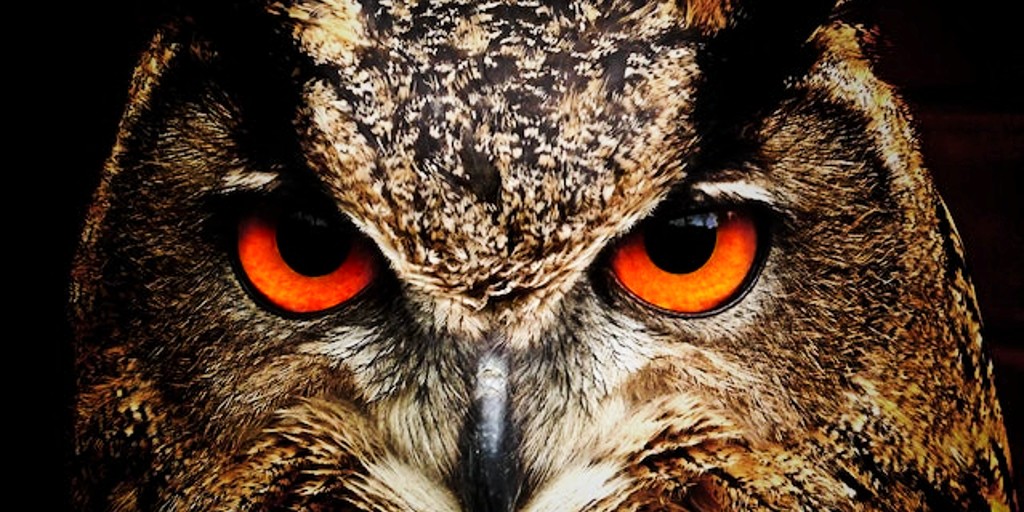
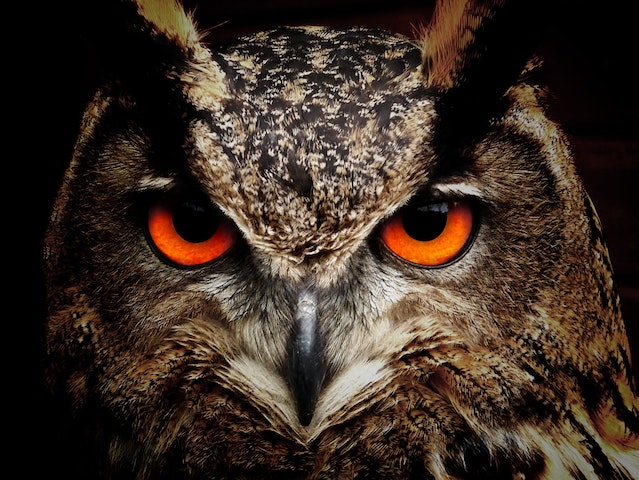
He is a shadow
Sitting in the
Cold still of the
Night,
High above the
Rest of the world
Quietly watching
And listening
Unknown and
Out of sight,
Witty and elusive
As he glides along
The wind,
His nocturnal cry
Will taunt your
Soul
Like the haunting
Sounds
Of a violin,
Such a proud and ornate
Creature
Kind of mysterious in
His ways,
The wise old owl
Stands alone
Watching you
With a most
Conspicuous gaze.
Carlos Dickens is a poet and short fiction writer from West Virginia, with 20 years’ experience in writing poetry and short stories, subjects ranging from Gothic, science and rural settings.
Please share this to give it maximum distribution.
Tonight, I lit a candle
But it remained alight
There was no telling flicker
No disruption to the night.

My eyelids heavy, closed
Drifted I into a dream
I did not see you there
To tell me where you’ve been.

I lay in solid slumber
Undisturbed by ghosts of past
So bitterly let down
I was sure I’d know at last.

I was sure you would not leave me
I was sure you’d come to say
That you’re up there in your heaven
That I’ll meet you there one day.

But the sharp light of the sunshine
Woke me to reality
My eyes opened, looked for you
And nothing glared right back at me.
Nicola Pett currently teaches English and Literature in Cairns, Australia. She has worked as an actor, script writer, voice-over artist and creative producer. Her poetry has been published online in The Chamber Magazine, Writing in a Woman’s Voice and Grand Little Things.
Please share this to give it maximum distribution.
Rural Fiction Magazine (RFM) would like to publish more writers from around the world, regardless of your country of origin.
I am seeking short fiction and poetry and non-fiction articles on topics of interest to a rural audience in any nation, but I am open to more than just fiction and poetry. I am also open to short plays, folklore, legends, tall tales, essays, etc. I am open to almost all genres such as fantasy, science-fiction, horror, mainstream, literary, romance, etc, so long as they are connected to rural life and/or have a rural setting.
Your work must be in English. It can a translation from your native language, but it must be in English, which is spoken around the globe and gives the work and author substantial worldwide exposure.
Please note that there is no pay for this other than a publication credit and exposure to the American and English markets. However, all rights remain with the author.
Currently, RFM is publishing material within a few weeks of acceptance, though this may vary depending on the number of submissions.
Please re-post or share this announcement to give it maximum exposure.
Robin Swann penned by hand the “perfect calendar” on January 1st, 2255. For the last fourteen years, the retired nuclear engineer labored alone on his invention in the rural community of French Gulch, California. Rumored by some to be an illegitimate grandchild of Julius Robert Oppenheimer, all that could be said for certain about Robin is that he was born on Christmas Day in Berkeley, California, was first married in Reno, Nevada, and was hitched for the second time at Niagara Falls. Both times, Swann fell in love with gentlemen of numbers: the first an applied mathematician, the second a specialist in pure math. At holiday gatherings, after a couple mugs of spiked eggnog, Robin Swann likes to jest that his first marriage could have been an “infinite series” but for want of “pure numbers and significant digits.” He called his second go-at-love a “perfect set.”
Every evening after supper, Robin and his partner Oliver would walk down Main Street, past the local general store, to feed the fish under Clear Creek Bridge before the one-room schoolhouse. A sizable black salmon would dance often in the shadow of the two lovers on evenings lit by moonshine and starlight. It was this same spot within which Robin experienced his greatest revelation. Mesmerized by the flickering movements of light and dark, Swann found the answer to the question that had stolen weeks of slumber from the intrepid scheduler: How can weeks and years get along? The answer was simple: “To heck with the years, by George, let the week inherit the Earth!”
The town preacher, who also happened to be Swann’s landlord, invited Robin to debut his “perfect calendar” before the Easter potluck at the community church. Swann wore the same satin tuxedo within which he was married twice. The preacher named Max paid Robin a compliment: “I don’t think French Gulch has received a more dapper gentleman than when President Kenney visited back in 1963!” Apologetic, Robin begged the pastor’s pardon, “I don’t mean to distract! I’m very grateful for the opportunity to share my work and get feedback from my community. I hope French Gulch will become the first city in the world to adopt the “One-World-Calendar!”
“We ain’t a town,” interrupted Paul, the portable toilet technician. “Gotta have a Mayor to be a town and we ain’t got none. No government, no town, and sure as heck no city. If you wanted to get your calendar started in nowhere U.S.A., you couldn’t have picked a better stool to pop your squat, with all due respect,” Mr. Putter concluded. With a look capable of chilling a glacier, Robin promised with a squint, “Where time reaches its dainty hands, there shines the metropolis of our greatest honors: our most valuable treasure is time and its vault is our commonwealth. I am proud to offer to the world a new type of bank that will pay a hefty return on every moment a learned investor is wise enough to deposit.”
While the flock queued up for grub, Pastor Max made a short pitch for the attention of the congregation: “Dear parishioners, we have a special presentation this Easter from our own Dr. Robin Swann. As you may recall, we all lost Oliver quite suddenly two winters ago. Ever since Robin has been dedicated to producing something he thinks will make the world better off. Without further ado, please give a warm welcome to Dr. Robin Swann!”
Sheepishly Robin began his pitch, “Good people of French Gulch, this Easter Sunday I do not come to you with a message from another world, but instead a gift born of this one.” Dr. Swann began passing out laminated squares of cardstock paper. On the card was a 12×12 grid.
Swann sang, “Hate having to buy a new calendar every year? Are you done with the chore of keeping track of leap years? So were the Egyptians! I have a solution to all your chronological controversies in the form of the first ONE-SHEET per year calendar in the multiverse.” The old man was now short of breath from excitement. After a long silence, the only sounds the audience provided were the rustling of paper plates, the chatter of plastic cutlery, and the periodic pouring of water over ice. The old visage of the inventor transformed into that of a man struck by lightning, “I forgot to explain how it works! My apologies. Look here, give it a simple fold in half once and now another half — twice!”
The elder waived the folded paper over his head like it was a winning lottery ticket, “See! Four seasons means a fourfold deal. Each season is 108 days: three 36-day months of six-day weeks. That means the year is 432 days in total. You see, we base most of our structurally defective calendars on how many times our planet circles our sun, which is all wrong since an orbit isn’t even the same every year. Imagine setting your clock to the cry of Clancey’s bloodhound. Sure, the poor boy cries every night, except – mark my words – except, on the night after Turkey Day since that lucky guy is too busy slurping bird marrow to bother us with a ballad. Plus, some folks don’t even live on this rock anymore, so why keep up the guises? Someday, we will find intelligent life in this multiversal cosmic gumbo of ours and this! This piece of paper will prove that our elevator goes to the top floor! This intellectual passport, if you will, shall prove to any new interstellar lover, that we are playing with a full deck!”
Paul Putter swung open the bathroom door to embrace Robin with a hearty bear hug. He swung back around to bow to the church crowd yelping, “By George, this does work!” Putter waived around a completely soiled “One-World-Calendar” provoking some to vomit out the church basement side windows onto some sunbaked pews. Walking back home, Robin didn’t notice he forgot all his extra “One-World-Calendars” in the church sanctuary. The pastor’s final semi-compliment, “Great for bingo,” echoed in the noggin of the once-esteemed scientist. When he got home, he took a long look in his bedroom mirror. Some tears began to collect in the corners of Dr. Swann’s eyes recalling the quiet evenings he spent with Oliver making collages out of their old calendars. Oliver would call Robin “his one world man who just so happens to be out-of-this-world.” Before falling asleep that night Robin got a ring from outer space. The lifeform on the other end said that they heard his presentation through a cellular phone locked in the church kitchen deep freezer. The being thanked the inventor for finally giving his superiors a good reason to visit Earth. Earth’s newest fan confided in Dr. Swann, “If the people of Earth are sensible enough to get their calendars in order, they might be worth sharing in a holiday or two with together.” Holding back tears of joy, the only reply with which Dr. Robin Swann could muster a response was as follows: “If that wouldn’t be lovely, I don’t know what is, Oliver. If setting a date with you wouldn’t be lovely, I don’t know what is.”
A. R. Carrasco is an American author based in Oakland, California with works of short fiction appearing in365 Tomorrows and theStreet Sheet San Francisco (a publication of the Coalition on Homelessness).
As he glided around the river bend, Scott’s eyes widened in surprise. It wasn’t the swamp stretching out before him, rotting wooden sentinels standing guard over brackish water, a glut of sticks marking a distant beaver dam. The still lake was certainly impressive in a decaying sort of way, and Scott was already calculating the spots where large fish were laying wait for him.
It was the lone structure clinging to the shore along the left side of the expanse that was the most surprising: a barely-recognizable cabin. While it had not sheltered man, nor probably beast, for decades, it was still the first hint of humanity that Scott in his kayak had seen for the past hour or more. Like the swamp, its fallen-in roof and ragged exterior suggested that it had been left on its own, abandoned, for a long, long time.
Scott paddled up to a pair of stumps hunkering in the water about 20 yards off-shore from the cabin. Just beyond, the water of the swamp turned starkly darker, a sure sign of depth and, Scott hoped, large catfish or some other scaly monster. As he flipped open the kayak’s forward hatch and started baiting up his pole, a familiar shape drew his eye to the nearest stump.
It rested amid the sticks and other debris that had been building against the stump for years, and at first Scott thought it was just another stick and his eyes playing tricks on him. He paddled over for a closer look. What he had seen had not been an illusion, but the outline of a small fishing rod and reel, its thin pole nearly indistinguishable amongst the driftwood ensnarled it.
Scott inched closer to the pile. He leaned out over the brackish water, the kayak tilting precariously, one edge sinking lower and lower in the water as Scott shifted his weight towards the prize. As his face got closer to the blackness, Scott could smell decay, decades of rot and stagnation. The point between upright and overturned was reached, surpassed, and Scott was going over into the black water. Flailing in panic, his fingers hooked onto a bit of driftwood, and he pulled himself closer to the stump, the kayak once again upright and buoyant.
It took a few minutes of untangling, but he finally managed to free the pole from the knot of bleached wood. It wasn’t much of a prize. For one thing, it was a kid’s pole, barely larger than a toy. The rod itself was missing an eye and was bent slightly at the tip. The reel was mostly rust, traces of red paint and a name, Fishin’ Pal, barely legible on it. Scott tried to turn the handle on it. It did give, grudgingly, with an unhealthy rasping shriek. The line was still intact though, running from the reel, up the rod, and into the dark depths beyond the stump.
Scott tugged on the pole, but the line still held fast to whatever it had latched onto years before. The kayak slid slowly away from the stump and towards the dark water as Scott tried to free the line, but it held firm.
“Junk,” Scott said, his voice foreign in the dead stillness of the swamp. He tossed the pole towards the dark waters. It arced, turning end over end, before slicing the surface and sinking. And scaring any fish that might have been waiting, Scott thought with a sigh. He grabbed his paddle and started out across the swamp to find another spot to try his luck.
He didn’t get very far. Two, three kayak lengths, and all of a sudden Scott felt drag on the boat. His forward momentum slowed, slowed, and then stopped completely.
Scott turned in the kayak. Perhaps one of the dead branches had grabbed him? But it wasn’t a branch. The line from the old fishing pole had caught on the stern of the kayak when Scott had tossed the pole away. He paddled a few strokes. The line grew taut, but did not give. Scott paddled a little harder. Still the line held, like an invisible hand clutching the end of the boat, holding it fast to one spot.
Scott turned and snapped the paddle into place on the side of the kayak. He drew his knife from its belt sheath and, turning to the back of the boat, began carefully edging out along it towards the tangled line.
The boat rocked in protest, but held fairly steady as Scott inched towards the fishing line. Kneeling in the cockpit, then one knee out, he adjusted his balance as the kayak rolled from side to side. Stretching, Scott grabbed the line with one hand, triumphantly, and was reaching out the other, knife grasped, when the line gave three quick tugs.
Scott froze in disbelief, waiting. The line lightly slackened, then slowly grew tauter, twice. Tug. Tug. Scott laughed, still not quite believing what he was seeing. Somehow, some way, after sitting idle and waiting for decades, the Fishin’ Pal had managed to catch itself a fish.
Scott imagined the scene as it had unfolded in the water. The line, hook intact, tangled in a glut of wooden debris and mud on the bottom. He on the surface, freeing the pole, moving it just enough to wiggle the hook, a dancing enticement to some monster slowly swimming by…
Tug.
Tug.
Still grasping the line with one hand, Scott pulled on it. It cut slightly into his palm, but the kayak started to pivot towards where the line sliced into the water. Scott slid back into the cockpit of the kayak where he was better able to work the fish. All the while he could feel the line lazily tugging back, as if it was testing him.
He set the knife on the floor of the cockpit. Grabbing the line with both hands, Scott slowly pulled on it. Whatever it was, it was heavy, and for a second Scott thought that he had only managed to free the same log that some kid fishing two decades earlier had snagged.
Hand over hand the mass slid through the water towards the kayak. As line started pooling in the cockpit, Scot’s heart sank. No resistance at all. It had to be a log, a large branch, a…
As if awakened, the fish suddenly surged away from the kayak, the line burning into Scott’s hands as it slid through them. Reflexively, he closed his grip on the line, wincing as the line sliced deeper into his skin and drew blood. It worked though. For a few seconds, Scott and the fish had themselves a stalemate, each on the end of a taut, unyielding length of line.
The fish started to weave through the water, first to the left, then the right, the line making a ssssst, ssssst sound as it cut the surface. The kayak bobbed and spun. Ignoring the pain in his palms, Scott braced himself in the kayak’s cockpit and started once again to drag the fish in.
Visibility in the swamp was terrible to begin with, and Scott and the fish weren’t helping it with their battle. Still, Scott kept his eyes on the spot where the line entered the water, eager for a first glimpse of his prey.
When the glimpse finally came, Scott still wasn’t sure what he was looking at. He expected the flattened head and antennae of a catfish, or the familiar muscular markings of a large-mouth bass. Instead he got… flashes of color? Whites and reds, a touch of blue or two. It was hard to make out in the murk. The fish fought mightily, twisting and turning, colors flashing frantically. Scott saw eyes, eagerly seeking their first glimpse of him.
And then it was under the boat, so fast that Scott didn’t have time to adjust to it. The line went tight against the edge of the cockpit, pulling hard as Scott’s hands kept a tight grip on it. With a final wrenching jerk of the line, the kayak rolled over into the water, scattering Scott and his tackle over the dark surface of the swamp. Scott was under, flailing at the water, seeking the surface. He finally saw sky and swam towards it, the fishing line tangling itself around his legs and torso.
Scott broke the surface and breathed deeply. The kayak lay on its side a few feet away, partially submerged. Yellow bobbers danced in the rippled water all around Scott and the swamped boat. Scott swore to himself. All that tackle, gone. Big fish, gone. Himself, wet and more than a little pissed.
He started swimming towards the kayak, his arms struggling with the motion. The fishing line. He was completely tangled in it. Scott grabbed for the knife on his belt, but the sheath was empty. The knife had been on the floor of the kayak’s cockpit. He mentally added it to the list of items that were now slowly sinking into the mud an unknown number of feet below him.
Splashing around like a wounded duck, Scott finally made it to the kayak and reached out his hand for it… and stopped. The line held him secure, a good foot from the boat. He tried paddling harder, but this only tightened the line wrapped around him.
And then the boat started to recede, as Scott was slowly, steadily pulled backwards.
Scott laughed. Well, this would make for an interesting story when he got back home. He swam against the pull of the line, but still he was dragged backwards. He felt the first twinge of fear and swam harder, but the line continued its casual drag. Only the angle had changed, sharper, deeper.
“Help!” Scott yelled, but his cry only echoed off the dilapidated structure, the far edges of the swamp. The line was straight down, and Scott was no longer trying for the kayak, he was trying to stay on the surface. Inch by inch, his shoulders, neck, and head were dragged down into the water. He drew a last breath and blinked as water overtook the sky.
Underwater. He struggled with the line, desperately trying to free himself. He was dragged deeper, deeper, his lungs clutching their last breath tightly. Out of the murky depths, Scott’s adversary came into focus.
It had once been a boy, red and white striped shirt, little blue shoes. It gripped the pole, his pole, with a joyful determination known to anyone on the verge of landing their first big catch. Scott heard the rasp of the reel echo in the dark waters around him. Scott had never been one for catch and release. As unconsciousness took him, his last glimpse of the ruined, rotting smile told him that neither was the child.