I smell his cigarette smoke, hear his wheezing before the door to my room opens. There’s no squeak, so I know that little green air tank he drags around is sitting next to his chair in living room. I can hear some right-wing talking head coming for the TV down the hall.
“Put that goddamn book down and go take care of him,” he slurs.
I put the book on my desk, taking care to mark my page. I turn to look at him. He’s holding our varmint rifle, a smoldering grit hanging from his blue tainted lip, smoke swirling up around his gaunt weathered leather face. I say nothing. I hold my face and eyes blank and flat like carboard.
“Be a man for fucks sake. Go put him out of his misery. One between his eyes. Then dig a grave if he means that much to you.” I take the rifle from him, say nothing, and head out back.
Jet is laying on his side on pile of fallen leaves. His tawny coat blends into the yellow and reds surrounding him, as if the earth has already begun to reclaim him. He hears and smells me looking in my general direction with milky, cataracted eyes. His tail wags, he stands, and shuffles to greet me. He leans against my leg, all his weight now, and I rub his head. I know that old bastard is right. The blindness is new, but his tumors and arthritis…
“Jesus Christ! Just shoot him. Do I have to do everything?”
I take two steps back, lever a round in the chamber, put the barrel to Jet’s forehead.
“Goodbye buddy,” I say, voice cracking, then squeeze.
There is no sound beside the boom and it’s over and it’s merciful.
“Was that so damn hard?” he says from behind me.
I turn and we lock eyes. “No,” I say. Then I jack another round, already resigned to the digging ahead.
JD Clapp writes in San Diego, CA. His work has appeared in Wrong Turn Literary, The Milk House, The Whisky Blot, and several others. His story, One Last Drop, was a finalist in the 2023 Hemingway Shorts Literary Journal, Short Story Competition. This story was previously published in Bristol Noir.
Please share this to give it maximum distribution.
Rural Fiction Magazine is on a mission to showcase the rich tapestry of rural experiences from around the globe. Whether you’re penning heartwarming tales, poignant poems, or insightful reviews on rural fiction books, we want your voice! Our open-minded approach means we welcome all genres—be it romance, horror, or magical realism—as long as it connects to rural life. Your story matters!
A Worldwide Platform for Diverse Voices
With contributors from 46 countries and counting, RFM celebrates the universal human experience. By submitting your work, you join a vibrant community that transcends borders. Share your unique perspective and connect with readers who appreciate the beauty and complexity of rural narratives.
Fast Publication for Your Creative Work
No waiting indefinitely to see your words in print! At RFM, we pride ourselves on our efficiency—most submissions are published within weeks of acceptance. Get ready to inspire others and gain well-deserved exposure in English-speaking markets including the USA, UK, Canada, Australia, New Zealand, and Ireland.
Your Voice Matters – Take Action Today!
Ready to share your story? Visit our submissions page for detailed guidelines and join us in celebrating rural fiction’s diverse tapestry. Remember: while there’s no monetary compensation beyond publication credit and exposure, your writing will resonate with an audience eager for authentic voices like yours.
Spread the Word!
Please share this announcement far and wide to help us discover exceptional talent from every corner of the world!
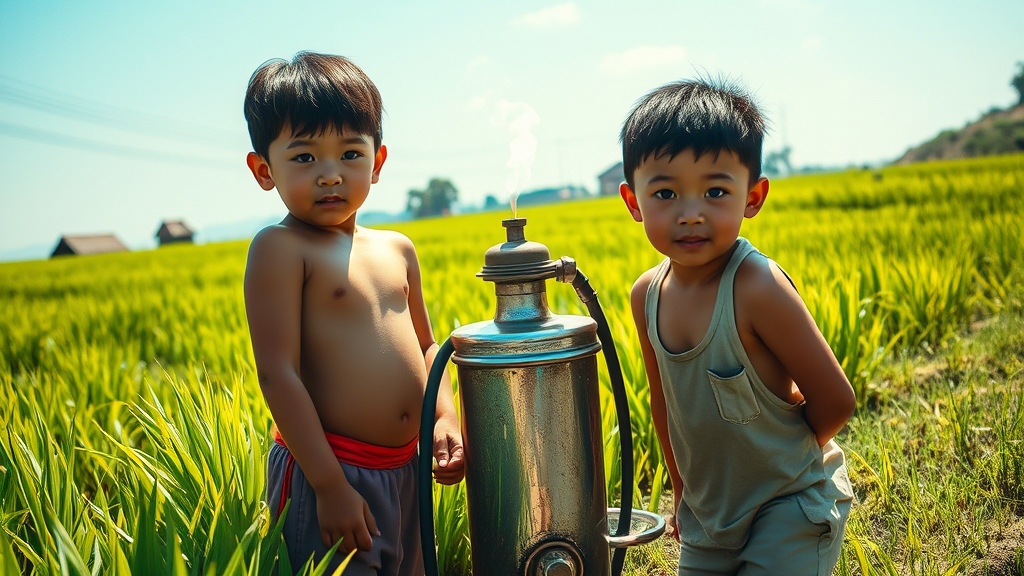
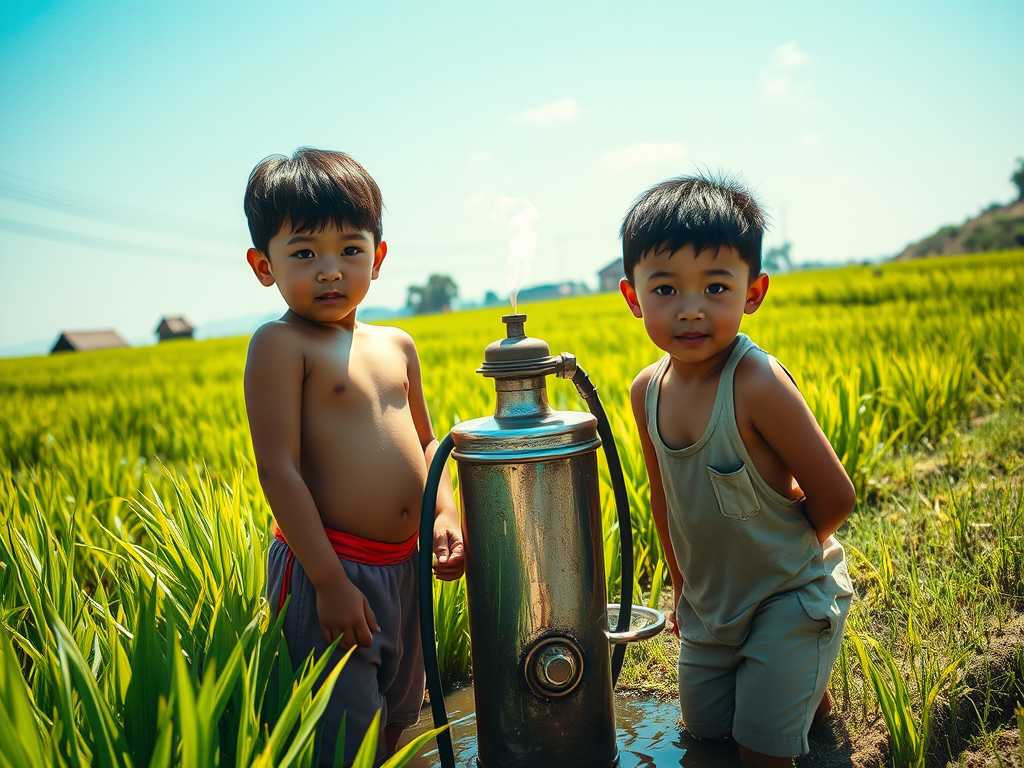
It was a scorching mid-summer afternoon in 1965. All trees and crops stood still as if holding their breaths for a ceremony to begin, while cooking smoke rose all the way up towards the sky without changing its shape beyond the fields. Ming was gleaning leftover grain with a neighbor boy when he spotted something strange across the ditch, which looked quite deep.
“Hey, what’s that stuff roaring and smoldering over there?” asked Ming in a loud voice.
“Ha-ha, you dummy! Don’t you know that’s a machine? Called ‘fuel pump’!” answered Six-Lives, who was a couple years older and apparently knew more about it.
“Fuel pump? What does it do? How does it work?”
“It burns kerosene. Used to draw water from a pool to irrigate rice paddies.”
“How do you know?”
“My youngest uncle’s the operator! He told me that.”
From his tone, Ming knew that Six-Lives was very proud of his connection with the farming tool, which made him feel envious. As the first industrial product Ming had ever seen since he had memory, the pump was nothing less than a living representative of all the advanced sciences and technologies of the twentieth century.
“Can we go take a close look,” proposed Ming. Even if they had to walk a long way to cross the bridge, he wouldn’t want to miss this opportunity to open his eyes.
“Why not? Let’s swim across the ditch.”
“But I don’t know how to swim!”
“Easy-peasy!”
“How’s that?”
“Just follow me…”
Scarcely had Six-Lives finished his sentence when he asked Ming to take off his shorts, the only garment every boy wore during the entire season. Then, the older boy put it together with his own on his forehead and transported them dry and clean by treading water to the other side of the pool, which was about four to five meters wide. When he came back, he grabbed Ming’s left hand and told him to make strokes with his right arm and keep kicking his two legs backwards the moment they stepped down into the water.
“Paddle hard just like a crazy duck, or a dog, remember!”
But the instant his feet left the ground, Ming fell down straight like a dumb rock. As he struggled to re-grab Six-Lives’ right hand or arm, he was choked with water and got a sharp pain in his nose. For a fraction of moment, he found himself catching one of his friend’s limbs but only to lose it again, because the other boy avoided him like a poisonous snake. With nobody or nothing he could get hold of, Ming hoped to get out of the water by kicking his legs and waving his arms as hard as he could. At one point, he did manage to raise his head above the water and see Six-Lives standing alone on the ridge, totally naked, doing nothing but wiping his tears away.
After swallowing a large quantity of water and despite all his efforts, Ming failed to keep his head above the water as he and his coach had both anticipated. What followed was an ineffable experience. As time seemed to stop, he felt his body drifting around like a little cloud in a greenish sky. With his eyes close tightly, he certainly saw nothing at all. Nor did he hear a single sound; even the loud noise of the pump had become totally muted. There was no pain, no choking anymore. Instead, he was overwhelmed with a sense of comfort and serenity, while the idea of death never came cross his mind. He knew he was very much alive since he was still as self-conscious as usual. This he could tell because he could somehow see, from somewhere above, his own naked body in the heart of an enclosed space, which was full of light-like water or water-like light. He reminded himself to keep plodding forward in one direction all the time. This way, he believed that he would touch the ground sooner or later.
It was not long before he felt his hands catching something solid, which he presumed to be a tree root. Without a second thought, he used all his remaining strengths to climb up along the root, though it seemed endless. No matter what, he was sure about his proximity to the ditch side. Otherwise, there would be no root for him to grab. That being the case, he could get out of the pool sooner or later as long as he kept climbing. But just when he found himself too exhausted to continue trying, he felt the root broken off and shrunk into a short and weightless straw in his grasp.
Before he woke from a dreamless sleep, he heard some faint human voices coming closer and louder, “Whose boy’s this? Isn’t he from the Lius living on the dike?”
A few days later, he learned that it was a young couple who had seen Six-Lives crying on the ridge when they happened to take a short cut to visit the wife’s parents for the first time after they got married. From the boy’s terrified response, the couple guessed that someone was drowning in the depth of the pool. Not knowing how to swim, the couple shouted for help at the top of their voices. When an old woman airing her laundry on her bamboo pole nearby heard them, she ran to the scene with the pole and used it to reach Ming, which he mistook for a tree root.
To the couple and the old woman, his parents were certainly grateful, but at the age of eight, Ming didn’t give a fig about this episode back then. In fact, if he’d known he’s to expend his whole lifetime only to prove himself to be one of billions of “shit-makers,” he would probably have stopped climbing the root in the water, or preferred to die of some disease like Six-Lives before he became an adult.
Yuan Changming edits Poetry Pacific with Allen Yuan. Credits include 16 chapbooks, 12 Pushcart nominations for poetry and 2 for fiction besides appearances in Best of the Best Canadian Poetry (2008-17), BestNewPoemsOnline and 2109 other publications across 51 countries. Yuan began writing and publishing fiction in 2022, with his debut (hybrid) novel Detaching just released by Alien Buddha Press.
Please share this to give it maximum distribution.
RFM will begin publishing again on January 21st at 11:00 a.m. US EST with the short story “Rowan” by Irish writer Naomi Elster. Naomi’s bio reads:
“Naomi Elster’s writing has been published and performed almost 30 times, including in Imprint, Crannóg, and Meniscus, and at the Smock Alley Theatre. She has campaigned for reproductive justice and pay equality. She has a PhD in cancer and leads the research department of a medical charity. Originally from Laois, in the Irish midlands, she now lives in London. “
Rural Fiction Magazine would like to publish more writers from around the world, regardless of your country of origin.
RFM is seeking short stories, poems, reviews and press releases, on rural fiction books that reflect the beauty, tranquility, joys, anguish, sorrows, humor, tragedy, comedy, and drama of rural life. RFM believes that all stories are about people and that genre is secondary. Therefore, RFM is open to almost all genres such as mainstream, literary, romance, horror, western, mystery, thriller, historical, realist, coming of age (Bildungsroman for those who speak German), science fiction, magical realism, dystopian, etc, so long as they are connected to rural life and culture anywhere in the world.
Your work must be in English. It can a translation from your native language, but it must be in English, which is spoken around the globe and gives the work and author substantial worldwide exposure.
For more information on what RFM is accepting and on the submissions guidelines, please go to our submissions page.
Please note that there is no pay for this other than a publication credit and exposure to the American and English markets. However, all rights remain with the author.
Currently, RFM is publishing material within a few weeks of acceptance, though this may vary depending on the number of submissions.
Please share this announcement to give it maximum exposure.