
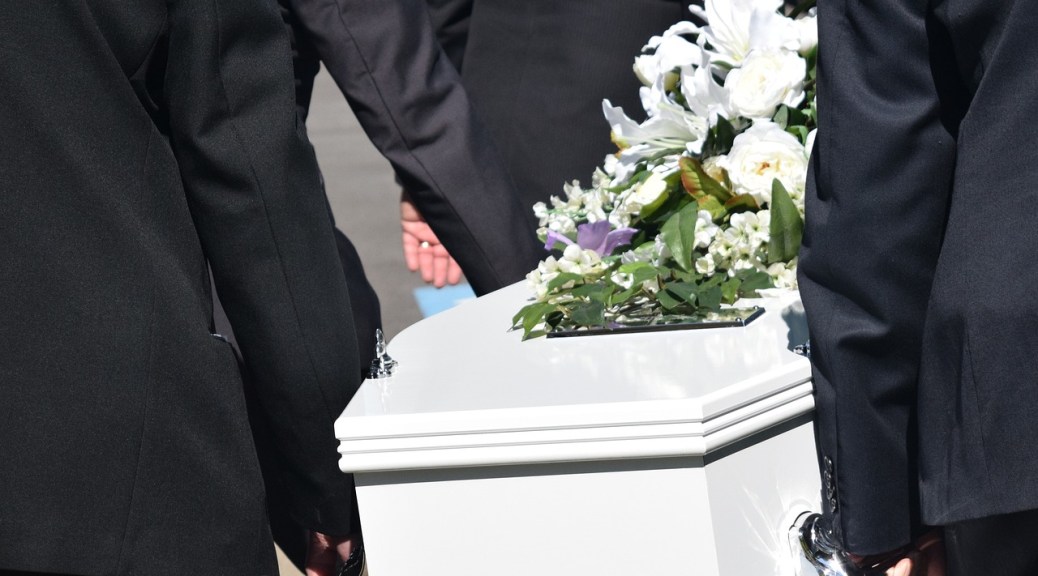
“Uncle Jack,” I heard someone call out. In a mangled straw hat, a jungle-print shirt, and a tie looped around his neck. he looked like a clown, a buffoon. But I recognized him right away, that pony tail, those cloudy blue eyes. For two decades we hadn’t heard from him, thought he was dead. Or at least I hoped he was.
I turned to my husband. “For god’s sake. Of all the places,” I muttered, at the cemetery now for a funeral, my mother-in-law’s.
Teddy slid his meaty arm around my husband’s neck and pulled him toward him, as if they were buddies, saying, “Damn shame. Damn shame about grandma” over and over, clearly sloshed.
I did the math. He had to be thirty-five by now, yet, despite all the drinking and street-living, he still looked boyish, handsome, the quarterback of the football team, though as far as I knew he’d never even graduated high school.
“Now don’t you embarrass me.” Jack’s sister Nadine came over. She yanked him away. Wearing a dress and heels, she was wobbly herself, though it wasn’t from drink. She never drank, despite having plenty of her own problems.
In the meantime, Rosa May, reduced to a pewter urn sitting in a small hole surrounded by green tarps, would have been fuming. A long time ago she’d gotten a restraining order against him, but over the years, whenever his name had come up, would say, shaking her head, smoke swirling up from her cigarette, “Such a sweet baby. Can’t understand it. Wasn’t he Jack? Now don’t tell me he wasn’t,” and my husband, ever his mother’s favorite, the one that turned out good, would gently remind her that Nadine had been sweet before she’d gotten hit on the head and raped and started having babies at fifteen, a dozen or so by the time she was through, no one exactly sure what had happened to most of them.
As for me, Teddy was the last person I wanted to see, even though I knew Jack had always had a sweet spot for him, had wondered about him. Before we’d married, he’d been living with him, and when Jack introduced me and then went back in the kitchen to prepare dinner, Teddy threatened me.
“He hates women,” Jack had said afterward, when he’d driven me home, explaining how Teddy had been sexually abused by a next-door neighbor.
I’d said if he moved in with us—we were planning on marrying then—I’d be a goner.
“Now don’t you embarrass me,” Nadine repeated, waving her finger at Teddy who was now standing there with his hands in his pocket. Then for some reason she giggled. It sounded like a machine gun.
Stepping back a little, I turned a little, gazing at all the other headstones. A simple, humble rural cemetery it was. Plastic flowers and angelic figurines sat in front of headstones. At the fence line a half dozen cows from neighboring ranchland, heads hanging over, were gazing at us. I glanced back over at Teddy, hoping time and decades of booze had brought on a certain amnesia. I remember how we’d been on the deck together, Jack in the kitchen. It was so dark I could hardly see Teddy. “You better not mess with my Uncle Jack,” I remember him saying. He was just a kid then, but the way he’d said it had made my skin crawl.
“So how’ve you been? How’ve you been? How you been, Uncle Jack?” Teddy slapped him on the back now, then gave him a soft punch on the arm, all the while his head slowly weaving and bobbing like a stunned boxer’s.
“Now you shush, Teddy,” Nadine said. “Vernal wants to get started.” Her skittish eyes darted back and forth like spooked minnows. “A nervous tick,” Jack had said, and I wondered if that had started after the rape. She’d been knocked on the head apparently too.
As we situated ourselves around the gravesite, some people sitting, some standing, the sky which had been overcast, cracked open, letting sun through. Earlier it had rained, and now I started thinking about the worms that had unearthed themselves, their chalky smell, how the sun would soon dry them up if the birds didn’t get them first. We sat down. From behind I felt a hand touch my arm.
“Sweetheart.” It was Rosa May’s sister Auntie Lou Lou, dressed in lime pants and a checkered blouse, her annual Christmas outfit. Soft white ringlets framed her face, and the points of her horn-rimmed glasses jutted out at the edges of her eyes. “Isn’t it just terrible,” she said, shaking her head. Stooped a little, she’d been sick in the pancreas but wouldn’t say if it was the cancer com back.
“I’m so sorry,” I said, taking her hands, withered things, all the veins protruding.
“I mean about Trashbin,” she said.
Jack had told me that about how she and her late husband had run him over, just a puppy then, on some lonesome road out to Las Vegas and then got him fixed up. But after they brought him home, he ate everything in sight.
Auntie Lulu pulled a cedar box out of her bag, a paw print on top. “Can’t we just send him to the Lord with Rosa May? Just mix him in there.”
I looked behind me, at all the chairs, three rows filled with people I didn’t know. I started to stand up. “Here.” I took Auntie Lulu’s hand. “Sit.”
She started moving backward. “Oh no, you honey. That seat’s for you.”
“I’m not family, though,” I said, but she was already shrinking toward the small herd of mourners milling some distance behind. For decades, she and Rosa May had lived in separate apartments in the Glendora Palms, spying on each other through parted curtains, across the courtyard, the feud about a car or money or whose children turned out worse: one a rapist, the other a child molester.
I peered at the mourners now, wondering which was rapist, which molester, but in my husband’s family it was hard to know whose children were really whose, what was true and what wasn’t, when I heard a man clear his throat. It was Vernal, an old friend of Rosa May’s, standing behind a podium, flipping pages of a large, leather-bound Bible, with yellow post-its sticking out of it. With his black suit and white hair he was very dignified looking, a stout statue.
I sat down again and discovered another chair now beside mine. Slouched down in it, head drooping on his chest, Teddy was snoring lightly beneath the shade of his thatched hat. Too late to say anything, I squared myself to the podium, then I placed my hand at the back of my husband’s neck and leaned into him. When he’d gotten word that Rosa May was gone, he’d just gone silent. That’s how he was when someone died.
“We shouldn’t think of this as the ending of life but the beginning,” Vernal began. “Rosa May wouldn’t have wanted you to be sad for her. Her entrance into the Kingdom of Heaven.” Vernal looked up at his raised hands, large pink hands, hands that in their youth could have conducted orchestras, summoned thunder, or throttled chickens. Then he looked down at the Bible, on the brink of quotation, of profundity, and then, his finger stumbling across the page, he peered over at us. “She’s looking down on us right now. I know she is. Her loved ones, her friends.” He cleared his throat again, and beside me Teddy had come to, clucking his tongue, saying, “Amen, my friend, amen” as if he were steeped in spiritual passion, until Nadine, at the other end, came over and shushed him while Vernal kept running his finger across scripture like a blind man. “Rosa May liked to talk and drink coffee, and she liked trees and the little birds that twittered in them. She liked screwdrivers and to quote Nietzsche” to which Teddy, said, “Right on,” and everyone looked at him, and he looked at me with his pale blue eyes, and in his still-handsome face I thought I saw mild curiosity, a kind of recognition.
Inside, a small party of us met up at the hostess station of PJ’s, All You Can Eat, in honor of Rosa May, who believed in food, especially at a bargain. At the center of the restaurant were food bars, each shaped like a little square house topped with a steamy glass roof. Once we were given the go-ahead, we all lined up at a counter and took a warm, white plate and utensils and set them down on our trays. Then we dispersed among the various food houses, each one a different nationality–Mexican, Chinese, Japanese, Italian, Greek, and American, where I caught up with my husband who, bent under the roof, was peering at the tins of fried chicken, chicken fried steak, mashed potatoes and gravy, kernels of corn that looked like baby teeth, and string beans glistening in butter. “This food.” I peered at the steaming houses, the mounded plates passing by. “There’s so much of it. I hope your nephew isn’t coming.”
My husband leaned toward me and said, “He asked me who you were, why didn’t I introduce him.”
From my plate I plucked a string bean with my fingers and bit into it. Oddly enough that was how Teddy had eaten his food the night we’d first met at Jack’s, with his fingers.
My husband and I sat down at a table across from Vernal. A regal-looking woman with a whorl of white hair and pretty sapphire eyes sat beside him.
“I remember you from the hospital, “Vernal said to me as I sat down. “After Rosa May’s last bypass. Jack’s wife. Rosa May loved you. And Lord knows she didn’t love everybody.”
I looked down at my plate, chicken wings, mashed potatoes, string beans. “I didn’t know Rosa May liked birds.” I glanced out the picture window, at the front of the restaurant, to the huge cement parking lot where pigeons were pecking at the ground.
The woman beside Vernal suddenly lifted her head and smiled at me. Her fork hovering in mid air, she slowly turned her head left and right like a cobra. “Where is my husband?” He was here just a minute ago.” Her fine brows furrowed slightly. She turned to Vernal and peered at him, as if he might give her the answer.
“Darling,” Vernal said, sliding his arm around her, “I’m right here. We’re in a restaurant. We’re eating.”
“Oh yes.” She smiled sweetly at the fork, then delivered it to her mouth and chewed. “I’m eating,” she said, “eating food.”
Vernal, leaning across the table toward us, said, “This is my devoted wife, Eleanor. God bless her, she’s got Alzheimer’s. She used to manage a See’s Candy shop downtown. Isn’t that right, Eleanor? Can’t you just see her in her white uniform? Isn’t she beautiful?” He sat back and beamed at her.
My husband and I both nodded then went back to eating. What else could we do? I looked around the restaurant. Most everyone else had eaten a cursory plate and cut out.
“Don’t you worry about Teddy.” Nadine suddenly appeared and sat next to me. “He’s not to come in until everyone’s done. Then he can feed.”
I looked out to the parking lot again. There he was with the pigeons pacing back and forth, smoking a cigarette.
“The Lord has a plan for everyone,” Vernal said.
“Well I hope he doesn’t plan on letting him in,” I said.
“I doubt the Lord wants us to be mean, to make him wait out there,” Jack said.
“He’s drunk,” I said. “Totally sloshed. He could get mean.”
“Oh, honey,” Nadine said, “he’s not like that anymore. He’s got that sickness in his head. Hears voices. He gets them tremors. Now I worry someone might hurt him.”
“Your mother,” Vernal said, rising, “was a good woman. I’ll miss her.” He looked down at his wife, who was still seated. She’d stopped eating, was staring serenely, immersed in some memory, chocolates nestled in their paper shells, egrets poised in upturned fields, or something else pleasant.
I used to work as an aide in a nursing home, in the memory unit, always had the urge to ask them, “What? What are you seeing?” as if they were psychics of the past.
But Vernal was already lifting her up by her shoulders, gathering her like a bouquet of flowers. “Come along now, Eleanor.”
A flash of annoyance crossed her face, but she stood up anyway. At her full height she was taller than Vernal, probably taller than everyone in the restaurant and the whole wide world. Extending her hand to me, she smiled. “Who are you?” She still had the perfect white teeth of a beauty queen.
Through the window my husband and I watched them cross the lot. Teddy stopped pacing and tossed his cigarette. For a minute the three of them were huddled. Maybe they were praying.
Jack turned to Nadine. “Why don’t you let him in now?”.
“I told him if he don’t behave he isn’t allowed in. What he just done at Mama’s funeral. Darn near embarrassed me half to death.” She shook her head. “Barely leaves his room anymore. Like a little mouse, afraid of his own shadow. Always thinks someone’s following him. I’m afraid someone might hurt him.” Nadine stood up and reached into her bag pulling out a green velvet box, J.C. Penney inscribed on it, handed it to me. “Mama wanted you to have this.”
I cracked it open. Nestled inside was a gold ring with a be-be size jade stone in it. “That’s lovely,” I said, removing the ring from its slit and slipping it on my finger.
My husband touched the ring. “You’ll need a guard for that.”
Then Nadine handed me a book. “I’m not much of a reader, so I think Mama would want this for you too.” She bunched up her shoulders and giggled. Nadine always liked giving presents.
Sonnets from the Portuguese. I opened the cover; inside someone had written, “To my Love, Rosa May.” I looked at Teddy. “Your father?”
Nadine giggled again. “Oh, I don’t think Daddy liked poetry.”
My husband stood up. He headed back to the restrooms.
Nadine went out to the parking lot.
Before my husband got back, the front door of the restaurant opened.
“Now you fix yourself some food and don’t make a nuisance of yourself,” Nadine said, leaving Teddy there, heading to the restroom too.
I turned back around, alone at the table now, except for all the other people eating at their own tables, the ones who hadn’t attended the funeral and were just eating. I was hoping Teddy, in his stupor, would just go sit down at one of those tables with strangers. There’d be commotion, of course, but then again maybe there wouldn’t.
In his straw hat, he sat down beside me anyway and started shoveling in the food with a spoon, the mashed potatoes and gravy, the turkey, corn, baby carrots. And for a minute I thought he didn’t even realize I was there. If you could imagine people following you, maybe you could think no one was beside you.
But Teddy put his fork and knife down, his eye catching the book on the table. He took his straw hat off and wiped his hands on a napkin and then helped himself to it. “Sonnets from the Portuguese.” He flipped through it and then put it down. “I’ve been writing some poetry, you know.” He looked me full in the face this time. His hair, out of its ponytail, now hung down past his shoulder blades Viking style. “Lousy stuff, though” he said, morosely. “How do I love thee? Let me count the ways.” He tossed the book on the table, then rubbed his cheek. “What about you?”
Jack had always said Teddy was a reader, was always stealing his books.
“Well sometimes you have to write the bad stuff to get to the good stuff” came out of my mouth.
He glared at me sideways. “What do you mean by that?”
“That’s how it works.” I hadn’t meant for it to come out sarcastic. My heart started palpitating. “Not just with poetry. With everything,” I looked over my shoulder for Jack. I began thinking that he and Nadine had planned this, that together they were watching from some secret corner of the restaurant or in a backroom on a security screen.
“Hey, I know you,” he said. “I remember you. You’re the one.” His face contorted. He suddenly stood and pushed his chair back hard, tipping it over.
The restaurant had suddenly gone silent. The bus boys hurrying down the aisles seemed to have frozen. But I held my ground as I’d done that night on the dark deck when Teddy had threatened me. Now though, he was gone, out of the restaurant, back into the parking lot.
My husband sitting down beside me now.
I peered at Teddy’s plate, the half-eaten food all congealing into a puddle.
Then Nadine showed up. “Doggie bag, eh?”
It was sunset when we left, when we drove the winding stretch of Marsh Creek Road, the narrow, two-lane artery that bisected farmland and orchards, the pretty part of the valley. On the way in, we’d taken the highway, the ugly way, so we wouldn’t be late.
“Look at those,” I said to my husband as he maneuvered the curves. Egrets were dipping their white necks into the green fields. “It was a nice funeral, especially Vernal with his post-its in his Bible. Your mother would have gotten a kick out of it.”
My husband, taking another curve, cut the wheel.
I grabbed of the door hold. “You aren’t angry, are you? You haven’t said much.”
“Did you notice that the flowers were missing? The roses I had sent over?”
“Maybe the florist sent it to the wrong funeral.”
“No, the card was there. I found it on the ground, near the tarp.” He pulled it out of his jacket and handed it to me.
“From a loving son” was written in someone else’s hand. I held onto the card, could feel its sharp edges, as I watched the asparagus fields pass. “You don’t think . . .”
“Why would he?”
I shrugged. “Why does anyone do anything?”
“I told you he’d never hurt you.”
“Your mother said he threatened to kill her with an ax. I don’t think he should have been there.”
“It was his grandmother. And now look at him. Couldn’t hurt a fly.”
“You don’t know that. You don’t know where he’s been. Did you know your Auntie Lulu wanted to dump Trashbin in there with your mother? She had him in her bag, in a box, his ashes.”
My husband chuckled. “Mother did like dogs. Remember, I did grow up on a farm. Ducks, chicken, cats.”
We were passing through the orchards now and all the cheerful signs: Pick Your Own Fruit. Cherries: You Pick. Pick & Eat. Then came Round Valley, a hilly hiking area we’d been to before, a sloping place of tall grasses, wildflowers, old growth oaks, and the fragrant Buckeye trees.
“We’re going to need some more of those bebobs,” I said, as we passed the entrance, “for the glass vase in the dining room.” Bebobs. That was the name we’d made up for the Buckeye fruit, the dark brown seeds that looked like a buck’s eye. Next fall, when they burst their green pods, we wouldn’t be able to resist.
Janet Goldberg’s novel The Proprietor’s Song was published last year by Regal House, and her story collection Like Human is due out from the University of Wisconsin’s Cornerstone Press in Fall 2025.
Please share this story to give it maximum distribution. Exposure is our authors’ only pay. You can also help our contributors gain exposure by back linking to them and to RFM’s homepage.
If you would like to be part of the Rural Fiction Magazine family, follow this link to the submissions guidelines.
Image generated by AI
