Tag Archives: Fiction

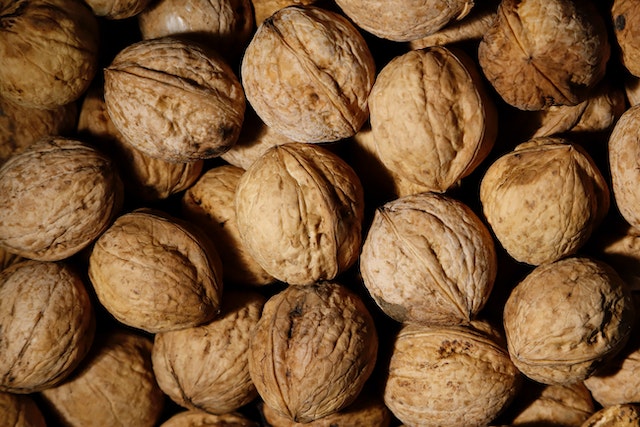
“Walnuts” Short Story by Billy Stanton

"Walnuts" Short Story by Billy Stanton: Billy Stanton is a London-based working-class writer and film-maker, originally from Portsmouth. His short fiction has appeared in Wyldblood, The Chamber, Horla, The Rumen, Literally Stories, Tigershark and the ‘New Towns’ anthology. He co-runs the ‘Noli Me Tangere Short Film Festival’. His blog is: steelcathedrals.wordpress.com

“Are you washed in the Blood of the Lamb?”

He was putting those words on the wall, was Old Frankie, called old although he was only forty-two; he was putting the words on the stone wall trying for precision but falling short. They were slapdash black-paint words now, not running and dripping, but alternately thin and crooked or rounded and porcine. He was copying as best he could from the paper Reverend had given him; he was bent below the stained-glass window of the knight wrapped up in ribbons; it was a Saturday, it was August 23rd 188-, and he was all to-aching. 

The Reverend had made them sing the song, the Blood of the Lamb song where the words came from, the hymn, on each of the last four Sundays. He was very fond of it already. He received hymn books and correspondence from other men of the cloth in the Americas and he had got the words and the tune from one of them. They had sent it as an example of the sort of hard material that the hard evangelists were preaching to the people; the Reverend of St Boltoph’s liked it because he was hard too, a fire-and-brimestone man, a man of two centuries prior. He was for Cromwell and no Christmas still; he was for scaring the wits out the parishioners; he was for telling them the Devil stalked the hills around them and was waiting for them to come up; he was for letting them in on the secret that they were sinning every moment they weren’t in his church, that Chasteborough people sinned obliviously in the alehouse, in the fields, over their dinner table, crouched on the chamber pot, tending to their vegetable plots and stroking their children’s hair. No hope for the wicked, is what he would say, not the dyed-in-the-bone wicked. 

Old Frankie rounded out the second ‘o’ in blood and stood back to see if all had gone well enough. No; the first ‘o’ had almost no opening in the middle and was narrow like the trail left by a cartwheel; the second ‘o’ could let through the massed Onward forces of the Christian Soldiers. He sighed. If you want a job doing well… but then, Reverend would never deign to twist himself all up against the cold grey ground of the church and be overpowered and stifled by the musty smell of the kneeling cushions. His faith made him walk on beams, sunbeams, gilded beams; he was meant for better things, or so you gathered from his talk.

What made it all the worse was that this was dishonest labour besides. Old Frankie had got plenty of lamb’s blood on him from helping out with both the birthing season and the slaughtering; none of that had seemed to come from the Lord or do him much good- it just stank. He was still a sinner and still someone thought of as being a bit behind the rest of the men he toiled with in most respects; that’s why he was unmarried still, and that bit at him, and that’s why they called him Old, because he walked and talked slow.

He heard laughter from the tumulus across the way from the church, just beyond the low wall that marked the bounds of the holy lands; just beyond the broken old yew tree that threatened to drop a branch on a pew-filler’s head every Sunday; just beyond the gravestones of unusual names, of names that no-one seemed to be called by anymore. Frankie looked out to see who was laughing. He felt a pang of jealousy when he saw the source: it was Emily, Emily Sandwell, daughter of John Sandwell, sweet Emily Sandwell, Emily Sandwell of the darling smile, Emily Sandwell of the cherry cheek, Emily Sandwell who had grown from an ungainly child with big feet to angel-woman, to divinity, to Frankie’s vision of the mother of God, the impeccable blessed Virgin.

She had her long skirt pulled up to her knee on one side, showing a pale leg strong from both her workday tramping for her family and the Sunday afternoons she usually spent solitary walking regardless of the strain of her weekday labour, without concern for modesty or the thoughts of her companion Arthur Ranger, the wagon boy. Yes, yes- there was Arthur suddenly taking hold of her leg, almost toppling her over, and kissing up the irresistible goose-pimpled exposed skin, from pristine white ankle to cushioned red knee, not caring who knew or who saw. Emily threw her head back and laughed all the more; she touched his face; she let him for a few seconds kiss up inside what was not left bare by her hitching, deeper and deeper, then she pushed his head away and raised a finger mock-stern, like a schoolmarm secretly amused by the tearaway antics of her charges.

Old Frankie could tell by their casualness, by their easy amusement, by their lack of scruple, that they knew each other much more than leg-kissing; that the nighttime woods on the hill had not been left undisturbed by their clandestine footsteps and rustlings. He’d heard it was happening all over, this looseness; now, he knew it for sure, but he also suspected it had always been that way for everyone but himself- it just seemed that people forgot somewhere along the way, that they buried their own illicit memories deep enough in the soil that the plough could not turn them back over and bring them again to the light. 

Arthur Ranger bent over and got on all fours and the reason for Emily Sandwell hitching her skirt became clear- she stepped up upon his back and her head and shoulders were lost amongst the thick leaves and branches of the walnut tree. The tree grew well here, just on the edge of a crop of beeches that crowned the tumulus as they do other such miniature eminences up and down the isle, because the rise meant it was closer to the sun; because the ground opened in craters and holes that held the rainwater in deep puddles that were a constant threat to the wayfarer looking for a shortcut home from the crop; because the tree, allowed such a prominent position overlooking the church, was respected and even venerated like it was a sign of confirmation from the Lord of the rightness of the worship within, of the truth in the words on the wonder of creation that spilled forth so often from the good book. Not many came to pick the walnuts that grew here abundantly, preferring instead to take from the more modest growth of various other trees dotted about the town, but Arthur and Emily dared; Old Frankie saw that they had with them a basket, hidden from sight up to now, and Emily had reached down and picked it up to fill it.            

Arthur, one of the slimmer boys in the village, not solid like some of the farmhands, was a surprising source of strength and determination in his task- he held Emily all the while without buckling, without wavering, without complaint. He stayed like a table, as if his one humble purpose on earth was to allow maids to climb upon him, to use him like a stool or ladder. Maybe Old Frankie shouldn’t have been surprised, though- who would have been prepared to show anything but their strength to this angel; to let down the God-touched; to make perfection feel as if she were even slightly at fault?

Emily sang a song, distinct and different in every way from the song whose title he was painting on the wall as a warning and a reminder. It was lilting but knotty in the way she sang it; she drew out the phrases she liked in long trilling notes and rushed over others to reach those she preferred. She knew the lyric well and was trying to live up to it, to reach its promise, to fulfil its dreaming, to give it flesh and realness:

“It’s of a brisk young farmer, a-ploughing of his land,
He called unto his horses, and he bid them there to stand.
As he sit down upon his plough, all for a song to sing,
His voice was so melodious, it made the valleys ring.

It’s of this fair young damsel, a-nutting in the wood.
His voice was so melodious, it charmed her where she stood.
She could no longer stay,
And what few nuts she had, poor girl, she threw them all away.

She stepped up to young Johnny, as he sat on his plough
Said she, “Young man I really feel, oh I can’t tell you how.”
He took her to some shady grove, and there he laid her down,
Said she, “Young man, I think I feel the world go round and round.”

“Do you ever feel the world go round and round?” Arthur asked her slyly, interrupting.
           

“I feel it now more than ever,” she giggled.

Then she screamed for joy, deep and long.

She had evidently done it; she had found the heart of the song that had charmed her whole life, that, from the moment she first heard it drifting from an inn window or from the mouth of her grandmother at the fireside of a winter’s evening, had whispered to her of paradise, of passion, of hidden and forbidden things, of the untold pleasures of voice and body, of days too ideal to last and yet remaining all the same, available to all with a mind to it, the glimmer in the clouds of the workhorse’s life, the shining behind all things. Her reenactment had been a perfect act of manifestation. She was enveloped within the song, her own variation of its lyric and meaning, the world outside replaced by the world within the tune.

Old Frankie could see the delight in her; he could read the quivering excitement in her limbs; he could understand the brief ignition of the flame within her, the flame that called back beyond original sin to original peace and happiness. The sun was yellow on them; the sky was blue; the grass was green; the violets purple; the primrose pink; their dress white and brown and red of neckerchief; all was as it should be and the crow’s caw had been covered by sound of Emily’s voice, caressed by innocence and experience. She and he on the tumulus were more beautiful than the nightingale; prouder than the robin; more fleet of foot and thought than the sparrow; above all things like the hovering kite. She- they- were more than the words on the wall, more than the blood of the lamb, more than Reverend’s sunbeams.            

Old Frankie threw down his paintbrush, walked through the knave and left the church. Damn the Reverend; damn him to heaven or to hell and back. He could paint for himself. Frankie didn’t need his few pence. The couple were still laughing and the nuts on the tree were ready and ripe for the picking and it was Saturday and it was summer. 


Billy Stanton is a London-based working-class writer and film-maker, originally from Portsmouth. His short fiction has appeared in Wyldblood, The Chamber, Horla, The Rumen, Literally Stories, Tigershark and the ‘New Towns’ anthology. He co-runs the ‘Noli Me Tangere Short Film Festival’. His blog is: steelcathedrals.wordpress.com


Please share this to give it maximum distribution. 

If you would like to be part of the Rural Fiction Magazine family, follow this link to the submissions guidelines. If you like contemporary dark stories and poems, you may also want to check out The Chamber Magazine.



“The Perfect Calendar” Short Story by A. R. Carrasco

A. R. Carrasco is an American author based in Oakland, California with works of short fiction appearing in 365 Tomorrows and the Street Sheet San Francisco (a publication of the Coalition on Homelessness).

Robin Swann penned by hand the “perfect calendar” on January 1st, 2255. For the last fourteen years, the retired nuclear engineer labored alone on his invention in the rural community of French Gulch, California. Rumored by some to be an illegitimate grandchild of Julius Robert Oppenheimer, all that could be said for certain about Robin is that he was born on Christmas Day in Berkeley, California, was first married in Reno, Nevada, and was hitched for the second time at Niagara Falls. Both times, Swann fell in love with gentlemen of numbers: the first an applied mathematician, the second a specialist in pure math. At holiday gatherings, after a couple mugs of spiked eggnog, Robin Swann likes to jest that his first marriage could have been an “infinite series” but for want of “pure numbers and significant digits.” He called his second go-at-love a “perfect set.” 

Every evening after supper, Robin and his partner Oliver would walk down Main Street, past the local general store, to feed the fish under Clear Creek Bridge before the one-room schoolhouse. A sizable black salmon would dance often in the shadow of the two lovers on evenings lit by moonshine and starlight. It was this same spot within which Robin experienced his greatest revelation. Mesmerized by the flickering movements of light and dark, Swann found the answer to the question that had stolen weeks of slumber from the intrepid scheduler: How can weeks and years get along? The answer was simple: “To heck with the years, by George, let the week inherit the Earth!” 

The town preacher, who also happened to be Swann’s landlord, invited Robin to debut his “perfect calendar” before the Easter potluck at the community church. Swann wore the same satin tuxedo within which he was married twice. The preacher named Max paid Robin a compliment: “I don’t think French Gulch has received a more dapper gentleman than when President Kenney visited back in 1963!” Apologetic, Robin begged the pastor’s pardon, “I don’t mean to distract! I’m very grateful for the opportunity to share my work and get feedback from my community. I hope French Gulch will become the first city in the world to adopt the “One-World-Calendar!

We ain’t a town,” interrupted Paul, the portable toilet technician. “Gotta have a Mayor to be a town and we ain’t got none. No government, no town, and sure as heck no city. If you wanted to get your calendar started in nowhere U.S.A., you couldn’t have picked a better stool to pop your squat, with all due respect,” Mr. Putter concluded. With a look capable of chilling a glacier, Robin promised with a squint, “Where time reaches its dainty hands, there shines the metropolis of our greatest honors: our most valuable treasure is time and its vault is our commonwealth. I am proud to offer to the world a new type of bank that will pay a hefty return on every moment a learned investor is wise enough to deposit.

While the flock queued up for grub, Pastor Max made a short pitch for the attention of the congregation: “Dear parishioners, we have a special presentation this Easter from our own Dr. Robin Swann. As you may recall, we all lost Oliver quite suddenly two winters ago. Ever since Robin has been dedicated to producing something he thinks will make the world better off. Without further ado, please give a warm welcome to Dr. Robin Swann!

Sheepishly Robin began his pitch, “Good people of French Gulch, this Easter Sunday I do not come to you with a message from another world, but instead a gift born of this one.” Dr. Swann began passing out laminated squares of cardstock paper. On the card was a 12×12 grid.

Swann sang, “Hate having to buy a new calendar every year? Are you done with the chore of keeping track of leap years? So were the Egyptians! I have a solution to all your chronological controversies in the form of the first ONE-SHEET per year calendar in the multiverse.” The old man was now short of breath from excitement. After a long silence, the only sounds the audience provided were the rustling of paper plates, the chatter of plastic cutlery, and the periodic pouring of water over ice. The old visage of the inventor transformed into that of a man struck by lightning, “I forgot to explain how it works! My apologies. Look here, give it a simple fold in half once and now another half — twice!” 

The elder waived the folded paper over his head like it was a winning lottery ticket, “See! Four seasons means a fourfold deal. Each season is 108 days: three 36-day months of six-day weeks. That means the year is 432 days in total. You see, we base most of our structurally defective calendars on how many times our planet circles our sun, which is all wrong since an orbit isn’t even the same every year. Imagine setting your clock to the cry of Clancey’s bloodhound. Sure, the poor boy cries every night, except – mark my words – except, on the night after Turkey Day since that lucky guy is too busy slurping bird marrow to bother us with a ballad. Plus, some folks don’t even live on this rock anymore, so why keep up the guises? Someday, we will find intelligent life in this multiversal cosmic gumbo of ours and this! This piece of paper will prove that our elevator goes to the top floor! This intellectual passport, if you will, shall prove to any new interstellar lover, that we are playing with a full deck!” 

Paul Putter swung open the bathroom door to embrace Robin with a hearty bear hug. He swung back around to bow to the church crowd yelping, “By George, this does work!” Putter waived around a completely soiled “One-World-Calendar” provoking some to vomit out the church basement side windows onto some sunbaked pews. Walking back home, Robin didn’t notice he forgot all his extra “One-World-Calendars” in the church sanctuary. The pastor’s final semi-compliment, “Great for bingo,” echoed in the noggin of the once-esteemed scientist. When he got home, he took a long look in his bedroom mirror. Some tears began to collect in the corners of Dr. Swann’s eyes recalling the quiet evenings he spent with Oliver making collages out of their old calendars. Oliver would call Robin “his one world man who just so happens to be out-of-this-world.”  Before falling asleep that night Robin got a ring from outer space. The lifeform on the other end said that they heard his presentation through a cellular phone locked in the church kitchen deep freezer. The being thanked the inventor for finally giving his superiors a good reason to visit Earth. Earth’s newest fan confided in Dr. Swann, “If the people of Earth are sensible enough to get their calendars in order, they might be worth sharing in a holiday or two with together.” Holding back tears of joy, the only reply with which Dr. Robin Swann could muster a response was as follows: “If that wouldn’t be lovely, I don’t know what is, Oliver. If setting a date with you wouldn’t be lovely, I don’t know what is.” 


A. R. Carrasco is an American author based in Oakland, California with works of short fiction appearing in 365 Tomorrows and the Street Sheet San Francisco (a publication of the Coalition on Homelessness).


If you would like to be part of the Rural Fiction Magazine family, follow this link to the submissions guidelines. If you like contemporary dark fiction and poetry, you may also want to check out The Chamber Magazine.

Please repost this to give it maximum distribution. 

“The Fish” Short Story by R. Wayne Gray

R. Wayne Gray is a Vermont-based writer who has published in a wide range of genres and formats. His short fiction has recently appeared in Cosmic Horror Monthly, Trembling With Fear, and the anthologies 666 Dark Drabbles and Bloody Good Horror.

As he glided around the river bend, Scott’s eyes widened in surprise. It wasn’t the swamp stretching out before him, rotting wooden sentinels standing guard over brackish water, a glut of sticks marking a distant beaver dam. The still lake was certainly impressive in a decaying sort of way, and Scott was already calculating the spots where large fish were laying wait for him.

It was the lone structure clinging to the shore along the left side of the expanse that was the most surprising: a barely-recognizable cabin. While it had not sheltered man, nor probably beast, for decades, it was still the first hint of humanity that Scott in his kayak had seen for the past hour or more. Like the swamp, its fallen-in roof and ragged exterior suggested that it had been left on its own, abandoned, for a long, long time.

Scott paddled up to a pair of stumps hunkering in the water about 20 yards off-shore from the cabin. Just beyond, the water of the swamp turned starkly darker, a sure sign of depth and, Scott hoped, large catfish or some other scaly monster. As he flipped open the kayak’s forward hatch and started baiting up his pole, a familiar shape drew his eye to the nearest stump.

It rested amid the sticks and other debris that had been building against the stump for years, and at first Scott thought it was just another stick and his eyes playing tricks on him. He paddled over for a closer look. What he had seen had not been an illusion, but the outline of a small fishing rod and reel, its thin pole nearly indistinguishable amongst the driftwood ensnarled it.

Scott inched closer to the pile. He leaned out over the brackish water, the kayak tilting precariously, one edge sinking lower and lower in the water as Scott shifted his weight towards the prize. As his face got closer to the blackness, Scott could smell decay, decades of rot and stagnation. The point between upright and overturned was reached, surpassed, and Scott was going over into the black water. Flailing in panic, his fingers hooked onto a bit of driftwood, and he pulled himself closer to the stump, the kayak once again upright and buoyant.

It took a few minutes of untangling, but he finally managed to free the pole from the knot of bleached wood. It wasn’t much of a prize. For one thing, it was a kid’s pole, barely larger than a toy. The rod itself was missing an eye and was bent slightly at the tip. The reel was mostly rust, traces of red paint and a name, Fishin’ Pal, barely legible on it. Scott tried to turn the handle on it. It did give, grudgingly, with an unhealthy rasping shriek. The line was still intact though, running from the reel, up the rod, and into the dark depths beyond the stump.

Scott tugged on the pole, but the line still held fast to whatever it had latched onto years before. The kayak slid slowly away from the stump and towards the dark water as Scott tried to free the line, but it held firm.

“Junk,” Scott said, his voice foreign in the dead stillness of the swamp. He tossed the pole towards the dark waters. It arced, turning end over end, before slicing the surface and sinking. And scaring any fish that might have been waiting, Scott thought with a sigh. He grabbed his paddle and started out across the swamp to find another spot to try his luck.

He didn’t get very far. Two, three kayak lengths, and all of a sudden Scott felt drag on the boat. His forward momentum slowed, slowed, and then stopped completely.

Scott turned in the kayak. Perhaps one of the dead branches had grabbed him? But it wasn’t a branch. The line from the old fishing pole had caught on the stern of the kayak when Scott had tossed the pole away. He paddled a few strokes. The line grew taut, but did not give. Scott paddled a little harder. Still the line held, like an invisible hand clutching the end of the boat, holding it fast to one spot.

Scott turned and snapped the paddle into place on the side of the kayak. He drew his knife from its belt sheath and, turning to the back of the boat, began carefully edging out along it towards the tangled line.

The boat rocked in protest, but held fairly steady as Scott inched towards the fishing line. Kneeling in the cockpit, then one knee out, he adjusted his balance as the kayak rolled from side to side. Stretching, Scott grabbed the line with one hand, triumphantly, and was reaching out the other, knife grasped, when the line gave three quick tugs.

Scott froze in disbelief, waiting. The line lightly slackened, then slowly grew tauter, twice. Tug. Tug. Scott laughed, still not quite believing what he was seeing. Somehow, some way, after sitting idle and waiting for decades, the Fishin’ Pal had managed to catch itself a fish.

Scott imagined the scene as it had unfolded in the water. The line, hook intact, tangled in a glut of wooden debris and mud on the bottom. He on the surface, freeing the pole, moving it just enough to wiggle the hook, a dancing enticement to some monster slowly swimming by…

Tug.

Tug.

Still grasping the line with one hand, Scott pulled on it. It cut slightly into his palm, but the kayak started to pivot towards where the line sliced into the water. Scott slid back into the cockpit of the kayak where he was better able to work the fish. All the while he could feel the line lazily tugging back, as if it was testing him.

He set the knife on the floor of the cockpit. Grabbing the line with both hands, Scott slowly pulled on it. Whatever it was, it was heavy, and for a second Scott thought that he had only managed to free the same log that some kid fishing two decades earlier had snagged.

Hand over hand the mass slid through the water towards the kayak. As line started pooling in the cockpit, Scot’s heart sank. No resistance at all. It had to be a log, a large branch, a…

As if awakened, the fish suddenly surged away from the kayak, the line burning into Scott’s hands as it slid through them. Reflexively, he closed his grip on the line, wincing as the line sliced deeper into his skin and drew blood. It worked though. For a few seconds, Scott and the fish had themselves a stalemate, each on the end of a taut, unyielding length of line.

The fish started to weave through the water, first to the left, then the right, the line making a ssssst, ssssst sound as it cut the surface. The kayak bobbed and spun. Ignoring the pain in his palms, Scott braced himself in the kayak’s cockpit and started once again to drag the fish in.

Visibility in the swamp was terrible to begin with, and Scott and the fish weren’t helping it with their battle. Still, Scott kept his eyes on the spot where the line entered the water, eager for a first glimpse of his prey.

When the glimpse finally came, Scott still wasn’t sure what he was looking at. He expected the flattened head and antennae of a catfish, or the familiar muscular markings of a large-mouth bass. Instead he got… flashes of color? Whites and reds, a touch of blue or two. It was hard to make out in the murk. The fish fought mightily, twisting and turning, colors flashing frantically. Scott saw eyes, eagerly seeking their first glimpse of him.

And then it was under the boat, so fast that Scott didn’t have time to adjust to it. The line went tight against the edge of the cockpit, pulling hard as Scott’s hands kept a tight grip on it. With a final wrenching jerk of the line, the kayak rolled over into the water, scattering Scott and his tackle over the dark surface of the swamp. Scott was under, flailing at the water, seeking the surface. He finally saw sky and swam towards it, the fishing line tangling itself around his legs and torso.

Scott broke the surface and breathed deeply. The kayak lay on its side a few feet away, partially submerged. Yellow bobbers danced in the rippled water all around Scott and the swamped boat. Scott swore to himself. All that tackle, gone. Big fish, gone. Himself, wet and more than a little pissed.

He started swimming towards the kayak, his arms struggling with the motion. The fishing line. He was completely tangled in it. Scott grabbed for the knife on his belt, but the sheath was empty. The knife had been on the floor of the kayak’s cockpit. He mentally added it to the list of items that were now slowly sinking into the mud an unknown number of feet below him.

Splashing around like a wounded duck, Scott finally made it to the kayak and reached out his hand for it… and stopped. The line held him secure, a good foot from the boat. He tried paddling harder, but this only tightened the line wrapped around him.

And then the boat started to recede, as Scott was slowly, steadily pulled backwards.

Scott laughed. Well, this would make for an interesting story when he got back home. He swam against the pull of the line, but still he was dragged backwards. He felt the first twinge of fear and swam harder, but the line continued its casual drag. Only the angle had changed, sharper, deeper.

“Help!” Scott yelled, but his cry only echoed off the dilapidated structure, the far edges of the swamp. The line was straight down, and Scott was no longer trying for the kayak, he was trying to stay on the surface. Inch by inch, his shoulders, neck, and head were dragged down into the water. He drew a last breath and blinked as water overtook the sky.

Underwater. He struggled with the line, desperately trying to free himself. He was dragged deeper, deeper, his lungs clutching their last breath tightly. Out of the murky depths, Scott’s adversary came into focus.

It had once been a boy, red and white striped shirt, little blue shoes. It gripped the pole, his pole, with a joyful determination known to anyone on the verge of landing their first big catch. Scott heard the rasp of the reel echo in the dark waters around him. Scott had never been one for catch and release. As unconsciousness took him, his last glimpse of the ruined, rotting smile told him that neither was the child.


R. Wayne Gray is a Vermont-based writer who has published in a wide range of genres and formats. His short fiction has recently appeared in Cosmic Horror Monthly, Trembling With Fear, and the anthologies 666 Dark Drabbles and Bloody Good Horror.


If you would like to be part of the Rural Fiction Magazine family, follow this link to the submissions guidelines. If you like contemporary dark fiction and poetry, you may also want to check out The Chamber Magazine.

Please repost this to give it maximum distribution. 

“Sagging” Flash Fiction by Alan Caldwell

"Sagging" Flash Fiction by Alan Caldwell: Alan Caldwell has been teaching in Georgia since 1994 but only began submitting writing in May 2022. He has since been published in over two dozen journals and magazines. He is being nominated for the Pushcart this year. 

The porch sagged under the damp weight of rotting board-lumber and planks. Many times, Ruth had seen sweating, virile men insert fresh timbers, some still secreting sticky sap, to lift and support sagging porches. Sagging porches were a common feature among the rural cottages and shacks that still stood in her memories. This porch, the very porch of her fondest recollections, was presently far too putrefied for support by even the freshest of sticky timbers and the most virile of sweating men. The remnant proud paint and poor whitewash could cling only to the very edges of the decaying siding and soffit.  Ruth surveyed the disintegrating structure from the tangled brier thicket that had once been the front yard, the bright flowers her mother had planted now throttled by hardier and more dangerous vegetation.

Ruth feared that her modest weight might represent the proverbial straw that fell the entire structure, and yet she decided that summoned souvenirs of childhood might justify the risk. She proceeded with an abundant caution.

The floor creaked, and perhaps even swayed, but didn’t collapse. The front door, though moisture swollen and stiff,  opened with a strong shoulder shove. Ruth had always been a woman of strong shoulders. The opening door stirred thick dust that then floated in the rays that bore through the cracked and dirty windows of the front room. Though the scent and sights of decay and corruption were omnipresent, the home appeared much as it did when she had found her mother those three decades ago lying on her bed, cold and stiff, her hands folded across her chest as if preparing for an inevitable and endless slumber.

Ruth recalled the sadness of that morning and how the solemn men had wrapped her mother in a white sheet and slid her into the back of the long cream-colored hearse. She recalled how she had lingered for an hour or more among her mother’s pink and blue hydrangeas and wept. She recalled how she had driven by the homeplace many times and contemplated selling it or even burning to the ground. She finally decided that the lodging should pass into oblivion at its own pace, much as she had decided for herself, as if she and the structure shared a common senescence.

Ruth examined each room, its contents, and evocations. Finally, she came to her mother’s bedroom. She approached the large travel trunk that rested at the foot of the black iron bed frame. As a girl, Ruth had fancied that the trunk cloistered priceless treasures. A brass key still protruded from the lock and Ruth had but little trouble turning the key and opening the lid. Inside, she found neatly folded fine linens and bedcovers.  At the bottom of the chest, as if purposely hidden, she discovered a most beautiful and colorful patchwork quilt with perfectly hand-sewn geometric figures forming perfectly aligned rows and columns. Her mother, and her mother before her, had faced, bated, and backed many quilts. Ruth kept and treasured those coverings, but she had never seen this one. It appeared new, as if it had been completed only a few weeks, or even days, before.

Ruth neatly folded and returned all of the other lines and bedding to the trunk, but kept the new quilt pulled close to her breast.

She then carefully placed the quilt on her mother’s bed, making certain that it was perfectly aligned. She stepped back to admire its craft and symmetry and decided that it was the most elegant quilt she had ever seen.

Ruth then noticed that she was unaccountably tired and that her shoulders sagged with fatigue. She decided to recline atop the quilt on her mother’s bed, and soon found herself in a state of what one could only describe as complete bliss, as if she had consumed a hypnotic potion of some sort. She lingered in this state for what must have been an hour or more before falling into a deep and absolute sleep.  She began to dream of her childhood and of all the seasons and of all her revelry in all of those seasons. She saw all of these things through her very eyes, as if she were seeing them once more in actual time. Dreams and visions of her youth continued, and she could identify her lodging, its fresh white paint and level porch. She could see and touch the pink and blue petals of her mother’s flowers. She could detect the sweet scent of pound cake wafting through the open window. And finally, she could hear her mother humming soothing hymns from inside the kitchen.


Alan Caldwell has been teaching in Georgia since 1994 but only began submitting writing in May 2022. He has since been published in over two dozen journals and magazines. He is being nominated for the Pushcart this year. 


If you would like to be part of the Rural Fiction Magazine family, follow this link to the submissions guidelines. If you like contemporary dark fiction and poetry, you may also want to check out The Chamber Magazine.

Please repost this to give it maximum distribution. 

“Chile Heaven” Flash Fiction by David Cameron

David Cameron catches poems and stories half-formed from an off-hand comment or a surprising twist of phrase. His career was as a Presbyterian pastor in Virginia and New Mexico, and a Meals on Wheels director in western NC where he now lives with his wife and son.
“Stringing Ristras” at El Rancho de las Golondrinas, Santa Fe, Photo by Larry Lamsa. No changes have been made to this photo. This photo is under the Creative Commons Attribution 2.0 Generic license.

It was the farthest north she had ever been, but it was nowhere near as far north as Clementina wanted to go. She had learned from maps that north was up. She had learned from lying on her back looking at clouds that the sky was up. She had learned in science class that the moon was in the sky up beyond the Earth’s atmosphere. She had learned in church that heaven was up somewhere beyond the moon—even beyond the stars.

Clementina wanted to go north to heaven and see her abuela; stand beside her again at the cracked Formica-topped kitchen counter and fold their Christmas tamales tight until they had made an even hundred. She wanted to go, but not yet.

She would settle for going north to the moon, but only if her friend Francisca could go with her. Francisca was Jicarilla Apache on her mother’s side and named after Francisco Chacon,

the Apache chief who kicked blue coat ass at the Battle of Cieneguilla in 1854. Clementina thought an ass-kicker would come in handy on the moon.

Clementina had been a little bit north before to Truth or Consequences with her mother for what her mother called a “girls’ spa weekend.” They had paid to sit in a hot spring pool and drink Coca-colas, the good ones from Mexico with real cane sugar. Her mother said she could have stayed all day soaking her bones, but they only had enough money for an hour. They saved enough to have carne adovada that night at La Cocina—with red chile, of course. Carne adovada requires red.

Clementina had traveled even farther north on a school trip to Socorro to see the Very Large Array of radio telescopes that listen for messages—greetings or jokes or recipes—from aliens in the north part of the universe. She laughed to herself to think of what an alien joke would be like. Would an alien recipe look anything like her tía Julia’s recipe for posole?

But now she was way up north in Albuquerque—the big city. It was an annual trip for her father, Miguel, a big man with a small chile farm who had been growing chiles forever. The harvest had been good, but it had been hard to find pickers. Miguel had picked along side the others from dawn to past dusk while Clementina helped feed them all. Miguel shipped most of his crop to the big processors, but he always saved the best of his chiles to bring himself to Albuquerque on his old flatbed truck with the removable sides. They were perfect chiles with just the right amount of heat.

Miguel loved having Clementina with him anytime, and she had finally been free to accompany him on his delivery to the Hatch Chile pop-up store in the South Valley that had been selling Miguel’s special chiles every year for over twenty years. Tiago, the proprietor, took time off from his regular job to sell chiles when the harvest came in. The site for his pop-up was a buddy’s vacant used car dealership, and Tiago depended on Miguel’s chiles. His customers knew they were the best.

Miguel sounded the horn when they pulled into the cracked asphalt parking lot next to the small shed where Tiago had his makeshift office. A small, black dog leapt up from under an outside table and barked a greeting. Tiago came from the shed wearing a green cap that read, “Chile Heaven.” It matched the chipped sign that hung over the shed. Tiago had used the same sign since the beginning.

The men hugged and slapped backs while Clementina patted Zoro, the grinning dog. Miguel brought his friend over and introduced him to his daughter, pride puffing his chest and widening his grin. “Bienvenida, señorita,” Tiago said, bowing low. “At last, I meet the famous Clementina. I have heard about you for 20 years!” Clementina laughed, “I’m only 13.” “Yes,” Tiago said, “But your papa has been talking about you for 20 years.”

Tiago had red chile ristras hanging across the front of the shed and roasting baskets ready to fill. It was mid afternoon, and Tiago knew it was the perfect time to begin roasting the chiles. Soon the distinct aroma would fill the neighborhood, and by the time people were getting off from work, the parking lot would be crowded with patrons carrying everything from burlap sacks to washtubs to fill with the seasonal staple they craved.

Clementina and Miguel pitched in to keep the chile roasting baskets full and turning and also to help serve customers. It was a fiesta atmosphere with mariachi music blasting from Tiago’s battered CD player. The site was crazy busy for a while, but by 7:30 p.m., the roasters were quiet. Tiago pulled a chain across the entrance.

Miguel went to Blakes for cheeseburgers, and they sat in lounge chairs eating and enjoying the evening air. They would soon drive back to Hatch, and it would be late when they got in. It had been a long, full day. Clementina felt good. Her papa had wanted her company, and she knew she had been a big help to him and Tiago.

Clementina lay back in the webbed, aluminum chair and looked up at the shifting clouds. She thought about being all the way north in Albuquerque from her little home in Hatch. Clementina knew she and Francisca may not make it to the moon, but maybe, when they were older, they could go as far north as Santa Fe. They may or may not have to kick ass when they got there. Clementina knew she would not be with her abuela for a while, but she also knew her abuela would have loved to be with her there that day under the big New Mexico sky in Chile Heaven.


David Cameron catches poems and stories half-formed from an off-hand comment or a surprising twist of phrase. His career was as a Presbyterian pastor in Virginia and New Mexico, and a Meals on Wheels director in western NC where he now lives with his wife and son.


If you would like to be part of the Rural Fiction Magazine family, follow this link to the submissions guidelines. If you like contemporary dark fiction and poetry, you may also want to check out The Chamber Magazine.

Please repost this to give it maximum distribution.