As children we can often recall that pinnacle moment when the power between the child and the parent shifted. For some of us, it has never happened, but for those who can recall that place and time it is often revered as life changing.
My mother’s father, Lorne Brennan, was a tortured man. He decided to trade in his lucrative career on the CP railway to acquire a small gentleman’s farm in Caradoc Township. The end result was questionable at best. What the hell was he thinking?!
Fast forward… My mom, Mary Jo, was the 12th and last child…her mother, Ethel, was a stoic farmer’s wife…there was never a lack of food or love ..perhaps more for some than others; but every family has it’s unique dynamics.
Mary Jo was brought into the world on February 12th, 1934…it was a bitter cold morning with snow dusting the inside of the master bedroom window sills where her elder sister, Loretta, was the acting mid wife. Ethel was 42 years old and this birthing experience was not new to her, but in fairness..thankfully, it was her last. The delivery was unremarkable and Mary Jo, nicknamed MJ, was wrapped in a blanket and trotted down to the kitchen and tucked neatly into the warming oven. Ethel informed her second oldest daughter, Loretta, (already a mother herself) that she would tidy herself up and be down shortly to nurse the newborn. My mom would recall years later that her mother’s philosophy was that if MJ didn’t survive and had passed on in the warming oven Ethel would have been sad but in her next breath would have said: “we will bury her later, there are chores to be done.”
MJ’s life was fair but difficult. She felt her mother loved her but her memory of her father is conflicted. “I was one more mouth to feed and girls were helpful, but in his mind, boys were the true asset of a troubled and aging farmer who required their manly toil on the land.”
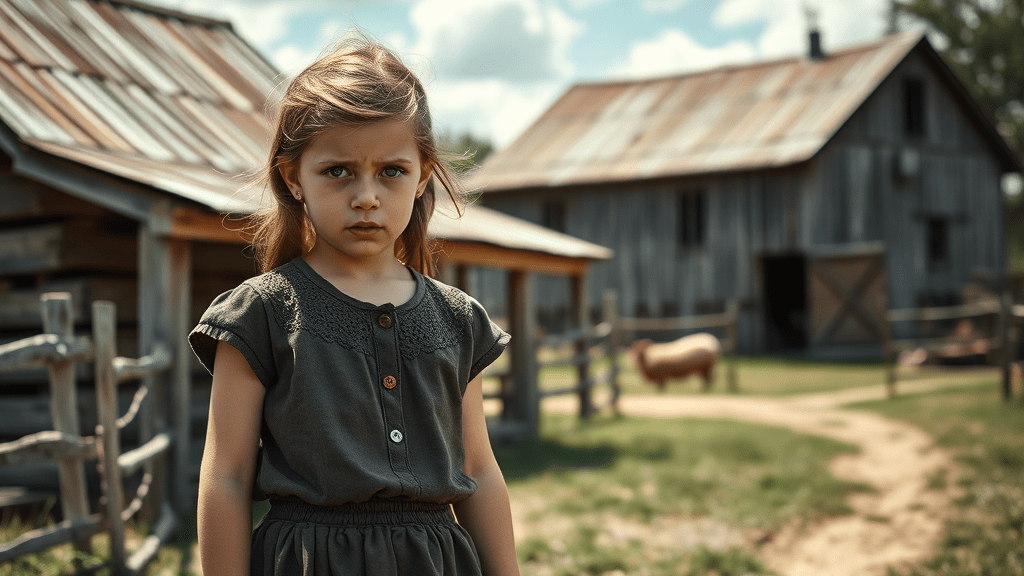
At the tender age of nine MJ was seasoned to her father’s hot Irish temper. She recalled her dining room error when she inadvertently reached for a piece of pie before her elder brothers had had an opportunity to have a second piece…a house rule. In a split second Lorne pushed back from the table and grabbed MJ by the shoulder. On the wall in a very conspicuous location he reached for the family hickory switch. With the skill of Zorro, Lorne switched my mother’s legs until blood filled her shoes. Everyone was frozen in fear. Even her elder brothers, who were larger than life, remained firm in their chairs. A memory MJ remembers with puzzlement.
The next day her older sister (by 4 years) Elyse lent her younger sister her treasured nylons to wear to school so the evidence of her whipping would be hidden from her fellow classmates. It took weeks for the scars to mend but the emotional wound would never heal. MJ was determined that her father would never bring physical harm to her again. She was prepared to take an “eye for an eye” and she felt Lorne knew his rage was unjustified and reprehensible….but the reoccurring question was…where was her mother in all this chaos? A question that has never been answered…MJ does recall that her father never raised a hand to her mother and that her father’s rage was channeled for the most part at her and her elder sister Jean who she recalls Lorne saying: “She is not welcome here anymore.”
It was mid afternoon in late August of 1945 and MJ was home alone with her father. He was busy in the barn while she was tidying up the kitchen and washing garden vegetables for her mother who was away that sunny summer day visiting neighbours with sister Elyse.
MJ could hear a loud commotion from the barnyard and raced out to see what was going on…to her dismay, her father was wielding a large mallet and threatening a stubborn hog that was being difficult to load on the trailer. Maybe the pig new that it was a fateful trip…Mary Jo ran between the frightened animal and Lorne..eyes locked, she firmly told him to put the pig back in the barn and if he bludgeoned the helpless creature it would be his last act of rage…MJ gave him the ultimatum..”put the hammer down, put the pig back in the barn, take it to the butcher another day!” Lorne complied without speaking a word – the sword had been drawn and for the very first time she saw fear in her father’s eyes.
Mary Jo recalls that in her heart she was prepared to kill her father that afternoon rather than see him torture the stubborn pig. And from the tender age of eleven the scales of power had shifted and their relationship would change forever. Lorne had met his match in this feisty young girl…..and her life as she knew it would never be the same.
Dan Fraleigh resides in London, Ontario Canada. He is a real estate agent by day and at night and enjoys writing poems and stories. His writing has appeared in Literary Yard as well as Istanbul Masticadores.
Please share this post to give it maximum distribution. Exposure is our contributors’ only compensation. Don’t forget to back link to this.
Financial donations through either our GoFundMe or Buy Me a Coffee accounts will help expand our global reach by paying for advertising, more advanced WordPress plans, and expansion into more extensive Content Delivery Networks.
He rang the bell and then leaned in against the wall, out of the rain. Hands in his pockets, listening for her. Then the door opened in a spill of light, and it was Lizzie.
“There she is,” he said, and stepped straight in past her, headed for the warmth.
“Dad…”
Henry thumped his stumpy tail when he saw who it was, but he didn’t get up and Dan fussed him for a minute. Lizzie’s homework things were all over the sofa. He shoved them out of the way and took the spot she’d been sitting in, right next to the fire.
“Look at the height of you,” he said, “You’re shooting up.”
“That’s because you haven’t seen me for ages.” She perched on the edge of the armchair nearest the door.
“Sure I was here the other week.”
“You were not.”
“I was. You were out somewhere. Did your mother not tell you?”
Lizzie said nothing. Dan stretched out his legs and rested his feet on the dog’s back. Henry didn’t mind that.
“What about a cuppa for your auld Da?”
He listened to the sounds from the kitchen as she clinked around in there. Her mother would likely have biscuits in. He wouldn’t mind something sweet.
The fire had a good glow going, and the mantel clock was ticking away, same as ever. Lizzie was 13 last birthday so it was thirteen years since they’d took this house and set that fancy clock on the mantelpiece. Thirteen years in a house Maureen thought she was too good for. Her bloody Da had it drummed into her that she was a Donnelly and could expect the best. Well, she could and she did, but she was a long time waiting for it.
Lizzie brought the mugs of tea in one hand and a plate of biscuits in the other–Hobnobs. Him and her both liked their Hobnobs.
“Move that stuff,” she said, and when he’d lifted her books off, she settled on the other end of the sofa and put the plate between them. She did well in school, did their Lizzie. Never any trouble getting her to do her homework. She’d always been a bright wee thing. When she was no age he would take her with him out on the milk run, and she’d read out the orders for him. Great company, she was. Cute as a button.
He had loved those mornings. Loved being up at the farm before light, warmth pouring out of the dairy shed.Him and the wean in their wellies, and the rich smell of cowshit in the good country air, and the air steaming with their breath and the breath of the cows.
But you can’t raise a family on a milk round. Maureen’s father said he’d put him over the middle arch of the town bridge if he didn’t get a proper job. So he went into the factory then, and the milk was sold cheap to Allied Dairies.
“Is your Mammy at work?” he said, although he knew she would be.
“Mm-hmm.”
They held their cups of milky tea and concentrated on dunking their Hobnobs just the right amount, catching the soggy biscuit end before it fell off. The dog was snoring gently, and the fire was glowing, and the mantel clock was marking time. Lizzie had her feet pulled up under her. Look at those long legs – she was getting tall. Thirteen. He hardly knew her.
“I was up at the farm,” he said, and he spoke softly into the softness of the room.
“Were you?” Her head snapped up to look at him, eyes like her mother’s. “How was me Uncle James?”
“Grand. Grand.”
She loved the farm. Loved that her auld Da had grown up there. In that white-washed foursquare house, with the dairy yard milling with cows. When she was wee, he would pick her up so she could rub their big trusting faces and smell their sweet grassy breath. Even after he gave up the milk round, he had her out there all the time, seeing her Granny and Granda and her Great-uncle James. Now there was only Jamesy living out there, the old bastard, still going strong. And no cows at all.
“Why did you not call for me?”
“Ach, I didn’t know I was going,”he said.
It wasn’t true, and saying it didn’t help. The wean wasn’t stupid. She looked at him out of the side of her eye, and then drank the last of her tea, tipping the cup so as to let the sugary, biscuity sludge drip into her mouth.
“Lizzie, love,” Dan leaned a bit closer, his arm along the back of the sofa, “Uncle Jamesy’s not as young as he used to be.”
She was toying with her mug, turning it in her hands. She was not looking at him now.
“You know he’s had his name down for an old folk’s bungalow? Well, one’s come up in The Heights.”
She was a bright one, his Lizzie. She knew what it meant.
“You’ll be able to call in and see him after school.”
He didn’t need to say it. He didn’t need to say it out loud.
Maureen’s mantel clock whirred, winding up to chime. She’d be finishing her shift and getting back soon.
“Sure the place is half-derelict, Pet, it’s not fit to live in.”
She would know that. She would know that Uncle Jamesy would be better off in the town. It wasn’t the farm it used to be. The days were gone when it sung to the sound of cows lowing for their breakfast, and the yard pooled with light from the milking shed. The days were gone when it could have been a home for a family. And when a child’s breath could make time stand still in the frosty air.
Deborah Templeton lives on the north coast of Ireland. She writes for all kinds of contexts, including soundwalks and live performance. Water’s Edge was published in audio and book formats by Confingo (UK) in 2023.
Please share this story to give it maximum distribution. Exposure is our authors’ only pay. You can also help our contributors gain exposure by back linking to them and to RFM’s homepage.
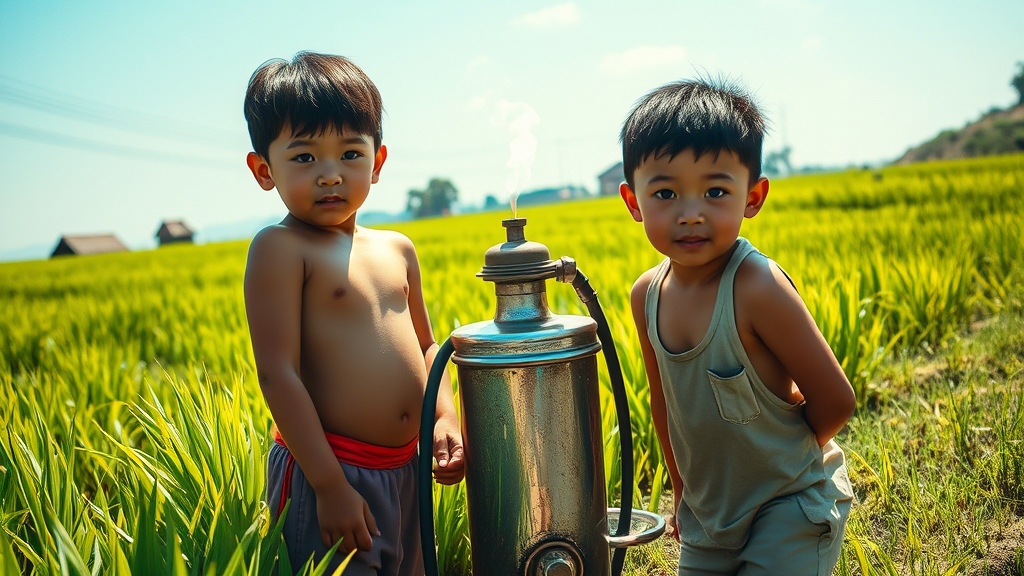
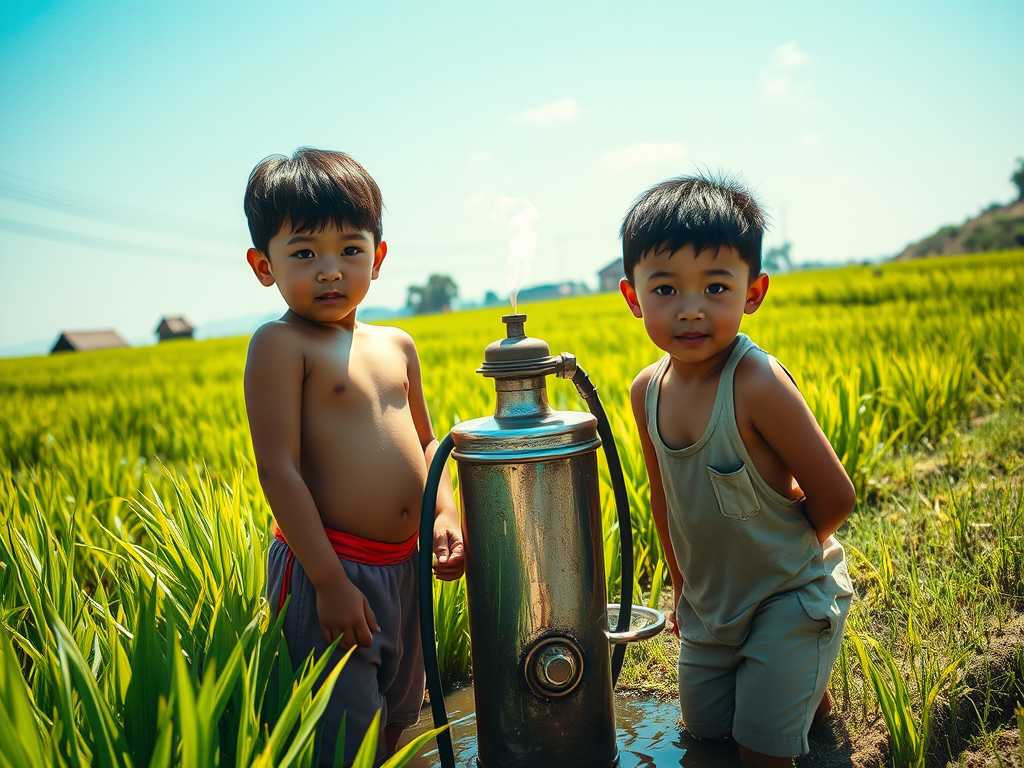
It was a scorching mid-summer afternoon in 1965. All trees and crops stood still as if holding their breaths for a ceremony to begin, while cooking smoke rose all the way up towards the sky without changing its shape beyond the fields. Ming was gleaning leftover grain with a neighbor boy when he spotted something strange across the ditch, which looked quite deep.
“Hey, what’s that stuff roaring and smoldering over there?” asked Ming in a loud voice.
“Ha-ha, you dummy! Don’t you know that’s a machine? Called ‘fuel pump’!” answered Six-Lives, who was a couple years older and apparently knew more about it.
“Fuel pump? What does it do? How does it work?”
“It burns kerosene. Used to draw water from a pool to irrigate rice paddies.”
“How do you know?”
“My youngest uncle’s the operator! He told me that.”
From his tone, Ming knew that Six-Lives was very proud of his connection with the farming tool, which made him feel envious. As the first industrial product Ming had ever seen since he had memory, the pump was nothing less than a living representative of all the advanced sciences and technologies of the twentieth century.
“Can we go take a close look,” proposed Ming. Even if they had to walk a long way to cross the bridge, he wouldn’t want to miss this opportunity to open his eyes.
“Why not? Let’s swim across the ditch.”
“But I don’t know how to swim!”
“Easy-peasy!”
“How’s that?”
“Just follow me…”
Scarcely had Six-Lives finished his sentence when he asked Ming to take off his shorts, the only garment every boy wore during the entire season. Then, the older boy put it together with his own on his forehead and transported them dry and clean by treading water to the other side of the pool, which was about four to five meters wide. When he came back, he grabbed Ming’s left hand and told him to make strokes with his right arm and keep kicking his two legs backwards the moment they stepped down into the water.
“Paddle hard just like a crazy duck, or a dog, remember!”
But the instant his feet left the ground, Ming fell down straight like a dumb rock. As he struggled to re-grab Six-Lives’ right hand or arm, he was choked with water and got a sharp pain in his nose. For a fraction of moment, he found himself catching one of his friend’s limbs but only to lose it again, because the other boy avoided him like a poisonous snake. With nobody or nothing he could get hold of, Ming hoped to get out of the water by kicking his legs and waving his arms as hard as he could. At one point, he did manage to raise his head above the water and see Six-Lives standing alone on the ridge, totally naked, doing nothing but wiping his tears away.
After swallowing a large quantity of water and despite all his efforts, Ming failed to keep his head above the water as he and his coach had both anticipated. What followed was an ineffable experience. As time seemed to stop, he felt his body drifting around like a little cloud in a greenish sky. With his eyes close tightly, he certainly saw nothing at all. Nor did he hear a single sound; even the loud noise of the pump had become totally muted. There was no pain, no choking anymore. Instead, he was overwhelmed with a sense of comfort and serenity, while the idea of death never came cross his mind. He knew he was very much alive since he was still as self-conscious as usual. This he could tell because he could somehow see, from somewhere above, his own naked body in the heart of an enclosed space, which was full of light-like water or water-like light. He reminded himself to keep plodding forward in one direction all the time. This way, he believed that he would touch the ground sooner or later.
It was not long before he felt his hands catching something solid, which he presumed to be a tree root. Without a second thought, he used all his remaining strengths to climb up along the root, though it seemed endless. No matter what, he was sure about his proximity to the ditch side. Otherwise, there would be no root for him to grab. That being the case, he could get out of the pool sooner or later as long as he kept climbing. But just when he found himself too exhausted to continue trying, he felt the root broken off and shrunk into a short and weightless straw in his grasp.
Before he woke from a dreamless sleep, he heard some faint human voices coming closer and louder, “Whose boy’s this? Isn’t he from the Lius living on the dike?”
A few days later, he learned that it was a young couple who had seen Six-Lives crying on the ridge when they happened to take a short cut to visit the wife’s parents for the first time after they got married. From the boy’s terrified response, the couple guessed that someone was drowning in the depth of the pool. Not knowing how to swim, the couple shouted for help at the top of their voices. When an old woman airing her laundry on her bamboo pole nearby heard them, she ran to the scene with the pole and used it to reach Ming, which he mistook for a tree root.
To the couple and the old woman, his parents were certainly grateful, but at the age of eight, Ming didn’t give a fig about this episode back then. In fact, if he’d known he’s to expend his whole lifetime only to prove himself to be one of billions of “shit-makers,” he would probably have stopped climbing the root in the water, or preferred to die of some disease like Six-Lives before he became an adult.
Yuan Changming edits Poetry Pacific with Allen Yuan. Credits include 16 chapbooks, 12 Pushcart nominations for poetry and 2 for fiction besides appearances in Best of the Best Canadian Poetry (2008-17), BestNewPoemsOnline and 2109 other publications across 51 countries. Yuan began writing and publishing fiction in 2022, with his debut (hybrid) novel Detaching just released by Alien Buddha Press.
Please share this to give it maximum distribution.
As the sun sits low, flaming red but powerless,
 the frozen sod could be Christmas cake frosting.
My breath is visible with each crunching step towards the back fence, checking for damage, and
water glistens like diamonds under the ice in the trough as I kick the sides to loosen its grip, gasping in shock when I lift the three inch thick, rectangular block out.
Hoof print art in the mud throughout the field,
skid marks where something or someone, or
maybe nothing at all, caused him to snort and
buck and kick his heels as he cantered towards the safety of the gate.
My eyes water and I wipe my nose while
I stand for a few seconds listening to the silent morning,
wiggling my toes to feel less cold.
The paddocks are empty now early in the day, save for the dozens of crows aimlessly walking the ground trying to get to tombed worms, or a drop of water that’s still liquid.
There is little else I can do until the weather passes, but to enjoy it.
He was up early and well gone to his work on the farm, as always. She found the envelope on the kitchen table, propped up against the tomato sauce bottle that was already attracting flies in the burgeoning heat of the day. Well, that’s a bit romantic, she thought. Hadn’t picked that up in their limited conversations to date. She put the kettle on and added fresh tea leaves to the pot. They were both old-fashioned that way.
Sitting down at the Laminex table, she opened the envelope and began to read.
Kate (no Dear she noted)
Talking’s never been something I’ve had much use for and the only way I know what I think about anything is if I write it down.
Unless I’m mistaken, and I don’t think I am, you’d like this occasional weekend thing to become a permanent arrangement. I can see the sense in that but I want you to be clear about what that will mean for our future. Women say they want honesty in a man but in my experience they don’t really mean it. Now’s as good a time as any to find out if you’re different.
I don’t want to marry you but I do want to spend my life with you. Instead of getting rubber-stamped by the Government or the Church, we’ll have this contract and we’ll have each other’s word that we’ll stick to it. Without that, life together would be pointless. And, besides, nothing about me will ever change. There will be no negotiation.
I’ll work hard all the rest of my life to keep a roof over our heads and put food on the table. You will be responsible for the household. I’d prefer you didn’t work but if you do, the household mustn’t suffer. I want plain traditional food. You can eat whatever your like.
If you want children, that’s fine with me but you will raise them. I will never mistreat them but I will not coddle them, because the world will not when I’m gone. They will learn tasks appropriate to their age and take responsibility for their actions.
If you have visitors or relatives to our house I won’t be interested in talking to them. You and the children will be all the society I need except for necessary business arrangements.
We will continue to have sex as long as we both want it but I won’t be ‘making love to you’.
I will never say ‘I love you’. I have no idea what ‘love’ is except people say that there wasn’t much of it around in my house when I was growing up. I guess you can’t miss what you never had.
We will be faithful to each other. I know myself well enough to know that will be true for me for all time. If you are ever unfaithful to me, the contract is ended.
I will almost certainly not remember occasions such as birthdays and anniversaries and I will ignore all attempts to rope me into Xmas.
There won’t be any cuddling on the couch and watching TV and I won’t be interested in going anywhere to be entertained.
There won’t be any deep and meaningful conversations about books or what’s in the news.
You must be thinking, “Where are the good things about this contract?”
You will have financial security as long as you live. The farm produces well and is pretty much drought-proof. If I die before you I don’t expect you to keep the farm and the place will fetch a good price.
You will have children (if you want them) to love and nurture as you wish and they will grow up knowing how to be resourceful and resilient, putting them well ahead of the pack.
You will have a faithful and respectful partner that barely drinks, doesn’t smoke, is rarely ill and will stay strong for years to come.
You will live in a community that has kept its values and its connections tight and in that sense you’ll never be alone.
And we will sit on the back porch at dusk and look over our land and not have to say how much it means to us. We will know what we’ve done together and that’s enough peace for anyone.
So, if that’s a contract you can live with for the rest of your life and never reproach me or yourself for the choices you have freely made, let me know tonight.
She put down the letter, made herself a pot of tea, took it out to the back verandah and sat in her favorite cane chair, gazing at the landscape that could be hers forever.
As Kate sipped her tea, she mulled over what he’d written, let the landscape in to her mind until the horizon was clear and mapped out how she would provide her answer.
She returned to the kitchen, poured a second cup of tea, sat at the table and began to write. She didn’t bother with a salutation; who else would she be writing too?
I’ve heard people say that honesty can be a weapon. However, in your case I think you’re using it as insurance or, at the very least, assurance that I won’t try to change you.
Life doesn’t work like that. No matter how we isolate ourselves, the world will have its way and we have to deal with the consequences. Even for people like you who don’t follow the news, either the grapevine or the bank will tell them when there’s no longer a market for what they grow or what stock they raise; at least not at a price that they can live on.
You talk about the farm being drought-proof but you know such a thing has long gone and last year was the driest on record. In that sense, I’m not assured by your promise to keep a roof over our heads and provide well for me and any children we may have. To be blunt, that’s the sort of promise I’d expect from a townie, not a farmer.
Like you, I can take or leave marriage. It doesn’t seem to have made relationships any stronger or otherwise amongst people I’ve known. The fact that you want to spend the rest of your life with me fills me with peace and hope. But I won’t have a life without love from my partner and promising to be faithful entirely misses the point.
You know I don’t mean romance novel love or love that has to keep telling itself over and over again that it exists. That would scare me even more than what you’ve proposed. However, at the very least, I would expect you to look me in the eye and tell me you love me enough to want to spend the rest of your life with me and promise to let me know if that ever changes. (By the way, the sex doesn’t need to change – no complaints in that department.)
But here’s the real rub. We (as distinct from me alone) need to decide if we’re going to have children. And if we decide we will, you will be their father in all the important ways; comforting them, tending to their needs, teaching them patiently and defending them to the death. Don’t worry, I’m perfectly happy to take on the traditional mothering roles but I’m not going to let the cold distance of child-rearing that you inherited from your father and grandfather enter my bloodline.
How you are with others is fine with me. In case you hadn’t noticed, I’m not much different. Besides, think of the money we’ll save on presents. But we will talk, especially about the important things and we will talk about them at the time it’s needed, not when it’s too late.
I’m all for meaningful silences but when they end I want to know what they mean.
I want this life. Since the beginning I’ve felt I’m coming home when I come here and I feel lost when I’m not. I love you and I want to spend the rest of my life with you, provided you are prepared to accept what I’ve asked for in your ‘contract’ (that word is so wrong my first impulse was to take off, forever.) If that much is too much then it says a lot about our chances of survival.
I think you will because I believe you are the strongest and most honest man I have ever met and that you have finally met the woman that you need to survive what’s coming.
You can give me your answer, face to face, when I come next weekend.
Signed, guess who?
Flynn read the letter several times over, climbed on to the ancient TD-18 International Harvester tractor with its metal seat shined by three generations of ample backsides and drove out to do some ploughing. His plan was for the concentration on straight lines to bring him the peace to think clearly about what Kate had said. What wasn’t helping was the ‘love’ part.
His father had been a hard and harsh taskmaster and he found it difficult to recall any words of praise passing his lips. The most anyone could hope for was the odd grunting nod and a mumbled ‘Not bad’. His mother was only slightly better, with hugs disappearing by the time he went to school and a relentless ticking off of tasks when he came home.
He understood they were hard years when they were trying to get the land into the condition that it needed to be in for long-term sustainability and there was little time for anything peripheral. And as he grew older he imagined that they thought that leaving him the legacy of the farm was, in the end, the only love that counted.
Breast cancer (deliberately left untreated he discovered later) took his mother in her late forties and five years later he found his father dead from a heart attack while repairing fences on a boundary paddock. When he picked him up, he half expected to be told to bugger off and get back to his work. Flynn made the necessary arrangements and stood dutifully solemn at their funerals, accepting condolences, but felt nothing. One day they were alive, the next day they were dead. That’s how life worked.
On his first night alone, he went through some old photos and lingered over a picture of his Mum, clipped from the local paper, holding one of her prize cakes at the annual regional agricultural show. Mum’s recipes were a local legend and she kept them, written in immaculate copperplate script, in a re-purposed school exercise book, kept from her teaching days. He decided to keep it safe, without knowing why.
Women rarely entered his mind as he continued to develop the farm, with some occasional hired help. Those he had met at school seemed weak or unapproachable. After he left school, he would see them again in town, usually either flaunting what he imagined were country town fashionable clothes or pregnant or walking along with a tribe of whining kids trailing behind them.
A couple of girls had pursued him (or his property) and once he had found himself suddenly engaged to Cheryl Clarke, not that he could recall popping the question. The next thing he knew was that has being paraded around the district like a prize bull with a ring through his nose. He hibernated for weeks before that blew over.
Then one day, when he was collecting his mail from the post office, in strode a statuesque female stranger. The coat and slacks could only belong to a city type and her long red hair hung in waves down her back. Her face contained eyes and a fixed smile that spoke of openness while still conveying concealed steel.
Having collected her mail, she strode out again, unfolded herself into a dusty, dented hatchback and sped off. In the background he could hear fragments from the tongues wagging. ‘ … new schoolteacher … not married … bit of a tyrant in the schoolroom I’ve heard but the kids seem to like her … asked for wine in the pub the other day… drives like a maniac’. This woman had certainly entered Flynn’s mind and he was totally uncertain as to how to deal with that.
Up until then, he’d go into town for the mail and shop at random times, when the opportunity arose between jobs. Now he found himself on schedule to be there, coincidentally, when she came into the post office. She’d started nodding to him, as country people do, but with an odd, crooked smile on her face when she did it.
Kate made the first move. Instead of nodding, she asked him ‘I’ve heard that sometimes you take animals for agistment.’ After a moment, from the side of a barely opened mouth, he said ‘What did you have in mind?’
‘I have an ageing horse that I’d like to have close at hand.’
‘One horse?’
‘Sum total.’
‘Not sure my fences are high enough to contain a horse.’
‘Oh, her fence jumping days are over. Besides, you could ride her. If you wanted to.’
They pretended to haggle over an agistment fee and then Kate said, ‘I’ll bring her up at the weekend.’
And so it began.
And now here he was, sitting on his veranda, waiting for Kate, who was waiting for an answer.
Kate’s traveling car wreck pulled up at the veranda. She emerged, climbed the steps and sat in his Mum’s rocking chair and waited.
‘Not sure where to start’, he said.
She offered no help.
Silence.
‘I love you and want to spend the rest of my life with you’ he blurted, as if fearful that if he didn’t get it out quickly his words would be strangled at birth.
Silence.
Kate smiled but said nothing.
‘About kids’, he nervously continued, ‘I want to be able to leave the farm to a next generation. I’m just not sure I’d be much good at the raising bit. You might have to give me a few tips.’
Kate laughed and said ‘I can always work with a willing pupil’.
They watched a pair of kookaburras land in the giant redgum that dominated the front yard.
Kate’s voice softened and she said, ‘That’s settled then.’
Now the silence between them was easy.
Later, she said, ‘Thought I might make a cake tomorrow. What did you do with your Mum’s recipe book?’
Finn smiled and said ‘Think I might have put it somewhere in the bedroom. Want to help me find it?’
Doug Jacquier has lived in many places across Australia, including regional and remote communities, and has travelled extensively overseas. His poems and stories have been published in Australia, the US, the UK, Canada, New Zealand and India. He blogs at Six Crooked Highways