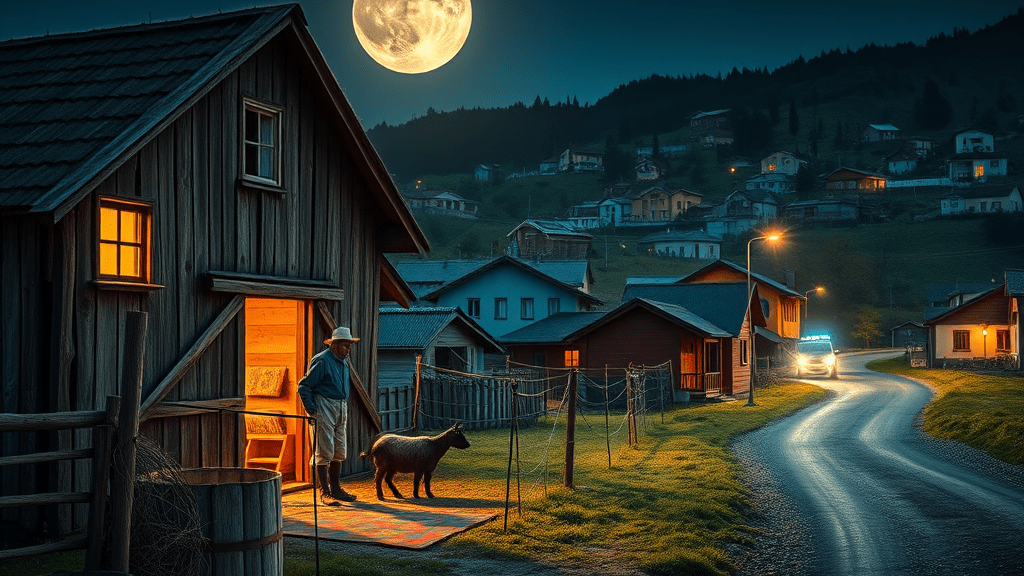
The brightly colored homes, the royal blues and turquoises, the sandy oranges and vermilions, which dotted the village in random patterns here, orderly lines there, the little houses which were invariably described as “storybook” by the tourists, the Germans and Americans and Ukrainians, all of these were gone at night. Instead, a dozen tiny windows shone dim yellow from reading lamps or dimmer blue from televisions. Headlights crawled down and up the dirt road from time to time, a faint gravelly song ascending from beneath the tires and up the hillside to where the goatherd stood outside his barn. A street lamp hung outside the little roadside clinic where the doctor and his daughter stood watch, day and night, to aid villagers or travelers in pain.
It wasn’t just the village. Even the enormous hills were invisible, especially on a moonless night like this one. They weren’t to be called mountains in this part of Bukovina for they were mere foothills of the Carpathians, which swept the land of Transylvania up toward the sky many miles away. These hills were mighty though, forming great streams which efficiently watered the goats, who traversed the hillsides every morning after feeding and then again every evening before sleep. The goatherd, whose father had died three months earlier and whose wife had left not long after that, now had to tend not only to the goats but to the business, the selling, the auction, the distributor in Suceava, a craft for which he’d felt ill-equipped since his youth. His preference had always been to collaborate with the dogs, the collies and Canaan dogs, to lead the goats, organize them, contain them on their grazes, or to feed them, milk them, birth them, wean them, vaccinate them or slaughter them when the time came. He tended to the goats and his father had tended to the business: that was the way it had been until recently. His wife had tended to the home, a two-room concrete structure set on the south side of the pasture, near the makeshift dog pens and hidden from the village and the tourists who came through to snap photographs of the painted monasteries. The barn on the pasture’s north side kept the goats at night. On one end were the milking stalls and on the other were the haylofts and stacked bales; the goats slept in the middle. A special stable housed Jet and Roma, the donkeys, whom the goatherd’s wife had humorously referred to as conducators, or the “drivers.” Jet and Roma pulled the cart into town, and to Iasi or Suceava several times a year, and the goatherd’s wife had felt a particular affection for them. The goatherd, on the other hand, preferred the dogs, of which he had more than necessary. They were full of energy, unlike the donkeys, and full of pride, unlike the goats. He had once thought about naming them, but couldn’t think of any names, so instead began identifying them with sounds. He hissed at the white-and-brown collie. He clucked at the one with black on its ears. He made kissing sounds at the littlest one. There were two Canaan hounds too, one called with a sort of bark, the other with a whistle. The whistle dog, however, hadn’t come when called for several weeks now. She pleased herself instead by lying in the pasture and watching the others, her mouth open with a kind of panting smile, her ears usually perked, her youth and mobility mere recollections in the goatherd’s mind. Ever since his wife left, the whistle dog had slept in the goatherd’s bed, her fragile frame raised to the mattress by the master’s arms, her warm-blooded mass a luxury on these cold winter’s nights. The other dogs slept outside in the pen, as they were doing now, quietly, while the goatherd raked manure by lantern light.
“Good dog,” the goatherd said during a moment of rest.
The whistle dog’s ears perked slightly, but she didn’t raise her chin from the ground. She was comfortable.
When the goatherd was done for the night, he tossed the rake against the barn door and dimmed the lantern. He sat on the ground and stretched his long legs out straight in front of him. He tossed a few scraps of bread to his companion.
“Good dog,” he said again. The dog let out a light groan of relief, like a hum. She tended to stick by the goatherd at night after the other dogs fell asleep in their pens by the house. During the day, she continued to make eye contact with the goats from afar, which the goatherd surmised preserved the dog’s sense of occupational purpose. But she couldn’t be a runner anymore. And she hadn’t chased a goat off a rock or ledge for months.
A rumble from the sky perked up the dog’s ears again and opened wide her eyes, which caught a gold twinkle just as a lightning streak flashed above. The goatherd looked skyward to find stars, and he found some, but they were faint and sparse. Storm clouds had moved in.
After a few more rumbles and their accompanying flashes, the goatherd rose to his feet.
“Come on, girl, it’s time,” he said, even though no drops had fallen. The dog rose reluctantly and stood in place, making sure the goatherd was heading home before commencing the walk herself. The man had only traveled a few paces when another streak of lightning slashed the sky just overhead, this one neither preceding nor following a rumble. Both man and dog looked up instantly, not wanting to miss such a sight. In fact, they couldn’t possibly have missed it. The jagged vein of white remained overhead, locked in its position, locked in time, the violence of its energy pulsating barely a half-mile up, its top end fading into invisible clouds, its bottom end thinning as it approached the earth somewhere far to the east, as if on its way to Moldova.
The dog seemed to lose interest after a few moments, so she lowered herself back to the ground and stared off toward the village, which still teemed with silent life.
The goatherd, on the other hand, couldn’t cease his skyward gaze as the streak was brightest just overhead. In fact, his neck soon became tight. Ideas grew quickly in his mind. It was something, or someone, extra-terrestrial paying a visit to Bukovina or Moldova. It was a glitch, a freeze in time, which would end shortly so the lightening could continue on its course. It was a military maneuver of some sort, or an attack by the Ukrainians or Russians. It was an optical illusion, his eyes tricked by physics. None of these ideas stuck, however, so he was forced to ponder some more, but no explanations came forth. He closed his eyes for fifteen seconds, then looked again to spy any movements or vibrations coming from the streak, but none were detectable. He turned his glance down toward the village to see if lights had turned on, if residents had come outside to look, but it appeared just the same as before. When the dog moaned in comfort again, the sound broke the silence that had been sustained for several minutes. It dawned on the goatherd that the thunder had stopped. No more thunder. There had been no rain. No more lightening. It was as if the storm had aborted its mission in mid-strike. It was as if nature had suddenly paused.
The goatherd’s wife was Crina, named for the lily, and the only moments when he didn’t behold her to be as beautiful as the flower were right before she walked out on him.
“Roxana’s desperate,” she’d said, bag around her shoulder. “She needs her big sister.”
Roxana was Crina’s younger sister who had recently given birth to her dead husband’s twins and with whom Crina had just decided to live back in Brasov twelve hours away. Roxana needed assistance caring for the babies, according to Crina, but Roxana had five other sisters who lived in neighboring villages. This was just Crina’s latest ploy to leave this place.
“You’ve wanted to leave since the day he died,” said the goatherd. His father’s death had created a hole in their marriage three months earlier, one that let in a frightening coldness the goatherd had never experienced. They had been forced together, but it hadn’t felt like force at the time. In fact, he’d long appreciated Crina’s respect and affection for his father as a fortuitous underpinning of their marriage. What he hadn’t suspected was that the old man’s absence would drain the marriage of purpose.
Crina shook her head, mostly to avoid her own tears. She felt abandoned and insecure and wouldn’t bother denying it. It was true, the father had been her strength. In fact, it was the father, a widower for nearly ten years at the time, who had introduced her to the son. She’d been half-drunk as usual in a Iasi bar on a Friday afternoon when the old man walked up to her and gazed at her peacefully, as if willing her to put her glass down and calm herself, which she did. He lit a cigarette and offered her one. Then they talked and drank coffee. As she sobered up, he asked about her life, her family, her drunkenness. At no point did she feel threatened by him even though he was twice her age and even though he once said she resembled his dead wife. They sat on stools and stared ahead at the bar owner as she performed quotidian tasks like drying glasses and stacking six-packs of Coke. Crina told him about her large family back in Brasov, how she had followed a boy here to Suceava, how that hadn’t worked out, how she now worked as a maid for a monastery, where she slept in a dark room and occasionally stole wine. She was too ashamed to return to her family, even though she knew they would accept her with open arms. He told her he had a son just about her age.
Once it became dark, he excused himself to water his donkeys outside, which made her chuckle.
“They have a long journey ahead,” he said when back inside. He told her he’d be coming back to Iasi the following Friday — it was the busy season — and wanted to see her again but only if she wasn’t drinking. She agreed, and when they met again the next Friday, she told him she had only drunk a few days that week. Then, the next Friday, she smiled brightly when announcing that she hadn’t drunk at all that week, and had stolen no more wine. He nodded as if that was good.
The old man made her laugh without knowing it. When he talked about his donkeys, his goats, even when he told stories about his dead wife and how she had often berated him for waking up too early or overcooking the rice. He was very fond of his son, who had to stay home to tend the flock when the old man came here to the market, and told Crina he hoped she would meet him sometime. And so it was arranged.
The following Friday, she rode back to the village with him. While cars zipped past the carriage, the donkeys walked ahead unfazed. Several times, she laughed at the sky, wondering what on earth her family would think of this strange adventure she was taking. When they arrived at the village, it was eight o’clock at night. He pointed to the top of an enormous hill, where she spied an orange speck like a hovering star. His son had lit a fire. The donkeys pulled the wagon and its passengers up the hill very slowly, languidly, their back muscles straining and losing their fight. At the top, the old man watered the donkeys some more and then escorted Crina toward the blaze, where his son’s figure became visible. He introduced Crina to him, saying, “She’s gonna help us around the house.”
Crina and the old man had not talked about that. She was just visiting. Instead of correcting him, she shook the son’s hand, which, along with his nervous, smiling face, glowed in the firelight. She saw that he was a tall boy, much taller than his father, and was holding a walking stick as tall as Crina. He had wavy, black hair and a strong Romanian nose. As for the goatherd, he had seen prettier girls in the village, but none who shone with the confidence of this Crina. She didn’t pretend to be demure. She had short-cut hair and a chin raised with pride. Her brown eyes didn’t appear to conceal much. He could tell her breasts were full even beneath her coat. Her brow crinkled as if awaiting his decision.
Crina never returned to the monastery again.
When the old man died the following year, Crina wanted to shut down the farm and return to Brasov with her husband, who opposed the idea out of respect for his father and the family name. He wanted to make his father proud by running the business, not just tending to the animals, but Crina reminded him that that wasn’t his strength and that there were plentiful farms in the Carpathians where he could be free to work in the pastures without the worries of industry. He could birth, rear, feed, milk and slaughter the goats for someone else. And sheep too! Farms were larger in the mountains. He could earn a solid wage.
The conflict worsened every day and a gulf of silence formed between them. They performed their allotted chores and ate meals together, but little else.
One day, Crina brought him a glass of juice outside, which he drank without pausing. When he returned the empty glass to her, she told him she was leaving.
“You have no faith in me,” the goatherd said.
Crina stared off toward the barn, feeling the stare of the whistle dog nearby but instinctively avoiding eye contact with the animal. A tear bloomed in her eye.
“I had faith in him.”
The whistle dog’s muzzle pointed toward the goatherd, whose attention was fixed on the white streak in the sky. It wasn’t yellow or gold as he had always envisioned a lightning flash to be, but now that it was cemented in the sky, he could see it was bright white, like it was made of pure light, devoid of any color or hue, as if comprised not of a color, but of the source of all color.
He turned away from the heavens only when she barked. One quick bark. Another when they made eye contact along with a timid wag of the tail, signaling something between fear and joy. Then a series of barks, like gentle gunfire, which rolled along as she raised her head and craned her neck with curiosity until the barks came faster, staccato, then faster into a continuous stream of sound, like a soprano howl, baying at the night. The goatherd had to chuckle. Not too far away, the other dogs had awoken from their slumber and, one by one, joined in. Soon a chorus of howls, in verse and refrain, called out to the hills, called out for any man or woman who could hear, anyone east or west, anyone in Moldova or Transylvania, in the valley or on the highest Carpathian peak, either as warning or consolation, and this chorus would attract other creatures in the vicinity and beyond; it was a song not meant for dogs and humans alone, but for beasts by the thousands, for either consciousness or instinct, for all the living to respond to a wonder in the sky.
Occasionally, there was a pause, and during one such pause a new type of howl called from the darkness. This call was extremely dim and from the opposite direction, from the bottom of the hillside by the road, and this was a howl of anguish. It was coming from a human, and it was coming from the clinic, whose lights were glowing alive now. Activity inside. A most dreaded activity. The dogs continued to howl from the kennel, but the whistle dog was silent now. After nearly two minutes of song, she had withdrawn from the chorus, as if out of respect for the suffering.
Almost instinctively, the goatherd wrapped his scarf tighter around his neck and threw bread to the dog.
“Eat this, and I’ll be back.”
The goatherd walked to the edge and began stepping down the hillside, which was extremely steep for a human if not for a goat. Stones and gravel slid in front and behind and his boots twisted with every step, but he sought human companionship. He sought affirmation that time had stopped and that dogs were singing.
When he arrived at the roadside, the woman’s cry had displaced entirely the distant howling. A cry with a groan, punctuated by deep breathing and authoritative words from two other voices, one male and one female. The goatherd tapped his boots onto the gravel driveway that vaguely welcomed visitors to the little house with a “Medicul” sign in front. Here’s where he saw the donkeys, their eyes closed in standing sleep as they waited, yoked to the wooden cart stuffed with hay at their backs. He patted one of the donkeys as he approached the clinic’s front door, which jingled softly as he opened it. Inside, the overhead fluorescent light offended him, so he winced. He heard the voices speaking Romanian in the backroom — the doctor and his daughter, whose name he recalled was Maria — but also a louder voice, a booming male voice, speaking an unrecognizable language. This voice sounded frightened.
Maria peeked from the back room to spy the goatherd in the waiting area, vaguely recognizing him as the neighbor on the hill.
“Have you seen the sky?” he asked her, then felt stupid about it. She cocked her head and stared at him with bewilderment. That’s when he noticed the blood on her plastic gloves.
“We’re closed,” she said, then returned to the back room. “Except for emergencies,” she shouted as clarification.
He considered going home or standing with the donkeys, but instead he took a seat on a tattered green cushion with an uncomfortable metal frame. It wasn’t long before the cries and shouts had faded and the spirit of the clinic had calmed. A tall, Middle Eastern man appeared from the back, his face red and his eyes avoiding contact with the goatherd. He exited the clinic right away. Through a small side window, the goatherd could see his forehead touch the forehead of one of the donkeys. It was like they were sharing a secret.
Maria re-appeared now. Her apron and gloves had been removed. Her father came behind her, nodded at the goatherd and exited to a side door which led to the residence. (He and Maria lived upstairs). Maria began making notes in a folder behind the reception desk. As she wrote, she automatically raised a hand and released her hair from its large plastic clip. Long hair was frowned upon during an emergency.
“You tend the goats,” she finally said, not looking up from her notes.
The goatherd said he did.
“Are you ill?”
He said he was not.
“My father’s not a veterinarian.”
“I’m not here because of the goats,” he said. He was about to tell her about the sky, to ask if she’d seen it or if she’d heard the dogs singing and what conclusions had she drawn about these things, but he didn’t want to feel dumb, so instead he asked her what had happened in the back room. Not for a moment did he wonder if such a question might be an invasion of privacy.
“She’s resting,” Maria said, her green eyes now acknowledging his presence. “It’s very sad.”
With minimal prompting from the goatherd, Maria volunteered the patient’s story. She had arrived with her husband Youssef, who just went outside. They were from a city called Daraa in the southern part of Syria. The Syrian government had forced them and their neighbors to scatter. They’d been traveling off and on for fourteen months already, making stops to camp, to work odd jobs, to accept the generosity of strangers, to purchase the donkeys, which were too old and too slow. They’d hoped to arrive in Suceava to meet up with distant cousins before the baby came, but it came very, very early. Too early. And now it was back there dead.
Maria showed little emotion. The goatherd knew that emotion and medicine didn’t go well together. That’s why she’d better not show it. She wasn’t cold though, just matter-of-fact. She rose and returned to the backroom matter-of-factly. What was there left for her to do, the goatherd wondered. What was it like for a woman to feel finally empty in her womb but have no baby? He rose and gently walked, almost tiptoed, to the door that swung open to the backroom. He pushed on it softly. It opened onto a hallway, so he entered. He smelled a chemical and heard Maria’s voice speaking. In a room on the right, she was standing next to a cot where another young woman lay with her eyes closed. Maria must have known the woman couldn’t understand her, but spoke anyway. She had a comforting tone of voice, so maybe the woman appreciated that. A glass of water stood on the table beside the woman’s cot, and a tube fed her nutrients through a needle in her arm. She may be empty, but she looked at peace, the goatherd thought. She wasn’t out of breath. She wasn’t weeping. She even moved her body a little to get more comfortable so that Maria could check her blood pressure.
The goatherd turned, unsure if he was satisfied, unsure what he had hoped to see, and retreated toward the door that would swing him back into the reception area. That’s when he glimpsed it. There was a room across the hall from where the patient rested. The door was open and it was dark inside, but rays of white light entered through a long, flat window up high near the ceiling. The rays were brighter than moonlight because they were made of lightning light, the source of all light, and they led the goatherd’s eyes to settle on the little body that lay on a metal table. It was laid on its stomach, its big dead head with its cheek to the metal, its eyes closed (had they ever opened, even for a second?) and its little torso wearing a few splotches of blood. The goatherd entered the room and felt his heart sinking. He touched the baby’s little toes, stroked the cheek of his little bum. Then he worried that maybe he should be wearing gloves, even though it was dead, so he reached for one on a shelf but yanked his hand back when he felt a sting. A surgical knife had cut him. The lightning shone brightly. The blood on his finger glistened and the table’s surface reflected on all sides of the body. Once gloves were on, the goatherd lifted the baby with both hands and held it against his chest. He tried to open one of its eyes. He tried to wrap its tiny fingers around one of his own. He thought about the lightning outside and how much longer it would be there. He thought about the tricks nature was capable of playing, and he wondered if this bundle of stillness in his arms could be a trick too. The room where he stood had an exit outside to the rear of the clinic, so he used it to return to the cool night, babe in arms.
“Can you see that?” he asked the little body while nudging its skull to give it a view of the lightning in the sky. If the baby could open its eyes, if it could live just for a moment, it could see the miracle.
“Can you hear that?” he asked. The dogs were still howling up the hill. This too was unnatural. A nearby brook was babbling. He reflected on his losses: his father and his wife, and soon his dog. But instead of mourning, instead of bowing his head in despair and disappointment, he studied the baby’s form in his arms and thought to himself how unfair not to be alive on a night like this. He rocked the baby in his arms, walking in slow circles, wishing it might open its eyes or its heart might take a beat, wishing and waiting for its arrival.
The whistle dog had never been down the hill, not even when she was young and agile. She had gazed at the hills and the houses her whole life, but never had the instinct to chase after them, to spring into the world below and beyond. She’d always had what she needed here with her master and the goats. This night was different. The master had gone down. He had encountered something.
While the other dogs continued their song, she took slow, difficult steps down the hill. Her hind legs were shaking and convulsing without pause. She fell on her side and had to steady herself on all four paws. She had to do this regularly. On the rocky section she stumbled and landed on her hind knee joints, which began to bleed. She would use her front paws to drag herself if necessary. The master was in view. His shape, his silhouette, stood outside, behind the little house, and he was holding something. She panted heavily and stumbled onto her side again. She felt no pain — she had felt nothing at all back there for many days — but she yelped a few times anyway, maybe out of fear. Or maybe because she missed him so much. She could call out for his attention, but he was having an experience and she needn’t disturb him. How she wished to be with him though.
The farther down she crawled, the other dogs sang more softly, more distantly. She could roll the rest of the way if she knew how to roll. She could fly if she knew how to fly. But she was trapped on these four legs, two that barely worked and two that were aching with exhaustion. Her insides felt funny now too. Like she was boiling up. She had to pause her trek to lean over and lick her side. Licking sometimes brought relief.
She kept going, inch by inch, one of her rear legs now just hanging, doing no work at all, the other making paw contact with the ground, but each step was a sharp heave and rarely did the paw make it to its next step without the need to adjust and stabilize and rest before the next. But, she was getting closer now. She could make out his nose. She always noticed his nose first because it was big and wide. He was bobbing softly on his knees and swaying a bundle in his arms gently. How she wished that bundle could be her.
She made it to about thirty feet away from him before settling to rest and gaze at her master as his smile caught the shine of the lightning streak. She had seen him smile many times, but not as big and happily as this. She forgot all about her legs to see him so happy. The gurgling of nearby water calmed her too. Was it water? A little twig was moving in his arms. Maybe a twig, but it had tiny leaves at the end of it and they wiggled too. Were they leaves? Maybe it wasn’t a twig at all but something more alive than that. Something reaching out. The master smiled and smiled and then he gasped extremely loud when the bundle’s mouth opened because a moment later a shrieking sound came out of it. A high-pitched, violent shrieking like she had never heard before, but this terrible, terrible noise only made her master laugh up at the sky and laugh some more. She knew he was rejoicing.
A minute later, shouts erupted throughout the clinic. The doctor raced downstairs upon hearing the baby’s cry. Maria screamed in shock, but couldn’t tell where the cry came from, or which way to run. Even the patient sat up on the cot and called out. The goatherd had raced to the front of the clinic, where the father named Youssef grabbed him by the shoulder, turned him around and studied the contents of his arms. It was the same. The same body they had removed from the room when all hope had been lost. “No!” he shouted nonsensically, then fell to his knees in front of the goatherd, who crouched to show him the child and its curious fingers and its cheeks already tired from wailing. Youssef took the child and held it, tears jumping from his eyes. The doctor arrived, aghast and pressing his hand against his chest. Maria arrived shortly, supporting the patient, who inched toward the child with an expression of grave bewilderment and doubt. Her husband turned to show her the infant. She touched its sobbing head and studied its form, still perhaps suspecting a trick. The father handed her the baby, which she enfolded into her bosom. Maria led her to sit down on the back of the cart, which was soft with hay. The donkeys were wide awake now, seemingly curious about this new revelation. The mother cried, holding the child as if it would never leave her again, not for all eternity.
As Youssef cradled his wife, who cradled their son, nobody asked the goatherd what exactly had happened, what led him to the backroom. Nobody asked for details. Nobody cared about that.
The baby finally ceased its wailing, allowing the silence of the night to soothe their spirits. Maria couldn’t stop grinning. The doctor looked extremely satisfied, but shivered in the brisk mountain air. From behind them all came a little yelp. The goatherd turned to spy the whistle dog lying in the gravel a few feet away. He gulped a sudden breath and scrambled to it.
“What?” he exclaimed. “How?”
The dog’s body was posed unnaturally, its four legs twisted in four directions. It was bleeding and panting and making no attempt to stand or sit or even move. The goatherd sat down next to the animal and removed his rubber gloves. He rested his palm on the animal’s side, stroking slowly and gently.
“Good dog,” he said. That’s all there was to be said.
The doctor studied the animal from his position beside the cart, his attention diverted from the living baby, his expression distracted from its uncontrollable glee. He was concerned by what he saw. The ravaged body. The lowered head. He excused himself as if the sight was objectionable.
The dog’s eyes closed as the goatherd stroked its back. Her panting was steadier, more regulated, than during her journey. She held her head up, welcoming her master’s affection.
The goatherd recalled the morning of the dog’s birth. He’d been sitting on the ground next to its mother just as he was sitting now. He recalled the squeaks she had made as she hunted for the mother’s teat, her eyes not yet opened, just like the baby’s now. The goatherd’s father had stayed in the barn working; birthing dogs held no interest for him. In fact, puppies in general were uninteresting to him. A dog was valuable only when it possessed active herding skills, he’d said.
The goatherd thought of Crina too. The dog was born many years before she came into their lives. And the dog was still here now that she’s gone. She had rarely interacted with the dogs. She fed them scraps after dinner and gave water occasionally on the hottest days, but otherwise she hadn’t been dedicated to the dogs. They’d had little to offer her besides companionship, but companionship was abstract and insufficient.
As the goatherd pet her muzzle, he noticed the blood on his finger, and so did the dog, which wrapped its old pink tongue around the wound, as if tasting a treat.
“You and your tiny mind,” the goatherd whispered. “You believe in me.”
The doctor reappeared and sat on the dog’s other side, holding a syringe in his hand. The goatherd was unsurprised by this and gave no resistance. The doctor only said three words to the goatherd. Three gentle words.
“She’s ready now.”
While the doctor fidgeted with his syringe by the dog’s rear end, the goatherd placed his forehead against the dog’s. She had stopped panting. Her eyes stared at him brightly — this was the closest their faces had ever been. And it was all she could have ever wanted. This was her destination. A moment later, her eyelids sank, so he released her chin, letting it fall gently to the gravel.
After a few quiet moments had passed, the goatherd pulled the whistle dog partly onto this lap. She was still fairly warm, but her heart had stopped. Like the baby only a few minutes ago, she was just an object in his arms. He stroked her fur and looked up at the sky. The lightning was fading quickly. Look at the light before it’s all gone, he thought, before nature resumes its course and time again moves towards tomorrow.
When the lightning had disappeared entirely, the night became cooler, but nobody moved. The family rocked together in the hay. The doctor had dropped the syringe in his lap and closed his eyes. Maria leaned against the cart as if mesmerized by everything that had happened. The goatherd ruminated. Nobody knows when life begins or ends, not really, he thought. Nobody knows when time ceases and light prevails. Where does this child exist? And this dog? Where is Crina, if not right here? These are the kinds of questions that grazed the goatherd’s soul in these silent moments on this remarkable night in the hills of Bukovina.
Leon says of his background: “By way of background, I hold an MFA in Creative Writing and currently teach graduate-level writing and communications at City University of New York and Johns Hopkins University. Twice nominated for the Pushcart Prize, my fiction has been published in The New Haven Review, The Westchester Review, The Stockholm Review of Literature, Thug Lit, Pulp Modern, and Union Station Magazine, among others. I served as editor for Now What? The Creative Writer’s Guide to Success after the MFA (Fairfield University Press, 2014), an anthology of essays and articles about the writing life. A lifelong fan of psychological crime fiction, I am also founding editor and publisher of Heart of Noir
(https://heartofnoir.com), a comprehensive website showcasing the
classic film noir cycle and its literary influences.”
Please share this to give it maximum distribution.
If you would like to be part of the Rural Fiction Magazine family, follow this link to the submissions guidelines.
Image generated by AI