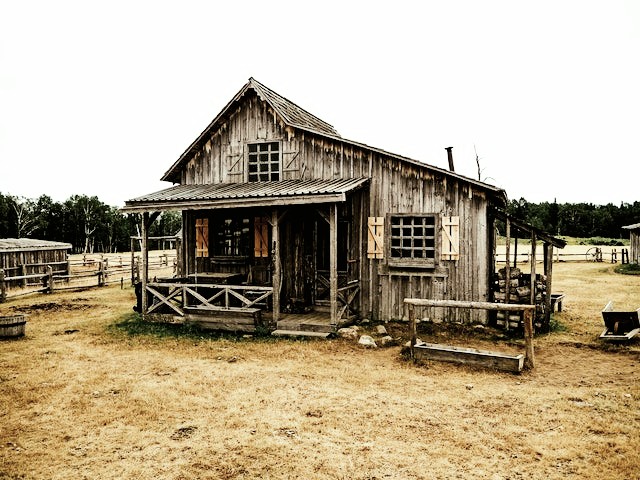
—remembering ¬¬a farm foreclosure.
For Darrell Ringer, 1953-93
“Thank you,” he said, while the black eyes
drilled from the shadow of his ballcap
as we stood in the sunbaked square
of a Kansas town where we’d just rallied
against such business as no one with honor
should dare to defend—then drove
over pocked macadam, between shoulders
cascading with purple wildflowers, wheat
turning green to gold—the field after field,
the rich carpet called forth, turned over,
culled with such care that I, for one,
don’t have blisters enough to imagine—
and beneath it the black earth seethes
with world-feeding life. Then we arrived
at his farm. Beautiful, I’d often thought,
this life, how the green soybean hug
at the earth and alfalfa explodes into pink
and animals trudge toward us in the slow-
motion rhythm of paddock-bound shadows
until their heads hike up with quick interest
when haybales are pitched with a thud
between the tarnished steel rails of the crib.
But the earth and its moods are uncertain,
despite the disconsolate pleading it gets
when sleep doesn’t come, that a storm
please pass by without flooding at harvest;
that a drought not set in, the wind not whisk
topsoil to a powder-dry ash floating off
in a glitter-filled cloud to the red
of a summer-long sun. And of course
words are addressed to the Notice of Debt
that’s attached like a leech to the title,
which is after all a mere sheet of paper
approved by the courts but without
the least smell of wet dirt to grace it.
And of all he foresaw or was faced with,
what he couldn’t agree to was losing this land
without even a fight. They might take it all,
but the fight, at least—they couldn’t take that.
Of David Salner’s sixth poetry collection, John Skoyles, Ploughshares poetry editor, said: “The Green Vault Heist is not only a beautiful book, it is great company.” Salner’s debut novel, A Place to Hide, won first place for 1900s historical fiction from Next Generation Indie Book Awards. This poem is reprinted from The Green Vault Heist. Both books are available on amazon or from the author dsalner@hotmail.com
Please share this to give it maximum distribution.
The beeches form an archway of fire
the road leads into an inferno
bonfires burn the dead leaves
thoughts of summer flare and die
autumn mists shroud the future

From his hospital bed
he looks at the gilded trees
the grass flecked with gold
the squirrels bury secret hoards
for a Spring which seems uncertain

Autumn that old trickster
In its hazy, languid warmth
The bees think summer is eternal
Ripe round apples ready to fall
Mimic a forgotten Eden

On the dark elms black rooks roost
the dead rise from neglected graves
witches lurk in thick forest gloom
in haunted castles chained skeletons rattle
the world’s horrors are eclipsed for a day

The landscape is dancing into winter
the rich browns of ploughed fields
framed by the flaming hedgerows of gold
darkly dour yews stand untouched by burning beech
the setting sun a red smudge on the darkening horizon
Sarah Das Gupta is a retired teacher from Cambridge, UK.Her work has been published in 12 countries: US, UK, Canada, Australia, India, Germany and others.
Please share this to give it maximum distribution.
If you enjoy Rural Fiction Magazine, please do us a small favor and link to us. Back links are important to any website and especially for one that is growing. If you have a story or poem published here, please link to it. If not, please link to any story, poem, or page that you like. Your assistance is greatly appreciated.
Follow our blog to have our stories, poems, and other works and articles sent directly to you as they are published.
We stopped at a phone booth to tell mom we’d found Morganton. Cell phones were only TV props in the early ‘90s. Our motel wasn’t open yet. While my dad went to the booth to call, an old man wearing a rainbow wig and dirty tuxedo jacket rode by our truck on bicycle, jingling the bells to greet the empty street. The morning was hot. Dad’s buddy, Clyde, leaned over in the truck cab, said, “There goes the mayor.” I giggled as I giggled at everything Clyde said, joke or not. He made you laugh so much you were just ready. The Mayor was the first homeless man I’d ever seen.
Dad came back and said he’d woke her. Up the street was a diner. Clyde and dad ate bacon, biscuits, scrambled eggs–but I didn’t like eggs, thought they tasted like fart smells. I had a hamburger. The motel opened and we saw bullet holes in the door. Dad said we’d ask Carson, the man we’d come to visit, if we could stay with him. The thought of staying at Carson’s house perked me up: I’d met his daughter, Ashley, once at an art show in Nashville. I recalled her hair was blonde and her skin sun-kissed. Carson lived on the lake.
Dad and Clyde drank beer until noon. We drove to Carson’s, which was large and wood and glass. It sat on the edge of Lake James. The boat we’d hauled was Clyde’s, a white bass boat with bench seat in back, the type with built-in cooler. Clyde dove scuba for the Nashville police, and drummed on recordings with famous musicians, even if I didn’t recognize the names. Clyde was a superhero.
Carson greeted us at the drive, gave dad and Clyde beers, and offered me one, too. Dad waved this off, though I knew Clyde would pay me back on the boat.
“Ashley’s still asleep,” Carson said, as if we were great friends. Clyde took dad and I out on the water. Carson stayed back. I wasn’t sure why.
Dad and Clyde were high on pain pills.
We fished in heat for hours, catching nothing because we’d waited too late. I drank a beer, felt nauseated, and needed my dad to bait my hook. Fish frightened me, I didn’t like the fin spines spiking my hands. I was glad we didn’t catch any, didn’t like Clyde seeing me struggle.
Late afternoon reached the mid-ninties. Clyde called this “dog-screwing weather.” We laughed and returned to Carson’s who’d made vegetarian lasagna. Most my dad’s college friends were hippies and vegetarians. Except for Clyde. Ashley joined dinner and she was prettier than I remembered. We didn’t share a word. After dinner, Carson took us to his pottery studio. Around the country his stuff sold to galleries. It was his career. Ashley, he insisted, should show her own plates. She grew embarrassed, blushed, and tried to refuse. Clyde said he wanted to buy one. They were better than Carson’s. He nudged me. I said that they were good and I agreed.
While the adults drank and smoked hash, Ashley and I wandered the yard, floundering at conversation. I wondered about sleeping arrangements. There was no timid first kiss, no hand-holding by firefly light. It smelled like hot mud and pine. She asked me if I liked fishing; I asked if she liked comic books.
My hopes of bunking with Ashley fell far short. Dad spread my sleeping bag at his feet. I lay curled there like a dog–a sun-baked and slightly hung over dog. Clyde snored like a chainsaw and I barely slept. They woke at dawn for better fishing and we went out to catch a couple bass.
The bass we ate for lunch. Dad announced we needed to head home. Back at his clinic there was a cancerous cat that, for some reason, he didn’t trust his employees to check on during the weekends. Dad died a workaholic. Never retired.
###
The last time I saw Clyde on his feet I was a senior in high school. He accidentally walked in on my girlfriend, Amanda, and I on the couch in my parent’s basement on his way to the garage. We were making out heavy. Hardly had time to cover up. He passed by quickly, eyes dead ahead, presumably to fetch something from his car. He’d said he’d stay the night, but instead drove straight back to Nashville.
Between our trip to Morganton and the incident in the basement, Clyde, whose real name was Michael Bayer–“Clyde the Clap” was his musician’s nickname–continued to abuse pills in increasing dosages and strengths. Where he got them I couldn’t say, and wouldn’t if I could. His liver failed my first year of undergrad. When we visited him in the hospital, I asked him if he remembered the Mayor of Morganton. He laughed and asked if I was still dating Ashley. I think he confused Ashley with my girlfriend, Amanda. I told him I was.
Shortly after Clyde passed, my dad started drinking. Our county relaxed its liquor laws and dad sent employees Saturdays to buy cheap white wine in crates. Dad didn’t want to meet a client at the liquor store. He thought it would start gossip, hurt his business.
I bought a bass boat, started taking dad out on the lake to give us an excuse to be together. Dad was drunk when he told me about the pills. We were fishing on Old Hickory, which is where Clyde would scuba for the police. Dad told me the same stories, over and over: Clyde drumming for James Brown, how Clyde earned his nickname. He never stopped missing Clyde. When he started losing his hearing and the quiet spells grew longer–him lost in the silence, trapped in head–I began letting him bait my hook again. Or try to. His hands trembled. I don’t think my dad ever liked fishing much more than I did. Not the baiting and casting and reeling and catching parts.
Travis Flatt (he/him) is an epileptic teacher and actor living in Cookeville, Tennessee. His most recent stories appear in Heavy Feather Review, Jake, Had, and elsewhere. He enjoys dogs, theatre, and theatrical dogs.
Please share this to give it maximum distribution. Our contributors’ only pay is exposure.
As of October 1, 2023, RFM is now publishing its stories and poems to its Facebook/Meta account at the same time the story/poem is published on the website. We are already publishing simultaneously to Mastodon and Tumblr. Follow us on any of these accounts to receive our moving and beautiful stores as soon as they appear on the main website.
Also, don’t forget that RFM is open to submissions of stories and poems about rural life in the US or around the world 24/7/365. Visit our submissions page for more information. There is no pay other than the publication credit and exposure, but we strive to reach a worldwide audience and to give our contributors as much exposure as possible.