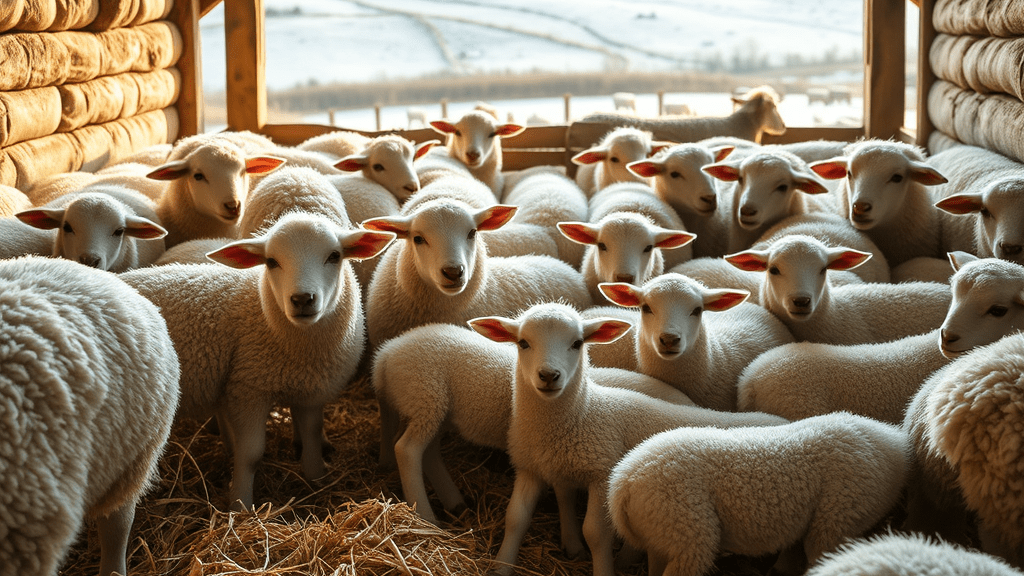
On the small hill farms
it’s lambing time again.
Inside the barn it is
breathily warm.
The old smell of dung,
straw and birth returns,
hovering over the pens.
Outside the world is held
in the tight fists of ice and snow,
the lambing pens now islands
of steamy breath and anxious
motherly calls.
These ewes have stood here
for centuries past.
The same who stood on the Judean Hills,
on Lakeland Fells,
in the vast Australian outback,
an ancient cycle of birth and death.
A stillborn lamb lies discarded,
its twin totters unsteadily towards
the ewe and life.
Orphaned lambs feed hesitantly
from strange figures holding bottles.

It’s early Spring.
The flock grazes peacefully,
lost lambs bleat pitifully,
until they find the ewe.
The sheep recognise
their public pastoral duty.
Artistically dotted over
rolling countryside,
they pose for photographs
which briefly reassure the world
that while sheep safely graze,
they can forget for a moment,
electric cars, greenhouse gas
and such imponderables.

The whirr of shearing blades
heralds a new phase.
Unshorn sheep protest noisily
at the fate of their bald neighbours
who splashing through the sheep dip,
skip to freedom.
The shearers expertly grasp each animal.
Held sitting on their haunches, the sheep
are comic, cartoon figures, faintly
stupid looks fixed on their faces,
truly sheepish.
Fleeces, thick and greasy, roll away
like winter suits.

The high hills are deep in snow.
It drifts silently into a lunar landscape.
Sheep are driven down to winter
in the barn.
At first light, shepherds search for
lost sheep in the snowy uplands.
Dogs sniff out the buried animals.
Sheep, safe in the barn, it’s Christmas Eve.
Do they hear the voices singing again
on far off hills?
Sarah Das Gupta is a writer from Cambridge, UK who has also lived and worked in India and Tanzania. Her work has been published in twenty countries from Australia to Kazakhstan. It has appeared in over 200 literary magazines and anthologies including ‘The New English Review’, ‘ Moss Piglet’, ‘Songs of Eretz’, ‘Quail Bell’, ‘Waywords’, ‘Cosmic Daffodil’, ‘Dorothy Parker’s Ashes’, ‘Hooghly Review’, ‘Meat for Tea’, ‘Rural Fiction’ and many others. This year she has been nominated for Best of the Net’ and a Dwarf Star’.
In the meadows, grass grows tall.
Poppies, vetch and clover
caught in the summer light
paint a canvas worthy of
Monet, Cezanne, van Gogh.
Flies and gnats drifting in clouds,
rise and sink as the breeze
strengthens, then dies away.

The mower relentlessly scythes
through the swaying grass,
with all its flowery jewels.
A lark’s nest falls victim
to the executioner’s blade.
Field mice flee before
the flashing metal fangs.
Butterflies hover, mesmerised
by the magnetic power
of certain death.
That impossibly blue sky
throws its airy net
over distant valleys
and far hills.
Haymakers’ weather
at last!

In the heat of midsummer,
the swathes are slowly drying.
The hay bob’s been busy
tossing and turning
the sleepy clumps.
Soon dry grass is neatly raked
in military ranks, under
the machine’s strident orders.
In the shade of a wood,
the tractor driver snatches
a hasty snack, a sneaky beer.
Looks at a job well done.

All week the weather holds,
The morning mist drifts away.
An officious red baler disturbs
the lark’s song high above
in the endless blue.
Neat bales of new hay
form into rigid lines.
Brash binder twine
strangles the dying poppies.

As evening falls,
swallows fly low, over
the twilight fields.
Breasting the waves of darkness,
they fish the shoals of insects.
The bales of hay stand sentinels
over a deepening silence.
Sarah Das Gupta is a writer from Cambridge, UK who has also lived and worked in India and Tanzania. Her work has been published in twenty countries from Australia to Kazakhstan. It has appeared in over 200 literary magazines and anthologies including ‘The New English Review’, ‘ Moss Piglet’, ‘Songs of Eretz’, ‘Quail Bell’, ‘Waywords’, ‘Cosmic Daffodil’, ‘Dorothy Parker’s Ashes’, ‘Hooghly Review’, ‘Meat for Tea’, ‘Rural Fiction’ and many others. This year she has been nominated for Best of the Net’ and a Dwarf Star’.
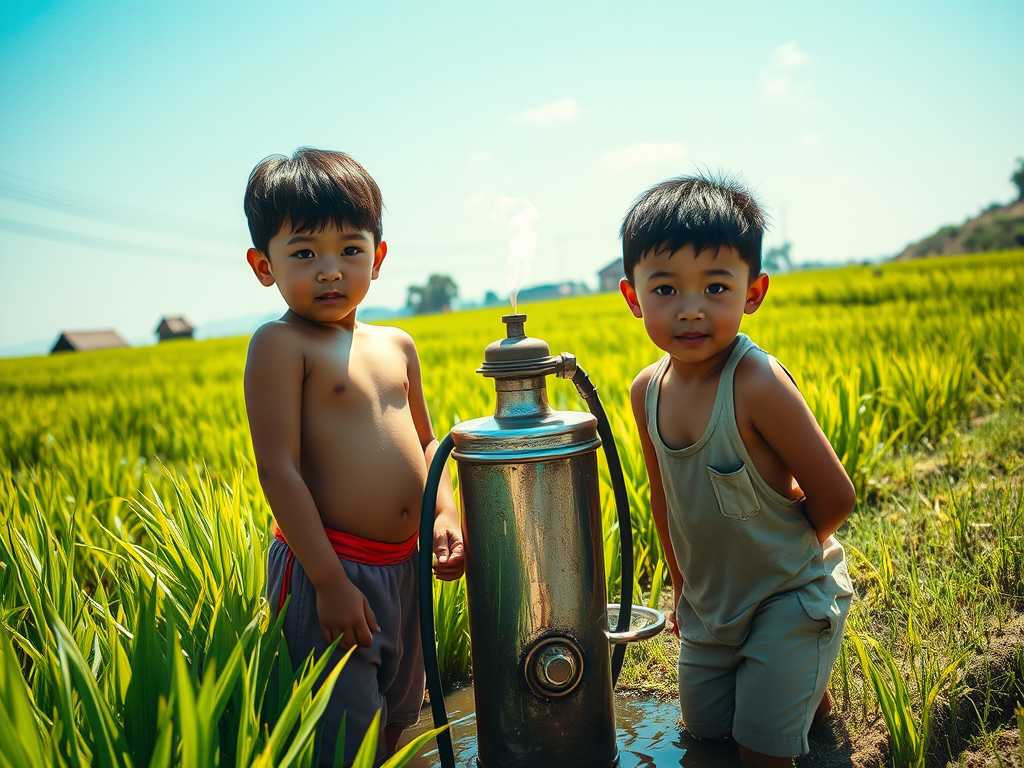
It was a scorching mid-summer afternoon in 1965. All trees and crops stood still as if holding their breaths for a ceremony to begin, while cooking smoke rose all the way up towards the sky without changing its shape beyond the fields. Ming was gleaning leftover grain with a neighbor boy when he spotted something strange across the ditch, which looked quite deep.
“Hey, what’s that stuff roaring and smoldering over there?” asked Ming in a loud voice.
“Ha-ha, you dummy! Don’t you know that’s a machine? Called ‘fuel pump’!” answered Six-Lives, who was a couple years older and apparently knew more about it.
“Fuel pump? What does it do? How does it work?”
“It burns kerosene. Used to draw water from a pool to irrigate rice paddies.”
“How do you know?”
“My youngest uncle’s the operator! He told me that.”
From his tone, Ming knew that Six-Lives was very proud of his connection with the farming tool, which made him feel envious. As the first industrial product Ming had ever seen since he had memory, the pump was nothing less than a living representative of all the advanced sciences and technologies of the twentieth century.
“Can we go take a close look,” proposed Ming. Even if they had to walk a long way to cross the bridge, he wouldn’t want to miss this opportunity to open his eyes.
“Why not? Let’s swim across the ditch.”
“But I don’t know how to swim!”
“Easy-peasy!”
“How’s that?”
“Just follow me…”
Scarcely had Six-Lives finished his sentence when he asked Ming to take off his shorts, the only garment every boy wore during the entire season. Then, the older boy put it together with his own on his forehead and transported them dry and clean by treading water to the other side of the pool, which was about four to five meters wide. When he came back, he grabbed Ming’s left hand and told him to make strokes with his right arm and keep kicking his two legs backwards the moment they stepped down into the water.
“Paddle hard just like a crazy duck, or a dog, remember!”
But the instant his feet left the ground, Ming fell down straight like a dumb rock. As he struggled to re-grab Six-Lives’ right hand or arm, he was choked with water and got a sharp pain in his nose. For a fraction of moment, he found himself catching one of his friend’s limbs but only to lose it again, because the other boy avoided him like a poisonous snake. With nobody or nothing he could get hold of, Ming hoped to get out of the water by kicking his legs and waving his arms as hard as he could. At one point, he did manage to raise his head above the water and see Six-Lives standing alone on the ridge, totally naked, doing nothing but wiping his tears away.
After swallowing a large quantity of water and despite all his efforts, Ming failed to keep his head above the water as he and his coach had both anticipated. What followed was an ineffable experience. As time seemed to stop, he felt his body drifting around like a little cloud in a greenish sky. With his eyes close tightly, he certainly saw nothing at all. Nor did he hear a single sound; even the loud noise of the pump had become totally muted. There was no pain, no choking anymore. Instead, he was overwhelmed with a sense of comfort and serenity, while the idea of death never came cross his mind. He knew he was very much alive since he was still as self-conscious as usual. This he could tell because he could somehow see, from somewhere above, his own naked body in the heart of an enclosed space, which was full of light-like water or water-like light. He reminded himself to keep plodding forward in one direction all the time. This way, he believed that he would touch the ground sooner or later.
It was not long before he felt his hands catching something solid, which he presumed to be a tree root. Without a second thought, he used all his remaining strengths to climb up along the root, though it seemed endless. No matter what, he was sure about his proximity to the ditch side. Otherwise, there would be no root for him to grab. That being the case, he could get out of the pool sooner or later as long as he kept climbing. But just when he found himself too exhausted to continue trying, he felt the root broken off and shrunk into a short and weightless straw in his grasp.
Before he woke from a dreamless sleep, he heard some faint human voices coming closer and louder, “Whose boy’s this? Isn’t he from the Lius living on the dike?”
A few days later, he learned that it was a young couple who had seen Six-Lives crying on the ridge when they happened to take a short cut to visit the wife’s parents for the first time after they got married. From the boy’s terrified response, the couple guessed that someone was drowning in the depth of the pool. Not knowing how to swim, the couple shouted for help at the top of their voices. When an old woman airing her laundry on her bamboo pole nearby heard them, she ran to the scene with the pole and used it to reach Ming, which he mistook for a tree root.
To the couple and the old woman, his parents were certainly grateful, but at the age of eight, Ming didn’t give a fig about this episode back then. In fact, if he’d known he’s to expend his whole lifetime only to prove himself to be one of billions of “shit-makers,” he would probably have stopped climbing the root in the water, or preferred to die of some disease like Six-Lives before he became an adult.
Yuan Changming edits Poetry Pacific with Allen Yuan. Credits include 16 chapbooks, 12 Pushcart nominations for poetry and 2 for fiction besides appearances in Best of the Best Canadian Poetry (2008-17), BestNewPoemsOnline and 2109 other publications across 51 countries. Yuan began writing and publishing fiction in 2022, with his debut (hybrid) novel Detaching just released by Alien Buddha Press.
Please share this to give it maximum distribution.