If you enjoy Rural Fiction Magazine, please do us a small favor and link to us. Back links are important to any website and especially for one that is growing. If you have a story or poem published here, please link to it. If not, please link to any story, poem, or page that you like. Your assistance is greatly appreciated.
Follow our blog to have our stories, poems, and other works and articles sent directly to you as they are published.
An ear-splitting cry ricocheted across the crumbling tombstones, sending an uneasy shiver down the backs of the tour group.
“Not to worry…,” their guide’s voice rumbled like distant thunder, “merely a screech owl on his nightly hunt for rodents and the like.”
Emily had butterflies in her stomach.
Exploring a cemetery on Halloween seemed like fun at first, which is why she accepted the dare last week from her friend Sarah with a laugh. But now that she was here, she felt a bit on edge. The Halloween Graveyard Ghost Tour, a yearly tradition in this small New England town, promised tales of local haunted history and the possibility of spirit sightings. Although Emily didn’t exactly believe in ghosts, she couldn’t completely dismiss the idea, either.
The night was chilly and, except for the cry of the owl, utterly silent. Smoky streams of clouds hung over the slivered moon before beating a hasty retreat as if sensing the spirits below would soon be out to prowl.
While waiting for the tour to begin, Emily huddled under the barren limbs of a massive oak with Sarah and the others—the cemetery loomed just ahead. Dating as far back as 1660, the ancient burial grounds sat on an eerie stretch of frost-heaved earth marked with gravestones in no logical pattern. It was as if the spirits of the dead had arranged them for some sort of otherworldly board game that only they knew how to play.
Their tour guide, Andrew, a dashing figure with his top hat and billowing black cape, carried a lantern whose flame flickered bravely against the gloom of the late October night. Emily felt a tingle of excitement at the thought of exploring the cemetery with such an attractive man leading the way—until she reached the entrance gate.
A rusty iron behemoth, it stood like a grim sentinel to all who entered, swinging inward on shrieking hinges as if expecting them. Something about that gate and the inky darkness beyond gave Emily pause as a cold sense of foreboding washed over her, creeping down into her bones. She took a deep breath and did her best to ignore it as she tucked a wayward curl behind her ear and marched along with the group.
No one spoke as they entered the cemetery. Leaves crunched beneath their feet while the hushed silence of death kept up a never-ending refrain. Through the thin rubber of her sneakers, Emily imagined she could feel the ground pulse with the souls of the dead preparing to make an entrance.
Stopping in front of an elaborate gravestone, Andrew held his lantern high to reveal its intricacies. The weathered grey stone stood about five feet tall and was flanked by what looked like angels kneeling on either side. As her eyes adjusted to the light, Emily realized they were actually snarling gargoyles with fangs bared. Their talon-like claws clutched the base of the stone as if through mere might alone, they could yank the unfortunate occupant back from the dead. A large, delicately carved skull sprouting a pair of feathery wings topped the stone, its mouth spread wide in a rictus grin. From her vantage point, Emily could only make out the words, Here lies the body of…
“Tonight, as you walk through this lonely patch of land, tread lightly, my friends,”
Andrew explained with a dramatic flourish, “For here lie the souls from centuries ago, those of the brave and the bold, those of lost youth and innocence, and those who may have struck a deal with the very devil himself!”
Sarah moved closer to Emily, grabbing her hand.
A whiff of something foul seeped into the crisp night air, growing stronger with each breath Emily took. She couldn’t place it at first, but as the fetid odor lingered, it dawned on her—sulfur. Andrew’s body stiffened, but he did nothing except raise the lantern higher while staring into the pitch-black beyond the gravestone
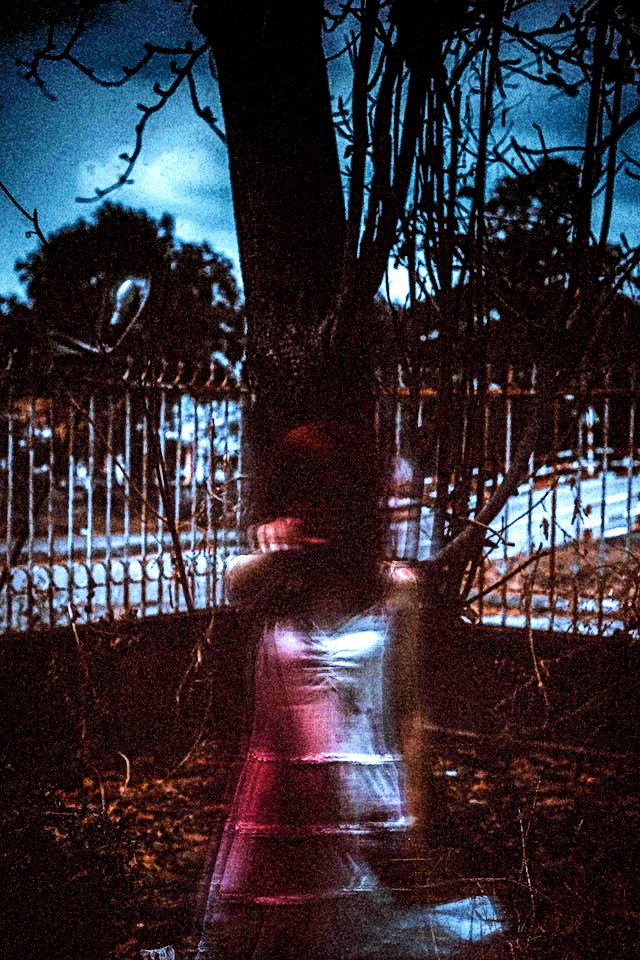
Strange tendrils of mist began to form above the stone—wispy outlines in vertical rows, and for a moment, Emily thought her eyes were playing tricks on her. She rubbed them with the heel of her hand but to no avail. The vaporous strands continued to multiply, swirling and rotating as if batted about by an errant breeze, though the night remained deathly still. They reminded her of the long, bony fingers of a wraith-like harpist who had performed during her senior year of high school. The woman’s fingers had flown up and down the strings as if fueled by an unseen force, their motion blurring like hummingbird wings.
But there were no soft, melodic notes drifting in on the sulfurous cemetery air, and no harp emerged from the shadows. Emily watched in disbelief, feeling her mouth go dry as, inch by inch, the spinning mass slowly took shape, and a pale apparition appeared, hovering over the gravestone. With empty, black eye sockets and corkscrew curls cascading down its back, the spirit focused all its ethereal attention on Andrew, who seemed unable to take his eyes off the spectral display. Slowly removing his hat, he bowed deeply and exclaimed with awe, “Madame, you honor us with your presence!”
Emily’s heart skipped a beat, and she dropped Sarah’s hand. She had to get closer—had to see the spirit more clearly. Taking a tentative step forward, she crept nearer until she was standing shoulder-to-shoulder with Andrew. An involuntary squeak, like air being sucked in through tinny, timeworn pipes, leaked out of her. Her hand flew to her mouth, but it was too late. The spell between Andrew and the spirit had been broken. When the ghost whirled toward the source of the noise, Emily knew. Terror bubbled in her chest, as caustic as acid, and she began to shake. It was unlike anything she had experienced in her twenty-something years on earth—as if a looking glass from beyond the grave had suddenly materialized in front of her.
The ghost was a dead ringer for Emily!
A lifelong resident of New England, Cheryl is captivated by its haunted history. Coupled with her love of the mystery-horror genre, she is inspired to write stories of spooky New England. Cheryl is an RN with a degree in nursing and English who enjoys playing tennis and trying out new recipes.
Please share this to give it maximum distribution. Our contributors’ only pay is exposure.
As of October 1, 2023, RFM is now publishing its stories and poems to its Facebook/Meta account at the same time the story/poem is published on the website. We are already publishing simultaneously to Mastodon and Tumblr. Follow us on any of these accounts to receive our moving and beautiful stores as soon as they appear on the main website.
Also, don’t forget that RFM is open to submissions of stories and poems about rural life in the US or around the world 24/7/365. Visit our submissions page for more information. There is no pay other than the publication credit and exposure, but we strive to reach a worldwide audience and to give our contributors as much exposure as possible.
Bonneville Salt Flats. Original photo by Zoxcleb. Distributed under the Creative Commons Attribution Share Alike 2.0 Generic license
In Salt, we measure out our lives in tales, trying to discover where we’ve been, find out how far we’ve come, and determine how long we have to get where we need to be.
The tales spread out across the Brine Fields at sunset, whisk through Salt Flats at dusk, hover over the Salt Pond like a slow-stirred evening fog, and settle, damp and mottled, like torn bark from the black walnut tree that hangs over the top of the Muck Dam at night.
Tales find you on front porches, catch you in doorways on Main Street, and even perk-up your ears while you doze. Accompanied by Old Man Brine’s solemn voice, each tale is stacked one upon the other and rises toward Red Rock Mountain until it becomes a revised-again legend.
Silence has descended upon Salt. Silence coupled with the darkness and a crazy sickle-shaped moon. I get up out of my chair, my ears still pressed to the wind. I’m not so good at hurrying anymore. As quickly as I can, I return inside and fetch my coat. When I get back outside, the wind is still and the air is silent.
When school ended this year, I tidied up my room and closed the door on that world. Then I moved through my summer as if in a dream. I never accomplished very much, although I had the best of intentions. There was the house to keep, and those promises to visit damn near everybody. You know how it is when time gets away from you.
I spend most of my summer mornings in bed reading books, which lay like lovers strewn all around me. I spend my afternoons puttering around the garden. I spend early evening hitting a tennis ball against the big brick wall that surrounds the Shaker High gymnasium. At 7:30 I sit myself down on my front porch with a glass of lemonade, hot chocolate, or brandy, and press my ears against the wind.
Old Man Brine came to town when Shaker High was built. He used to teach History while sitting in his wheelchair. Everyone called him Socrates—students, teachers and administrators alike.
On my first day as a newly-minted teacher, the first thing I did was walk right into that classroom of his filled with posters of the Parthenon, the Pyramids, and the Palisades. Old Man Brine was sitting in his wheelchair, head bent, penciling the children’s names into his grade book. “Hey, Socrates,” I said rather loudly, “remember me? Yewley Dunn? I had you as a teacher.”
Looking up from his wheelchair, I watched his eyes trace the contours of my face. Then, I heard that storied 7:30 voice that invoked so many memories I suddenly found myself smack in the middle of my childhood.
“Yewley Dunn!” Old Man Brine said. “Yes, I remember you; however, let me assure you, my boy, that you never once had me!”
I am sure to look both ways before I cross the road. I walk down the street in the general direction of Old Man Brine’s house. I am surprised that none of the Saltfolk are sitting on their porches. Oh, there are lights on in kitchens and front rooms. Every once in a while, I see the blue flicker of a television screen or hear the clatter of silverware combined with table talk. I walk past what I like to call the Republican Church on one side and the Democrat Church on the other. I flip a quarter into the doorway of the 5 & Dime. I walk past the home of the town newspaper, The Shaker, a two-page local affair filled mostly with obituaries, gossip, and the funnies.
I make my way down a steep hillside and cross the tracks whose parallel rails appear to inch ever closer before they escape the town. I sit on the steps of the depot and examine the rusty rails, which frame chunks of coal and salt rock.
About thirty feet sits an abandoned set of railroad tracks and on them, a rusty and rotting boxcar. Chicken Venerable, face as red as hellfire with his one leg stretched out, sits in the middle of the car drinking canned heat. Chicken Venerable used to load the salt buckets and still rides the bucket line now and again. Lives on his disability check, which he picks up at the Post Office, across the way.
He collects change bothering the old ladies outside the Piggly-Wiggly, offering to hop their grocery bags to their cars. The kinder ladies in town feel sorry for him, I suppose, and hand him their bags. I hear Chicken’s hop has become a little irregular lately. The ladies say that when they get home and unload their groceries, all of their eggs are broken inside of the Styrofoam containers.
When I walk down the steps to the Post Office to get my mail, Chicken Venerable is waiting for me. Without fail he says, “Yewley Dunn! How’ya getting along?” I used to give him my spare change.
Earlier today, Chicken was sitting on the yellow stonewall, next to the PO, his one leg sticking out. “Yewley Dunn,” he said, “how’ya getting along?” Instead of change, I handed him a postage stamp. Chicken screwed up his wild, red eyes, slipped the stamp into the front of his overalls, removed his leg from my path, and said, “Yewley, you’re the salt of the earth.”
Tonight I amble alongside the boxcar. It’s completely rusted, yet by the grace of some miracle, Chicken is able to open and close the door in order to give himself some privacy. I’ve heard Chicken remark on more than one occasion that the boxcar is both his coop and his coffin.
Chicken says from somewhere inside, “T’ain’t tales in the air tonight, Yewley. You know I can’t sleep ‘thout the tales. I fear the worst.”
“I’m on my way to find out where they went, Chicken.”
“If they’s truly lost, Yewley, you’re going to need me to find ’em.”
Chicken hops out to the edge of the boxcar and into the dying light. He’s always hopping and flapping his arms like some crazy bird. He holds out his wings and flutters to the ground, landing on his one leg, poised and sure-footed. “The tales are the heart of Salt, Yewley, and the heart has stopped beating. I fear the worst.” Soon, Chicken’s hopping along beside me, a bottle of shine in one hand, his other claw resting on my shoulder. He has this remarkable ability to keep up the pace, drink shine, and talk nonstop-nothing all at the same time.
“Funny, Yewley,” Chicken says, “I was wondering just this very afternoon which tale Brine was going to tell tonight. I thought maybe the one ’bout Salt’s oldest living man who pulled into the town’s only fillin’ station and asked where in damnation he was. Oldest living man in Salt likely died on the spot when the grease monkey by the name of Flim-Flam Flynn said, ‘Why, young fella, you’re in Salt.’ That’s one of my particular favorites, Yewley.”
Chicken’s hopping kicks up the chemical dirt around us. “‘Member when the paleontologists from up north came looking for dinosaur bones? Ha! I’ve hear tell paleontologists have poor dispositions from working so long in shallow graves. Yewley, I don’t know much, but I know one thing for certain. Them paleontologists look to dust off bones so they can build a monument to the past, all the while standing in shallow graves. And do you know why they do it, Yewley? I’ll tell you why: ‘Cause they want to live forever.”
We pass the Western Auto Store, the concrete tennis courts with their fence-metal nets, drooping in sad half-smiles in the direction of the saltwater swimming pool. The willows are weeping and hang across the road like a curtain, which we part. The lights of the Saltbox Diner fill up the sky—neon colors racing toward a pot of glittering gold.
“That gold oughta’ be salt. What kind of senseless theme is a rainbow diner and a pot of gold in this town?” Chicken says.
The great wall of Shaker High School is in front of us now. “You been working at that school for how long now? And you just keep on doing it—keep slugging away even though most of those kids haven’t got the sense to pick up the marbles they spit out of their mouths. And do you know why you keep after those bone children, Yewley? I’ll tell you why: ‘Cause you want to live forever.”
I look toward the school that has occupied my time. “I feel like I’ve spent my whole life in that building, Chicken, first as a student and now as a teacher, and it’s as if I’ve never spent a day,” I say.
“You know why you keep doing it, though, and that’s what’s important.”
Chicken hops beside me as we walk across the golf course, down Smoky Row, through the weeds that stand between the Madam Russel Church and the pillars that frame the entrance to the Salt Works.
Together, under the crazy sickle-shaped moon, we make our way across the baseball field whose outfield dissolves, by degrees, and turns into Old Man Brine’s lawn, porch, and white, three-tiered house. Chicken steals my thoughts. “Yewley, I can’t believe that we’re the only ones here. How long you been listening to them tales? I know I have for the better part of fifty years.”
Chicken takes a swig of shine and passes the bottle to me. I wipe off the bottle with my shirt, take a long, slow drink and hand Chicken the bottle. He throws it against the steps.
“Old Man Brine! Old Man Brine, you in there?”
“For God sakes, Chicken. We’re here to find the tales, not to tell ’em.”
Chicken hops up the stairs and onto the porch. He hesitates at front of the door, lays a hand for a moment on Old Man Brine’s empty wheelchair, twists the doorknob to the right and hops on in as if he’s the one-legged tenant. He sees my quizzical look and says from the doorway, “Yewley, I’ve been more places than you can think of.”
Old Man Brine’s front room is filled with beautiful old furniture. A spinning wheel sits in one corner, a huge family Bible adorns a coffee table. There is a totem pole in another corner and a glass case filled with all kinds of arrowheads, spear tips and headdresses. A picture of the town, nearly as big as one wall, hangs above it all.
We look at the picture of our skillet-of-a-town. All of the buildings are labeled with a letter. There’s the old hardware store, the Salt Works, Shaker High School, the no-tell motel, Smoky Row, Lick Skillet, Slaughter Pen Hill, Goose Bottom, Pump Log Hollow, and Henrytown Road.
Two envelopes are stuck into the right corner of the picture. The first in Old Man Brine’s sprawling hand: “Open this letter if something happens to me.” The second is addressed to The Shaker.
“Them tales are the heartbeat of this town, Yewley. They are past, present, and the future and I fear they are way past due. And do you know why Socrates tells ‘em? I’ll tell you why: ‘Cause he wants to live forever.”
Chicken walks over to the stairs, plops down in the bucket lift, buckles the seatbelt, and hits the button on the wall. The bucket moves up the stairs, and Chicken sits smiling back at me like a bird in a shooting gallery. “Catchcha, later alligator.” I hear Chicken thumping around upstairs. “Yewley,” he yells. “I found Socrates. He’s sitting up in the chair reading a book. Dead as a polecat caught between a golf cart and the tires. Smells almost as bad, too.”
The bucket backs down the stairs. Chicken’s fingers are pinching his nose. “I’m too lazy to unfasten this buckle-belt, Yewley. Come-on over here with that letter addressed to the finders of misfortune or death. Thankya’ kindly.” Chicken bites open the first letter and begins to mumble, scratches his head, and mumbles some more.
“What’s the letter say, Chicken?”
“Says a lot of things, Yewley.”
Chicken hits the button on the wall and it begins its slow climb back up the stairs. As it’s moving, Chicken says, “Yewley, go down to the root cellar and get the shovel that’s propped up ‘gainst the wall. Once you’ve done that, lean it outside ‘gainst the porch. Wheel in that chair and set her at the base of these stairs. After that, help me get the Old Man.”
I do as I’m told. I race through the front room, into the kitchen, and down the cellar steps. Just as Chicken says, the shovel is propped up against one wall. I move through the front room and out onto the porch. I lean the shovel against the wall, wheel the chair through the front door.
“On three now, Yewley. One, two, three!” We both explode upwards like weight lifters, Chicken under one armpit, me under the other.
“Dignity is as important as any one thing a man can have,” Chicken says smiling at me. Together we inch Old Man Brine toward the bucket-belt, sit him down, buckle him up and send him on his way.
“Now, go on down them stairs after him, Yewley. Don’t mind me, I’ll hold onto your shoulders and just hop along behind. Watch your speed now, son. Nobody has any business going anywhere that fast. I expect the Old Man will wait. Okay, now unbuckle ’em and load ’em into that chair while I study this map a minute.” Chicken unsticks the second letter addressed to The Shaker and pushes it into his bib pocket. He points to the red dot on the map, studies it for a little while longer, scratches his head, bites his lip, closes his eyes, points to the dot again, and says, “I could find this spot in my sleep. Let’s skedaddle, Yewley. You know I can’t stand being on the inside of anything with four walls for long. Let’s take a roll, Socrates. Think you’re up for it? Course you are. Even though you’re dead, you still want to live forever.”
Chicken stands on the footrests in the front of the wheelchair; Old Man Brine has the seat but the way I figure it, he deserves it. “Step on up on the back of the seat, Yewley. You’re the lookout. I’m the captain of this outfit.”
The motorized chair moves out onto the porch and down the ramp. The last thing Chicken does as we roll toward the land of chemical grief is stop at Old Man Brine’s mailbox; he takes the stamp out of the front of his overalls, the unopened letter out of his bib pocket, licks the corner of the letter, sticks on the stamp, and makes sure it is in the mailbox and the flag is up.
“Just three good buddies out for a roll in the dust,” Chicken says.
“The white bitterness, the chemical grief, the very history of the town,” I say.
“You got that right and poetics, too.”
We follow underneath the cables of the bucket line on which large black buckets carry alkaline and gypsum into this valley. One final thing: as we round the corner and head toward Henrytown Road, the Drayman passes us with an empty cart and a quizzical look.
“Looks like we beat ole’ Dray to the punch. Did you see his face, Yewley?”
I fake-tip my hat at Dray and we turn the bend and leave him in the dust.
“I ever tell you the story ’bout how I lost my leg. I’m sure I have but I’ll tell it again to kill the silence. I was working up around Smoky Row where the cinders fall off the train so thick you can cut the air. Boy Henry, Jr., had been brewing up some shine and, without too much encouragement, persuaded me to try some. After my tenth pull, I swear the sky falls and one of them iron buckets from that bucket line knocked my leg clean off. When I come to, my leg was sitting right next to me. Way I got it figured: in this town, the grief is going to get you one way or the other.”
The streetlights flicker in the distance— illuminating the rich shops, casting shadows on the poor ones. The lights of the Saltbox Diner rainbow flick off, first blue, then red, then green, then yellow and then the pot of gold turns into an outline of cauldron black.
Old Man Brine and I sit underneath the sickle moon and watch Chicken hopping around in circles of dust in the middle of the Salt Flats, spinning like a crazy compass needle, hopping on the cracked ground, spinning, howling, until he falls, vanishing in a puff —white chalk and chemical death all around him.
“Start digging right here, Yewley. And don’t say I never done nothing for us.”
“What are we doing out here, Chicken?”
“Just hush up. We ain’t doing nothing Socrates doesn’t want us to.”
“The ground is salty flat and caked hard. I feel like I’m stranded on the moon with a dead man and a one-legged Chicken looking back at the earth and wondering what it must be like now that I’ve left it. I push the shovel into the ground as deep as I can. The grit and rocks and muck and dust fill my mouth. I keep my ears pressed to the wind. Brine’s storied voice is all around us.
“‘I told those paleontologists where to dig but they never listened to me either. They could have sifted through the layers of dirt and time ‘til their heart was content. They could have uncovered this ole’ town bit-by-bit, dusted it off, labeled it, unearthed whole houses, resurrected the charred ruins of a Civil War town.” We listened to the wind as Brine continued. “Pterodactyl bones and more bones, stacked on top of one another, intertwined like the crazy twisted roots of bent-over trees. They could have tasted the roots that fought their way through coal and gypsum in search of nourishment, finding only saltwater.’
“‘The Old Man here told the archaeologist where to dig, too, Chicken. ‘Salt,’ he told ‘em, ‘was salted down and is waiting to be rediscovered.’
“‘Stop jabbering and keep digging, Yewley. God never gave us soil in Salt, just adversity.’
“‘During the Civil War, Salt was the site of what’s come to be known as conflagration, salvation, and redemption. Both the Confederate and Union armies desperately needed salt to preserve their food and lengthen their supply lines. Up there around Red Rock Mountain, several Union soldiers were captured. They were stripped naked, salted down, and tied to the tall pine trees overlooking the town. Out of some devilish spite, the Confederate soldiers set the tops of the trees on fire. The conflagration danced across the heavens from treetop-to-treetop, licking at the sky, donning a fiery wig on the sun, whose big bald head was setting over Salt. Instead of finding the Union soldiers on the ground, the conflagration raced down the mountainside headlong bound by some invisible thread from tree-to-tree. Horror-stricken, crazy with fear, the Confederate soldiers hurled themselves one-by-one from the face of Red Rock Mountain and attempted to gather the flames in their arms before they destroyed Salt. Rumor has it that on warm summer nights the sunset casts a red glow that dances on the tops of the trees while the woods fill with hysterical laughter.’
“And Old Man Brine wasn’t quiet done.
“‘Salt was built on top of the sacred Indian burial grounds. There are caves with secret passages that are filled with everything imaginable: headdresses, canoes, animal skins, and the bones of great warriors who, after their lifelong journeys, took something to protect them when they entered the next life.’
“Chicken sits in the wheelchair on Old Man Brine’s lap. I can see their feet and both are silent for once in their lives.
“The last thing Old Man Brine did before he retired ten years ago was collect pine cones from underneath that big pine tree they planted in front of Shaker High School when they built it. From my classroom window on the second floor, I watched him get up out of his chair, bend down, press his palms over the brown nettles, pick up a pinecone, and put it in a brown paper bag. Then he waited for the three o’clock bell to ring, and he just rolled away.
“As time passes, I’ve begun to realize that it’s not really the tales that change.
“’Salt it away, Yewley,’ Chicken says.
“Suddenly, my shovel hits something solid. Chicken springs out of the chair and hops down into that shallow grave with me and helps uncover a trunk. Then, we hoist it out onto the Salt Flats. He uses the shovel to break open the lock.
“In the trunk are thousands of tales, carefully written down in the Old Man’s hand, each sheet piled on top of the other, preserved, salt it away.
“Together, Chicken and I unload the trunk and set the tales down on the Salt Flats, one page at a time. We place Old Man Brine into the empty trunk and lower him into the ground.
“Before we leave the Salt Flats, we watch as the wind gathers up the tales and stacks them one on top of the other in the wheelchair. After the wind dies down. Chicken climbs up on top of the stack of tales and sits perched his crazy bird shape astride the crazy sickle-shaped moon.” Then, he climbs down, sits in the wheelchair, which he makes his own.
“Three days later, The Shaker ran the following Verse (Matthew 5:13)—a posthumous reminder from Old Man Brine.
Salt of the Earth
Ye are the salt of the earth: but if the salt have lost his savour; where with shall it be salted: it is thenceforth good for nothing, but to be cast out, and to be trodden under the foot of men.
“After Old Man Brine’s death, I thought that Salt would remain irrevocably silent, but the townsfolk placed pots of morning glories on their front porches and those flowers trumpeted each time a breeze blew across their railings.”
I release my breath and with it the tale of Old Man Brine. The wind grabs hold of my words and in a flurry of dust transports them through the night.
The way I got it figured, the students in the afterschool program will have just have to get along without me this year. No, not really. If they sit on their porches, and they press their ears to the wind tonight at exactly 7:30, they will hear the reason for the town’s name.
Dr. J. Bradley Minnick is a writer, public radio host and producer, and an Professor of English at the University of Arkansas at Little Rock. He is the Executive Producer for Arts & Letters Radio, celebrating modern humanities in the South, found at artsandlettersradio.org. He’s published numerous journal articles and fiction.
Please share this to give it maximum distribution. Our contributors’ only pay is exposure.
Rural Fiction Magazine (RFM) would like to publish more writers from around the world, regardless of your country of origin.
I am seeking short fiction and poetry and non-fiction articles on topics of interest to a rural audience in any nation, but I am open to more than just fiction and poetry. I am also open to short plays, folklore, legends, tall tales, essays, etc. I am open to almost all genres such as fantasy, science-fiction, horror, mainstream, literary, romance, etc, so long as they are connected to rural life and/or have a rural setting.
Your work must be in English. It can a translation from your native language, but it must be in English, which is spoken around the globe and gives the work and author substantial worldwide exposure.
Please note that there is no pay for this other than a publication credit and exposure to the American and English markets. However, all rights remain with the author.
Currently, RFM is publishing material within a few weeks of acceptance, though this may vary depending on the number of submissions.
Please re-post or share this announcement to give it maximum exposure.