“Wild Oats of Home” Short Story by Terril L. Shorb

Desiree Permian’s vision blurred with tears when she found the page.  Encircled in red pencil was Introduction to Veterinary Science.  How could it have been eighteen years since that Junior College class launched her plan to be a veterinarian?  She had been sure her love of critters and straight-As in high school would sail her through the biology and chemistry courses.  But another kind of chemistry had diverted her—six-feet-two inches of it by the name of Will Permian.  She hadn’t been in the course three weeks when he proposed and Desiree dropped her books to pick up pitchforks, crescent wrenches and eventually a seven-pound wriggler christened JoAnn Mae Permian.

She had no regrets about the life she had made with Will and the girls here in the Valley.  It said right in the Good Book, though, there’s a time for all things under the sun.  So she had announced her time had come to begin driving the 21 miles to the J.C. to resume her veterinary classes.  Ellie and JoAnn said, “Cool, Mom.“  Will had offered no opinion until this morning when her hands were full of a mare’s forefoot and a hoof-rasp.  “I had to let the hired hand go.  Found him passed out in the haystack cuddling a whiskey bottle.  Need you to drive barley truck.”  Will’s voice was husky with genuine regret.  “Sorry it shuts the gate on your college thing.”

“I’m already through the gate, Will.”

Will stared at his dusty boots.  “Every available man or woman within fifty miles is on the harvest.  Maybe next year.”

Desiree gently put down the mare’s foreleg and was out of the barn before Will could gather himself to trot after her.

She paused on the screened-in porch, Sampsonite suitcase in hand.  She kissed Will, lay a finger across his questioning mouth.  “I’ll be back in a few days.”  He shuffled into her upraised palm.  “I will be back.  Please get the girls to town so they can buy their wardrobes for school.”

“I’m no good at that girl stuff,” he pouted.

Desiree restrained a giggle.  “They‘ll teach you.”

The old Ford growled up the rocky road above the ranch.  In the side mirror Desiree watched Will’s tall figure remain rigid with disbelief.  Not once in all their years had she walked away from him.  She held back tears, but never eased up on the gas pedal.  Where exactly was she going?  She had enough mad money to buy the distance needed to sort things out.  She could catch the vomit comet out of the county air park and drift over to Denver.  From there–where?  Vegas?  San Francisco?  A bungalow up in the Canadian Rockies?

She slowed for the cattleguard, scanned a track dogging the fence line to the high pastures.  Desiree wheeled onto the road.  Just can’t leave, right Dezi?  She could imagine Will’s gently teasing eyes.  Not so, but she needed one clear view of what she was leaving.  

She parked the Ford on Cain Mountain’s shoulder and walked through a stand of aspen tinged gold.  From this perch most of Lansome Valley lay revealed: Resolute rectangles of alfalfa and barley fields flanked the creek and its ruffles of cottonwoods and willows.  Far up-valley the Herm Ranch was a scatter of children’s blocks.  She had been born in one of those blocks and her parents still lived there.  A thousand feet directly below were glimmers of barn, machine shop, calving sheds, and her own house.  Inside, Will and the girls probably huddled around the big oak table to decipher the mystery of the absent wife and mother.

Desiree turned her gaze to the mountain itself, to its sun-cured grasses and splashes of summer’s last wildflowers.  “You’re all so very beautiful!”  Heart-shaped aspen leaves rattled as if to confirm her praise.  Her gaze returned to the valley and to a memory: A third-grade class project to make a paper mache relief map of the United States.  The Rocky Mountains were globs prodded into toothy shapes.  The teacher helped them daub on bright blue creeks and green fields.  All the children placed a gold star on the map to stand for their birthplace and their connection to the greater, geographic scheme of things.  Mrs. Stevens then said,  “Sad to say, children, most of you will leave the protection of your little gold star to make your lives elsewhere between the shining seas.”

Desiree now whispered, “Not me, Mrs. Stevens.  I haven’t left my gold star!”  Her entire life was bounded by these mountains, these pointy dollops on the map of the nation, which lay beyond her experience.  She lay back until the grasses curled around her like a lacy shawl. 

She awoke shivering in the mountain’s shadow.  The airport was an hour’s drive.  She leapt up, squinted down at the shadow line which had crawled to the house.  A rectangle glowed in the upper North bedroom–the girls’ room.  Desiree had stood in that same tall rectangle with her fingers stretched over her belly the night before JoAnn was born.  She had watched the sun disappear beyond the mountain named for her great-great grandparents.  Their log homestead, impossibly small, still stood in rumpled dignity two miles up the valley.  Likely, Grandma Cain had watched her own spot on the mountain crest and uttered prayers to the evening stars for the health of her child soon to breathe the sweet air of Lansome Valley.

The airport could wait.  Desiree retrieved a bedroll and emergency kit from the Ford.  The stars came on thick as frost crystals.  She gathered dry branches from the aspen grove and kindled a small fire away from the precipice and the gaze of anyone in the valley who might glance this way.  Reflection of flames gilded aspen under-leaves and she felt like some storybook princess in an enchanted forest.  A Great Horned owl hooted thrice from the higher darkness.  As if to answer, coyotes yipped from their lair across the valley.  Crickets ratcheted up love songs and a breeze brought delicious fragrances of pine and spruce trees.

Desiree left the fire and sat near the cliff‘s edge, staring tenderly at lights strewn along the valley floor like a strand of pearls.  These were the pearls of her life, her history.  An outsider might proclaim Desiree’s life hopelessly hobbled.  Desiree sometimes felt it too, especially when Will assumed demands of ranch-life always took precedence over her needs.  It could be claustrophobic living under a tiny golden star.  But it afforded something rare and good.   

Hers was a life of rich connections.  She was embroidered right into a quilt panel of bee hum and wild roses.  Morning sun that warmed her shoulders in the garden had fallen upon shoulders of five generations of Cains, Herms and Permians.  Generations of crickets had played their tunes for her ancestors under a starlit canopy that was an enduring roof–no matter what challenges life brought.  Hers was a gift of continuity in a world bent on transforming itself every seven seconds.  She recalled the old saw about not being able to appreciate one’s home until one left.  Well, a thousand feet of altitude had done it.

She no longer needed to fly away, but she did need this place on the durable mountain’s shoulder to prospect for gratitude in a life whose value could get buried in the strata of endlessly busy days.  How wonderful it would be to open an animal biology textbook up here on the mountain and read sentence after sentence without a teen-ager lobbying for maternal attention or a husband insisting that fence posts could not be properly tamped unless she were there to hold them.  When she drove back down into the valley tomorrow she would carry within a new spaciousness to stand resolutely for her right to embark upon the greatest journey of all–her formal education. 

Desiree stared into the campfire.  Sparks rose to dosey-do with the stars.  Anybody could run toward a new horizon.  But if you hunker down in a place you know and love, it is the world that moves toward you.  In a few hours the good earth would tip its forested crown to the flaming orb that touches all.  Desiree gave up a coyote yowl of greeting to that unseen but steadily approaching light.


Terril says of his life: “My life has been spent in rural areas of Montana, Wyoming, and Arizona.  It has been blessed with experiences as a rancher, subsistence farmer, agricultural journalist, teacher, and as photographer and writer.  My work has appeared in Range Magazine, Montana Mouthful, Projected Letters, The MacGuffin, QU Literary Journal, Cargo Literary Magazine, bioStories, and Green Teacher Magazine. “


Please share this story to give it maximum distribution. Exposure is our authors’ only pay. You can also help our contributors gain exposure by back linking to them and to RFM’s homepage.

If you would like to be part of the Rural Fiction Magazine family, follow this link to the submissions guidelines. 


Image generated by AI
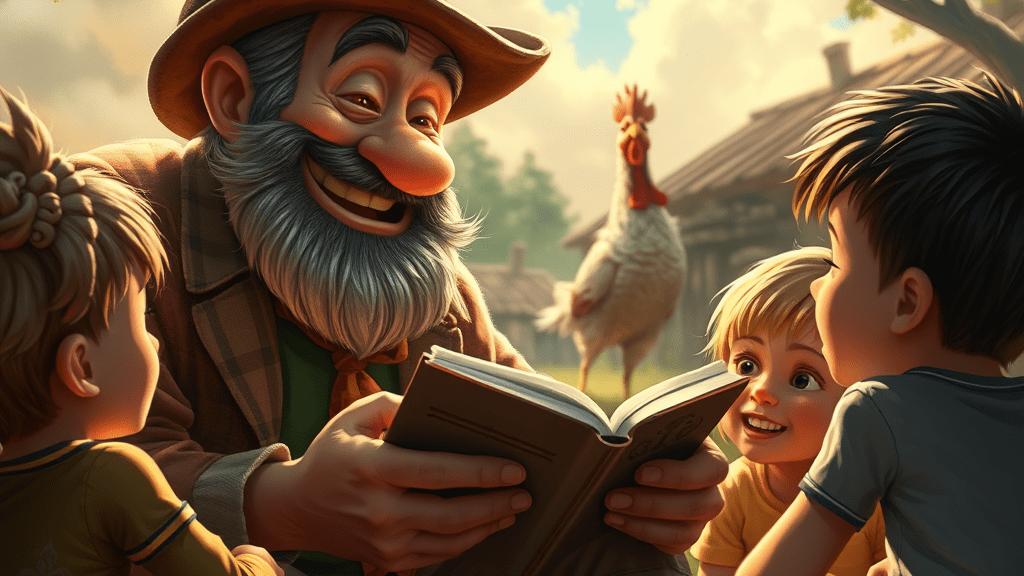
“Uncle Slappy and the Rooster” Short Story by Vonni Sage

There’re some things you jus cannot unsee. 

Take, fer example, gross stuff. I doan get why grown ups hafta be sharin’ slobbers. Ma and Pa share spit ever’ mornin’ and I even seen Granny and Papa do it oncet or twice. Seems like a nasty habit us kids ain’t developed. I hope it ain’t genetic. 

Ma says I shudn’t be sayin’ these things and tells me I’ll feel differ’nt when I’m older. She says I’m an orn’ry twerp, always watchin’ and thinkin’. But I ain’t got nuttin’ better ta do than contemplate life. ‘Sides, it’s interestin’ ta notice. I learns lots jus by watchin’ and lis’nin’. Doan need to say much. Life’s purty amusin’ on its own.

Mos’ times I see things I doan wanna unsee cuz they’re funny. Like oncet when Granny decided it was high time she learnt ta ride a bike. Dint want no lessons from noone. Nope. Fiercely independent, my Granny is. ‘Twernt long afore she was whippin’ that bike round and round the silo cuz she couldn’t figure how ta make it stop. Took crashin’ inta the back o’ the hay waggin ta bring that fiasco ter an end. Course, Granny found it amusin’.  She laughs at ever’thin’.  

Then there were the time us kids and the dog wuz racin’ inter and outta the house and let in a chicken. Inter Granny’s kitchen. That dint go so well. She and us kids managed ta corral that hen. Fer a moment I thought Granny was fixin’ chicken fer dinner that night, but she got it outside. Then us kids and the dog resumed our shenanigans, which nearly resulted in Granny droppin’ her precious carton o’ eggs. That were the straw. Granny can get purty flustrated and she did jus then. She put down those eggs and tole us kids we hadta stop. She said we hadta put the dog in the fridge and throw the eggs outside. Bein’ the obedient children we wuz, we wuz commencin’ to stuff that flailin’ dog inter the fridge when Granny realized what she’d said and we all had a good laugh.

My Uncle Slappy, he’s a man cut outta differ’nt cloth. He ain’t quite so bright as some, but he can tell some tall tales. Uncle Slappy got ‘is name cuz he gets tickled easy and when he does, he slaps his leg or he’ll slap anyone who’s close ‘nuf to reach. It doan pay to sit near Uncle Slappy when the tales start. That can be a painful ‘sperience. I hain’t never been whaled by Uncle Slappy cuz I watched and learnt so I hain’t never sat near ‘im. Took somma t’others awhile ta figure that’n out. Now, when Uncle Slappy tells tales, he has an audience. Kinda like a play, where ever’one is sittin’ afar and watchin’. He either ain’t figured out that he slapped his audience inter submission or he’s clever ‘nuf to have created his very own assemblage. Either way, when Uncle Slappy starts talkin’, people start movin’. 

Anyways, I’m not sure o’ Uncle Slappy’s real name. Ain’t heerd noone say it. But I heerd him tell some big tales. The one ‘bout the banty rooster’s my fav’rit cuz I know the truth. 

Granny was plannin’ dinner one day and fell short one chicken. Havin’ bin chased inter the house mor’n oncet by the new banty rooster she’d bin given, she decided he was a prime candi’te fer her next roast. But she weren’t fond o’ the notion o’ ketchin’ him, so she set Uncle Slappy ‘bout doin’ it. He hadn’t seen that rooster yet, havin’ jus showed up, so he dint know no better.

I happenta be slothin’ ‘round in the hay stacks that mornin’, makin’ miself scarce. As I was lollin’ ‘round, starin’ at the barn ceilin’ and contemplatin’ life’s myst’ries, I heerd the screen door slam. It always slammed shut cuz the spring fell off and ain’t nobody fixed it yet. I figured Granny likes it that way. Serves as a sorta doorbell. 

Anyways, I rolled onter my belly and peered over the haystack to see Uncle Slappy skulkin’ ‘round like he wuz lookin’ fer sumpin. The chickens wuz runnin’ loose jus then cuz Granny liked ‘em ta have lotsa space. Said they laid more flavorful eggs and made fer better meat that way. Uncle Slappy was walkin’ through the bunch when he met the banty rooster. I’ll never be able to unsee what I seen next. But ta understand, ya gotta hear it Uncle Slappy’s way first. 

“Well now,” Uncle Slappy says to his rapt audience, who’s all settled in now after doin’ the Slappy Shuffle. “Granny says she ain’t got ‘nuf meat fer dinner and tells me she wants a ‘ticular rooster. It’s his time, she tells me. So I goes outside and, knowin’ that an’mals requires a firm hand, I eyes up that rooster. Ya know…ta let ‘im know who’s the boss n’all. Well, he eyes me back and we gets inta one big starin’ contest. I overcome his finer sensibilities by narrer’in my eyes to slits. See, like this…” and he demonstrated to us’n by narrer’in his eyes and sqwinchin’ up his face. He looked ta me like he et a saur lemon and it come out his nose. I tried not to laugh too hard so as not to set off Slappy’s hands, but it wern’t easy to hold that’n in.

Uncle Slappy unsqwinched his face and his audience lost its spasms. “Yessir, I stared ‘im inter submission. He purt near keeled over from my evil eye. But he ain’t no dummy. I wuz swaggerin’ towards ‘im when he jus jumped up and runned at me, feathers all big n’such.” Slappy’s hands were a flyin’ by now, showin’ us those wings and causin’ his audience to sway. “He sunk his beak inter my leg and owwww,” Uncle Slappy howled, “did that’n ever hurt. But I weren’t done. In one big, fast swoop, I done grabbed his neck and wuz holdin’ him up in front ‘o me, his legs jus danglin’ in thin air. We stared,” he sqwinched up his face again and I found a sudden need to pull lint offen my sock. “Then I saw this sof’ look in his eyes and I swear ta ya on my grave that a tear run down that rooster’s face and I cudn’t do it. Nope. Tol’ Granny she’d hafta find her another murd’rer.” Slappy laughed and attacked his leg with one’a his big hands, causin’ us’n ta rear back. I wuz laughin’ now at the memory o’ that rooster and him, but he dint know that. I won’t tell.

Ya see, Uncle Slappy hadta tell a tall tale cuz the truth is that rooster done got the best of ‘im. Here’s what really happened. 

As he wuz skulkin’ among the chickens, the banty come runnin’ right at ‘im, feathers fluft, wings out, head low. He got Uncle Slappy in the leg, that’s about the onliest truth of it. Slappy howled (I’m supposin’ he hadta put that’n in the story cuz someone mighta heerd ‘im) and started spinnin’ his legs backwards, like Fred Flintstone goin’ in reverse. But that rooster wuz right on ‘im. He wuzn’t lettin’ up. Uncle Slappy turned and run ta the waggin. He wuz commencin’ to climb in when the rooster got the backa ‘is leg. He wuz kickin’, the rooster wuz peckin’, and it dint look too good fer Slappy ‘til he pulled hisself up inter the waggin. 

Well now, that dint last long. The rooster had tekken a most def’nit dislike to Slappy and was in the waggin right baside ‘im afore my uncle’s back hit the hay. From atop the hay loft, I cud see inter the waggin. Slappy was slappin’ at that rooster, ‘is hands goin’ so fast they looked like blades. The rooster jumpt up top ‘o the waggin rail above Slappy’s head, lookin’ down at ‘im. I’m purty sure he was a’laughin’. That tear Slappy saw wuz pure mirth. Slappy retched up ter grab its legs but the rooster appeared to fall off t’other side so Slappy done retched ‘tween the slats ta grab ‘im. Well, that there wuz a bad idea cuz Slappy got ‘is arms caught ‘tween the rails. Now the rooster wuz back in the waggin and havin’ a time with Slappy’s armpits. The howl I heerd from Slappy was one thin’ but the sqwinched up, lemon-nose face he gave the rooster brought tears ta my eyes. Slappy got his arms free and the rooster done backed off. Mebbe he wuz convinced he’d made ‘is point. Anyways, Slappy set hisself on top o’ the waggin rail, holdin’ ‘is hands under ‘is armpits, a lemony look on ‘is face. Seein’ as ‘is prey wuz disabled, the rooster got onter the rail aside Slappy. They eyed each other fer a while and I’m purty sure a tear ran down Slappy’s face. Now that’n were a Norman Rockwell scene.


Vonni Sage enjoys exploring humanity through her writing and other art forms. When she isn’t creating, Vonni enjoys reading, kayaking, hiking, and snowshoeing. Recent publications include an essay, “Art in Place,” in Transformational: Stories of Northern Michigan Arts and Culture and “It Rained Down” at Friday Flash Fiction.

Vonni says about this story: “This is an oral storytelling piece based loosely on my experiences as a very young child visiting my grandparents’ farm. I noted your call, albeit in November, 2022, for oral storytelling, a tradition my Appalachian family revered. After many decades living a suburban life, I have returned to my farming roots and, as I settle into this new-old lifestyle, I find myself returning to my childhood experiences with fond remembrance.”


If you would like to be part of the Rural Fiction Magazine family, follow this link to the submissions guidelines. 

Please share this story to give it maximum distribution. Exposure is our authors’ only pay. You can also help our contributors gain exposure by back linking to them and to RFM’s homepage.


Image generated by AI

Global Call for Rural Fiction Writers

Share Your Rural Tales with the World!

Embrace the Beauty of Rural Life

Rural Fiction Magazine is on a mission to showcase the rich tapestry of rural experiences from around the globe. Whether you’re penning heartwarming tales, poignant poems, or insightful reviews on rural fiction books, we want your voice! Our open-minded approach means we welcome all genres—be it romance, horror, or magical realism—as long as it connects to rural life. Your story matters!

A Worldwide Platform for Diverse Voices

With contributors from 46 countries* and counting, RFM celebrates the universal human experience. By submitting your work, you join a vibrant community that transcends borders. Share your unique perspective and connect with readers who appreciate the beauty and complexity of rural narratives.

RFM wants to develop talent, measuring it in a fair and equitable way to find hidden and disadvantaged talent in a world where not everybody has an equal chance to exhibit their abilities. RFM does not discriminate against anyone. The only personal criterium for publication is talent in use of English and in developing outstanding stories. Because RFM embraces the global community, RFM embraces differences, whether those are race, age, ethnicity, religion, gender, sexual orientation, or physical ability. RFM wants to see diversity in writing from around the world, from all time zones. RFM respects everyone’s voice and strives to create a culture in which people from all cultures, races, and backgrounds feel encouraged to express their ideas and perspectives. You can help our contributors gain exposure by sharing their works widely and also by back linking to them and to RFM’s homepage.

Fast Publication for Your Creative Work

No waiting indefinitely to see your words in print! At RFM, we pride ourselves on our efficiency—most submissions are published within weeks of acceptance. Get ready to inspire others and gain well-deserved exposure in English-speaking markets including the USA, UK, Canada, Australia, New Zealand, and Ireland.

Your Voice Matters – Take Action Today!

Ready to share your story? Visit our submissions page for detailed guidelines and join us in celebrating rural fiction’s diverse tapestry. Remember: while there’s no monetary compensation beyond publication credit and exposure, your writing will resonate with an audience eager for authentic voices like yours.

Spread the Word!

Please share this announcement far and wide to help us discover exceptional talent from every corner of the world!


*These nations include Canada, United Kingdom, India, Austria, Taiwan, Australia, Thailand, Japan, Ireland, Germany, Poland, New Zealand, Lithuania, Indonesia, Costa Rica, Greece, Singapore, South Korea, France, Netherlands, Sweden, Norway, Nigeria, Finland, Saudi Arabia, Romania, South Africa, Mexico, Bangladesh, Italy, Palestinian Territories, Guatemala, Switzerland, Nepal, Portugal, Barbados, Kenya, Malta, Hungary, Spain, Ukraine, Turkey, Oman, Brazil, Estonia, and Pakistan.


Image generated by AI

“The Farm” Flash Fiction by Deborah Templeton

​He rang the bell and then leaned in against the wall, out of the rain. Hands in his pockets, listening for her. Then the door opened in a spill of light, and it was Lizzie.       

​“There she is,” he said, and stepped straight in past her, headed for the warmth.

​“Dad…”

​Henry thumped his stumpy tail when he saw who it was, but he didn’t get up and Dan fussed him for a minute. Lizzie’s homework things were all over the sofa. He shoved them out of the way and took the spot she’d been sitting in, right next to the fire. 

​“Look at the height of you,” he said, “You’re shooting up.”

​“That’s because you haven’t seen me for ages.” She perched on the edge of the armchair nearest the door.

​“Sure I was here the other week.”

​“You were not.”

​“I was. You were out somewhere. Did your mother not tell you?”

​Lizzie said nothing.  Dan stretched out his legs and rested his feet on the dog’s back. Henry didn’t mind that. 

​“What about a cuppa for your auld Da?”

​He listened to the sounds from the kitchen as she clinked around in there. Her mother would likely have biscuits in. He wouldn’t mind something sweet. 

​The fire had a good glow going, and the mantel clock was ticking away, same as ever. Lizzie was 13 last birthday so it was thirteen years since they’d took this house and set that fancy clock on the mantelpiece. Thirteen years in a house Maureen thought she was too good for. Her bloody Da had it drummed into her that she was a Donnelly and could expect the best. Well, she could and she did, but she was a long time waiting for it.

​Lizzie brought the mugs of tea in one hand and a plate of biscuits in the other–Hobnobs. Him and her both liked their Hobnobs. 

​“Move that stuff,” she said, and when he’d lifted her books off, she settled on the other end of the sofa and put the plate between them. She did well in school, did their Lizzie. Never any trouble getting her to do her homework. She’d always been a bright wee thing. When she was no age he would take her with him out on the milk run, and she’d read out the orders for him. Great company, she was. Cute as a button. 

​He had loved those mornings. Loved being up at the farm before light, warmth pouring out of the dairy shed.Him and the wean in their wellies, and the rich smell of cowshit in the good country air, and the air steaming with their breath and the breath of the cows. 

​But you can’t raise a family on a milk round. Maureen’s father said he’d put him over the middle arch of the town bridge if he didn’t get a proper job. So he went into the factory then, and the milk was sold cheap to Allied Dairies.

​“Is your Mammy at work?” he said, although he knew she would be. 

​“Mm-hmm.”

​They held their cups of milky tea and concentrated on dunking their Hobnobs just the right amount, catching the soggy biscuit end before it fell off. The dog was snoring gently, and the fire was glowing, and the mantel clock was marking time. Lizzie had her feet pulled up under her. Look at those long legs – she was getting tall. Thirteen. He hardly knew her.

​“I was up at the farm,” he said, and he spoke softly into the softness of the room. 

​“Were you?” Her head snapped up to look at him, eyes like her mother’s. “How was me Uncle James?”

​“Grand. Grand.”

​She loved the farm. Loved that her auld Da had grown up there. In that white-washed foursquare house, with the dairy yard milling with cows. When she was wee, he would pick her up so she could rub their big trusting faces and smell their sweet grassy breath. Even after he gave up the milk round, he had her out there all the time, seeing her Granny and Granda and her Great-uncle James. Now there was only Jamesy living out there, the old bastard, still going strong. And no cows at all. 

​“Why did you not call for me?”

​“Ach, I didn’t know I was going,”he said. 

​It wasn’t true, and saying it didn’t help. The wean wasn’t stupid. She looked at him out of the side of her eye, and then drank the last of her tea, tipping the cup so as to let the sugary, biscuity sludge drip into her mouth.  

​“Lizzie, love,” Dan leaned a bit closer, his arm along the back of the sofa, “Uncle Jamesy’s not as young as he used to be.”

​She was toying with her mug, turning it in her hands. She was not looking at him now. 

​“You know he’s had his name down for an old folk’s bungalow? Well, one’s come up in The Heights.”  

​She was a bright one, his Lizzie. She knew what it meant. 

​“You’ll be able to call in and see him after school.”

​He didn’t need to say it. He didn’t need to say it out loud. 

​Maureen’s mantel clock whirred, winding up to chime. She’d be finishing her shift and getting back soon. 

​“Sure the place is half-derelict, Pet, it’s not fit to live in.”

​She would know that. She would know that Uncle Jamesy would be better off in the town. It wasn’t the farm it used to be. The days were gone when it sung to the sound of cows lowing for their breakfast, and the yard pooled with light from the milking shed.  The days were gone when it could have been a home for a family. And when a child’s breath could make time stand still in the frosty air.


Deborah Templeton lives on the north coast of Ireland. She writes for all kinds of contexts, including soundwalks and live performance. Water’s Edge was published in audio and book formats by Confingo (UK) in 2023.


If you would like to be part of the Rural Fiction Magazine family, follow this link to the submissions guidelines. 

Please share this story to give it maximum distribution. Exposure is our authors’ only pay. You can also help our contributors gain exposure by back linking to them and to RFM’s homepage.


Image generated by AI

“The Hailstorm” Short Story by E.C. Traganas

​It was still dark, opaquely black, with just a faint strip of light from the village square’s streetlamp peeking through the shutter. It couldn’t possibly be time to rise. I pulled the itchy goat’s wool blanket with the threadbare satin hem over my neck in half-sleep as I lay on the wooden floorboard with only a thin comforter for my mattress. I had slept badly the night before: a field mouse had somehow wandered in from the storehouse below and found its way into my room. At one point, as I frozemotionless on my rock-hard pillow alerted by the faint pitter-patter of the tiny foraging rodent, I had locked glances with its beady seedlike eyes in mutual alarm before pulling the blanket up even tighter hoping to ignore its intrusive presence. But it was now long gone, and I struggled to shake off the torpor still holding me in its grip. ​

​The alarm clock on the mantel had shot off with a shrill clang simultaneously with neighbor Kira Katina’s cockerel sounding its second pre-dawn crow. It was precisely four-thirty, well before sunrise. There was no delaying now. I jumped up and sprang about with the elasticity of a hare, rolled up mymattress, folded my bed-things and dressed myself in the early morning chill. Then, the green-painted wooden shutters had to be opened. One of them, overlooking the steep reclining cobblestone path to the busy square, was kept permanently locked. Aunt Lidia was not too keen on encouraging neighborhood eyes to pry into her formal living room. The other two windows opened onto Kira Katina’s stone cottage several feet below on the mountain slope. I pushed aside the delicate tatted cotton lace curtains and unlatched the shutters one by one. Straight ahead the mountain range receded towards the town of Nemea still hazy with the indigo dust of nightfall. To the left, thedistant lake mirrored faint salmon undertones of the rising sun now barely visible. The starry vault stretched expansionless above, and I breathed in the crisp morning air immersing myself in the ancient aura of my surroundings with every breath. It was rumored that Aesclepius the mythical Greek surgeon had once walked these very paths millennia ago, and that an ancient lying-in clinic for women in confinement had been founded in his honor not far from the village. These thoughts absorbed mymind as I set about brushing my hair and lacing up my sturdy oxfords. It was mid-September, and I had volunteered to help with the seasonal grape packing on Uncle Stavro’s vineyards. 

​The cold dew on the roofless concrete patio shocked mytired body to attention. From the exposed outdoor tap, icy water poured forth from the mountain spring above. I looked up as Isplashed the freezing liquid on my face and watched as the heavy charcoal-colored rain clouds swiftly parted, clearing the sky in the eastern horizon. In the distance, a tractor could be heard pumping its way down towards the valley. I walked into the kitchen, bleached wooden floorboards creaking under foot. Uncle Stavro and Aunt Lidia were already at breakfast and Iimmediately sensed the unspoken tenor of urgency in the air. On the ivy-patterned oilcloth spread over the wooden table lay a modest breakfast of fresh, warm goat’s milk, powdered coffee, and dried crusts of yesterday’s bread.

​“Hurry, up,” Aunt Lidia commanded. “You’re always so late. We have to leave soon. Did you sleep well?”

​The pungent smell appalled me. “I’m sorry, but that goat’s milk—I don’t think I can drink it. Do you mind if I boil some water for tea? You do have rusks, don’t you? I remember we bought some in town last week.” 

​Uncle Stavro wiped his sleeve over his milk-stained whiskers and laughed sarcastically. “So this is what my sister has done to you in that sleek and civilized metropolis of hers, eh! Eat what you want, but we’re leaving in ten minutes—sharp!”

​Suddenly, I felt acutely aware of my over-refined fussinessand ‘city’ ways. I watched them attack their humble breakfast with the vigor and ravenous animal spirits of a falcon at its quarry, and felt ashamed, realizing that, however I attempted to assimilate myself into their native lifestyle, there remained some habits and traditions that would permanently estrange me frommy relatives.

​When I had finished my tea, the house was locked, the unwieldy skeleton key placed under the pot of flowering basil, and we were off to the vineyards in Uncle Stavro’s tractor. Aunt Lidia fastened a paisley bandanna over her hair then drew a bulky woolen goat’s blanket over our legs to keep away the morning chill. When we arrived at the fields twenty minutes later, neighbor Kira Katina and her daughter  were already hard at work, both carrying large wicker baskets on their shoulders and winding their way between the rows of grape vines picking out the ripe, gilded clusters for packing. I was struck by their thick, ochre-colored tights and black leather slippers that gave them the appearance of graceful, elegant dancers weaving in and out of every cane with artful skill and precision.

​Aunt Lidia sat herself down on a clearing of nettle stumps and baled hay between Mihali, a village elder, and a young bare-chested and sun-browned boy of about fourteen. “You can sit next to Taki,” Aunt Lidia said, pointing to the young day laborer whose mud-caked toes were poking out of his patched brown rubber sandals.

​“OK, now tell me,” I asked with eager anticipation. “I want to know all there is about grape packing.”

​“You have to move fast here,” Taki said, his shy smile exposing a broken front tooth. “Just pick the largest bunches from the baskets, three to a row, and place them together evenly in the crate and line them with sheets of pink paper from the pile. That’s all. Whenever you need another crate, just call out.”

​Well, if that’s all there is to it, I thought. I began slowly, clumsily at first, arranging and rearranging each cluster of grapes, straining to make something of an artistic composition out of the layout. I fussed about and consciously strove for the effect of aesthetic perfection, an exemplary crate that any greengrocer would be proud to display in his prized storefront collection of comestibles. When I called for another crate, Uncle Stavro came poking over to inspect the work.

​He took off his cap, shook off the dust then refitted it over his balding head. “Meh, it’s all right,” he said flatly. I was crushed. “But, look here,” he pointed with a stubby finger, “the edges are sticking up unevenly. They’ll be bruised. Try again.”

​This time, I waited and deliberated, silently holding a cluster in my hand. I closed my eyes for a moment to focus myresolve. Then, I fixed my gaze on my neighbor worker’s hands, absorbing his energy, letting his effortless experience and unselfconscious skill flood my thought channels. I began again, without deliberation this time, simply allowing my hands to guide themselves, enabling each bunchstem to come to life and settle itself perfectly into its pre-ordained niche, abandoning any thoughts of forced calculation. The crates now filled themselves automatically as I allowed myself to ride the spirit of their force, blindly, subconsciously, through a mystical process of mechanical memory. Soon, I was listening to the idle chatter allaround, threading the air along with the subtle wildflower-scented breezes.

​“How are the walnut trees going, Mihali?” asked Aunt Lidia.

​“There are twenty of them this year. Three we’ll use for preserves. It’s enough for Katina to handle for our daughter’swedding next January.”

​“How’s the boy—what’s his name—Antoni, isn’t it? He’s from a good family, is he? And Rena’s dowry?”

​“We thought we’d give her twenty acres. Along with Antoni’s forty, that’ll give them a good livelihood for now. But he wants to live in the city. All the young people are moving away. Pretty soon, there’ll be only us elders left in the village.”

​“Ah, Mihali, I feel for you,” Lidia empathized. “Since Amalia married, we’re all alone now, and our only son left for the city. He wants nothing to do with our village ways. What do you think, eh, Taki?” she asked, her eyes still fixated on her work. “Will your parents let you leave, too?”

​Taki didn’t reply. He just grinned and let a roguish expression steal over the corners of his mouth revealing a small dimple on his right cheek. Then, spontaneously, his lopsided lips opened and burst out in song, an old demotic folk ballad that Ihad never heard before. The lyrics were typical: a young man falls passionately in love with a village maiden called Marigówho he secretly meets in the moonlight. She refuses to marry him; her eyes are set on another. But his heart is aflame and he vows that on the next full moon he will kidnap her and take her away. 

I listened transfixed by the haunting melodic line, and felt the rising warmth of the midday sun gradually fill the air. As my hands worked abstractedly, my roving glance suddenly focused on a nearby pile of hay which seemed to be pulsating and rustling with a secret life force from within. 

​“What is this?” I shrieked in shock. “All this time this—this thing is lying there watching my every move and you said nothing?” 

​Taki and Aunt Lidia burst out laughing. “It’s just a harmless insect,” my aunt said derisively.

​“This thing is massive!” I protested. “It’s at least six, seven inches— ”

​“It’s a giant walkingstick,” Taki said, “a megaphasma. They’re everywhere. Look, they have no wings, they can’t fly—” He fearlessly picked up the slender straw-colored creature between his brown calloused fingers and held it tauntingly over my head.

​“Stop it! Please, take it away—”​

​“Just so you’ll know what rich little treasures we have here in the village,” he said smiling knavishly.

​Overhead, converging layers of nimbostratus clouds were rapidly starting to block the sun. Uncle Stavro sensed precipitation and coaxed the women to collect as many grapes as they could. “God forbid there’s a hailstorm,” I heard him mutter. “It will be our ruin.”

​The baskets and crates were hastily covered with blue tarp,and as the first raindrops began to fall Uncle Stavro called us all to the small wooden shed nestled at the slope of the hill overlooking his grove of fig trees. Aunt Lidia unpacked a woven hamper and spread out a meal of sour bread, cheese, olives, tomatoes and scallions on an oilcloth over the bare earthen floorwhile Taki was sent to unstrap a large wicker-wrapped wine bottle from the tractor. We tore into the food and ate heartily—all seven of us—cramped as we were in the narrow ramshackle enclosure, sharing drink from a pair of tin cups. 

When the plates and napkins were cleared away, Mihali produced a ragged pack of cards and shuffled out a game of Kumkan with Taki, while the women grouped themselves together with their knitting. I sat with Uncle Stavro before a small opening in the thin wooden wall, the only source of light.

​“You know,” he said teasingly, “right there where you were sitting, your mother was once bitten by a scorpion when she was a little girl. She almost died.”

​“Oh, no—why didn’t you warn me, Theio?” I asked. “It was bad enough to be surrounded by swarms of wasps and dragonflies. And, wait—snakes, horseflies, spiders, who knows what other hideous creatures. If I had known that,” I said brushing myself  briskly, “I might have just stayed at home!”

​“That’s just why I didn’t tell you,” he chuckled. “And the horseflies—they’re the worst, aren’t they!”

​The sky darkened abruptly and low-flying clouds swept over the vineyard almost touching the ground. A faint rattle on the corrugated tin roof increased to a deafening clatter; tiny crystalline pebbles suddenly began to pound through the window and in the distance, through a wedge of sunlight near the fig grove, they glistened like illuminated chips of pearl jewelry. No sooner had they appeared, when the rainfall subsided.

​“Thank God it wasn’t serious,” sighed Aunt Lidia while crossing herself.

​“Doxa si o Theos—God be praised!” nodded Kira Katina.

​The clouds drifted away rapidly, the sun reappeared, and from the direction of the distant town of Nemea, a rainbow formed in radiant ethereal particles stretching above us in a pastel-colored arch over the valley. I looked out the window entranced by the spectacle. The mountain range that housed all the neighboring hamlets formed an endless procession, like an army of ancient helmeted warriors—sentinels of a collective past that joined everyone present in a shared ancestry—spreading in grandiose symmetry steplike towards infinity, one stony crag rising behind another in every direction like a mythical landscape. This is my mother’s birthplace, I mused enraptured, letting myself be drawn into the grandeur of themountains, and the archaic legacy of the vista.

​We returned to work for two more hours, and I now let myself be absorbed into my labor with a rush of exhaustive fury. At four o’clock we loaded the crates onto Uncle Stavro’s tractor and headed back to the village following behind by foot. 

 “You worked hard, didn’t you?” he said encouragingly. “That was real farm work you were doing.” I thought there might be a veiled patronizing undertone somewhere in his praise, but only smiled in reply. 

When we arrived at the junction on the main road, the agent was already waiting for us with his truck. After inspection, he congratulated Uncle Stavro on his yield for the season, and settled a price for the load. As I began to ascend the steep slope home, I overheard his whispered murmuring as he drew my uncle aside. 

  “I see you have a new worker. We’ll have to redo some of the crates, you know. We’ll deduct for the extra labor. Make sure this doesn’t happen next year.”

​I knew I had overslept the next morning. When I awoke late at seven thirty, the village was eerily quiet except for the occasional bleating of the ewe below in her pen. Padding to the kitchen, I found the note my aunt had scrawled on a torn strip of lined notebook paper resting under a pack of rusks: 

‘Gone off to work on Mihali’s harvest. Back by sundown. Have dinner ready when we return.’

It was good to stay home.


Author of the debut novel Twelfth House and Shaded Pergola, a collection of short poetry with original illustrations, E.C. Traganas has published in over a hundred literary journals. She enjoys a professional career as a Juilliard-trained concert pianist & composer, and is the founder/director of Woodside Writers, a literary forum based in New York. www.elenitraganas.com


If you would like to be part of the Rural Fiction Magazine family, follow this link to the submissions guidelines.

Please share this story to give it maximum distribution. Exposure is our authors’ only pay. You can also help our contributors gain exposure by back linking to them and to RFM’s homepage.


Illustration: “Village Square, Corinth” — Watercolor & gouache by E. C. Traganas 

Embracing Rural Life