Category Archives: flash fiction

“Bat in the Attic” Flash Fiction by John Brantingham

In the morning, Charles smells a combination of diesel fuel burning and something dead, probably a deer or a raccoon out in the woods. The thing of it is that he starts to panic in the way that he did all those years ago when he got out of the war, and he was just back and didn’t know how to deal with the memories, so when he gets to the hardware store, before he opens up, he has a long and calming draught of the bourbon he keeps in his office even though it’s not quite 9am. It helps him to numb out a little. Just a little. Just enough.

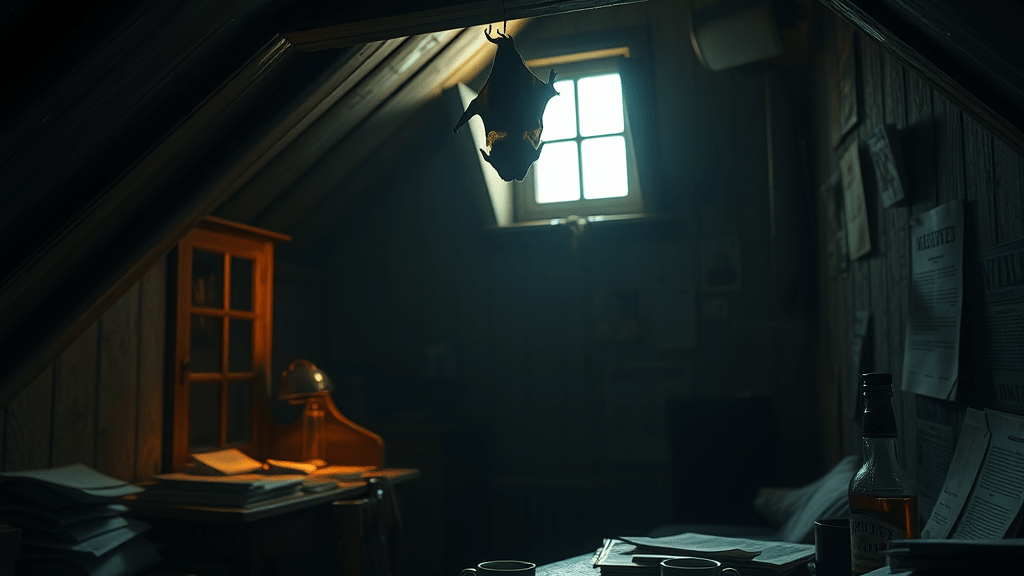
He pours a little out of the bottle into his coffee cup because that seems more dignified than pulling at a bottle, and leans back in his chair to see a bat hanging on the far end of his office. His hardware store is in a converted house, and his office is in the attic, and he’s had bats in here before, but he thought he’d sealed the place. Somehow the little bastard found its way in, so he goes downstairs where he keeps a .38 behind the counter and comes back up and shoots it, the smell of the powder, the sound of the shot bringing him back to that space again, so he takes a long drink straight from the bottle, before he puts the weapon on his desk and sweeps the carcass into a dustpan.

When Cindy, the woman who usually runs the cash register comes in to work and opens the place up, she asks him, “What’s that smell?”

Charles sniffs his hand. “Gunpowder. There was a bat in the attic.”

“So you shot him?”

“Seemed the fastest way.”

She laughs. “Well you better not let Henry know you shot a bat.”

Charles knows that he should chuckle with her, their inside joke that Henry, his teenage boy, loves awkward little creatures like bats and toads a little more than is normal even for boys, but her statement burns at him a little. It brings him back to when he was a lieutenant, and he’d watched a man get shot, and he’d ordered his private to retrieve the body, and the private said that the field was probably being watched by snipers.

The private had probably been right, but in a reflex, Charles had pulled his pistol and was about to threaten the eighteen year old kid with it, when a captain told Charles to stand down, and he did. He spent a day and a half thinking about shooting that punk kid who had been right, the scene playing over and over, him raging harder and harder every time he did. 

That’s what he’s feeling now, and his son is going to be here in the afternoon for the chores that earn him his spending money, and that drives Charles into his place of rage too, so he goes back upstairs and picks his pistol off the desk. He comes back down and gives it to Cindy. He says, “I need to take the morning and maybe the rest of the day off.”

“Where are you going?” Cindy asks, and it’s an innocent enough question, but it feels like insubordination.

He says, “I’m not sure, but I might not be back until tomorrow.”

Cindy waves, and Charles leaves, not going home but off somewhere to another town where Henry will not be.


John Brantingham is the recipient of a New York State Arts Council grant and was Sequoia and Kings Canyon National Parks’ first poet laureate. His work has been in hundreds of magazines and The Best Small Fictions 2016 and 2022. He has twenty-two books of poetry, nonfiction, and fictionCheck out his work at johnbrantingham.com.


If you would like to be part of the Rural Fiction Magazine family, follow this link to the submissions guidelines

Please share this post to give it maximum distribution. Exposure is our contributors’ only compensation. Don’t forget to back link to this story.

Financial donations through either our GoFundMe or Buy Me a Coffee accounts will help expand our global reach by paying for advertising, more advanced WordPress plans, and expansion into more extensive Content Delivery Networks.


Image generated by AI
“Beethoven in Indiana” Flash Fiction by Zvi Sesling

It is three a.m. and I have been driving thirteen, fourteen, maybe fifteen hours.  I have passed through West Virginia and then, Kentucky, which was the last time I stopped to eat. But now in the middle of the night there are no signs for restaurants or gas stations so I decide to get off the main highway and continue along on a backroad into Indiana. 

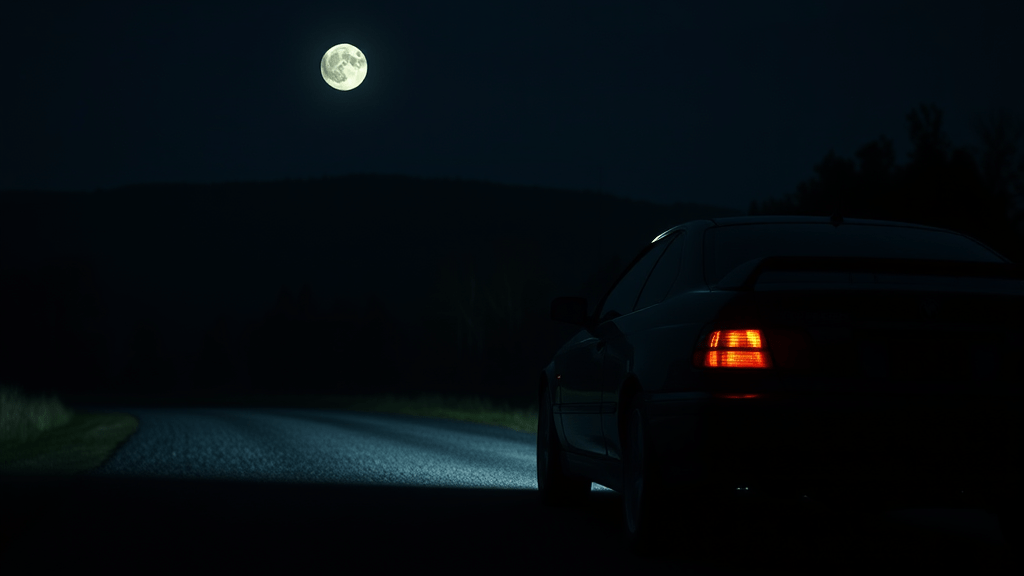
It is a pitch black night on this lonely road so I stop, get out to relieve myself and take a sip of bottled energizer to help me stay alert. I keep driving and now I am in the middle of Indiana. I decide to turn on the car radio where that I figure the music will help me stay awake as long as it is loud and noisy.  To my surprise the radio pulls in Beethoven’s Sixth Symphony. 

My New York snobbishness tells me that I did not know they played Beethoven in Indiana. I would have figured country music, Hank Williams, Willie Nelson or Dolly Parton.  But no, it is Beethoven on this Indiana station.

It is dark country in Indiana at 3 a.m., not like New York which stays alive twenty-four hours, lights make it seem like day time, especially in Times Square. But out here the night is black with no road lights so I have to stay alert. I would not want to hit a deer or a bear or even a coyote.

 I slow down for a minute, take another shot from the bottle of energizer liquid, swallowing a long gulp.  

The thing about these Indiana hills is that they are blacker than the night. They are just dark hulks. There are houses but they are spaced far apart and no lights are on at this hour. There are no towns, no gas stations no truck stops or diners. It is so dark even the moon sleeps and stars do not twinkle. You would think out here in nowhereland the stars would command the skies. A full moon would light the world.

It is kind of scary being all alone on a dark country road so I pump up the volume and slow down a bit to conserve gas but keep driving as Beethoven’s storm rages then calms and ends. The announcer is about to name the orchestra and conductor, but a rock station from somewhere takes over and a different announcer says, “That was Twisted Sister” as a faint morning light takes me head long through rough farm land.


Zvi A. Sesling, Brookline, MA Poet Laureate (2017-2020), has published numerous poems and flash fiction. He edits 10 By 10 Flash Fiction Stories. His flash fiction books are40 Stories (with Paul Beckman), Secret Behind the Gate and Wheels. Sesling lives in Brookline, MA with his wife
Susan J. Dechter.


Please share this story to give it maximum distribution. Exposure is our authors’ only pay. You can also help our contributors gain exposure by linking to them and to RFM’s homepage.

If you would like to be part of the Rural Fiction Magazine family, follow this link to the submissions guidelines

Financial donations through either our GoFundMe or Buy Me a Coffee accounts will help expand our global reach by paying for advertising, more advanced WordPress plans, and expansion into more extensive Content Delivery Networks.


Image generated by AI

“Free Birth” Flash Fiction by Sarah Das Gupta

It was hot in the Indian sunlight although it was early December. The students were sitting exams in stuffy classrooms where the ceiling fans whirred like dying insects. The rooms had a teacher’s desk raised above the level of the pupils. Girls bent over their papers, writing frantically. Every so often, a hand would shoot up for another sheet.

Sitting at the high desk, I noticed that every time I climbed down to hand out paper, I doubled up with a sharp pain which was increasingly hard to disguise. At eight and a half months through my second pregnancy, these spasms worried me. I certainly did not want to be the first member of staff to give birth in a classroom. I believed in practical work and class involvement but a demonstration of childbirth seemed to be stretching things too far.

 Moreover, I was teaching in a convent school run by an order of nuns dedicated to the Blessed Virgin, so I probably couldn’t rely on much assistance. To my relief, the bell rang for the end of school. Most teachers welcome the bell, especially at the end of a long, humid day. In this case I had been praying for it.

The students in their starched white blouses and red skirts, streamed out through the gates. With difficulty, I threaded my way through the crowd and luckily flagged down a taxi.By this time the spasms were more intense, making me bend over. I could see reflected in the driver’s mirror, his puzzled, anxious expression. I counted off the familiar landmarks, Lower Circular Road, Kolkata (Calcutta) Rugby Club, Kwality Restaurant, at last the turn into Ballygunge Place.

The taxi came to a rattling halt as I fumbled in my bag for the key. As it happened, the door was opened by our Nepalese ayah. Taking one anxious look at me, her usually unflappable character quickly changed. Despite her efforts, she couldn’t disguise the panic on her face. My Bengali was kindergarten level and my Hindi, non-existent. However, no words, whatever the language, were needed to explain my doubling up with pain every ten minutes.

I too was near panic as I weighed up my options. It didn’t take long; the choice was limited. My husband, a journalist, was away on an assignment. My own family were thousands of miles away in leafy Surrey. I understood from the ayah’s limited Bengali, that she was not up for the role of mid-wife. She wanted me in hospital as soon as possible but it was far away in Alipore, another part of the city. I had no transport.

I went out into the street. Total darkness hit me like a brick wall. No street lights, curtains tightly pulled. The usually busy city, silent. Rather belatedly, I remembered that India was at war with Pakistan over the future of East Pakistan, soon to become Bangladesh. Not the best night to look for a taxi.

Anti-aircraft guns lit up parts of the city with brilliant arcs of light. The silence was unnerving. Kolkata is rarely silent: the roar of traffic, the impatient hooting of horns, the rattling of trams, must make it one of the noisiest cities on earth I thought the chances of finding a taxi in the circumstances were nil.

Just at that moment, a battle scarred, black and yellow vehicle, lights dimmed, was crawling  down the street. Even from several yards away, I could hear a strange tapping noise from the engine and a general rattling as if all the bodywork were loose. As I raised my arm, the taxi came to a noisy halt. The driver was a Sikh, his turban just visible in the darkness. 

Pointing at my obviously pregnant figure, I whispered, “Forest Nursing Home, Alipore,” before the next spasm gripped me. I collapsed on the back seat. The stuffing was sticking out from the plastic covered seats as well as a few rusty springs. A few moments later, I considered jumping out. The taxi was swooping backwards and forwards across the road like a drunken seagull.

Somehow or other, we eventually crawled through the hospital gates. I was quickly ushered into a lift by a nervous receptionist. The nurse, took one look at me doubled up in pain, before hurrying me into a delivery room. After a quick check-up, she commented with barely concealed annoyance, “You’ve come far too early. You might as well go home.”

The night sister suddenly appeared. She had hardly begun her check-up, before she shouted, “Get this patient ready now. She’s about to give birth any minute!” 

I had hardly got into bed, before I was holding a tiny, pucker-faced daughter in my arms. My own doctor rushed in, red-faced and flustered.

“Don’t think I’m paying you. I delivered her myself!” 


Sarah Das Gupta is a writer from Cambridge, UK who has also lived and worked in India and Tanzania. Her work has been published in twenty countries from Australia to Kazakhstan. It has appeared in over 200 literary magazines and anthologies including ‘The New English Review’, ‘ Moss Piglet’, ‘Songs of Eretz’, ‘Quail Bell’, ‘Waywords’, ‘Cosmic Daffodil’, ‘Dorothy Parker’s Ashes’, ‘Hooghly Review’, ‘Meat for Tea’, ‘Rural Fiction’ and many others. This year she has been nominated for Best of the Net’ and a Dwarf Star’.

“Free Birth” appeared originally in Juste LIterary Magazine.


Please share this story to give it maximum distribution. Exposure is our authors’ only pay. You can also help our contributors gain exposure by linking to them and to RFM’s homepage.

If you would like to be part of the Rural Fiction Magazine family, follow this link to the submissions guidelines

Financial donations through either our GoFundMe or Buy Me a Coffee accounts will help expand our global reach by paying for advertising, more advanced WordPress plans, and expansion into more extensive Content Delivery Networks.


Image generated by AI
“Put the Pig Back in the Barn!” Flash Fiction by Dan Fraleigh

As children we can often recall that pinnacle moment when the power between the child and the parent shifted. For some of us, it has never happened, but for those who can recall that place and time it is often revered as life changing. 

My mother’s father, Lorne Brennan, was a tortured man. He decided to trade in his lucrative career on the CP railway to acquire a small gentleman’s farm in Caradoc Township. The end result was questionable at best. What the hell was he thinking?! 

Fast forward… My mom, Mary Jo, was the 12th and last child…her mother, Ethel, was a stoic farmer’s wife…there was never a lack of food or love ..perhaps more for some than others; but every family has it’s unique dynamics.

Mary Jo was brought into the world on February 12th, 1934…it was a bitter cold morning with snow dusting the inside of the master bedroom window sills where her elder sister, Loretta, was the acting mid wife. Ethel was 42 years old and this birthing experience was not new to her, but in fairness..thankfully, it was her last. The delivery was unremarkable and Mary Jo, nicknamed MJ, was wrapped in a blanket and trotted down to the kitchen and tucked neatly into the warming oven. Ethel informed her second oldest daughter, Loretta, (already a mother herself) that she would tidy herself up and be down shortly to nurse the newborn. My mom would recall years later that her mother’s philosophy was that if MJ didn’t survive and had passed on in the warming oven Ethel would have been sad but in her next breath would have said: “we will bury her later, there are chores to be done.”

MJ’s  life was fair but difficult. She felt her mother loved her but her memory of her father is conflicted. “I was one more mouth to feed and girls were helpful, but in his mind, boys were the true asset of a troubled and aging farmer who required their manly toil on the land.”

At the tender age of nine MJ was seasoned to her father’s hot Irish temper. She recalled her dining room error when she inadvertently reached for a piece of pie before her elder brothers had had an opportunity to have a second piece…a house rule. In a split second Lorne pushed back from the table and grabbed MJ by the shoulder. On the wall in a very conspicuous location he reached for the family hickory switch. With the skill of Zorro, Lorne switched my mother’s legs until blood filled her shoes. Everyone was frozen in fear. Even her elder brothers, who were larger than life, remained firm in their chairs. A memory MJ remembers with puzzlement.

The next day her older sister (by 4 years) Elyse lent her younger sister her treasured nylons to wear to school so the evidence of her whipping would be hidden from her fellow classmates. It took weeks for the scars to mend but the emotional wound would never heal. MJ was determined that her father would never bring physical harm to her again. She was prepared to take an “eye for an eye” and she felt Lorne knew his rage was unjustified and reprehensible….but the reoccurring question was…where was her mother in all this chaos? A question that has never been answered…MJ does recall that her father never raised a hand to her mother and that her father’s rage was channeled for the most part at her and her elder sister Jean who she recalls Lorne saying: “She is not welcome here anymore.”

It was mid afternoon in late August of 1945 and MJ was home alone with her father. He was busy in the barn while she was tidying up the kitchen and washing garden vegetables for her mother who was away that sunny summer day visiting neighbours with sister Elyse. 

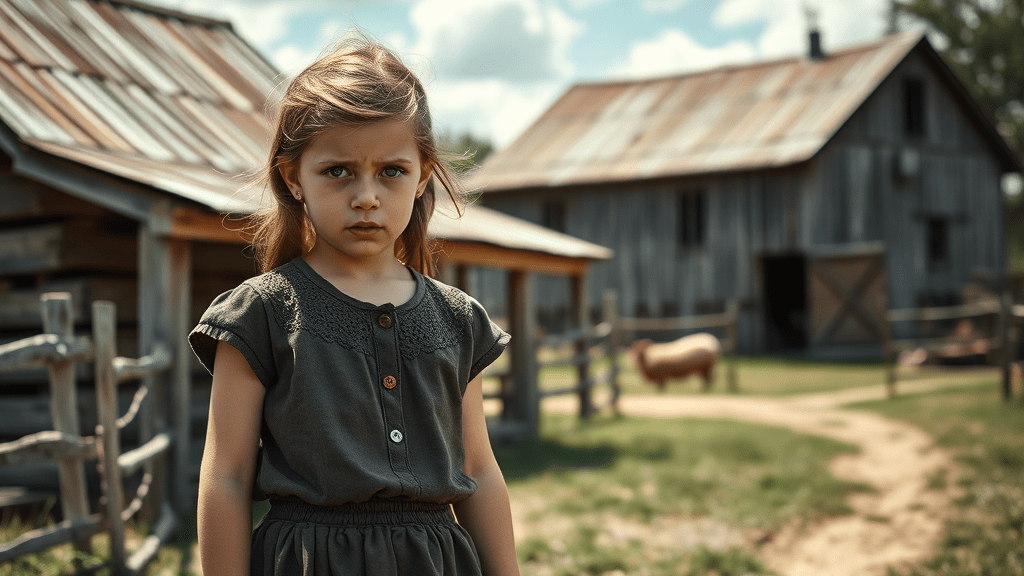
MJ could hear a loud commotion from the barnyard and raced out to see what was going on…to her dismay, her father was wielding a large mallet and threatening a stubborn hog that was being difficult to load on the trailer. Maybe the pig new that it was a fateful trip…Mary Jo ran between the frightened animal and Lorne..eyes locked, she firmly told him to put the pig back in the barn and if he bludgeoned the helpless creature it would be his last act of rage…MJ gave him the ultimatum..”put the hammer down, put the pig back in the barn, take it to the butcher another day!” Lorne complied without speaking a word – the sword had been drawn and for the very first time she saw fear in her father’s eyes.

Mary Jo recalls that in her heart she was prepared to kill her father that afternoon rather than see him torture the stubborn pig. And from the tender age of eleven the scales of power had shifted and their relationship would change forever. Lorne had met his match in this feisty young girl…..and her life as she knew it would never be the same. 


Dan Fraleigh resides in London, Ontario Canada. He is a real estate agent by day and at night and enjoys writing poems and stories. His writing has appeared in Literary Yard as well as Istanbul Masticadores.


If you would like to be part of the Rural Fiction Magazine family, follow this link to the submissions guidelines

Please share this post to give it maximum distribution. Exposure is our contributors’ only compensation. Don’t forget to back link to this.

Financial donations through either our GoFundMe or Buy Me a Coffee accounts will help expand our global reach by paying for advertising, more advanced WordPress plans, and expansion into more extensive Content Delivery Networks.


Image generated by AI

“Jack of All Trades, Revenant” Flash Fiction by Moss Springmeyer

Nobody had seen him since the fall. After sheepherding, he’d come by Crooked Creek Ranch to bathe and leave his summer’s pay with my grandparents for safekeeping; had hooked up the field cultivator to spread and work the summer’s worth of chicken manure into a small alkali flat that was a thriving hay meadow in my grandfather’s mind’s eye; had been seen loafing and sipping on Picon Punch at the bar in the Basque restaurant in Mica; had stopped over at the Shooting Star Ranch to shine as a deft roper during their autumn branding and arranged to winter there in exchange for maintaining their tack and harness. As usual in the fall, he had scooped up his prospecting gear from the Dreaming Lion Ranch and headed south. That was the last anybody had seen of him. 

He would usually have been back as October’s warm spell, Indian Summer, was cooling, before bitter cold and deep snow were serious risks in the mountains. Here in the valley, he would set trap lines for the winter. Maybe he had sensed bad winter coming and headed south on the eternal search for gold (or golden solitude with no responsibilities), far enough south that the Sonoran desert held him, ever promising but never delivering, all winter long. But, then, he would have drifted back to the Beckworth Meadows by April in time for lambing, spring round-ups, and deep disking the vegetable gardens. Yet he did not come. People began to wonder if the early snow had caught him and the Tormentoso winter had devoured him.

Then, a very old pickup truck rattled and clattered up to the Crooked Creek ranch house and out tumbled a disreputable looking bundle with a wild bushy beard and an unkempt mane. A pick and rucksack and a fat, 6’ square object (later revealed to be a cattail quilt) spilled out after him. He straightened up, squared his shoulders, futilely smoothed the mane, strode to the door, knocked, and then bowed respectfully to my grandmother. She stood stock still, then greeted him stirring warmth with exasperation. She jerked her head sideways. Obediently, Luke walked around the house to the patio facing east.

He set a wooden stool beside the galvanized metal washtub, then placed another nearby. He began shedding fabric, furs, feathers and cattail fuzz. Even stripped down, he still sported an unfamiliar fur. There was a terrible stink, but maybe he was used to it. He sat in sunlight, absorbed in simply being. He was the scrawniest man I had ever seen.

My grandmother came out in a canvas  apron and perched on the other stool. Luke hung his head and offered her his left arm — looking close you could see that his fur was not natural, but rather involved a ruin of weirdly dark and hairy waffle-cloth long underwear. Waffle cloth is normally a light oatmeal color, with bright narrow raised edges around square hollows, the squares about half an inch on a side. But not this version. 

She looked at his arm and then up into his eyes and shouted, “I’ve never seen a man go without a bath so long that his body hair’s grown through his Long Johns!” His body hair had wound its way through the waffle cloth, encasing him in an outer skin that was both him and not him.

With firm, deft, graceful movements, she began clipping the wiry hairs down close to the cloth. Remonstrating and occasionally expostulating — I could not hear the words — she eased the first two fingers of her left hand under the cuff of the sleeve, working it a little loose. She drew out a pair of nail scissors with the right hand, slid them in, and snipped. One square of the waffle cloth was detached. Relentlessly, but unhurriedly, she worked her way around that wrist. Luke regarded it with bemusement, blew softly on his newly bare wrist, and smiled. 

She snipped and lifted her way around the next row of squares, then the next. Onward, she worked her way up from the wrist, first clipping the hairs on the outside and then working underneath the fabric. Having trimmed the hairs on the outside meant that on some of the squares,  the hairs slid through when she lifted the cloth with the scissors. Then, with a bigger scissors, she cut off the fabric. 

On the stubborn squares, she eased the nail scissors under the fabric. She snipped the hairs one by one to free the cloth.

She and Luke began to sing. In some places, the fabric disintegrated as she worked. Shadows glided from the west. Finally Luke stood, naked as a baby, the long underwear in rags about his feet, some sores and angry patches on his skin. 

Cowboys who had been moving furniture during the weekly mopping of the house’s concrete floor staggered out, carrying huge kettles to pour into the washtub. My grandmother returned to the house. Luke folded his skinny frame into the tub and sat there for half an hour. Then he grasped the scrub brush, worked up a good foam on the soap, and scrubbed — wherever the skin was whole — from the crown of his head to the soles of his feet. Then a dip to rinse. My grandmother returned, donned rubber gloves, dipped a washcloth in a bucket of clean water and carefully cleaned injuries and sores. After he toweled himself off, she set to work with the medicines. As the day waned, he was decorated, almost tattooed, with purple gentian violet and vermilion  mercurochrome on his sores and injuries, a wild and savage look, but recognizably human.

“Thank you Ma’am, Bless you for your kindness. Never again, Ma’am,” he promised. “Welcome back,” she said. “You’re a sight for sore eyes, even if not a pretty one.” They laughed.


.Moss Springmeyer strives to express the world (s) in a grain of sand. Moss’s resourceful, ageing werewolf stars in  “Fur-Break”, Spring 2024 Altered Reality (p. 16).   https://www.alteredrealitymag.com/spring-2024-issue/ . “Choirboy”  probes the glory and cruelty of a very special gift in Story Block 2, Spring 2024 The Green Silk Journal https://www.thegsj.com/current-issue-spring-.html.


Please share this story to give it maximum distribution. Exposure is our authors’ only pay. You can also help our contributors gain exposure by linking to them and to RFM’s homepage.

If you would like to be part of the Rural Fiction Magazine family, follow this link to the submissions guidelines

Financial donations through either our GoFundMe or Buy Me a Coffee accounts will help expand our global reach by paying for advertising, more advanced WordPress plans, and expansion into more extensive Content Delivery Networks.


Image generated by AI