It was still dark, opaquely black, with just a faint strip of light from the village square’s streetlamp peeking through the shutter. It couldn’t possibly be time to rise. I pulled the itchy goat’s wool blanket with the threadbare satin hem over my neck in half-sleep as I lay on the wooden floorboard with only a thin comforter for my mattress. I had slept badly the night before: a field mouse had somehow wandered in from the storehouse below and found its way into my room. At one point, as I frozemotionless on my rock-hard pillow alerted by the faint pitter-patter of the tiny foraging rodent, I had locked glances with its beady seedlike eyes in mutual alarm before pulling the blanket up even tighter hoping to ignore its intrusive presence. But it was now long gone, and I struggled to shake off the torpor still holding me in its grip.
The alarm clock on the mantel had shot off with a shrill clang simultaneously with neighbor Kira Katina’s cockerel sounding its second pre-dawn crow. It was precisely four-thirty, well before sunrise. There was no delaying now. I jumped up and sprang about with the elasticity of a hare, rolled up mymattress, folded my bed-things and dressed myself in the early morning chill. Then, the green-painted wooden shutters had to be opened. One of them, overlooking the steep reclining cobblestone path to the busy square, was kept permanently locked. Aunt Lidia was not too keen on encouraging neighborhood eyes to pry into her formal living room. The other two windows opened onto Kira Katina’s stone cottage several feet below on the mountain slope. I pushed aside the delicate tatted cotton lace curtains and unlatched the shutters one by one. Straight ahead the mountain range receded towards the town of Nemea still hazy with the indigo dust of nightfall. To the left, thedistant lake mirrored faint salmon undertones of the rising sun now barely visible. The starry vault stretched expansionless above, and I breathed in the crisp morning air immersing myself in the ancient aura of my surroundings with every breath. It was rumored that Aesclepius the mythical Greek surgeon had once walked these very paths millennia ago, and that an ancient lying-in clinic for women in confinement had been founded in his honor not far from the village. These thoughts absorbed mymind as I set about brushing my hair and lacing up my sturdy oxfords. It was mid-September, and I had volunteered to help with the seasonal grape packing on Uncle Stavro’s vineyards.
The cold dew on the roofless concrete patio shocked mytired body to attention. From the exposed outdoor tap, icy water poured forth from the mountain spring above. I looked up as Isplashed the freezing liquid on my face and watched as the heavy charcoal-colored rain clouds swiftly parted, clearing the sky in the eastern horizon. In the distance, a tractor could be heard pumping its way down towards the valley. I walked into the kitchen, bleached wooden floorboards creaking under foot. Uncle Stavro and Aunt Lidia were already at breakfast and Iimmediately sensed the unspoken tenor of urgency in the air. On the ivy-patterned oilcloth spread over the wooden table lay a modest breakfast of fresh, warm goat’s milk, powdered coffee, and dried crusts of yesterday’s bread.
“Hurry, up,” Aunt Lidia commanded. “You’re always so late. We have to leave soon. Did you sleep well?”
The pungent smell appalled me. “I’m sorry, but that goat’s milk—I don’t think I can drink it. Do you mind if I boil some water for tea? You do have rusks, don’t you? I remember we bought some in town last week.”
Uncle Stavro wiped his sleeve over his milk-stained whiskers and laughed sarcastically. “So this is what my sister has done to you in that sleek and civilized metropolis of hers, eh! Eat what you want, but we’re leaving in ten minutes—sharp!”
Suddenly, I felt acutely aware of my over-refined fussinessand ‘city’ ways. I watched them attack their humble breakfast with the vigor and ravenous animal spirits of a falcon at its quarry, and felt ashamed, realizing that, however I attempted to assimilate myself into their native lifestyle, there remained some habits and traditions that would permanently estrange me frommy relatives.
When I had finished my tea, the house was locked, the unwieldy skeleton key placed under the pot of flowering basil, and we were off to the vineyards in Uncle Stavro’s tractor. Aunt Lidia fastened a paisley bandanna over her hair then drew a bulky woolen goat’s blanket over our legs to keep away the morning chill. When we arrived at the fields twenty minutes later, neighbor Kira Katina and her daughter were already hard at work, both carrying large wicker baskets on their shoulders and winding their way between the rows of grape vines picking out the ripe, gilded clusters for packing. I was struck by their thick, ochre-colored tights and black leather slippers that gave them the appearance of graceful, elegant dancers weaving in and out of every cane with artful skill and precision.
Aunt Lidia sat herself down on a clearing of nettle stumps and baled hay between Mihali, a village elder, and a young bare-chested and sun-browned boy of about fourteen. “You can sit next to Taki,” Aunt Lidia said, pointing to the young day laborer whose mud-caked toes were poking out of his patched brown rubber sandals.
“OK, now tell me,” I asked with eager anticipation. “I want to know all there is about grape packing.”
“You have to move fast here,” Taki said, his shy smile exposing a broken front tooth. “Just pick the largest bunches from the baskets, three to a row, and place them together evenly in the crate and line them with sheets of pink paper from the pile. That’s all. Whenever you need another crate, just call out.”
Well, if that’s all there is to it, I thought. I began slowly, clumsily at first, arranging and rearranging each cluster of grapes, straining to make something of an artistic composition out of the layout. I fussed about and consciously strove for the effect of aesthetic perfection, an exemplary crate that any greengrocer would be proud to display in his prized storefront collection of comestibles. When I called for another crate, Uncle Stavro came poking over to inspect the work.
He took off his cap, shook off the dust then refitted it over his balding head. “Meh, it’s all right,” he said flatly. I was crushed. “But, look here,” he pointed with a stubby finger, “the edges are sticking up unevenly. They’ll be bruised. Try again.”
This time, I waited and deliberated, silently holding a cluster in my hand. I closed my eyes for a moment to focus myresolve. Then, I fixed my gaze on my neighbor worker’s hands, absorbing his energy, letting his effortless experience and unselfconscious skill flood my thought channels. I began again, without deliberation this time, simply allowing my hands to guide themselves, enabling each bunchstem to come to life and settle itself perfectly into its pre-ordained niche, abandoning any thoughts of forced calculation. The crates now filled themselves automatically as I allowed myself to ride the spirit of their force, blindly, subconsciously, through a mystical process of mechanical memory. Soon, I was listening to the idle chatter allaround, threading the air along with the subtle wildflower-scented breezes.
“How are the walnut trees going, Mihali?” asked Aunt Lidia.
“There are twenty of them this year. Three we’ll use for preserves. It’s enough for Katina to handle for our daughter’swedding next January.”
“How’s the boy—what’s his name—Antoni, isn’t it? He’s from a good family, is he? And Rena’s dowry?”
“We thought we’d give her twenty acres. Along with Antoni’s forty, that’ll give them a good livelihood for now. But he wants to live in the city. All the young people are moving away. Pretty soon, there’ll be only us elders left in the village.”
“Ah, Mihali, I feel for you,” Lidia empathized. “Since Amalia married, we’re all alone now, and our only son left for the city. He wants nothing to do with our village ways. What do you think, eh, Taki?” she asked, her eyes still fixated on her work. “Will your parents let you leave, too?”
Taki didn’t reply. He just grinned and let a roguish expression steal over the corners of his mouth revealing a small dimple on his right cheek. Then, spontaneously, his lopsided lips opened and burst out in song, an old demoticfolk ballad that Ihad never heard before. The lyrics were typical: a young man falls passionately in love with a village maiden called Marigówho he secretly meets in the moonlight. She refuses to marry him; her eyes are set on another. But his heart is aflame and he vows that on the next full moon he will kidnap her and take her away.
I listened transfixed by the haunting melodic line, and felt the rising warmth of the midday sun gradually fill the air. As my hands worked abstractedly, my roving glance suddenly focused on a nearby pile of hay which seemed to be pulsating and rustling with a secret life force from within.
“What is this?” I shrieked in shock. “All this time this—this thing is lying there watching my every move and you said nothing?”
Taki and Aunt Lidia burst out laughing. “It’s just a harmless insect,” my aunt said derisively.
“This thing is massive!” I protested. “It’s at least six, seven inches— ”
“It’s a giant walkingstick,” Taki said, “a megaphasma. They’re everywhere. Look, they have no wings, they can’t fly—” He fearlessly picked up the slender straw-colored creature between his brown calloused fingers and held it tauntingly over my head.
“Stop it! Please, take it away—”
“Just so you’ll know what rich little treasures we have here in the village,” he said smiling knavishly.
Overhead, converging layers of nimbostratus clouds were rapidly starting to block the sun. Uncle Stavro sensed precipitation and coaxed the women to collect as many grapes as they could. “God forbid there’s a hailstorm,” I heard him mutter. “It will be our ruin.”
The baskets and crates were hastily covered with blue tarp,and as the first raindrops began to fall Uncle Stavro called us all to the small wooden shed nestled at the slope of the hill overlooking his grove of fig trees. Aunt Lidia unpacked a woven hamper and spread out a meal of sour bread, cheese, olives, tomatoes and scallions on an oilcloth over the bare earthen floorwhile Taki was sent to unstrap a large wicker-wrapped wine bottle from the tractor. We tore into the food and ate heartily—all seven of us—cramped as we were in the narrow ramshackle enclosure, sharing drink from a pair of tin cups.
When the plates and napkins were cleared away, Mihali produced a ragged pack of cards and shuffled out a game of Kumkan with Taki, while the women grouped themselves together with their knitting. I sat with Uncle Stavro before a small opening in the thin wooden wall, the only source of light.
“You know,” he said teasingly, “right there where you were sitting, your mother was once bitten by a scorpion when she was a little girl. She almost died.”
“Oh, no—why didn’t you warn me, Theio?” I asked. “It was bad enough to be surrounded by swarms of wasps and dragonflies. And, wait—snakes, horseflies, spiders, who knows what other hideous creatures. If I had known that,” I said brushing myself briskly, “I might have just stayed at home!”
“That’s just why I didn’t tell you,” he chuckled. “And the horseflies—they’re the worst, aren’t they!”
The sky darkened abruptly and low-flying clouds swept over the vineyard almost touching the ground. A faint rattle on the corrugated tin roof increased to a deafening clatter; tiny crystalline pebbles suddenly began to pound through the window and in the distance, through a wedge of sunlight near the fig grove, they glistened like illuminated chips of pearl jewelry. No sooner had they appeared, when the rainfall subsided.
“Thank God it wasn’t serious,” sighed Aunt Lidia while crossing herself.
“Doxa si o Theos—God be praised!” nodded Kira Katina.
The clouds drifted away rapidly, the sun reappeared, and from the direction of the distant town of Nemea, a rainbow formed in radiant ethereal particles stretching above us in a pastel-colored arch over the valley. I looked out the window entranced by the spectacle. The mountain range that housed all the neighboring hamlets formed an endless procession, like an army of ancient helmeted warriors—sentinels of a collective past that joined everyone present in a shared ancestry—spreading in grandiose symmetry steplike towards infinity, one stony crag rising behind another in every direction like a mythical landscape. This is my mother’s birthplace, I mused enraptured, letting myself be drawn into the grandeur of themountains, and the archaic legacy of the vista.
We returned to work for two more hours, and I now let myself be absorbed into my labor with a rush of exhaustive fury. At four o’clock we loaded the crates onto Uncle Stavro’s tractor and headed back to the village following behind by foot.
“You worked hard, didn’t you?” he said encouragingly. “That was real farm work you were doing.” I thought there might be a veiled patronizing undertone somewhere in his praise, but only smiled in reply.
When we arrived at the junction on the main road, the agent was already waiting for us with his truck. After inspection, he congratulated Uncle Stavro on his yield for the season, and settled a price for the load. As I began to ascend the steep slope home, I overheard his whispered murmuring as he drew my uncle aside.
“I see you have a new worker. We’ll have to redo some of the crates, you know. We’ll deduct for the extra labor. Make sure this doesn’t happen next year.”
I knew I had overslept the next morning. When I awoke late at seven thirty, the village was eerily quiet except for the occasional bleating of the ewe below in her pen. Padding to the kitchen, I found the note my aunt had scrawled on a torn strip of lined notebook paper resting under a pack of rusks:
‘Gone off to work on Mihali’s harvest. Back by sundown. Have dinner ready when we return.’
It was good to stay home.
Author of the debut novel Twelfth House and Shaded Pergola, a collection of short poetry with original illustrations, E.C. Traganas has published in over a hundred literary journals. She enjoys a professional career as a Juilliard-trained concert pianist & composer, and is the founder/director of Woodside Writers, a literary forum based in New York. www.elenitraganas.com
If you would like to be part of the Rural Fiction Magazine family, follow this link to the submissions guidelines.
Please share this story to give it maximum distribution. Exposure is our authors’ only pay. You can also help our contributors gain exposure by back linking to them and to RFM’s homepage.
Illustration: “Village Square, Corinth” — Watercolor & gouache by E. C. Traganas
“Uncle Jack,” I heard someone call out. In a mangled straw hat, a jungle-print shirt, and a tie looped around his neck. he looked like a clown, a buffoon. But I recognized him right away, that pony tail, those cloudy blue eyes. For two decades we hadn’t heard from him, thought he was dead. Or at least I hoped he was.
I turned to my husband. “For god’s sake. Of all the places,” I muttered, at the cemetery now for a funeral, my mother-in-law’s.
Teddy slid his meaty arm around my husband’s neck and pulled him toward him, as if they were buddies, saying, “Damn shame. Damn shame about grandma” over and over, clearly sloshed.
I did the math. He had to be thirty-five by now, yet, despite all the drinking and street-living, he still looked boyish, handsome, the quarterback of the football team, though as far as I knew he’d never even graduated high school.
“Now don’t you embarrass me.” Jack’s sister Nadine came over. She yanked him away. Wearing a dress and heels, she was wobbly herself, though it wasn’t from drink. She never drank, despite having plenty of her own problems.
In the meantime, Rosa May, reduced to a pewter urn sitting in a small hole surrounded by green tarps, would have been fuming. A long time ago she’d gotten a restraining order against him, but over the years, whenever his name had come up, would say, shaking her head, smoke swirling up from her cigarette, “Such a sweet baby. Can’t understand it. Wasn’t he Jack? Now don’t tell me he wasn’t,” and my husband, ever his mother’s favorite, the one that turned out good, would gently remind her that Nadine had been sweet before she’d gotten hit on the head and raped and started having babies at fifteen, a dozen or so by the time she was through, no one exactly sure what had happened to most of them.
As for me, Teddy was the last person I wanted to see, even though I knew Jack had always had a sweet spot for him, had wondered about him. Before we’d married, he’d been living with him, and when Jack introduced me and then went back in the kitchen to prepare dinner, Teddy threatened me.
“He hates women,” Jack had said afterward, when he’d driven me home, explaining how Teddy had been sexually abused by a next-door neighbor.
I’d said if he moved in with us—we were planning on marrying then—I’d be a goner.
“Now don’t you embarrass me,” Nadine repeated, waving her finger at Teddy who was now standing there with his hands in his pocket. Then for some reason she giggled. It sounded like a machine gun.
Stepping back a little, I turned a little, gazing at all the other headstones. A simple, humble rural cemetery it was. Plastic flowers and angelic figurines sat in front of headstones. At the fence line a half dozen cows from neighboring ranchland, heads hanging over, were gazing at us. I glanced back over at Teddy, hoping time and decades of booze had brought on a certain amnesia. I remember how we’d been on the deck together, Jack in the kitchen. It was so dark I could hardly see Teddy. “You better not mess with my Uncle Jack,” I remember him saying. He was just a kid then, but the way he’d said it had made my skin crawl.
“So how’ve you been? How’ve you been? How you been, Uncle Jack?” Teddy slapped him on the back now, then gave him a soft punch on the arm, all the while his head slowly weaving and bobbing like a stunned boxer’s.
“Now you shush, Teddy,” Nadine said. “Vernal wants to get started.” Her skittish eyes darted back and forth like spooked minnows. “A nervous tick,” Jack had said, and I wondered if that had started after the rape. She’d been knocked on the head apparently too.
As we situated ourselves around the gravesite, some people sitting, some standing, the sky which had been overcast, cracked open, letting sun through. Earlier it had rained, and now I started thinking about the worms that had unearthed themselves, their chalky smell, how the sun would soon dry them up if the birds didn’t get them first. We sat down. From behind I felt a hand touch my arm.
“Sweetheart.” It was Rosa May’s sister Auntie Lou Lou, dressed in lime pants and a checkered blouse, her annual Christmas outfit. Soft white ringlets framed her face, and the points of her horn-rimmed glasses jutted out at the edges of her eyes. “Isn’t it just terrible,” she said, shaking her head. Stooped a little, she’d been sick in the pancreas but wouldn’t say if it was the cancer com back.
“I’m so sorry,” I said, taking her hands, withered things, all the veins protruding.
“I mean about Trashbin,” she said.
Jack had told me that about how she and her late husband had run him over, just a puppy then, on some lonesome road out to Las Vegas and then got him fixed up. But after they brought him home, he ate everything in sight.
Auntie Lulu pulled a cedar box out of her bag, a paw print on top. “Can’t we just send him to the Lord with Rosa May? Just mix him in there.”
I looked behind me, at all the chairs, three rows filled with people I didn’t know. I started to stand up. “Here.” I took Auntie Lulu’s hand. “Sit.”
She started moving backward. “Oh no, you honey. That seat’s for you.”
“I’m not family, though,” I said, but she was already shrinking toward the small herd of mourners milling some distance behind. For decades, she and Rosa May had lived in separate apartments in the Glendora Palms, spying on each other through parted curtains, across the courtyard, the feud about a car or money or whose children turned out worse: one a rapist, the other a child molester.
I peered at the mourners now, wondering which was rapist, which molester, but in my husband’s family it was hard to know whose children were really whose, what was true and what wasn’t, when I heard a man clear his throat. It was Vernal, an old friend of Rosa May’s, standing behind a podium, flipping pages of a large, leather-bound Bible, with yellow post-its sticking out of it. With his black suit and white hair he was very dignified looking, a stout statue.
I sat down again and discovered another chair now beside mine. Slouched down in it, head drooping on his chest, Teddy was snoring lightly beneath the shade of his thatched hat. Too late to say anything, I squared myself to the podium, then I placed my hand at the back of my husband’s neck and leaned into him. When he’d gotten word that Rosa May was gone, he’d just gone silent. That’s how he was when someone died.
“We shouldn’t think of this as the ending of life but the beginning,” Vernal began. “Rosa May wouldn’t have wanted you to be sad for her. Her entrance into the Kingdom of Heaven.” Vernal looked up at his raised hands, large pink hands, hands that in their youth could have conducted orchestras, summoned thunder, or throttled chickens. Then he looked down at the Bible, on the brink of quotation, of profundity, and then, his finger stumbling across the page, he peered over at us. “She’s looking down on us right now. I know she is. Her loved ones, her friends.” He cleared his throat again, and beside me Teddy had come to, clucking his tongue, saying, “Amen, my friend, amen” as if he were steeped in spiritual passion, until Nadine, at the other end, came over and shushed him while Vernal kept running his finger across scripture like a blind man. “Rosa May liked to talk and drink coffee, and she liked trees and the little birds that twittered in them. She liked screwdrivers and to quote Nietzsche” to which Teddy, said, “Right on,” and everyone looked at him, and he looked at me with his pale blue eyes, and in his still-handsome face I thought I saw mild curiosity, a kind of recognition.
Inside, a small party of us met up at the hostess station of PJ’s, All You Can Eat, in honor of Rosa May, who believed in food, especially at a bargain. At the center of the restaurant were food bars, each shaped like a little square house topped with a steamy glass roof. Once we were given the go-ahead, we all lined up at a counter and took a warm, white plate and utensils and set them down on our trays. Then we dispersed among the various food houses, each one a different nationality–Mexican, Chinese, Japanese, Italian, Greek, and American, where I caught up with my husband who, bent under the roof, was peering at the tins of fried chicken, chicken fried steak, mashed potatoes and gravy, kernels of corn that looked like baby teeth, and string beans glistening in butter. “This food.” I peered at the steaming houses, the mounded plates passing by. “There’s so much of it. I hope your nephew isn’t coming.”
My husband leaned toward me and said, “He asked me who you were, why didn’t I introduce him.”
From my plate I plucked a string bean with my fingers and bit into it. Oddly enough that was how Teddy had eaten his food the night we’d first met at Jack’s, with his fingers.
My husband and I sat down at a table across from Vernal. A regal-looking woman with a whorl of white hair and pretty sapphire eyes sat beside him.
“I remember you from the hospital, “Vernal said to me as I sat down. “After Rosa May’s last bypass. Jack’s wife. Rosa May loved you. And Lord knows she didn’t love everybody.”
I looked down at my plate, chicken wings, mashed potatoes, string beans. “I didn’t know Rosa May liked birds.” I glanced out the picture window, at the front of the restaurant, to the huge cement parking lot where pigeons were pecking at the ground.
The woman beside Vernal suddenly lifted her head and smiled at me. Her fork hovering in mid air, she slowly turned her head left and right like a cobra. “Where is my husband?” He was here just a minute ago.” Her fine brows furrowed slightly. She turned to Vernal and peered at him, as if he might give her the answer.
“Darling,” Vernal said, sliding his arm around her, “I’m right here. We’re in a restaurant. We’re eating.”
“Oh yes.” She smiled sweetly at the fork, then delivered it to her mouth and chewed. “I’m eating,” she said, “eating food.”
Vernal, leaning across the table toward us, said, “This is my devoted wife, Eleanor. God bless her, she’s got Alzheimer’s. She used to manage a See’s Candy shop downtown. Isn’t that right, Eleanor? Can’t you just see her in her white uniform? Isn’t she beautiful?” He sat back and beamed at her.
My husband and I both nodded then went back to eating. What else could we do? I looked around the restaurant. Most everyone else had eaten a cursory plate and cut out.
“Don’t you worry about Teddy.” Nadine suddenly appeared and sat next to me. “He’s not to come in until everyone’s done. Then he can feed.”
I looked out to the parking lot again. There he was with the pigeons pacing back and forth, smoking a cigarette.
“The Lord has a plan for everyone,” Vernal said.
“Well I hope he doesn’t plan on letting him in,” I said.
“I doubt the Lord wants us to be mean, to make him wait out there,” Jack said.
“He’s drunk,” I said. “Totally sloshed. He could get mean.”
“Oh, honey,” Nadine said, “he’s not like that anymore. He’s got that sickness in his head. Hears voices. He gets them tremors. Now I worry someone might hurt him.”
“Your mother,” Vernal said, rising, “was a good woman. I’ll miss her.” He looked down at his wife, who was still seated. She’d stopped eating, was staring serenely, immersed in some memory, chocolates nestled in their paper shells, egrets poised in upturned fields, or something else pleasant.
I used to work as an aide in a nursing home, in the memory unit, always had the urge to ask them, “What? What are you seeing?” as if they were psychics of the past.
But Vernal was already lifting her up by her shoulders, gathering her like a bouquet of flowers. “Come along now, Eleanor.”
A flash of annoyance crossed her face, but she stood up anyway. At her full height she was taller than Vernal, probably taller than everyone in the restaurant and the whole wide world. Extending her hand to me, she smiled. “Who are you?” She still had the perfect white teeth of a beauty queen.
Through the window my husband and I watched them cross the lot. Teddy stopped pacing and tossed his cigarette. For a minute the three of them were huddled. Maybe they were praying.
Jack turned to Nadine. “Why don’t you let him in now?”.
“I told him if he don’t behave he isn’t allowed in. What he just done at Mama’s funeral. Darn near embarrassed me half to death.” She shook her head. “Barely leaves his room anymore. Like a little mouse, afraid of his own shadow. Always thinks someone’s following him. I’m afraid someone might hurt him.” Nadine stood up and reached into her bag pulling out a green velvet box, J.C. Penney inscribed on it, handed it to me. “Mama wanted you to have this.”
I cracked it open. Nestled inside was a gold ring with a be-be size jade stone in it. “That’s lovely,” I said, removing the ring from its slit and slipping it on my finger.
My husband touched the ring. “You’ll need a guard for that.”
Then Nadine handed me a book. “I’m not much of a reader, so I think Mama would want this for you too.” She bunched up her shoulders and giggled. Nadine always liked giving presents.
Sonnets from the Portuguese. I opened the cover; inside someone had written, “To my Love, Rosa May.” I looked at Teddy. “Your father?”
Nadine giggled again. “Oh, I don’t think Daddy liked poetry.”
My husband stood up. He headed back to the restrooms.
Nadine went out to the parking lot.
Before my husband got back, the front door of the restaurant opened.
“Now you fix yourself some food and don’t make a nuisance of yourself,” Nadine said, leaving Teddy there, heading to the restroom too.
I turned back around, alone at the table now, except for all the other people eating at their own tables, the ones who hadn’t attended the funeral and were just eating. I was hoping Teddy, in his stupor, would just go sit down at one of those tables with strangers. There’d be commotion, of course, but then again maybe there wouldn’t.
In his straw hat, he sat down beside me anyway and started shoveling in the food with a spoon, the mashed potatoes and gravy, the turkey, corn, baby carrots. And for a minute I thought he didn’t even realize I was there. If you could imagine people following you, maybe you could think no one was beside you.
But Teddy put his fork and knife down, his eye catching the book on the table. He took his straw hat off and wiped his hands on a napkin and then helped himself to it. “Sonnets from the Portuguese.” He flipped through it and then put it down. “I’ve been writing some poetry, you know.” He looked me full in the face this time. His hair, out of its ponytail, now hung down past his shoulder blades Viking style. “Lousy stuff, though” he said, morosely. “How do I love thee? Let me count the ways.” He tossed the book on the table, then rubbed his cheek. “What about you?”
Jack had always said Teddy was a reader, was always stealing his books.
“Well sometimes you have to write the bad stuff to get to the good stuff” came out of my mouth.
He glared at me sideways. “What do you mean by that?”
“That’s how it works.” I hadn’t meant for it to come out sarcastic. My heart started palpitating. “Not just with poetry. With everything,” I looked over my shoulder for Jack. I began thinking that he and Nadine had planned this, that together they were watching from some secret corner of the restaurant or in a backroom on a security screen.
“Hey, I know you,” he said. “I remember you. You’re the one.” His face contorted. He suddenly stood and pushed his chair back hard, tipping it over.
The restaurant had suddenly gone silent. The bus boys hurrying down the aisles seemed to have frozen. But I held my ground as I’d done that night on the dark deck when Teddy had threatened me. Now though, he was gone, out of the restaurant, back into the parking lot.
My husband sitting down beside me now.
I peered at Teddy’s plate, the half-eaten food all congealing into a puddle.
Then Nadine showed up. “Doggie bag, eh?”
It was sunset when we left, when we drove the winding stretch of Marsh Creek Road, the narrow, two-lane artery that bisected farmland and orchards, the pretty part of the valley. On the way in, we’d taken the highway, the ugly way, so we wouldn’t be late.
“Look at those,” I said to my husband as he maneuvered the curves. Egrets were dipping their white necks into the green fields. “It was a nice funeral, especially Vernal with his post-its in his Bible. Your mother would have gotten a kick out of it.”
My husband, taking another curve, cut the wheel.
I grabbed of the door hold. “You aren’t angry, are you? You haven’t said much.”
“Did you notice that the flowers were missing? The roses I had sent over?”
“Maybe the florist sent it to the wrong funeral.”
“No, the card was there. I found it on the ground, near the tarp.” He pulled it out of his jacket and handed it to me.
“From a loving son” was written in someone else’s hand. I held onto the card, could feel its sharp edges, as I watched the asparagus fields pass. “You don’t think . . .”
“Why would he?”
I shrugged. “Why does anyone do anything?”
“I told you he’d never hurt you.”
“Your mother said he threatened to kill her with an ax. I don’t think he should have been there.”
“It was his grandmother. And now look at him. Couldn’t hurt a fly.”
“You don’t know that. You don’t know where he’s been. Did you know your Auntie Lulu wanted to dump Trashbin in there with your mother? She had him in her bag, in a box, his ashes.”
My husband chuckled. “Mother did like dogs. Remember, I did grow up on a farm. Ducks, chicken, cats.”
We were passing through the orchards now and all the cheerful signs: Pick Your Own Fruit. Cherries: You Pick. Pick & Eat. Then came Round Valley, a hilly hiking area we’d been to before, a sloping place of tall grasses, wildflowers, old growth oaks, and the fragrant Buckeye trees.
“We’re going to need some more of those bebobs,” I said, as we passed the entrance, “for the glass vase in the dining room.” Bebobs. That was the name we’d made up for the Buckeye fruit, the dark brown seeds that looked like a buck’s eye. Next fall, when they burst their green pods, we wouldn’t be able to resist.
Janet Goldberg’s novel The Proprietor’s Song was published last year by Regal House, and her story collection Like Human is due out from the University of Wisconsin’s Cornerstone Press in Fall 2025.
Please share this story to give it maximum distribution. Exposure is our authors’ only pay. You can also help our contributors gain exposure by back linking to them and to RFM’s homepage.
Every family has a history filled with stories, recollections, and memories. Over time, these reminisces take on a life of their own, but a note of caution: they will only remain alive as long as someone in the family remembers and shares. Over the course of decades, leaves begin to fall from every family tree, and eventually, only bare branches remain. My parents passed away over 25 years ago, and in the intervening years, three of my sisters departed Dodge too soon and are with them. As the writer and historian in the family, I am putting the proverbial pen to paper to bring back to life one of the central stories my siblings and I were raised with. In fact, it is the genesis of our familial history, when two saplings met and created a new family tree.
Our parents were indeed an attractive couple. As a young man, Dad was one handsome dude, and Mom was beautiful, with high cheekbones. My sisters, brother, and I learned from our parents that Dad had a motorcycle as a young man and that our mother had met him in Vineland, in the Niagara area, when she worked there as a young Farmerette. This was after WWII when there was a need for produce, but in a world where many young men, formerly farmers, had given up their lives. Thus, the Farmerettes came into being, and many young women from the countryside joined to do their part at the Vineland Farmerette Camp and other places in the province. Mom was only 16 that summer, and it was her first time away from home for such a long duration. Dad was six years older than our mother and undoubtedly cut a dashing figure on his Harley-Davidson motorcycle that summer day. As children, we knew the bare bones of this seminal family history, but I now wish we had fleshed out more details and asked more questions.
When did Dad buy his motorcycle? When did he get rid of it, and why? Did Mom want to work as a Farmerette, or had her parents convinced her to go? Was it love at first sight when Dad and Mom met in Vineland? Did they date for the next four years until they married, or did it take time for our parents to fall in love? Were our maternal grandparents concerned that their daughter was interested in a man six years older than her? Why did our father ask our mother to
go on the motorcycle that fateful day in Vineland?; why not one of the other girls? Was it just for a spin around Vineland or a ride of a longer duration? How did The Clanging Pistons originate?
Yes, that was the name of the group of young men and their motorcycles: The Clanging Pistons. Dad would smile when telling us about the group’s name and fondly recall memories of how he and his friends would drive around the countryside on their motorcycles. Of course, the culminating story would be about the group travelling to Vineland to see some local girls from the Clinton area who were working at the Vineland Farmerette Camp. A few of the girls were either sisters or sweethearts of these dashing young, motorcycle-riding men.
Even as a child, when I heard about The Clanging Pistons and the Vineland Farmerette Camp, it seemed to me to belong to a gentler, kinder, and more romantic time. That story, the genesis of our family, took on a rather fabled and folkloric aspect over the years, particularly when, over time, it was apparent that our parents did not have a fairy-tale marriage. It was a
typical marriage of the era: hardworking parents, a large family, and children who grew up during radical societal change. Our parents loved each other but did not have much in common and were sometimes at odds. However, they stayed together for their children; that is the greatest gift they could give us. As our parents aged, they became closer, and due to my mother’s ill health, Dad became her caregiver.
For a long time, I had not thought about Dad being part of The Clanging Pistons and that Mom had been a Farmerette after the war. Then my sister sent an email to me with a link to an article in the local news about the Farmerettes and their central role during and post-WWII in tending and harvesting vegetables and fruit in the Niagara region. A new Canada Post stamp would be issued to recognize their services. The article highlighted the contributions of local girls who became Farmerettes from the early ‘40s to the early ‘50s, mostly in Ontario’s Niagara and Windsor regions. A few months earlier, the Blyth Festival had also staged a play about the Farmerettes. They were getting their long-deserved recognition.
Some of the women who were formerly Farmerettes are still alive, in their 90s, and have been interviewed. When my mother passed away in 1996, I was asked to give her eulogy. In one part of the eulogy, I referred to how our parents had met on a fateful, fairy-tale day in Vineland in the late ‘40s. I mentioned that our father had taken my mother on a motorcycle ride that lasted for almost 50 years. I said that I could imagine the two of them on our father’s motorcycle that day in Vineland: Dad, cutting a handsome and dashing figure on his beloved Harley-Davidson, and our youthful, beautiful mother sitting behind him, hanging on for dear life. I described how I pictured them that day: Mom’s glossy hair blowing back in the breeze, and I quipped that Dad’s hair was probably blowing in the wind, too, because he still had a good head of hair back then.
Due to the renewed interest in the Farmerettes recently, my brother sent a photo to my sisters and me that had been posted on Facebook years before. It is one that I remember from our youth; it had probably been in our mother’s photo album for years. It was in the local paper in 1948 and depicted five young men who had gone to the Vineland Farmerette Camp to visit local girls working there. The Clanging Pistons is not mentioned, but Dad and his four motorcycle buddies are in the photo, proudly sitting astride their Harley-Davidsons and presenting a dashing group. This may have been after their triumphant return to Clinton from Vineland; these vibrant young men had their whole lives ahead of them, and there was the promise of other anticipated adventures along the way.
John RC Potter is an international educator from Canada who lives in Istanbul. The author’s poems, stories, essays, articles, and reviews have been published in various magazines and journals. His story, ‘Ruth’s World’ was a Pushcart Prize nominee, and his poem, ‘Tomato Heart’ was nominated for the Best of the Net Award. The author’s gay-themed children’s picture book, The First Adventures of Walli and Magoo, is scheduled for publication.
Please share this story to give it maximum distribution. Exposure is our authors’ only pay. You can also help our contributors gain exposure by back linking to them and to RFM’s homepage.
Henry looked at the dead puma. Jesus H. Christ…Never seen anything like this shit. He nudged the corpse with his boot. Two-year-old male. He bent down, pulled his Buck knife from its worn leather sheath, and used the fixed blade tip to raise the dead lion’s outer lip to examine its teeth and gums. Full set of healthy teeth, including razor sharp fangs. Henry scraped a little bit of blood and flesh from the teeth. The puma had a tuft of bristly boar hair stuck in its lower lip. He bit that hell hog at least once.
Henry checked the claws next; they were also healthy. From the front left paw, he pulled another tuft of the boar’s coarse hair from between the toes. He pushed the pad just under one of the retractable claws, forcing it out. The claw also had dried blood on it. Raked him, too.
He rolled the corpse on its back. Damn, that hell hog splayed him open, mid-stomach to ball sack. Henry ran his hand over the rib cage; he felt at least three broken ribs. That bastard steamrolled him, just like the two cur dogs and pitbull he killed a couple weeks back. This bastard is big.
Henry dragged the cat off the single track by the tail, then used his knife to skillfully cut its head and paws off. He carried them over to his side-by-side and wrapped them in his camo jacket. As a professional hunter, Henry knew this was illegal as shit in California. Hell, I only seen one mountain lion in my life. I ain’t gonna get this chance again. I’ll make me a claw necklace and euro mount the head. He unsnapped the tie downs holding his shovel, then headed back to bury the remains.
#
From the top of the ridge at the edge of his ranch, Randall Miller waved for Henry to come up. Henry nodded and waved his cowboy hat, then jockeyed the ATV up the twisty dirt road. He stopped at the cattle gate leading into Randall’s ranch.
Randall greeted him, his old .44-70 with iron sites resting on his shoulder and his .44 magnum revolver strapped to his hip. Jesus, the old boy looks like he can barely carry his own weight let alone that old lever action and the hand cannon.
“Howdy, Randall. I found that dead lion you told me about down in the wash below west ridge.”
Randall blew snot cowboy-style from his nostril, then spat Redman juice into the dust. He looked at Henry with his good eye, his blind milk-white eye locked vacantly to the right.
“Ain’t never seen a damn thing like it,” Randall said.
“Amen to that. This is the nastiest boar I’ve ever heard of.”
“You gonna find and kill that sombitch before it kills another dog of mine?” Randall asked.
Henry smiled. Worry about yourself old man…that boar’ll kill you if he gets a chance.
“Yep. Randall, I’ll kill that boar for you. For now, you just keep your dogs in their pen for a few days. Tomorrow, I’ll bring out my ankle biters and scent hound and catch his ass.”
Randall spat chew juice again.
“You kill ‘em and bring me the skull and cape and I’ll pay you double. I want to mount that sombitch and hang him on the damn wall.”
Henry nodded, turned, gave a wave without looking back and headed to his side-by-side.
#
In the shade of the canyon, Henry drove down the dirt track just faster than he could walk, his body leaning out, his eyes scanning the dirt hoping to cut a fresh track. His scent hound, Clovis, sat next to him on the passenger side, his nose lifted into the breeze trying to catch the first pungent whiff of boar. Behind them, their leashes clipped to a D-ring bolted to the bed, his rat terrier, Mabel, and his jack russell, Gertie, laid on each other napping. Henry loved watching the little dogs fearlessly latching on to the ankles or ball sacks of pissed-off boars.
Henry spent the entire morning zig-zagging the network of ranch roads and trails that wound through the canyon. He knew the pigs would push up into the foothills soon; the days were getting hotter, and the creek was a trickle now. The mud would dry soon. I need to kill this bastard before he kills another dog or moves up into the hills for summer.
Around noon, Henry stopped atop a knob to glass. He hadn’t cut any fresh sign. He let the dogs loose. Mabel and Gertie stretched, sniffed, pissed, then began chasing each other in a big zig-zag.
“That’s it girls, get some exercise. We ain’t finding this bastard today.”
Clovis ambled a few yards out on the point and made a few circles with his nose held high. Smelling nothing, he laid in the dirt and promptly fell asleep. Henry pulled out his cooler and grabbed a cold Diet Coke and some jerky. He had two cold beers ready for after he killed the pig. Where the fuck did you go, you nasty fucker? Hell, I don’t even know what you look like…
#
Sometime around 1:00 a.m., Randall’s hounds began howling and yapping in their pen. Sombitches best not be yapping at a goddamn skunk again. The cacophony grew in volume, becoming frenzied after a minute or two.
Clad in long johns, Randall grabbed his .44 magnum, wrestled himself into his cowboy boots, and donned his cowboy hat. He’d almost tottered to the dog pen when he caught the rancid stench of wild boar. Goddamn he’s close.
Randall opened the pen and his four remaining cur hounds raced toward the small avocado orchard behind the ranch house. Randall gave chase in a slow, unsteady jog. He could hear the dog’s barks becoming more urgent. They’re on his ass now.
Randall became winded. I ain’t gonna catch ‘em on foot. He decided to get his ATV. I’m gonna kill that bastard myself!
He was halfway across his yard to his garage when the big boar charged. Half-deaf from age and gunshots, he heard a grunt right before impact.
As he laid in the dirt, blood trickling from his mouth and ears, and a warm torrent of blood running down his thigh, he realized the dog’s barks were moving further away. Then Randell realized the boar had returned. He reached for his pistol.
#
Just after sunup, Clovis picked up the scent. Henry clicked on the dog’s collar, made sure it was registering on the iPad display, then cut Clovis loose. As a scent dog, Henry had trained him to track and point when he was within a hundred yards.
“Once old Clovis finds that bastard, you girls are going to catch him and fuck his nuts up,” Henry said to his little terriers. Gertie pawed at the air, ready to work. Mabel yawned.
Henry watched the iPad icon of his hound move on the GPS grid. Clovis worked in a slow arc, first moving away from Henry, then looping back. That boar is moving slow.
Around 9:30 a.m., Clovis stopped moving. Henry checked the display. Shit, he’s only 200 yards north of me. Looking at the GPS topo map, Henry could see the boar had likely bedded increek bed below. He pushed back his cowboy hat and massaged his temples. He hit the recall button for Clovis.
“I ain’t losing old Clovis or you girls,” he said aloud.
#
Henry loaded his Remington .300 magnum with 180-grain solid bullets. He worked the bolt, put one in the pipe. He turned his scope down to its lowest power. He strapped his Ruger.44 loaded with bear rounds to his right hip, grabbed his shooting sticks and left the dogs leashed to the side-by-side.
He walked up a steep fifty-yard rise in the road to the top of the ridgeline. On top, he angled toward the canyon edge running above the creek. Henry figured the boar was bedded in a small wallow he’d found a few days earlier. The morning was already pushing 70 degrees Fahrenheit. That old boy will be laid up in the shade near the mud and water.
Henry moved slowly watching the ground for loose scree and rattlers. Crouching, he made his way to a small series of boulders. Keeping low, he peeked around the boulder. It took a minute to see the boar with his naked eye. A seventy-yard chip-shot.
Partially obscured by brush, the boar laid in the shade of a young oak tree. Henry spied the hind quarters through the scope. He can’t see or smell me. No hurry. He set his rifle down, took off his flannel overshirt and laid it atop the flattest boulder he could find. He got set and began to examine the scrub brush obscuring the boar’s front half. Through the scope, Henry could just make out a section of the boar’s light-skinned belly and its front leg. There it is… Lung shot…
He mentally rehearsed his plan. Aim. Half-breath, squeeze on the exhale. Reload, anchor back hips with follow-up. He practiced moving the scope from his first planned shot to the hindquarters.
He steadied himself, breathed, and took his shot. He heard the tell-tale “thwack” of the heavy solid bullet hitting the boar. He was surprised the boar’s hindquarters were not flopping as he lined up and took the second shot. The second thwack echoed.
Henry chambered another round, but the big body laid motionless. Stoned his ass on the first shot. Goddamn.
Henry made his way down to the dead boar. I’ll cape him and pack the head out now…leave the meat for other pigs or coyotes.
When he approached the dead boar, the smell struck him like a fist. It was ranker than the typical boar musk. Henry could smell the putrid stench of festering wounds. Must be those puma bites turned green.
“Holy Christ,” he said aloud when he finally saw the full size of the boar.
He must go 475 lbs…those cutters are at least six inches showing. Fucker looks like a cross between a Russian boar and a warthog.
He wanted a couple kill photos and skin out the cape for a shoulder mount, and pushed the boar onto its belly, bent its hind legs, and pushed them under the boar to stabilize it. When he repeated the process up front. Henry stopped and shook his head. Son-of-a-bitch was probably already dead when I shot him. He crouched and pulled the boar’s tattered right ear back and examined the entrance wound. Then he ran his hand back to the exit wound. A chunk of skull was missing a couple inches behind where the bullet entered. Randall must have got him…then he slowly died down from a brain bleed here.
He took his photos and went to work.
#
In the early dusk, Henry sat on Randall’s front stoop bathed in red and blue flashing lights. He ran his hands through his graying hair, while giving the head game warden his statement. The deputy warden walked over to join them.
“Looks like the old guy got a round off and nicked the boar’s brain before it killed him,” the second warden reported.
“Did Randall die right away?” Henry asked.
The wardens exchanged looks.
“It took a while. That boar slashed him good in a few places…then still fed on him for a while before leaving.”
Henry almost vomited, composed himself, and asked, “what about Randall’s dogs?”
“They’re fine. We locked them back in their pen. We think they got on a smaller boar and chased it when the big boar ambushed the poor old guy.”
“Jesus,” Henry said.
“The dogs were laying next to the old guy’s body when the ranch hands found him this morning.”
Henry shook his head and sighed.
“Never seen anything like it,” the head warden said.
The deputy warden patted him on his shoulder and started to walk off. “Can I take his dogs? He’s got nobody,” Henry asked.
“I don’t see why not. They’d be going to the shelter anyway. They look like good hog dogs,” the deputy warden said.
“Those dogs…my dogs…we’re all retired,” Henry said as he got up and headed for the pen.
JD Clapp is a writer based in SoCal. His creative work has appeared in over 50 different literary journals and magazines including Cowboy Jamboree, The Dead Mule, trampset, and Revolution John. He is a two- time Pushcart Prize nominee (non-fiction) and a three-time Best of the Net nominee (fiction and poetry). He has two forthcoming story collections (2024/2025): Poachers and Pills (Cowboy Jamboree Press) and A Good Man Goes South (Anxiety Press). He can be reached at www.jdclappwrites.com X @jdclappwrites; Bluesky@jdclappwrites.bsky.social; IG @jdclapp
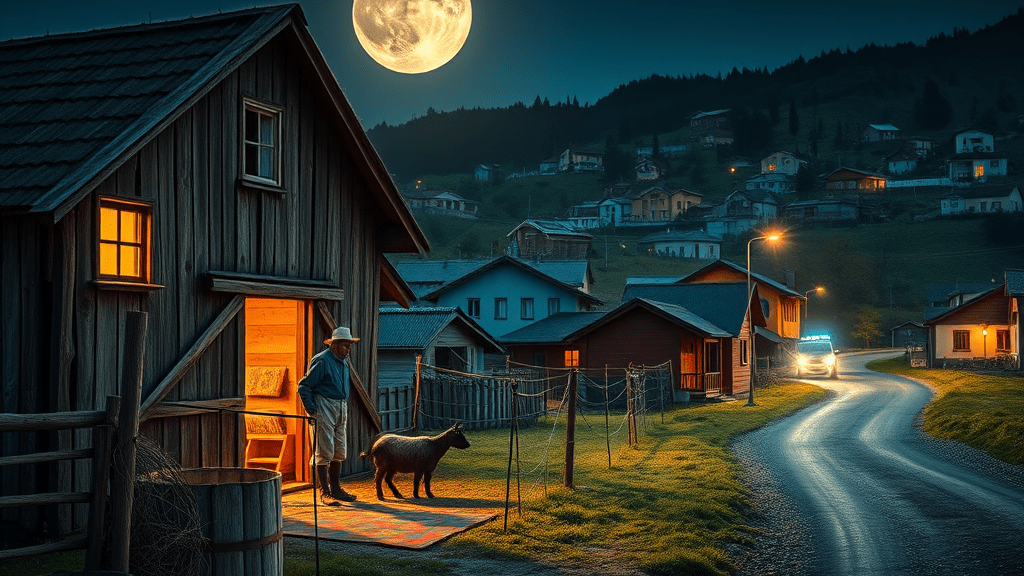
The brightly colored homes, the royal blues and turquoises, the sandy oranges and vermilions, which dotted the village in random patterns here, orderly lines there, the little houses which were invariably described as “storybook” by the tourists, the Germans and Americans and Ukrainians, all of these were gone at night. Instead, a dozen tiny windows shone dim yellow from reading lamps or dimmer blue from televisions. Headlights crawled down and up the dirt road from time to time, a faint gravelly song ascending from beneath the tires and up the hillside to where the goatherd stood outside his barn. A street lamp hung outside the little roadside clinic where the doctor and his daughter stood watch, day and night, to aid villagers or travelers in pain.
It wasn’t just the village. Even the enormous hills were invisible, especially on a moonless night like this one. They weren’t to be called mountains in this part of Bukovina for they were mere foothills of the Carpathians, which swept the land of Transylvania up toward the sky many miles away. These hills were mighty though, forming great streams which efficiently watered the goats, who traversed the hillsides every morning after feeding and then again every evening before sleep. The goatherd, whose father had died three months earlier and whose wife had left not long after that, now had to tend not only to the goats but to the business, the selling, the auction, the distributor in Suceava, a craft for which he’d felt ill-equipped since his youth. His preference had always been to collaborate with the dogs, the collies and Canaan dogs, to lead the goats, organize them, contain them on their grazes, or to feed them, milk them, birth them, wean them, vaccinate them or slaughter them when the time came. He tended to the goats and his father had tended to the business: that was the way it had been until recently. His wife had tended to the home, a two-room concrete structure set on the south side of the pasture, near the makeshift dog pens and hidden from the village and the tourists who came through to snap photographs of the painted monasteries. The barn on the pasture’s north side kept the goats at night. On one end were the milking stalls and on the other were the haylofts and stacked bales; the goats slept in the middle. A special stable housed Jet and Roma, the donkeys, whom the goatherd’s wife had humorously referred to as conducators, or the “drivers.” Jet and Roma pulled the cart into town, and to Iasi or Suceava several times a year, and the goatherd’s wife had felt a particular affection for them. The goatherd, on the other hand, preferred the dogs, of which he had more than necessary. They were full of energy, unlike the donkeys, and full of pride, unlike the goats. He had once thought about naming them, but couldn’t think of any names, so instead began identifying them with sounds. He hissed at the white-and-brown collie. He clucked at the one with black on its ears. He made kissing sounds at the littlest one. There were two Canaan hounds too, one called with a sort of bark, the other with a whistle. The whistle dog, however, hadn’t come when called for several weeks now. She pleased herself instead by lying in the pasture and watching the others, her mouth open with a kind of panting smile, her ears usually perked, her youth and mobility mere recollections in the goatherd’s mind. Ever since his wife left, the whistle dog had slept in the goatherd’s bed, her fragile frame raised to the mattress by the master’s arms, her warm-blooded mass a luxury on these cold winter’s nights. The other dogs slept outside in the pen, as they were doing now, quietly, while the goatherd raked manure by lantern light.
“Good dog,” the goatherd said during a moment of rest.
The whistle dog’s ears perked slightly, but she didn’t raise her chin from the ground. She was comfortable.
When the goatherd was done for the night, he tossed the rake against the barn door and dimmed the lantern. He sat on the ground and stretched his long legs out straight in front of him. He tossed a few scraps of bread to his companion.
“Good dog,” he said again. The dog let out a light groan of relief, like a hum. She tended to stick by the goatherd at night after the other dogs fell asleep in their pens by the house. During the day, she continued to make eye contact with the goats from afar, which the goatherd surmised preserved the dog’s sense of occupational purpose. But she couldn’t be a runner anymore. And she hadn’t chased a goat off a rock or ledge for months.
A rumble from the sky perked up the dog’s ears again and opened wide her eyes, which caught a gold twinkle just as a lightning streak flashed above. The goatherd looked skyward to find stars, and he found some, but they were faint and sparse. Storm clouds had moved in.
After a few more rumbles and their accompanying flashes, the goatherd rose to his feet.
“Come on, girl, it’s time,” he said, even though no drops had fallen. The dog rose reluctantly and stood in place, making sure the goatherd was heading home before commencing the walk herself. The man had only traveled a few paces when another streak of lightning slashed the sky just overhead, this one neither preceding nor following a rumble. Both man and dog looked up instantly, not wanting to miss such a sight. In fact, they couldn’t possibly have missed it. The jagged vein of white remained overhead, locked in its position, locked in time, the violence of its energy pulsating barely a half-mile up, its top end fading into invisible clouds, its bottom end thinning as it approached the earth somewhere far to the east, as if on its way to Moldova.
The dog seemed to lose interest after a few moments, so she lowered herself back to the ground and stared off toward the village, which still teemed with silent life.
The goatherd, on the other hand, couldn’t cease his skyward gaze as the streak was brightest just overhead. In fact, his neck soon became tight. Ideas grew quickly in his mind. It was something, or someone, extra-terrestrial paying a visit to Bukovina or Moldova. It was a glitch, a freeze in time, which would end shortly so the lightening could continue on its course. It was a military maneuver of some sort, or an attack by the Ukrainians or Russians. It was an optical illusion, his eyes tricked by physics. None of these ideas stuck, however, so he was forced to ponder some more, but no explanations came forth. He closed his eyes for fifteen seconds, then looked again to spy any movements or vibrations coming from the streak, but none were detectable. He turned his glance down toward the village to see if lights had turned on, if residents had come outside to look, but it appeared just the same as before. When the dog moaned in comfort again, the sound broke the silence that had been sustained for several minutes. It dawned on the goatherd that the thunder had stopped. No more thunder. There had been no rain. No more lightening. It was as if the storm had aborted its mission in mid-strike. It was as if nature had suddenly paused.
The goatherd’s wife was Crina, named for the lily, and the only moments when he didn’t behold her to be as beautiful as the flower were right before she walked out on him.
“Roxana’s desperate,” she’d said, bag around her shoulder. “She needs her big sister.”
Roxana was Crina’s younger sister who had recently given birth to her dead husband’s twins and with whom Crina had just decided to live back in Brasov twelve hours away. Roxana needed assistance caring for the babies, according to Crina, but Roxana had five other sisters who lived in neighboring villages. This was just Crina’s latest ploy to leave this place.
“You’ve wanted to leave since the day he died,” said the goatherd. His father’s death had created a hole in their marriage three months earlier, one that let in a frightening coldness the goatherd had never experienced. They had been forced together, but it hadn’t felt like force at the time. In fact, he’d long appreciated Crina’s respect and affection for his father as a fortuitous underpinning of their marriage. What he hadn’t suspected was that the old man’s absence would drain the marriage of purpose.
Crina shook her head, mostly to avoid her own tears. She felt abandoned and insecure and wouldn’t bother denying it. It was true, the father had been her strength. In fact, it was the father, a widower for nearly ten years at the time, who had introduced her to the son. She’d been half-drunk as usual in a Iasi bar on a Friday afternoon when the old man walked up to her and gazed at her peacefully, as if willing her to put her glass down and calm herself, which she did. He lit a cigarette and offered her one. Then they talked and drank coffee. As she sobered up, he asked about her life, her family, her drunkenness. At no point did she feel threatened by him even though he was twice her age and even though he once said she resembled his dead wife. They sat on stools and stared ahead at the bar owner as she performed quotidian tasks like drying glasses and stacking six-packs of Coke. Crina told him about her large family back in Brasov, how she had followed a boy here to Suceava, how that hadn’t worked out, how she now worked as a maid for a monastery, where she slept in a dark room and occasionally stole wine. She was too ashamed to return to her family, even though she knew they would accept her with open arms. He told her he had a son just about her age.
Once it became dark, he excused himself to water his donkeys outside, which made her chuckle.
“They have a long journey ahead,” he said when back inside. He told her he’d be coming back to Iasi the following Friday — it was the busy season — and wanted to see her again but only if she wasn’t drinking. She agreed, and when they met again the next Friday, she told him she had only drunk a few days that week. Then, the next Friday, she smiled brightly when announcing that she hadn’t drunk at all that week, and had stolen no more wine. He nodded as if that was good.
The old man made her laugh without knowing it. When he talked about his donkeys, his goats, even when he told stories about his dead wife and how she had often berated him for waking up too early or overcooking the rice. He was very fond of his son, who had to stay home to tend the flock when the old man came here to the market, and told Crina he hoped she would meet him sometime. And so it was arranged.
The following Friday, she rode back to the village with him. While cars zipped past the carriage, the donkeys walked ahead unfazed. Several times, she laughed at the sky, wondering what on earth her family would think of this strange adventure she was taking. When they arrived at the village, it was eight o’clock at night. He pointed to the top of an enormous hill, where she spied an orange speck like a hovering star. His son had lit a fire. The donkeys pulled the wagon and its passengers up the hill very slowly, languidly, their back muscles straining and losing their fight. At the top, the old man watered the donkeys some more and then escorted Crina toward the blaze, where his son’s figure became visible. He introduced Crina to him, saying, “She’s gonna help us around the house.”
Crina and the old man had not talked about that. She was just visiting. Instead of correcting him, she shook the son’s hand, which, along with his nervous, smiling face, glowed in the firelight. She saw that he was a tall boy, much taller than his father, and was holding a walking stick as tall as Crina. He had wavy, black hair and a strong Romanian nose. As for the goatherd, he had seen prettier girls in the village, but none who shone with the confidence of this Crina. She didn’t pretend to be demure. She had short-cut hair and a chin raised with pride. Her brown eyes didn’t appear to conceal much. He could tell her breasts were full even beneath her coat. Her brow crinkled as if awaiting his decision.
Crina never returned to the monastery again.
When the old man died the following year, Crina wanted to shut down the farm and return to Brasov with her husband, who opposed the idea out of respect for his father and the family name. He wanted to make his father proud by running the business, not just tending to the animals, but Crina reminded him that that wasn’t his strength and that there were plentiful farms in the Carpathians where he could be free to work in the pastures without the worries of industry. He could birth, rear, feed, milk and slaughter the goats for someone else. And sheep too! Farms were larger in the mountains. He could earn a solid wage.
The conflict worsened every day and a gulf of silence formed between them. They performed their allotted chores and ate meals together, but little else.
One day, Crina brought him a glass of juice outside, which he drank without pausing. When he returned the empty glass to her, she told him she was leaving.
“You have no faith in me,” the goatherd said.
Crina stared off toward the barn, feeling the stare of the whistle dog nearby but instinctively avoiding eye contact with the animal. A tear bloomed in her eye.
“I had faith in him.”
The whistle dog’s muzzle pointed toward the goatherd, whose attention was fixed on the white streak in the sky. It wasn’t yellow or gold as he had always envisioned a lightning flash to be, but now that it was cemented in the sky, he could see it was bright white, like it was made of pure light, devoid of any color or hue, as if comprised not of a color, but of the source of all color.
He turned away from the heavens only when she barked. One quick bark. Another when they made eye contact along with a timid wag of the tail, signaling something between fear and joy. Then a series of barks, like gentle gunfire, which rolled along as she raised her head and craned her neck with curiosity until the barks came faster, staccato, then faster into a continuous stream of sound, like a soprano howl, baying at the night. The goatherd had to chuckle. Not too far away, the other dogs had awoken from their slumber and, one by one, joined in. Soon a chorus of howls, in verse and refrain, called out to the hills, called out for any man or woman who could hear, anyone east or west, anyone in Moldova or Transylvania, in the valley or on the highest Carpathian peak, either as warning or consolation, and this chorus would attract other creatures in the vicinity and beyond; it was a song not meant for dogs and humans alone, but for beasts by the thousands, for either consciousness or instinct, for all the living to respond to a wonder in the sky.
Occasionally, there was a pause, and during one such pause a new type of howl called from the darkness. This call was extremely dim and from the opposite direction, from the bottom of the hillside by the road, and this was a howl of anguish. It was coming from a human, and it was coming from the clinic, whose lights were glowing alive now. Activity inside. A most dreaded activity. The dogs continued to howl from the kennel, but the whistle dog was silent now. After nearly two minutes of song, she had withdrawn from the chorus, as if out of respect for the suffering.
Almost instinctively, the goatherd wrapped his scarf tighter around his neck and threw bread to the dog.
“Eat this, and I’ll be back.”
The goatherd walked to the edge and began stepping down the hillside, which was extremely steep for a human if not for a goat. Stones and gravel slid in front and behind and his boots twisted with every step, but he sought human companionship. He sought affirmation that time had stopped and that dogs were singing.
When he arrived at the roadside, the woman’s cry had displaced entirely the distant howling. A cry with a groan, punctuated by deep breathing and authoritative words from two other voices, one male and one female. The goatherd tapped his boots onto the gravel driveway that vaguely welcomed visitors to the little house with a “Medicul” sign in front. Here’s where he saw the donkeys, their eyes closed in standing sleep as they waited, yoked to the wooden cart stuffed with hay at their backs. He patted one of the donkeys as he approached the clinic’s front door, which jingled softly as he opened it. Inside, the overhead fluorescent light offended him, so he winced. He heard the voices speaking Romanian in the backroom — the doctor and his daughter, whose name he recalled was Maria — but also a louder voice, a booming male voice, speaking an unrecognizable language. This voice sounded frightened.
Maria peeked from the back room to spy the goatherd in the waiting area, vaguely recognizing him as the neighbor on the hill.
“Have you seen the sky?” he asked her, then felt stupid about it. She cocked her head and stared at him with bewilderment. That’s when he noticed the blood on her plastic gloves.
“We’re closed,” she said, then returned to the back room. “Except for emergencies,” she shouted as clarification.
He considered going home or standing with the donkeys, but instead he took a seat on a tattered green cushion with an uncomfortable metal frame. It wasn’t long before the cries and shouts had faded and the spirit of the clinic had calmed. A tall, Middle Eastern man appeared from the back, his face red and his eyes avoiding contact with the goatherd. He exited the clinic right away. Through a small side window, the goatherd could see his forehead touch the forehead of one of the donkeys. It was like they were sharing a secret.
Maria re-appeared now. Her apron and gloves had been removed. Her father came behind her, nodded at the goatherd and exited to a side door which led to the residence. (He and Maria lived upstairs). Maria began making notes in a folder behind the reception desk. As she wrote, she automatically raised a hand and released her hair from its large plastic clip. Long hair was frowned upon during an emergency.
“You tend the goats,” she finally said, not looking up from her notes.
The goatherd said he did.
“Are you ill?”
He said he was not.
“My father’s not a veterinarian.”
“I’m not here because of the goats,” he said. He was about to tell her about the sky, to ask if she’d seen it or if she’d heard the dogs singing and what conclusions had she drawn about these things, but he didn’t want to feel dumb, so instead he asked her what had happened in the back room. Not for a moment did he wonder if such a question might be an invasion of privacy.
“She’s resting,” Maria said, her green eyes now acknowledging his presence. “It’s very sad.”
With minimal prompting from the goatherd, Maria volunteered the patient’s story. She had arrived with her husband Youssef, who just went outside. They were from a city called Daraa in the southern part of Syria. The Syrian government had forced them and their neighbors to scatter. They’d been traveling off and on for fourteen months already, making stops to camp, to work odd jobs, to accept the generosity of strangers, to purchase the donkeys, which were too old and too slow. They’d hoped to arrive in Suceava to meet up with distant cousins before the baby came, but it came very, very early. Too early. And now it was back there dead.
Maria showed little emotion. The goatherd knew that emotion and medicine didn’t go well together. That’s why she’d better not show it. She wasn’t cold though, just matter-of-fact. She rose and returned to the backroom matter-of-factly. What was there left for her to do, the goatherd wondered. What was it like for a woman to feel finally empty in her womb but have no baby? He rose and gently walked, almost tiptoed, to the door that swung open to the backroom. He pushed on it softly. It opened onto a hallway, so he entered. He smelled a chemical and heard Maria’s voice speaking. In a room on the right, she was standing next to a cot where another young woman lay with her eyes closed. Maria must have known the woman couldn’t understand her, but spoke anyway. She had a comforting tone of voice, so maybe the woman appreciated that. A glass of water stood on the table beside the woman’s cot, and a tube fed her nutrients through a needle in her arm. She may be empty, but she looked at peace, the goatherd thought. She wasn’t out of breath. She wasn’t weeping. She even moved her body a little to get more comfortable so that Maria could check her blood pressure.
The goatherd turned, unsure if he was satisfied, unsure what he had hoped to see, and retreated toward the door that would swing him back into the reception area. That’s when he glimpsed it. There was a room across the hall from where the patient rested. The door was open and it was dark inside, but rays of white light entered through a long, flat window up high near the ceiling. The rays were brighter than moonlight because they were made of lightning light, the source of all light, and they led the goatherd’s eyes to settle on the little body that lay on a metal table. It was laid on its stomach, its big dead head with its cheek to the metal, its eyes closed (had they ever opened, even for a second?) and its little torso wearing a few splotches of blood. The goatherd entered the room and felt his heart sinking. He touched the baby’s little toes, stroked the cheek of his little bum. Then he worried that maybe he should be wearing gloves, even though it was dead, so he reached for one on a shelf but yanked his hand back when he felt a sting. A surgical knife had cut him. The lightning shone brightly. The blood on his finger glistened and the table’s surface reflected on all sides of the body. Once gloves were on, the goatherd lifted the baby with both hands and held it against his chest. He tried to open one of its eyes. He tried to wrap its tiny fingers around one of his own. He thought about the lightning outside and how much longer it would be there. He thought about the tricks nature was capable of playing, and he wondered if this bundle of stillness in his arms could be a trick too. The room where he stood had an exit outside to the rear of the clinic, so he used it to return to the cool night, babe in arms.
“Can you see that?” he asked the little body while nudging its skull to give it a view of the lightning in the sky. If the baby could open its eyes, if it could live just for a moment, it could see the miracle.
“Can you hear that?” he asked. The dogs were still howling up the hill. This too was unnatural. A nearby brook was babbling. He reflected on his losses: his father and his wife, and soon his dog. But instead of mourning, instead of bowing his head in despair and disappointment, he studied the baby’s form in his arms and thought to himself how unfair not to be alive on a night like this. He rocked the baby in his arms, walking in slow circles, wishing it might open its eyes or its heart might take a beat, wishing and waiting for its arrival.
The whistle dog had never been down the hill, not even when she was young and agile. She had gazed at the hills and the houses her whole life, but never had the instinct to chase after them, to spring into the world below and beyond. She’d always had what she needed here with her master and the goats. This night was different. The master had gone down. He had encountered something.
While the other dogs continued their song, she took slow, difficult steps down the hill. Her hind legs were shaking and convulsing without pause. She fell on her side and had to steady herself on all four paws. She had to do this regularly. On the rocky section she stumbled and landed on her hind knee joints, which began to bleed. She would use her front paws to drag herself if necessary. The master was in view. His shape, his silhouette, stood outside, behind the little house, and he was holding something. She panted heavily and stumbled onto her side again. She felt no pain — she had felt nothing at all back there for many days — but she yelped a few times anyway, maybe out of fear. Or maybe because she missed him so much. She could call out for his attention, but he was having an experience and she needn’t disturb him. How she wished to be with him though.
The farther down she crawled, the other dogs sang more softly, more distantly. She could roll the rest of the way if she knew how to roll. She could fly if she knew how to fly. But she was trapped on these four legs, two that barely worked and two that were aching with exhaustion. Her insides felt funny now too. Like she was boiling up. She had to pause her trek to lean over and lick her side. Licking sometimes brought relief.
She kept going, inch by inch, one of her rear legs now just hanging, doing no work at all, the other making paw contact with the ground, but each step was a sharp heave and rarely did the paw make it to its next step without the need to adjust and stabilize and rest before the next. But, she was getting closer now. She could make out his nose. She always noticed his nose first because it was big and wide. He was bobbing softly on his knees and swaying a bundle in his arms gently. How she wished that bundle could be her.
She made it to about thirty feet away from him before settling to rest and gaze at her master as his smile caught the shine of the lightning streak. She had seen him smile many times, but not as big and happily as this. She forgot all about her legs to see him so happy. The gurgling of nearby water calmed her too. Was it water? A little twig was moving in his arms. Maybe a twig, but it had tiny leaves at the end of it and they wiggled too. Were they leaves? Maybe it wasn’t a twig at all but something more alive than that. Something reaching out. The master smiled and smiled and then he gasped extremely loud when the bundle’s mouth opened because a moment later a shrieking sound came out of it. A high-pitched, violent shrieking like she had never heard before, but this terrible, terrible noise only made her master laugh up at the sky and laugh some more. She knew he was rejoicing.
A minute later, shouts erupted throughout the clinic. The doctor raced downstairs upon hearing the baby’s cry. Maria screamed in shock, but couldn’t tell where the cry came from, or which way to run. Even the patient sat up on the cot and called out. The goatherd had raced to the front of the clinic, where the father named Youssef grabbed him by the shoulder, turned him around and studied the contents of his arms. It was the same. The same body they had removed from the room when all hope had been lost. “No!” he shouted nonsensically, then fell to his knees in front of the goatherd, who crouched to show him the child and its curious fingers and its cheeks already tired from wailing. Youssef took the child and held it, tears jumping from his eyes. The doctor arrived, aghast and pressing his hand against his chest. Maria arrived shortly, supporting the patient, who inched toward the child with an expression of grave bewilderment and doubt. Her husband turned to show her the infant. She touched its sobbing head and studied its form, still perhaps suspecting a trick. The father handed her the baby, which she enfolded into her bosom. Maria led her to sit down on the back of the cart, which was soft with hay. The donkeys were wide awake now, seemingly curious about this new revelation. The mother cried, holding the child as if it would never leave her again, not for all eternity.
As Youssef cradled his wife, who cradled their son, nobody asked the goatherd what exactly had happened, what led him to the backroom. Nobody asked for details. Nobody cared about that.
The baby finally ceased its wailing, allowing the silence of the night to soothe their spirits. Maria couldn’t stop grinning. The doctor looked extremely satisfied, but shivered in the brisk mountain air. From behind them all came a little yelp. The goatherd turned to spy the whistle dog lying in the gravel a few feet away. He gulped a sudden breath and scrambled to it.
“What?” he exclaimed. “How?”
The dog’s body was posed unnaturally, its four legs twisted in four directions. It was bleeding and panting and making no attempt to stand or sit or even move. The goatherd sat down next to the animal and removed his rubber gloves. He rested his palm on the animal’s side, stroking slowly and gently.
“Good dog,” he said. That’s all there was to be said.
The doctor studied the animal from his position beside the cart, his attention diverted from the living baby, his expression distracted from its uncontrollable glee. He was concerned by what he saw. The ravaged body. The lowered head. He excused himself as if the sight was objectionable.
The dog’s eyes closed as the goatherd stroked its back. Her panting was steadier, more regulated, than during her journey. She held her head up, welcoming her master’s affection.
The goatherd recalled the morning of the dog’s birth. He’d been sitting on the ground next to its mother just as he was sitting now. He recalled the squeaks she had made as she hunted for the mother’s teat, her eyes not yet opened, just like the baby’s now. The goatherd’s father had stayed in the barn working; birthing dogs held no interest for him. In fact, puppies in general were uninteresting to him. A dog was valuable only when it possessed active herding skills, he’d said.
The goatherd thought of Crina too. The dog was born many years before she came into their lives. And the dog was still here now that she’s gone. She had rarely interacted with the dogs. She fed them scraps after dinner and gave water occasionally on the hottest days, but otherwise she hadn’t been dedicated to the dogs. They’d had little to offer her besides companionship, but companionship was abstract and insufficient.
As the goatherd pet her muzzle, he noticed the blood on his finger, and so did the dog, which wrapped its old pink tongue around the wound, as if tasting a treat.
“You and your tiny mind,” the goatherd whispered. “You believe in me.”
The doctor reappeared and sat on the dog’s other side, holding a syringe in his hand. The goatherd was unsurprised by this and gave no resistance. The doctor only said three words to the goatherd. Three gentle words.
“She’s ready now.”
While the doctor fidgeted with his syringe by the dog’s rear end, the goatherd placed his forehead against the dog’s. She had stopped panting. Her eyes stared at him brightly — this was the closest their faces had ever been. And it was all she could have ever wanted. This was her destination. A moment later, her eyelids sank, so he released her chin, letting it fall gently to the gravel.
After a few quiet moments had passed, the goatherd pulled the whistle dog partly onto this lap. She was still fairly warm, but her heart had stopped. Like the baby only a few minutes ago, she was just an object in his arms. He stroked her fur and looked up at the sky. The lightning was fading quickly. Look at the light before it’s all gone, he thought, before nature resumes its course and time again moves towards tomorrow.
When the lightning had disappeared entirely, the night became cooler, but nobody moved. The family rocked together in the hay. The doctor had dropped the syringe in his lap and closed his eyes. Maria leaned against the cart as if mesmerized by everything that had happened. The goatherd ruminated. Nobody knows when life begins or ends, not really, he thought. Nobody knows when time ceases and light prevails. Where does this child exist? And this dog? Where is Crina, if not right here? These are the kinds of questions that grazed the goatherd’s soul in these silent moments on this remarkable night in the hills of Bukovina.
Leon says of his background: “By way of background, I hold an MFA in Creative Writing and currently teach graduate-level writing and communications at City University of New York and Johns Hopkins University. Twice nominated for the Pushcart Prize, my fiction has been published in The New Haven Review, The Westchester Review, The Stockholm Review of Literature, Thug Lit, Pulp Modern, and Union Station Magazine, among others. I served as editor for Now What? The Creative Writer’s Guide to Success after the MFA (Fairfield University Press, 2014), an anthology of essays and articles about the writing life. A lifelong fan of psychological crime fiction, I am also founding editor and publisher of Heart of Noir (https://heartofnoir.com), a comprehensive website showcasing the classic film noir cycle and its literary influences.”
Please share this to give it maximum distribution.