Mitch leaned against the lamppost, cigarette smoke caressing his face, a Pabst sweating in his hand. Behind him, the thrum of the jukebox; the bartender, a middle-aged mother of eight named Karen, had switched over to southern rock to pacify the rowdier element. Mitch took it as his cue to sneak some Skynyrd into his next set. No harm in pandering.
He took a drag and a pull. The humidity felt soothing on his skin; reminded him of his childhood, playing with the other boys in the trailer park late at night, while their parents drank or screwed themselves to sleep. Midwestern summers could be a hell of a thing, but Mitch had spent a year in Montana on his cousin’s ranch, and wouldn’t trade the oppressive heat for anything. The winters balanced out the scales eventually.
Lucky’s Tavern sat across the street from the courthouse, the tallest building in Charleston County. Mitch eyed the rows of windows, impenetrable and black. Cicadas hummed from the trees that dotted the town square, filtering through the screaming electric guitars of the jukebox. There was a song in this somewhere. That part of Mitch’s mind itched to stitch the pieces together, while the rest of him tried simply to enjoy the taste of smoke in his mouth. He hadn’t played a gig in three weeks; no matter how much he played during his free time away from the factory, he was still out of practice. Singing to his dog wasn’t the same as to a crowd, some of whom actually wanted to hear him. His voice had almost gone out halfway through “Sunday Morning Coming Down.” Thankfully, the beer was on the house. It usually was, around here, long as you were still able to play. A small perk of failure.
Voices drifted into his revelry, coming from the far end of the town square. He turned, sipping the beer, and saw a group of college-aged kids approaching, six of them, jostling casually amongst themselves in a way that suggested long or at least youthful familiarity. Mitch studied them openly, taking in the careless enjoyment on their faces, the confidence in the hitch of their shoulders, the girls in short skirts and swaying their hips absently to whatever music it was women that age could always hear. Mitch had known many like them, once, during his stint at the community college. Not that long ago, in the scope of things. The half-life of a dream was longer. The desire to embrace what life had to offer and the fear of doing so. The concept of youth, the certainty of it, outlasted its physical manifestation.
The group approached the entrance to Lucky’s. Four guys, two girls. An interracial bunch, which Mitch realized one did not normally see around here. He couldn’t tell if that was surprising or not. Decided if it didn’t matter to them, it didn’t matter to him, though he felt maybe it should.
One of the guys noticed Mitch watching them and nodded in a friendly, easy manner. Mitch nodded back and returned his attention to the courthouse. He’d seen what he needed to see.
“Hey, there’s someone singing tonight,” a girl said. “Is there a cover? I don’t have cash.”
“Nah,” one of the guys answered. “It’s just some dude. There’s never a cover when it’s just some dude.”
“I don’t have cash, either,” said the other girl.
“They try to guilt you into tipping,” said another one of the guys. “Like, no thanks, man.”
“Then just don’t fucking tip,” said the first guy, as the door clanged open and they went inside.
Mitch smiled and killed his beer, tossing the bottle into the nearest trashcan. He wondered if the bars in Nashville had covers. He’d only been twice, years ago, and couldn’t remember much through the alcohol haze. Had enjoyed the trips, the overall experience of being there, the lights and music and people, but not enough to go back in the subsequent years. In fact, other than trips to St. Louis and Chicago for ballgames, he rarely visited anywhere approaching a metropolis. The majority of his life, over the past ten years, had been spent surrounded by the flatland corn and soybean fields he’d been born amongst. He wondered if he should regret that.
He took his penultimate drag on the cigarette as the door swung back shut behind him. Maybe Allman Brothers instead of Skynyrd. It was all the same to them. Mitch took one more look at the darkened windows of the courthouse, the building seemingly dead to the world. The center of town, the center of the world he had fallen into and become discerningly comfortable with. He closed his eyes for a moment, listening to the cicadas, making a music sweeter than any he or any other human being could hope to create. Yes, he thought, stringing the lines together, the fingers of his left hand reaching for the notes. He wouldn’t have to try very hard to find it. The song would come eventually. It always did.
D.W. Davis is a native of rural Illinois. His work has appeared in various online and print journals. You can find him at Facebook.com/DanielDavis05, or @dan_davis86 on Twitter.
Please share this story to give it maximum distribution. Exposure is our authors’ only pay. You can also help our contributors gain exposure by back linking to them and to RFM’s homepage.
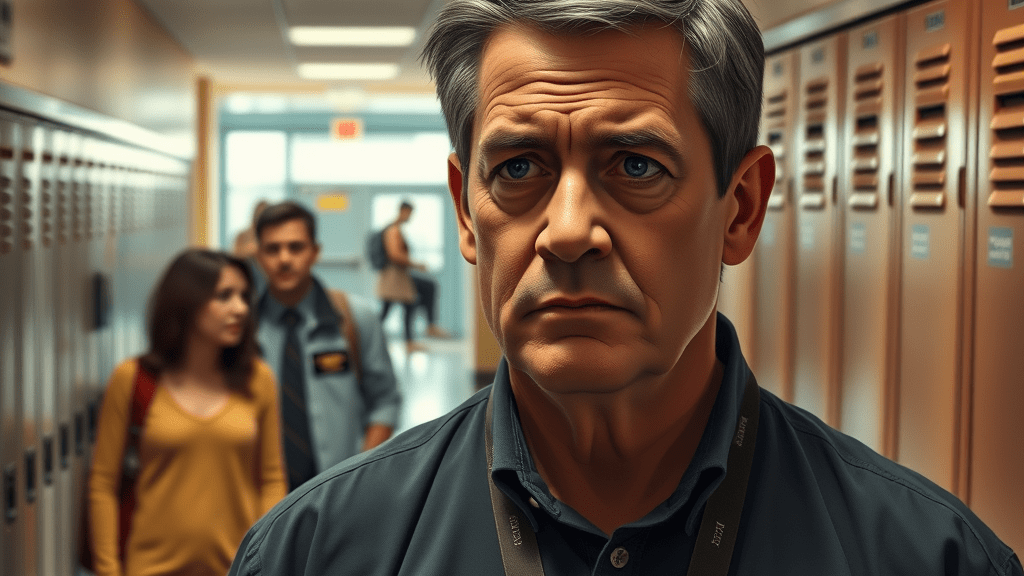
The pain beneath Lee’s breastbone and in his back and arm twisted like a hot coil in soft tissue, so he grimaced and clutched his chest. When Bruin noticed the principal gritting his teeth, looking pained, he grew concerned. Bruin, listening to Lee describe the symptoms, said what ailed him did not sound like heartburn or indigestion, and advised him to see a doctor.
Meanwhile, Bruin said that reminded him: the school needed to invite a flight paramedic from the air ambulance service to speak at the career day open house. He got the idea after he assigned a theme on a life changing event to his class. He read Amy’s essay indicating she wanted to become a flight paramedic, and her composition left him impressed with its passion and conviction.
Lee massaged his chest and arm with a pained expression and told Bruin he did not want to be like his predecessor. In the morning, at the start of classes, he did not want to stand in the main doors to the high school before the opening bell, holding his wristwatch in his hand, watching the secondhand tick, seeking students and teachers wandering the hallways a minute or two after the opening bell rang. He did not want to spend the school days locked away in the principal’s office, fretting over classroom schedules, avoiding telephone calls from parents, obsessing over office supplies, organizing his desk, worrying about missing pens and markers, rearranging supplies of paper and toner in the photocopy room. He did not want to lecture the student body in the gymnasium during their orientation, preaching about everything they should not do, emphasizing they were not to exhibit overt signs of affection anywhere in high school. He did not want to hand out detentions and suspensions; he wanted to give encouragement and inspiration. He wanted to have a positive impact on the careers and educations of his students. Lee wanted his students to succeed throughout high school and contribute to the betterment of their lives and society and, yes, the community, which continued to see tough times after the radar base had been decommissioned and the sawmill shuttered forever.
Lee hired Bruin believing he was one of the more unlikely, successful students to have graduated from their high school. Bruin had certainly taken a rocky route in life recently, and his path towards becoming a teacher had been unusual. But Lee ignored the advice of another teacher and the hiring committee, which was merely a school board trustee and the vice-principal. Lee went ahead and hired his former geography and history student.
Amy told Bruin that she had a reading and public speaking phobia. That was the reason that she could not perform the dramatic recital. Amy told him quietly at his desk after he walked the aisles of the classroom of grade nine students, asking them which Shakespearean speech or monologue they wanted to read and recite. He went around the English classroom wearing his suit and tie, stained with coffee, his scuffed shoes, and his cologne. This was the first course in Shakespeare that he taught; this was the first year that he worked as a schoolteacher. Likewise, this was only Lee’s second year as principal; previously, he taught history and geography.
Bruin had been a financial advisor, a stockbroker, and a derivatives trader, but then his firm was caught in a massive insider trading scandal. He was also personally fined tens of thousands of dollars as a result, which also wiped out any equity and savings he had built over the years. He also discovered that he was tainted, damaged goods in the securities industry, and he could not get hired by any other firms afterwards.
So, he decided to pursue his original goal of becoming a high school teacher, even though he now believed that aspiration was something of a cop out. He admitted during his job interview with Lee that if you were not of a certain personality and character, high school teaching could be personally demanding work. Now in his first year of teaching, he faced a student with a problem similar to his own when he struggled in high school.
Bruin asked to see Amy after school, a time more suitable to discuss the issue. He sat at his desk grading papers, drinking coffee, which he should have avoided, because the caffeine caused him jitters and anxiety. He thought about what he would say to her, the best way to approach this problem.
Amy arrived for the appointment with a frosty can of cola from the vending machine in the cafeteria. She sat in the bare minimalist student’s desk at the front row across from Bruin at his large wooden desk, with the hardwood podium dividing them. Amy arrived in her jean jacket, baseball cap, coveralls, and with her backpack, filled with books and school assignments. Her backpack emanated the smell of fish. Bruin guessed the reason for that bit of fish odor was because she worked, filleting and gutting fish, for her father, who owned and operated a commercial fishing operation. Amy filleted and gutted walleye, whitefish, and red sucker in her father’s fish processing plant on the shores of the long mysterious lake and reservoir of Lac Seul near Sioux Lookout. Amy also occasionally worked on the fishing boat, handling gill nets, piloting the trawler.
Bruin mentioned offhand he and her father, high school classmates years ago, had briefly discussed the issue at their last parent-teacher interview. They had merely touched upon the issue; but her father wanted him, or them, to try to first work through the issue personally and individually, or with the help of her teachers only. Her father did not want to seek professional help because he had lost faith and confidence in the medical and social work professions; he believed that the professionals, psychologists, and psychiatrists had only made Amy’s mother’s condition worse. He believed the doctors and psychiatrists had gotten her addicted to prescription drugs until she met her untimely demise. He refused to accept the doctor and coroner’s conclusion she committed suicide.
Now Bruin wondered, having never known the circumstances surrounding her death. Bruin wondered if Amy’s phobia had some origin in her mother’s demise. But Bruin also realized that speculation about causation was of no help to him currently. And her father merely wanted them to deal with the issue themselves.
Amy told him that she could not do the reading.
“Ok. So, you’ve chosen Mark Antony’s eulogy, his funeral oration, for Julius Caesar. How did you know this is one of my favorite passages from Shakespeare?”
“I didn’t know.”
“Are you sure your father did not choose it? It just seems like a passage your father might like.”
“No. I chose it because I like the speech. My father never does my homework.”
“That is wonderful. So why don’t you just read the passage now.”
Amy read the passage perfectly, resonantly, with the enunciation and diction of a Shakespearean actor, albeit one her age. Bruin felt most impressed, and he applauded. He told Amy she was a skilled performer, who possessed talent. “And, you see, that was not a problem. You did not seem self-conscious, or self-aware. You just did it. So why don’t you just try it on Monday, like the rest of the students.”
“Because I can’t face the class and read it. I’ll choke, I’ll stumble, I’ll stutter and stammer. I might even get physically sick.”
Bruin confessed, when he was her age, he had the same problem. The phobia plagued him all through high school, so that he skipped class and missed classroom discussions, lectures, and assignments. His grades suffered, but he never disclosed the true reasons to his teachers, so they thought he had become a truant and a juvenile delinquent. He even dropped out of high school, and later went to community college, where he eventually overcame the problem, possibly because the atmosphere in the college seminars was usually relaxed, informal, collegial. Bruin explained he did not want her to face similar challenges.
“Do you understand?”
Amy nodded.
Did she want to know how he thought it started for him personally?
Amy shrugged and averted her face as she rolled her eyes backwards. She felt distracted and glanced through the open door into the hallway, where lockers crashed shut amidst loud laughter and chatter. Bruin said when he was a student in Catholic grade school, the spring before graduation, the students had undergone intensive personal and religious training to receive the Catholic sacrament of confirmation. The event dominated the spring schedule for the confirmands—proved as big as the graduation from Catholic school itself. The grade seven and eight students preparing for the sacrament and ceremony were feted by their parents, guardians, and the sponsors, and parishioners at a Saturday night mass. A parent active in the church who volunteered in helping behind the scenes made a last-minute request to the adolescent Bruin to thank the selfless priest for helping them prepare for confirmation.
When he went up to deliver that speech, he realized he was unprepared. Then he noticed the hundreds of people in the church. He stumbled and stammered over his words, which he perceived as virtually incoherent and nonsensical. He thought he made a complete fool and ass out of himself, especially after the priest joked, saying he thought Bruin was going to ask for permission to go to the washroom. The entire church, suddenly in a mood of hilarity, broke into laughter. Bruin never felt so humiliated and embarrassed in his life.
“Does that make sense to you?” Bruin asked.
“Yes.”
“Can we just give it a try Monday? Can’t we just take the bull by the horns, as your father would say, and try to work through the problem ourselves? As I mentioned, I spoke with your father.”
Amy became upset Bruin said he had spoken with her father, and she winced and looked taken aback.
“I think he agreed we should give it a try.”
“Can I go now?” Amy asked. “I need to be at work.”
“Can we give this a try on Monday?”
“I don’t see what choice I have.”
On Monday when Bruin arrived for class, with his mug of fresh coffee, he realized she was the most photogenic student in his class. He never noticed previously because he usually paid no attention to her or any other student’s looks. Now it was difficult for him not to notice her grooming and dress. The steel buttons of her perfectly fitting denim shirt were unbuttoned low down her chest. She wore cowboy boots, a cropped denim jacket, a short denim skirt, and a tight shirt, which fit perfectly and which she left open. He had never seen her wear a dress before. She allowed her long brushed hair to flow over her shoulders, and she wore makeup and lipstick. He thought she looked as handsome as any Hollywood teen celebrity.
Bruin had scheduled three students for this Monday, and her reading was scheduled to be the last. Towards the end of class, he called upon Amy to make her dramatic recital.
Bruin asked her if she would be more comfortable if she sat down at her desk, but she might perform better if she stood. He could barely hear her say, yes. With adrenaline pumping throughout her system, she felt warm and flushed. As soon as she stood everyone saw her limbs trembling. Her face turned crimson, and she broke into a profuse sweat, yet the room was cool, after Mr. Bruin cleared his throat and opened the windows at the rear. Amy was breathless, and her voice broke and cracked.
Amy stammered and her voice continued to pause and quaver. She read three lines, and Bruin was ready to thank her for her spirited performance and say she could sit down, after he realized his error. But she threw down her English textbook, property of Queen Elizabeth District High School, the complete volume of Shakespeare, the plays, comedies, tragedies, histories, and the sonnets, on her desk and her loose note paper and pens and pencils scattered.
“I hate you!” Amy shouted in a very loud, clear, and resonant voice. “I hate you! I hate you! I hate you! You’re a horrible man, just terrible. I told you I couldn’t do it, but you made me, and I couldn’t, and now look. I just fucking hate you.”
Amy burst from the front door of the classroom sobbing and crying. Later, Bruin thought if she was one of the more popular students in the class or one of the school princesses, some of the girls would have chased after her for moral support. Instead, the whole class sat in stunned silence, as half the students stared at him, and the other half glanced at her, fleeing the classroom through the back door, into the empty corridor. Through the row of classroom windows, her classmates could see her fleeing from the school outside the doors and across the lawn to the walkway. Then they stared and glared at Bruin, who froze where he stood in front of the classroom of expectant students. Then Bruin realized he could not face the class. Bruin feared he had irreparably traumatized her. Grade eight confirmation at Sacred Heart School decades ago recurred all over again for them both.
Now again Bruin was full of humility, embarrassment, and fear, and he could not face the class. The students looked at him with such deadly serious expressions, seeking leadership and guidance through the crisis, and he could not step up and provide. He felt frozen, afraid to face his classroom of students, and he feared he could not face them again. This, this classroom, in his hometown high school, was not the place for him. Feeling defeated, he grabbed his mug, as if he needed a refill of coffee, slipped out of the classroom. Then, outside, after rushing through the foyer and the bank of doors, he tossed his favorite coffee mug in the wastebasket. He strode with a sense of defeat to his car in the parking lot beside the football field and the athletic track.
Bruin drove home, even though he lived only a short distance away, in the house he had inherited in his hometown from his mother; he had been planning to go walleye fishing at Frog Rapids bridge after school. He drove home from the high school he had walked to each day when he himself was a high school student. He drove away from the only high school that would hire him after he returned to university, for his degree in education, as a mature student.
After an insider trading scandal overwhelmed Bruin’s career, he departed the securities industry, and Lee hired him. Now Bruin sent his resignation, formal, brief, curt, business-like, like President Nixon’s resignation letter, the student of history mused. Then Bruin blocked his former employer’s telephone number, email, and social media. Bruin decided he was finished with whatever career he may have had in education. Yes, he decided he had finished his tenure as a high school educator. He did not want to hear from his hometown high school anymore; it was enough for one lifetime.
Later, Bruin told Lee had just enough money, savings, to last for a few years if that turned out to be how long he needed to figure out what to do with the remainder of his life. The school sent Lee to visit him, after the teachers lobbied him in the staff room during another teacher’s birthday party. During that celebration he suffered more chest pains and shortness of breath, which caused some teachers to be concerned, including one who kept feeding him brand name antacids from a roll wrapped in foil.
Lee spoke to Bruin briefly at the screen door since Lee was not invited inside his house. Bruin thanked Lee for believing in him, for hiring him to the position of teacher and apologized his hire did not work out. Motivated more by curiosity than suspicion, Lee asked if Bruin had been drinking. Saying he usually did not consume alcoholic beverages, Bruin wondered aloud if Lee had noticed the recycle bin outside, in the backyard, filled with empty coffee containers and sugar free soft drink cans. He did not invite the principal who had hired him inside for a coffee.
Bruin expressed concern for his former student, saying he hoped Amy was well, not suffering any adverse consequences. Having learned his life lesson, Bruin said he did not expect to teach any longer; his work as an educator was complete. Bruin said he now felt more concerned with the fate of his former pupil. Lee advised him there should be no worries; Bruin was officially on paid leave, until the issue was resolved, and they had a substitute teacher to cover for him.
The school had a psychologist, who visited from Kenora, where the head office of the school board was located, and a guidance counsellor, and a social worker who might be able to help, Lee reminded Bruin. In fact, a counsellor later came to Bruin’s door to talk to him, but Bruin assured him he was fine, even though he lost weight, remained unshaven, grew a beard, and gave off a strong body odor. Bruin looked haunted and shell shocked, with a thousand-yard stare. Bruin felt inclined to inquire about his former student and how she fared, but he did not think it was appropriate, since she was a former pupil, and he was no longer in a position of authority.
After a few months, the school board sent police for a wellness check on him. The pair of police officers shouted through the door they needed to talk. Bruin reassured them he was fine; they did not need to break down the door. He had plenty of food, electricity, water, groceries, flush toilets. They could go away, and he would feel better. After he found his housecoat, he opened the door for the police officers, but by the time he answered they were gone. The officers left their business cards and the business cards of a social worker on the steps of the concrete stairwell.
Amy arrived at his door with a gift of fresh fish, walleye, she herself had filleted. Bruin told her she could leave the wrapped fresh fish, packaged in translucent plastic freezer bags, in the garden shed. Through the screen door he said he loved fish, but he didn’t mention he preferred canned fish, because cooking left him annoyed and flustered. To neighbors he even gave the fish he caught in the lakes and rivers that surrounded and divided the town.
Amy’s father also visited him at his house. Bruin drank the beer and whiskey her father brought along, even though he normally did not consume alcoholic beverages, but he felt he owed it to the man. They talked about their own high school years and shared interests, hunting, fishing, although Bruin had to admit he had not been hunting or fishing for decades, since he was a teenager.
It would work out, Amy’s father said, as he drank his fourth can of beer. Bruin tried to reassure him everything would work out all right and well in the end, especially for Amy and her future. Amy’s father promised him he and his daughter both would take him hunting and fishing someday soon.
A few weeks later, Lee received the letter from the director of education and superintendent indicating the school board reviewed his contract, which was temporary, a short-term agreement for the year that followed his probationary period. Lee originally expected the school board to renew his contract for the principal’s position and for them to offer him the office on a permanent basis. With this letter from the top executives and officials, he nurtured fresh doubts and fears. After he made a phone call to a few school trustees and the superintendent, he realized the school board was unlikely to keep him as a hire and a new candidate would assume his position as principal. The superintendent, with whom he was friends, said a few trustees questioned Lee’s judgement in hiring Bruin, whose qualifications for the position, they felt, were weak and questionable. That seemed like the worst of excuses, Lee thought.
The chest pains had been aggravating Lee even before he received the letter. When he received the foreboding news, the aggravation started to worsen and overpower him, so he could not move from his comfortable swiveling, reclining chair in the principal’s office. By the end of the lunch hour and the start of afternoon classes, Lee was struggling to breathe, his face contorted in pain, as he experienced a crushing pain beneath his breastbone that radiated to his arm and the center of his back. He buzzed for the secretary and, when she did not respond, he shouted for the vice-principal.
The vice-principal called the emergency telephone number and summoned an ambulance. The paramedics gave Bruin oxygen and nitroglycerin tablets for him to place beneath his tongue and diagnosed him as likely undergoing a myocardial infarction. Within an hour, doctors and nurses examined him, assessed him, and treated him in the emergency department of the rural hospital. The healthcare team agreed he needed specialized treatment and a cardiologist. The head doctor made the telephone calls to medivac him to the hospital in Thunder Bay for emergency treatment and cardiac surgery.
As Amy walked to school for her afternoon class, she saw the air ambulance take off from the airport nearby, ascending into the clear skies beyond the high school football field. Amy wondered who might be aboard the air ambulance. She remembered the air ambulance flight she took to Thunder Bay, after the family physician asked her to function as patient escort for her mother, who lay comatose after an overdose. The air ambulance impressed her with its sense of urgency and professionalism, and its life support equipment, a critical care unit in a light aircraft.
During the air ambulance flight of the Pilatus aircraft, the sunset she saw settle beneath the horizon of the rugged rock formations and vast waterways and forests of the Canadian Shield landscape was the most beautiful and moving she saw in her life. She crouched alongside her mother on the gurney and clutched her limp hand. Her mother lay in critical condition, her kidneys failing, her vital organs shutting down, a few days away from her ultimate end. Oddly enough, she looked more tranquil and serene than Amy had ever seen her in her life.
Aboard that air ambulance flight with her ailing unconscious mother, as she struggled to find hope, Amy first nurtured her aspiration of becoming a flight paramedic. She decided she would continue to pursue that dream. The career, she hoped, would take her far from her hometown, surrounded by epic, endless rocks, forests, and lakes, and all its unhappy and bittersweet memories.
Born and raised in Sioux Lookout, Ontario, John Tavares is the son of Portuguese immigrants from Sao Miguel, Azores. Having graduated from arts and science at Humber College and journalism at Centennial College, he more recently earned a Specialized Honors BA in English Literature from York University. His short fiction has been featured in community newspapers and radio and published in a variety of print and online journals, magazines, and anthologies, in the US, Canada, and internationally. His many passions include journalism, literature, economics, photography, writing, and coffee, and he enjoys hiking and cycling.
Please share this story to give it maximum distribution. Exposure is our authors’ only pay. You can also help our contributors gain exposure by back linking to them and to RFM’s homepage.
Desiree Permian’s vision blurred with tears when she found the page. Encircled in red pencil was Introduction to Veterinary Science. How could it have been eighteen years since that Junior College class launched her plan to be a veterinarian? She had been sure her love of critters and straight-As in high school would sail her through the biology and chemistry courses. But another kind of chemistry had diverted her—six-feet-two inches of it by the name of Will Permian. She hadn’t been in the course three weeks when he proposed and Desiree dropped her books to pick up pitchforks, crescent wrenches and eventually a seven-pound wriggler christened JoAnn Mae Permian.
She had no regrets about the life she had made with Will and the girls here in the Valley. It said right in the Good Book, though, there’s a time for all things under the sun. So she had announced her time had come to begin driving the 21 miles to the J.C. to resume her veterinary classes. Ellie and JoAnn said, “Cool, Mom.“ Will had offered no opinion until this morning when her hands were full of a mare’s forefoot and a hoof-rasp. “I had to let the hired hand go. Found him passed out in the haystack cuddling a whiskey bottle. Need you to drive barley truck.” Will’s voice was husky with genuine regret. “Sorry it shuts the gate on your college thing.”
“I’m already through the gate, Will.”
Will stared at his dusty boots. “Every available man or woman within fifty miles is on the harvest. Maybe next year.”
Desiree gently put down the mare’s foreleg and was out of the barn before Will could gather himself to trot after her.
She paused on the screened-in porch, Sampsonite suitcase in hand. She kissed Will, lay a finger across his questioning mouth. “I’ll be back in a few days.” He shuffled into her upraised palm. “I will be back. Please get the girls to town so they can buy their wardrobes for school.”
“I’m no good at that girl stuff,” he pouted.
Desiree restrained a giggle. “They‘ll teach you.”
The old Ford growled up the rocky road above the ranch. In the side mirror Desiree watched Will’s tall figure remain rigid with disbelief. Not once in all their years had she walked away from him. She held back tears, but never eased up on the gas pedal. Where exactly was she going? She had enough mad money to buy the distance needed to sort things out. She could catch the vomit comet out of the county air park and drift over to Denver. From there–where? Vegas? San Francisco? A bungalow up in the Canadian Rockies?
She slowed for the cattleguard, scanned a track dogging the fence line to the high pastures. Desiree wheeled onto the road. Just can’t leave, right Dezi? She could imagine Will’s gently teasing eyes. Not so, but she needed one clear view of what she was leaving.
She parked the Ford on Cain Mountain’s shoulder and walked through a stand of aspen tinged gold. From this perch most of Lansome Valley lay revealed: Resolute rectangles of alfalfa and barley fields flanked the creek and its ruffles of cottonwoods and willows. Far up-valley the Herm Ranch was a scatter of children’s blocks. She had been born in one of those blocks and her parents still lived there. A thousand feet directly below were glimmers of barn, machine shop, calving sheds, and her own house. Inside, Will and the girls probably huddled around the big oak table to decipher the mystery of the absent wife and mother.
Desiree turned her gaze to the mountain itself, to its sun-cured grasses and splashes of summer’s last wildflowers. “You’re all so very beautiful!” Heart-shaped aspen leaves rattled as if to confirm her praise. Her gaze returned to the valley and to a memory: A third-grade class project to make a paper mache relief map of the United States. The Rocky Mountains were globs prodded into toothy shapes. The teacher helped them daub on bright blue creeks and green fields. All the children placed a gold star on the map to stand for their birthplace and their connection to the greater, geographic scheme of things. Mrs. Stevens then said, “Sad to say, children, most of you will leave the protection of your little gold star to make your lives elsewhere between the shining seas.”
Desiree now whispered, “Not me, Mrs. Stevens. I haven’t left my gold star!” Her entire life was bounded by these mountains, these pointy dollops on the map of the nation, which lay beyond her experience. She lay back until the grasses curled around her like a lacy shawl.
She awoke shivering in the mountain’s shadow. The airport was an hour’s drive. She leapt up, squinted down at the shadow line which had crawled to the house. A rectangle glowed in the upper North bedroom–the girls’ room. Desiree had stood in that same tall rectangle with her fingers stretched over her belly the night before JoAnn was born. She had watched the sun disappear beyond the mountain named for her great-great grandparents. Their log homestead, impossibly small, still stood in rumpled dignity two miles up the valley. Likely, Grandma Cain had watched her own spot on the mountain crest and uttered prayers to the evening stars for the health of her child soon to breathe the sweet air of Lansome Valley.
The airport could wait. Desiree retrieved a bedroll and emergency kit from the Ford. The stars came on thick as frost crystals. She gathered dry branches from the aspen grove and kindled a small fire away from the precipice and the gaze of anyone in the valley who might glance this way. Reflection of flames gilded aspen under-leaves and she felt like some storybook princess in an enchanted forest. A Great Horned owl hooted thrice from the higher darkness. As if to answer, coyotes yipped from their lair across the valley. Crickets ratcheted up love songs and a breeze brought delicious fragrances of pine and spruce trees.
Desiree left the fire and sat near the cliff‘s edge, staring tenderly at lights strewn along the valley floor like a strand of pearls. These were the pearls of her life, her history. An outsider might proclaim Desiree’s life hopelessly hobbled. Desiree sometimes felt it too, especially when Will assumed demands of ranch-life always took precedence over her needs. It could be claustrophobic living under a tiny golden star. But it afforded something rare and good.
Hers was a life of rich connections. She was embroidered right into a quilt panel of bee hum and wild roses. Morning sun that warmed her shoulders in the garden had fallen upon shoulders of five generations of Cains, Herms and Permians. Generations of crickets had played their tunes for her ancestors under a starlit canopy that was an enduring roof–no matter what challenges life brought. Hers was a gift of continuity in a world bent on transforming itself every seven seconds. She recalled the old saw about not being able to appreciate one’s home until one left. Well, a thousand feet of altitude had done it.
She no longer needed to fly away, but she did need this place on the durable mountain’s shoulder to prospect for gratitude in a life whose value could get buried in the strata of endlessly busy days. How wonderful it would be to open an animal biology textbook up here on the mountain and read sentence after sentence without a teen-ager lobbying for maternal attention or a husband insisting that fence posts could not be properly tamped unless she were there to hold them. When she drove back down into the valley tomorrow she would carry within a new spaciousness to stand resolutely for her right to embark upon the greatest journey of all–her formal education.
Desiree stared into the campfire. Sparks rose to dosey-do with the stars. Anybody could run toward a new horizon. But if you hunker down in a place you know and love, it is the world that moves toward you. In a few hours the good earth would tip its forested crown to the flaming orb that touches all. Desiree gave up a coyote yowl of greeting to that unseen but steadily approaching light.
Terril says of his life: “My life has been spent in rural areas of Montana, Wyoming, and Arizona. It has been blessed with experiences as a rancher, subsistence farmer, agricultural journalist, teacher, and as photographer and writer. My work has appeared in Range Magazine, Montana Mouthful, Projected Letters, The MacGuffin, QU Literary Journal, Cargo Literary Magazine, bioStories, and Green Teacher Magazine. “
Please share this story to give it maximum distribution. Exposure is our authors’ only pay. You can also help our contributors gain exposure by back linking to them and to RFM’s homepage.
Take, fer example, gross stuff. I doan get why grown ups hafta be sharin’ slobbers. Ma and Pa share spit ever’ mornin’ and I even seen Granny and Papa do it oncet or twice. Seems like a nasty habit us kids ain’t developed. I hope it ain’t genetic.
Ma says I shudn’t be sayin’ these things and tells me I’ll feel differ’nt when I’m older. She says I’m an orn’ry twerp, always watchin’ and thinkin’. But I ain’t got nuttin’ better ta do than contemplate life. ‘Sides, it’s interestin’ ta notice. I learns lots jus by watchin’ and lis’nin’. Doan need to say much. Life’s purty amusin’ on its own.
Mos’ times I see things I doan wanna unsee cuz they’re funny. Like oncet when Granny decided it was high time she learnt ta ride a bike. Dint want no lessons from noone. Nope. Fiercely independent, my Granny is. ‘Twernt long afore she was whippin’ that bike round and round the silo cuz she couldn’t figure how ta make it stop. Took crashin’ inta the back o’ the hay waggin ta bring that fiasco ter an end. Course, Granny found it amusin’. She laughs at ever’thin’.
Then there were the time us kids and the dog wuz racin’ inter and outta the house and let in a chicken. Inter Granny’s kitchen. That dint go so well. She and us kids managed ta corral that hen. Fer a moment I thought Granny was fixin’ chicken fer dinner that night, but she got it outside. Then us kids and the dog resumed our shenanigans, which nearly resulted in Granny droppin’ her precious carton o’ eggs. That were the straw. Granny can get purty flustrated and she did jus then. She put down those eggs and tole us kids we hadta stop. She said we hadta put the dog in the fridge and throw the eggs outside. Bein’ the obedient children we wuz, we wuz commencin’ to stuff that flailin’ dog inter the fridge when Granny realized what she’d said and we all had a good laugh.
My Uncle Slappy, he’s a man cut outta differ’nt cloth. He ain’t quite so bright as some, but he can tell some tall tales. Uncle Slappy got ‘is name cuz he gets tickled easy and when he does, he slaps his leg or he’ll slap anyone who’s close ‘nuf to reach. It doan pay to sit near Uncle Slappy when the tales start. That can be a painful ‘sperience. I hain’t never been whaled by Uncle Slappy cuz I watched and learnt so I hain’t never sat near ‘im. Took somma t’others awhile ta figure that’n out. Now, when Uncle Slappy tells tales, he has an audience. Kinda like a play, where ever’one is sittin’ afar and watchin’. He either ain’t figured out that he slapped his audience inter submission or he’s clever ‘nuf to have created his very own assemblage. Either way, when Uncle Slappy starts talkin’, people start movin’.
Anyways, I’m not sure o’ Uncle Slappy’s real name. Ain’t heerd noone say it. But I heerd him tell some big tales. The one ‘bout the banty rooster’s my fav’rit cuz I know the truth.
Granny was plannin’ dinner one day and fell short one chicken. Havin’ bin chased inter the house mor’n oncet by the new banty rooster she’d bin given, she decided he was a prime candi’te fer her next roast. But she weren’t fond o’ the notion o’ ketchin’ him, so she set Uncle Slappy ‘bout doin’ it. He hadn’t seen that rooster yet, havin’ jus showed up, so he dint know no better.
I happenta be slothin’ ‘round in the hay stacks that mornin’, makin’ miself scarce. As I was lollin’ ‘round, starin’ at the barn ceilin’ and contemplatin’ life’s myst’ries, I heerd the screen door slam. It always slammed shut cuz the spring fell off and ain’t nobody fixed it yet. I figured Granny likes it that way. Serves as a sorta doorbell.
Anyways, I rolled onter my belly and peered over the haystack to see Uncle Slappy skulkin’ ‘round like he wuz lookin’ fer sumpin. The chickens wuz runnin’ loose jus then cuz Granny liked ‘em ta have lotsa space. Said they laid more flavorful eggs and made fer better meat that way. Uncle Slappy was walkin’ through the bunch when he met the banty rooster. I’ll never be able to unsee what I seen next. But ta understand, ya gotta hear it Uncle Slappy’s way first.
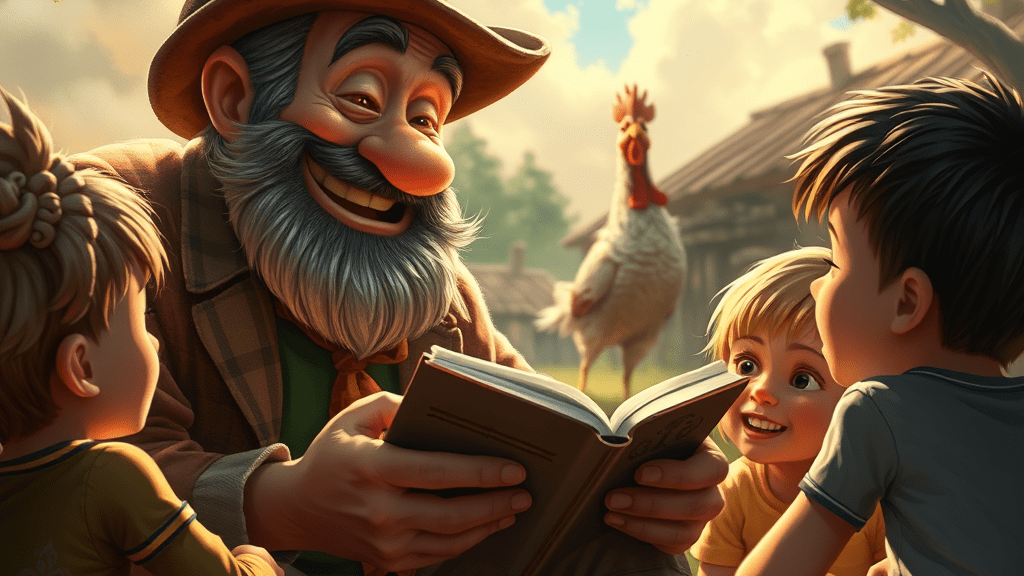
“Well now,” Uncle Slappy says to his rapt audience, who’s all settled in now after doin’ the Slappy Shuffle. “Granny says she ain’t got ‘nuf meat fer dinner and tells me she wants a ‘ticular rooster. It’s his time, she tells me. So I goes outside and, knowin’ that an’mals requires a firm hand, I eyes up that rooster. Ya know…ta let ‘im know who’s the boss n’all. Well, he eyes me back and we gets inta one big starin’ contest. I overcome his finer sensibilities by narrer’in my eyes to slits. See, like this…” and he demonstrated to us’n by narrer’in his eyes and sqwinchin’ up his face. He looked ta me like he et a saur lemon and it come out his nose. I tried not to laugh too hard so as not to set off Slappy’s hands, but it wern’t easy to hold that’n in.
Uncle Slappy unsqwinched his face and his audience lost its spasms. “Yessir, I stared ‘im inter submission. He purt near keeled over from my evil eye. But he ain’t no dummy. I wuz swaggerin’ towards ‘im when he jus jumped up and runned at me, feathers all big n’such.” Slappy’s hands were a flyin’ by now, showin’ us those wings and causin’ his audience to sway. “He sunk his beak inter my leg and owwww,” Uncle Slappy howled, “did that’n ever hurt. But I weren’t done. In one big, fast swoop, I done grabbed his neck and wuz holdin’ him up in front ‘o me, his legs jus danglin’ in thin air. We stared,” he sqwinched up his face again and I found a sudden need to pull lint offen my sock. “Then I saw this sof’ look in his eyes and I swear ta ya on my grave that a tear run down that rooster’s face and I cudn’t do it. Nope. Tol’ Granny she’d hafta find her another murd’rer.” Slappy laughed and attacked his leg with one’a his big hands, causin’ us’n ta rear back. I wuz laughin’ now at the memory o’ that rooster and him, but he dint know that. I won’t tell.
Ya see, Uncle Slappy hadta tell a tall tale cuz the truth is that rooster done got the best of ‘im. Here’s what really happened.
As he wuz skulkin’ among the chickens, the banty come runnin’ right at ‘im, feathers fluft, wings out, head low. He got Uncle Slappy in the leg, that’s about the onliest truth of it. Slappy howled (I’m supposin’ he hadta put that’n in the story cuz someone mighta heerd ‘im) and started spinnin’ his legs backwards, like Fred Flintstone goin’ in reverse. But that rooster wuz right on ‘im. He wuzn’t lettin’ up. Uncle Slappy turned and run ta the waggin. He wuz commencin’ to climb in when the rooster got the backa ‘is leg. He wuz kickin’, the rooster wuz peckin’, and it dint look too good fer Slappy ‘til he pulled hisself up inter the waggin.
Well now, that dint last long. The rooster had tekken a most def’nit dislike to Slappy and was in the waggin right baside ‘im afore my uncle’s back hit the hay. From atop the hay loft, I cud see inter the waggin. Slappy was slappin’ at that rooster, ‘is hands goin’ so fast they looked like blades. The rooster jumpt up top ‘o the waggin rail above Slappy’s head, lookin’ down at ‘im. I’m purty sure he was a’laughin’. That tear Slappy saw wuz pure mirth. Slappy retched up ter grab its legs but the rooster appeared to fall off t’other side so Slappy done retched ‘tween the slats ta grab ‘im. Well, that there wuz a bad idea cuz Slappy got ‘is arms caught ‘tween the rails. Now the rooster wuz back in the waggin and havin’ a time with Slappy’s armpits. The howl I heerd from Slappy was one thin’ but the sqwinched up, lemon-nose face he gave the rooster brought tears ta my eyes. Slappy got his arms free and the rooster done backed off. Mebbe he wuz convinced he’d made ‘is point. Anyways, Slappy set hisself on top o’ the waggin rail, holdin’ ‘is hands under ‘is armpits, a lemony look on ‘is face. Seein’ as ‘is prey wuz disabled, the rooster got onter the rail aside Slappy. They eyed each other fer a while and I’m purty sure a tear ran down Slappy’s face. Now that’n were a Norman Rockwell scene.
Vonni Sage enjoys exploring humanity through her writing and other art forms. When she isn’t creating, Vonni enjoys reading, kayaking, hiking, and snowshoeing. Recent publications include an essay, “Art in Place,” in Transformational: Stories of Northern Michigan Arts and Culture and “It Rained Down” at Friday Flash Fiction.
Vonni says about this story: “This is an oral storytelling piece based loosely on my experiences as a very young child visiting my grandparents’ farm. I noted your call, albeit in November, 2022, for oral storytelling, a tradition my Appalachian family revered. After many decades living a suburban life, I have returned to my farming roots and, as I settle into this new-old lifestyle, I find myself returning to my childhood experiences with fond remembrance.”
Please share this story to give it maximum distribution. Exposure is our authors’ only pay. You can also help our contributors gain exposure by back linking to them and to RFM’s homepage.
He rang the bell and then leaned in against the wall, out of the rain. Hands in his pockets, listening for her. Then the door opened in a spill of light, and it was Lizzie.
“There she is,” he said, and stepped straight in past her, headed for the warmth.
“Dad…”
Henry thumped his stumpy tail when he saw who it was, but he didn’t get up and Dan fussed him for a minute. Lizzie’s homework things were all over the sofa. He shoved them out of the way and took the spot she’d been sitting in, right next to the fire.
“Look at the height of you,” he said, “You’re shooting up.”
“That’s because you haven’t seen me for ages.” She perched on the edge of the armchair nearest the door.
“Sure I was here the other week.”
“You were not.”
“I was. You were out somewhere. Did your mother not tell you?”
Lizzie said nothing. Dan stretched out his legs and rested his feet on the dog’s back. Henry didn’t mind that.
“What about a cuppa for your auld Da?”
He listened to the sounds from the kitchen as she clinked around in there. Her mother would likely have biscuits in. He wouldn’t mind something sweet.
The fire had a good glow going, and the mantel clock was ticking away, same as ever. Lizzie was 13 last birthday so it was thirteen years since they’d took this house and set that fancy clock on the mantelpiece. Thirteen years in a house Maureen thought she was too good for. Her bloody Da had it drummed into her that she was a Donnelly and could expect the best. Well, she could and she did, but she was a long time waiting for it.
Lizzie brought the mugs of tea in one hand and a plate of biscuits in the other–Hobnobs. Him and her both liked their Hobnobs.
“Move that stuff,” she said, and when he’d lifted her books off, she settled on the other end of the sofa and put the plate between them. She did well in school, did their Lizzie. Never any trouble getting her to do her homework. She’d always been a bright wee thing. When she was no age he would take her with him out on the milk run, and she’d read out the orders for him. Great company, she was. Cute as a button.
He had loved those mornings. Loved being up at the farm before light, warmth pouring out of the dairy shed.Him and the wean in their wellies, and the rich smell of cowshit in the good country air, and the air steaming with their breath and the breath of the cows.
But you can’t raise a family on a milk round. Maureen’s father said he’d put him over the middle arch of the town bridge if he didn’t get a proper job. So he went into the factory then, and the milk was sold cheap to Allied Dairies.
“Is your Mammy at work?” he said, although he knew she would be.
“Mm-hmm.”
They held their cups of milky tea and concentrated on dunking their Hobnobs just the right amount, catching the soggy biscuit end before it fell off. The dog was snoring gently, and the fire was glowing, and the mantel clock was marking time. Lizzie had her feet pulled up under her. Look at those long legs – she was getting tall. Thirteen. He hardly knew her.
“I was up at the farm,” he said, and he spoke softly into the softness of the room.
“Were you?” Her head snapped up to look at him, eyes like her mother’s. “How was me Uncle James?”
“Grand. Grand.”
She loved the farm. Loved that her auld Da had grown up there. In that white-washed foursquare house, with the dairy yard milling with cows. When she was wee, he would pick her up so she could rub their big trusting faces and smell their sweet grassy breath. Even after he gave up the milk round, he had her out there all the time, seeing her Granny and Granda and her Great-uncle James. Now there was only Jamesy living out there, the old bastard, still going strong. And no cows at all.
“Why did you not call for me?”
“Ach, I didn’t know I was going,”he said.
It wasn’t true, and saying it didn’t help. The wean wasn’t stupid. She looked at him out of the side of her eye, and then drank the last of her tea, tipping the cup so as to let the sugary, biscuity sludge drip into her mouth.
“Lizzie, love,” Dan leaned a bit closer, his arm along the back of the sofa, “Uncle Jamesy’s not as young as he used to be.”
She was toying with her mug, turning it in her hands. She was not looking at him now.
“You know he’s had his name down for an old folk’s bungalow? Well, one’s come up in The Heights.”
She was a bright one, his Lizzie. She knew what it meant.
“You’ll be able to call in and see him after school.”
He didn’t need to say it. He didn’t need to say it out loud.
Maureen’s mantel clock whirred, winding up to chime. She’d be finishing her shift and getting back soon.
“Sure the place is half-derelict, Pet, it’s not fit to live in.”
She would know that. She would know that Uncle Jamesy would be better off in the town. It wasn’t the farm it used to be. The days were gone when it sung to the sound of cows lowing for their breakfast, and the yard pooled with light from the milking shed. The days were gone when it could have been a home for a family. And when a child’s breath could make time stand still in the frosty air.
Deborah Templeton lives on the north coast of Ireland. She writes for all kinds of contexts, including soundwalks and live performance. Water’s Edge was published in audio and book formats by Confingo (UK) in 2023.
Please share this story to give it maximum distribution. Exposure is our authors’ only pay. You can also help our contributors gain exposure by back linking to them and to RFM’s homepage.