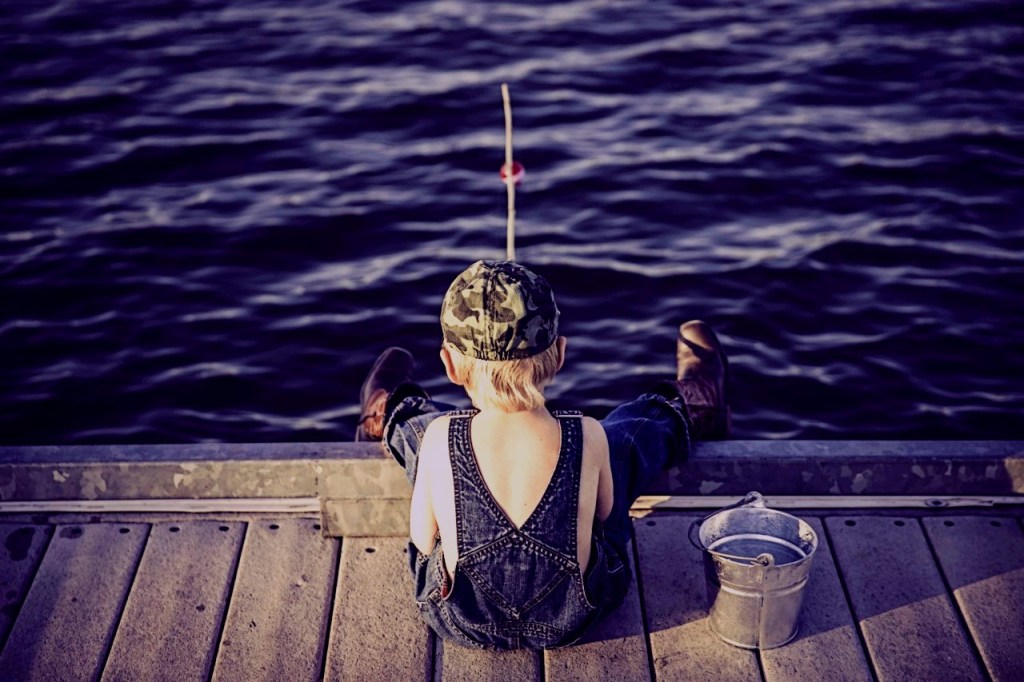
It was the first real warm Sunday in April. The Boy thought fish might rise and bite today. The crick was cold and the fish would never bite till the first warm day in April. The preacher had warned about fishing on the Sabbath, but the Boy couldn’t get away from his chores any other day. He sometimes couldn’t even make time on a Sunday. He chuckled about the preacher, and about the image of an ox in a ditch. He wondered if an ox could pull a plow like a mule did.
He went to the barn to retrieve his pole and tackle, and the Hills Brothers coffee can filled with black worms, brown leaves, and black dirt.. The boy wished he had sifted the rafts of the branches for pennywinkles but he hadn’t had time. He also wished he had some catalpa worms or drone bee larvae, but he supposed he would have to make do with what he had.
The cane rested on the seal over the barn door. Some kept their cane pole leaning in a corner, but the Boy knew better. They were best lain flat so as not to warp. He had put up a strong and supple one last summer to cure, and it was ready now, the color of clover honey and almost 10 feet long.
The boy crossed the terraced field and made his way down to the waters.
The boy knew that the crick widened as it flowed, and the eddied pools that waited half a mile away held bream (brim,) blue on the back and red on the belly. He could taste them as surely as he thought of them. He could taste the flour, and the pepper, and the lard, and the corn dodgers the Mother spooned into the crackling grease.
The maternal Uncle taught the boy where and how to fish. And although he didn’t mind fishing alone, he missed the Uncle. The Uncle passed last spring. The Boy could still hear the Uncle cough and still see the bloody sputum on the white handkerchief he kept in the bib of his Duck Head overalls. The Boy didn’t mind fishing alone, but he missed the Uncle, even though he was glad he had finally stopped coughing.
The Boy’s Father didn’t fish and he didn’t cough, but he had died anyway, just 3 months ago. He didn’t suffer like the Uncle. “Time and chance,” the Boy thought. He was eating his tomato soup and cornbread and just fell from his chair, dead before he hit the plank floor. The doctor called it a widow maker, a heart failure, the same doctor who couldn’t even stop a cough. Sometimes the boy thought physicians and preachers were just guessing.
But the Uncle had taught the Boy to fish and the Father had taught the boy to be small, silent … invisible, cause you he was less likely to beat what he didn’t notice. And now they both were gone and the Boy had learned all his lessons well.
The Boy extended the cane and dipped the struggling worm in the eddy. He employed neither bobber nor weight, but used the cane’s tip to move the bait up and down and ease it closer to the opposing bank. The line swirled and then went taut. The Boy set the hook and eased the struggling fish out of the water and worked the cane under his right arm and slid his catch back to his waiting hands.
The Boy gently removed the barbed hook and marveled at the colors he saw, every slant of light a revelation. Then he slid the now-subdued fish back into the stream. Though he didn’t know why, the Uncle had always freed the first, and the Boy knew he would always do the same. Then the boy began to cry as he had not done since he learned to be small, silent, and invisible, and the tears flowed like the waters of that mountain stream.
Alan Caldwell is a veteran teacher and a new author. He has recently been published in Southern Gothic Creations, Deepsouth Magazine, The Backwoodsman Magazine, and oc87 Recovery Diaries.
Mam’s reminders that either yourself or your sister were always sick on Christmas nick sharply at your patience as you tuck in your eldest, assuring him that you won’t forget to put out Santa’s milk and cookies. “I’ve got to go, Mam. Need to finish tucking Padraig and Sheila in.” The Merry Christmas is rushed, you can feel in your chest it’s rushed, but you assuage the guilt with a promise to call again tomorrow. You hang up, repeat your promise to Padraig that the tree will remain lit overnight so Santa knows someone’s home. That the food and drink will be out to sustain the jolly old bastard for his trek to grant every childhood wish. You just need to get the milk, you think, a whispered goodnight heralding the inching shut of the door as Padraig whispers a goodnight to Misty shifting at his feet. “We shouldn’t let the dog sleep on the bed,” Jeff’s said often enough. Well, Jeff’s not the one expected to police such rules, be the bad guy or Christmas Grinch when a boy’s sick.
Jeff’s fitful snores rise and fall from behind your bedroom door, the paracetamol weaving its magic. He should have worn his mask at work, you chide, self-congratulation evident in that puffed-up surety of tone. To have one under the weather at this holiday season might be considered unfortunate, but a whole household – and you don’t feel so hot yourself – must surely somehow be considered careless. At least the chicken’s prepped, the veg and spuds already chopped, almost all the presents wrapped.
Milk. That remembered conversation by the freezer cabinets with Pauline Wren, who’s had the dose and labels it’s ‘no big deal’ sets your teeth grinding. You shuffled off, eager to get the rest of the trolley filled and be home. And you didn’t return to pick up the extra milk needed for your Christmas Eve visitor. Hence the need to just pop over to the neighbours.
“Don’t bother with it,” Jeff would’ve said. Well, that Christmas magic drains away soon enough as kids age, leaving only chores, utilitarian or half-considered presents, and face-time chats with different time-zones. Your hands are already chafed with the cold as your coat stretches tight over the second sweater. You promise yourself an hour in front of the convection heater with a Bailey’s when you get back; it won’t take that long, those barely five hundred yards. No need for the car. It takes an age to heat up the engine anyways. Make sure you’ve got house keys. And some pies for Dawn’s kids. The phone snuggles against your left breast, imagined heat from a round of texts that should make you feel guilty but would Jeff really care? The door shuts with a morose thump as that first gust of wind catches you, its chill tingling at your fingertips despite last Christmas’ knitted gloves. The ‘Fuck’ that escapes your trembling lips is directed as much to Jeff’s wheedling for hot milk so he could sleep as it is the cold. Not even a hint of moonlight to guide you on your way.
The crunch of feet on gravel gives way to the scrap of sole leather on tarmac as your flashlight bobs ahead. More gritting of teeth, your head bowed as you walk into the wind. Your eyes sting, tears trailing down and into your mask – at least it protects below your nose, keeps the chilled wind from chapping your lips and freezing your jaw. You have the lines with Dawn rehearsed; ‘Thanks so much. So silly of me to forget. I brought some mince pies for the kids. No, I insist.’ You catch a trinkle of something in the flashlight’s glare – a fox, maybe? A rabbit? Surely forest animals have somewhere better to be? The light catches a twitch of tail as something flees into the ditch. Of course you shouldn’t be out at night either.
Deep murmurs of warning ride on the wind. Why won’t you go home? A howl wells up out of the dark. You tramp your feet harder to keep some circulation in them, grumbling at the pins and needles already at your toes. The thought of those texts keeps you warm. He lives back in Dublin, an accountant. Still not married. Looking for the right girl. Well, he’ll never know. You’ll never meet. A little flirtation before a ‘Thanks, but no thanks.’ Which will only hurt you.
You tramp past the driveway of Michael McGurk who’s taken the whole family – even the in-laws – off to Tenerife for some winter sun. Prick. One class ahead of you at school, always trying to coax girls behind the bike sheds. No college, stuck on the land his father wanted him to farm like past generations of McGurks had before. And the smirk the first time he saw you back from the Big Smoke, with a husband and two kids in tow, with part-time work once the latest bubble burst.
Is that a spatter of rain? You’ll be damn lucky to be back indoors before that kicks in proper. Another howl tappers off into a series of barks. Screeching yaps answer it. You swing the light up and down the left ditch and wonder if you catch a glint of an eye watching you through the briars. “Piss off,” you shout, jerking the flash forward and back like you were tossing out chicken feed.
Your strides aren’t bringing Dawn’s place any closer. The rain’s closer to sleet now, stinging your eyes. Lean into it, stride onwards. Nobody’s out at this time. No need to worry about a car flashing round the corner, a kid on a bicycle smashing into you. Another three hundred yards or so to the driveway, then careful across the cattle grid and up the drive. The paper bag with the pies for Dawn’s kids is already sodden. Ho, Ho, Ho! Kids. Santa’s not here yet but look what this second-rate, rain-battered elf’s brought you. A gust flings the bag upwards and one of the pies rolls out, splatting onto the trail of grass running up the center of the road. “Ah…”
You consider removing the few strands of grass and returning it to the bag. Then toss it into the ditch. Let the foxes, rabbits or whatever else eat it. Here’s really that final chance to pay attention to yourself saying ‘hang it, just go home’.
It’s probably about half-way between houses now. Your boot soles scrap against the road’s surface, giving your brewing anger some modicum of release. The bobbing flashlight the only guide along the road, no moon or stars above, no sight of pinprick of light from a kitchen or sitting room window ahead here. Your mask’s a sagging rag by now, useless against this wind that numbs your jaw. You want to fling it to the same place you threw that pie, but can imagine Dawn’s reticence once you show up at her door from a Covid-struck household without even the most basic modicum of thought for others. You should have just said to leave the carton on the front step. You could phone ahead yet and tell her that if you weren’t so cautious about dropping your phone. A half-dozen or so more steps and there’s that howl again. It’s closer, you’re sure of it, though the flashlight’s glare spots nothing. Faster, Maggie, faster. Get there and get home. Set out Santa’s snack, screw the fire and the Bailey’s. Turn off the phone and snuggle under the covers with a hot water bottle for at least a few hours rest before Santa’s 3am visit. Something else Jeff won’t feel up to doing.
If you think of the hot water bottle hard enough, maybe it’ll help stem some of the chill shivering your bones. The rain’s coming like sheets, slashing across your face, soaking your legs. A Nobel Prize should be given to the inventor of the wax jacket. Blackthorn and hazel thrash against the brambles and briars, like an old biddy shaking the dust from stored blankets before the coming winter chills. Something flies across your path, wings slashing at your face, and you jerk backwards momentarily, gripping the flashlight, a yelp rising from your cold-chapped lips. Enough now; turn back, say Santa loved the milk, lie to the child.
Its eyes glint unblinking in the shine of the torch. Back haunches set to spring, jagged vertebrae rising out of tautly pulled skin along the curve of its back. Each backward foot slide of yours is matched by its forward treads: snarling, teeth bared, saliva dripping too. It came out too on this Christmas Eve night, certainly not to cadge a pint of milk, but what has serendipity set before it. You take another step back and it, more emboldened before your growing fear, moves closer. It is hungry.
Keep your eyes on it. At what point does a hungry animal decide to strike? A car crawling homewards would be so welcome now. Will Dawn wonder why you haven’t arrived yet? Will she think you’ve given up and stayed home? Will she phone, the landline ringing on and on with no one shifting to answer it.
‘Maggie, Phone!’
‘Mom, the phone’s ringing!’
They won’t come out to see what’s keeping you yet. You’re at the bend, Dawn’s porchlight like a lighthouse beacon if you could risk a glance. The wind and rain are jostling against your backwards progress.
The pie. Fling it over the animal’s head and run? You can already imagine the thing slamming into your back, your face shoved into the ground. And then? It’ll find the wax jacket something of a negotiation unless it goes straight for your face. Tear at your ears. Burrow into your neck. What will it care? It’s only hungry after all. And you are only food.
“Here boy.” You raise the bag, shake it slightly. Taking your time with removing the pie, you can’t even be wholly sure the food’s taken the slightest scrap of its attention. Would it be satisfied with a smaller offering for little to no effort? Would some natural inclination to hunt see it chase the bigger prize? It takes a step closer. Be sure to put the right strength into your throw, make sure it passes over the creature’s head. And hide your fear. That’ll get you killed.
It tenses as you wind into the underarm throw, ready to react. “Go fetch,” you yell, flinging the food upwards and away. Its trajectory is lost in the dark and you’re back-pedalling as its eyes search out what you’ve thrown. It actually takes a few steps back. Can it see in the dark? Those two pin-pricks like search-lights scanning the dark for prey?
And you’re running, arms pumping, the flashlight’s beam jerking up and down. And there’s that same howl. You let out a scream as your feet pound the asphalt; a slip and you’re fucked, some inner demon snipes. But then, aren’t you fucked anyway? You could burrow inside your coat for the phone but who’d answer your call and save you in the next thirty seconds? Surely a hundred yards from the driveway. Will they have opened the gate for you? Surely they aren’t expecting you to use the intercom. And then there’s the cattle grid that you’ll somehow tip-toe across with fucking Cerberus barrelling after you.
Its barks sound far too close. Your wheezing breaths flame your lungs and scald your throat as your heart thumps against your sternum. Or are those heart beats the sound of your pursuer gaining on you? You feel its heft upon you three, two, one second before that happens, you hitting the rain-soaked road with a thump before you roll, the nails of the dog’s front paws scratching across your face. Its breath is hot, rank with an underlying putridity borne of scavenging and vermin. Those teeth will be sharp. You manage an arm between you and it; bawl out another shriek as its teeth clamp down, as its mouth shakes your arm back and forth, shredding through the wax sleeve and layers of winter sweaters, sinking into your flesh. The flashlight crunches and dies. No light now bar that ravenous glint in its eye. You drag the glove from your left hand with your teeth, snake it upwards and gouge into that glint, kneading at the pulp of its eyeball. You hear the pop, the yelp as it jerks backwards, briefly surrendering its grip.
The soles of your feet pedal you backwards, pebbles shove like pins into your palms. There’s no pain from the bites yet. It’ll be back, just as determined and probably even angrier. You roll and stumble as you gain your feet, manage a half-dozen strides. Here it comes again, hitting you full pelt. Your arms fly outwards to cushion your landing and you’re grasping at metal bars. Dawn’s driveway, somehow. You feel its breath below your left ear and squirm right. Its jaws catch on the coat’s neck, tearing at the fabric, and you grasp at the bars, pulling yourself away. More growls. Vented frustrations. Half your coat’s ripped away, all protection against its teeth and the elements almost gone. You roll as it lets out a volley of barks; a dart of hope hits you as you wonder whether it will stumble on the cattle grill. You drag yourself along, pulling your feet upwards as you feel a snapping at your ankles. “Go fuck yourself!” you shout back, kicking outwards.
More barking, more growls. How can Dawn have an intercom on the gate but not motion sensored lighting? Your roars won’t make it near the house in this wind and rain. You try anyway. The scrambling sound of claws scrabbling on the edge of the garden wall shows it’s far from giving up. You grit your teeth, your arm’s aching, a damp patch you fear is not from the rain forming just above the knee. It’ll circle you, waiting you out, hoping you’ll lie here bleeding, marooned on the iron grill, as the rain chucks down, the freezing wind slaps, as the light above’s switched off. Dawn will have decided that unanswered phone calls are a sign you’ve gone to bed. ‘But I’d take the phone off the hook, wouldn’t I, Dawn?!’
You unzip the top of your coat and fumble inside. A growl undulates in its throat. It’s on the wall now, getting ready to leap. “Call Dawn!” You listen to the ring’s trill and it’s now the only sound in the world. Answer. Answer. Answer! The rest of your life stretches out, soundtracked by that ring: you’ll ‘fess up to the accountant about the marriage and the kids; you’ll tell Jeff what you really think of the Pandora bracelet he’s got you, ask how he knew you were building a collection year on yea…
“Maggie?!”
It lands on you and you scream, the phone tumbling from your grasp and clanging against one of the grid’s bars and down into the bed of gravel beneath. You can still hear Dawn’s voice and you bawl for her, hands flailing in front of you as the dog sinks its teeth into your left hand. You twist, shrieking as the flesh around your ring finger rips within its teeth, its mouth shakes your hand left and right. It splutters, wool, fingernail, skin, and ligaments swallowed, but at least one of the wedding and engagement rings has been swallowed too, the other making a hollow pinging sound as it drops from its jaws. Its paws scrabble as its pads, no comparison to the soles of your sturdy Timberlands, slip on the steel. You grasp at two bars, a lone shipwreck survivor scrambling over jagged rocks towards that lighthouse beacon. Is there someone at the door peering out? Lights switch on from two points either side of the front gate and the thing above you pauses, transfixed by the glare, caught between fight and flight. You yell Dawn’s name. Are there returning shouts coming from the house?
It emits another growl, weighing up this new layer of risk. One isolated creature is not like facing an entire rival pack. It scrambles backwards, lets out a yelp as it slips, its leg sliding between two bars. Dawn’s husband Tom’s yelling for her to grab his shotgun, summoning a long-forgotten memory of your own Dad hefting his while pointing out possible fox trails. Off the grid at last, it turns and barks twice, one eye glinting in the halogen lights. Not so big after all; what blocked your path on the road – a black beast reminiscent of Conan Doyle’s Hound – in these halogens actually looks half-starved from the ribs jutting through its emaciated shanks. Blood and saliva drips from its mouth, pus dribbles from its popped left eye, and in this light you see how pathetic something creeping out of the dark might be. A final cursed warning from Tom and it turns tail, bounding off into the dark.
Tom darts through the gap in the whining gates and lifts you up. You let out a gasp of pain, hear Dawn warn him to carry you carefully. Instead, you find your feet and limp between them as they half-cradle you up the driveway. Adrenaline still resonates through you, your thoughts, desires, and dreams in tumult as you greet light, warmth, and safety. Shorn of monotony and fatigue, but also of pain and terror, everything about life appears suddenly so crystal clear.
L.P. Ring is an Irish-born writer and teacher based in Ibaraki, Japan. He writes crime, horror, and weird and has been published with Bag of Bones, Kaidankai, and The Bombay Literary Magazine. He has upcoming fiction with Mythaxis, Black Beacon,FOTD, and Shotgun Honey. He tweets at @L_P_Ring .
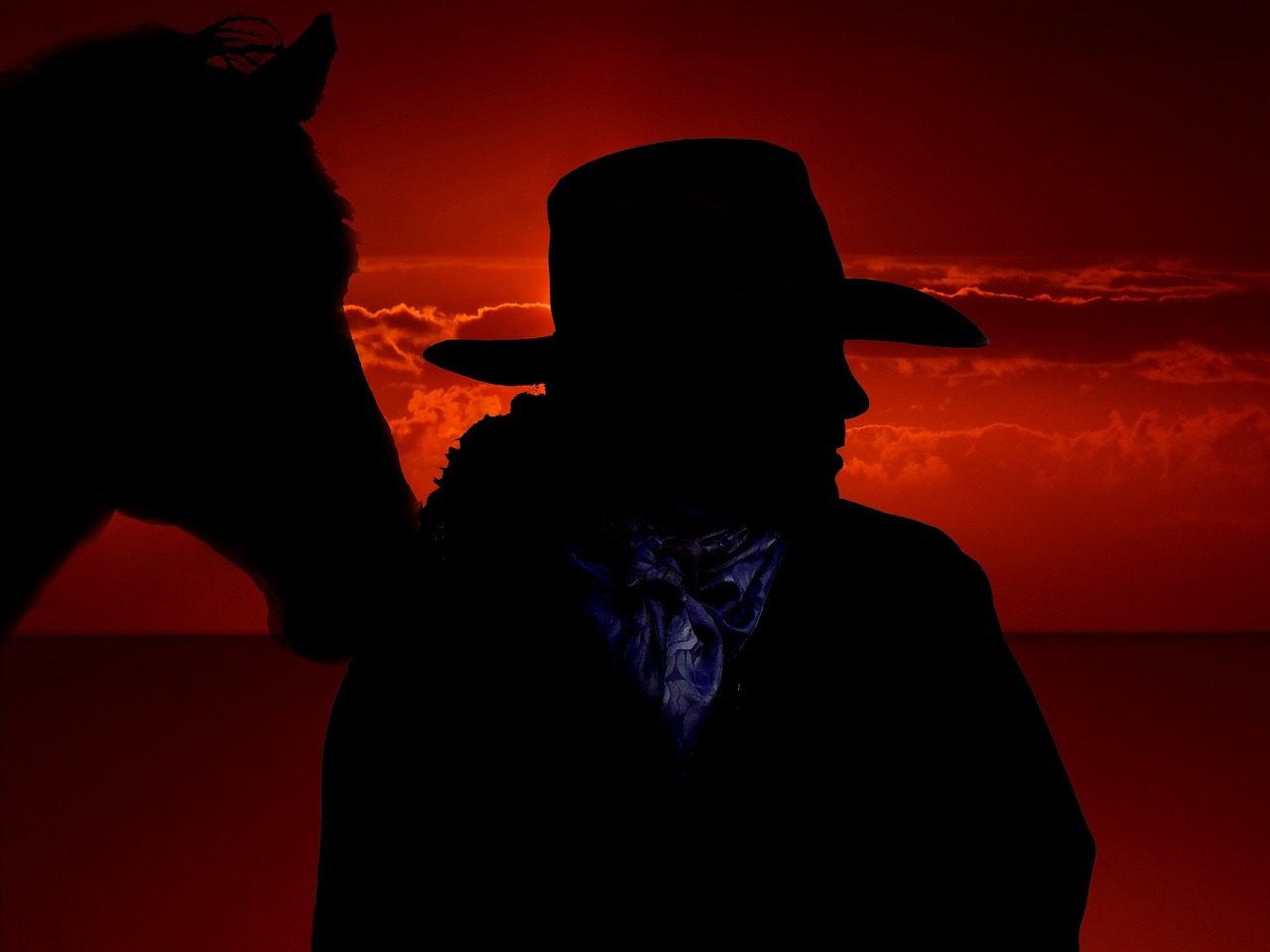
After reading too many westerns, God went to the old west to try his hand as a cowpuncher. It was expensive as he had to spend $200 on a saddle horse, $60 on a saddle, $20 on a sidearm, an another $20 on a saddle roll and other accoutrements—a good $300 before he even got to get a little doggie along. He had a whiskey at a saloon and agreed to terms with the trail boss for an outfit headed for Ogallala. He turned down a roll in the sheets with a soiled dove named Maggie before saddling up at the livery stable and heading out of town to meet up with the other cowpokes.
The going was tough at times, but it was a real adventure. A sandstorm rolled through early on in Texas and they got stuck in a hailstorm shortly after crossing the Red River into Indian Territory. The herd stampeded twice during thunderstorms and one cow was even struck by lightning. One evening, just after crossing into Kansas, as God sat around the fire with the other hands, eating a plate of beans and beefsteak, he heard an eerie singing from beyond the circle of firelight. It sounded like a poor imitation of Slim’s night song for the herd, but Slim was lounging on his bedroll with his own plate of grub and a full mouth.
“You fellers hear that?” asked Buster, sitting next to God.
For a moment, God was relieved that he was not the only one hearing the eerie, mournful singing. He nodded, eyes wide.
“You don’t suppose…” started Bill.
Buster nodded solemnly and only a second later they heard a falsetto voice call “Git along little doggies!”
“Who’s that?” asked God.
“Not who,” replied Slim from across the fire. “What. A jackalope, I reckon.”
“What’s a jackalope?” asked God.
Bill looked at Buster, who looked at Slim in turn. “It’s a fearsome critter,” said Slim. “Like a the biggest meanest jackrabbit you have ever seen, but with horns like an antelope. Can talk like a man, and it’ll stick you with its horns quick as it look at you.”
God was confused. He didn’t remember creating such an animal, but he’d made so many, maybe he forgot. He forgot about coelacanths for sixty millions years.
“’Spose it’ll need appeasing?” asked Buster.
“’Spose it will,” said Slim. “God, you’re the junior man here, so you seem to be the one for the job. It’ll be wanting whiskey.”
“But I don’t have any whiskey,” said God.
“Grab the jug from the chuck wagon,” said Bill.
“Cookie’s in there with it. Boss gives out the whiskey,” replied God, unsure what to do.
“Boss knows how serious a jackalope is. Especially a thirsty one. Just ease it out of there. You’ll need to pour some in a cup and put it out there for that varmint to drink.”
God looked around at the fire-lit faces for an indication that they were jesting, but they all seemed dead serious.
Cookie was splayed out in the corner of the chuck wagon, snoring loudly. In the flickering light, God spotted the jug of redeye. He quietly pulled it from the wagon, along with a tin cup. He brought it back to the circle, pulled the cork with his teeth, and poured a good bit of whiskey in the cup. He looked around at the other cowpunchers.
“Go put it out on the ground over toward the signing,” instructed Slim. “Maybe fifty yards out—far enough that it’s dark. But be careful!”
“Better leave the jug here,” added Buster, “you know, in case you gotta run.”
God set the jug down and stepped into the night. He crept quietly and carefully, expecting the sharp stab of horns at any moment. When he turned to see how far he’d gone, Bill, Slim, and Buster were passing the jug around, laughing. God’s heart sank as he realized he’d been tricked. He stood there for a minute, listening to them laugh at him. His face hardened and he threw back the full cup of whiskey in one swig. He walked steadily through the dark to the remuda, where he mounted his own horse and tied on three others. Quietly, he separated off a few dozen cattle and headed away from the light of the fire.
“They can keep their dern herd,” God thought to himself. “I guess I’m a horse thief and cattle rustler now. That’s where the real adventure is out west.”
He nickered to his pony and pointed his herd northwest.
Colin Punt does most of his writing as a practicing city planner, envisioning the future of cities. When he’s not planning the future urban form, he enjoys reading books, riding bikes, and sailing boats. His work has appeared in Steam Ticket, A Thin Slice of Anxiety, and in an upcoming edition of Midwest Review.
Not a call. Not from either of them. Too busy to call their father this Father’s Day. Well, that’s the way kids were today. Actually, they weren’t really kids anymore. They were both grown with families of their own and way too busy with themselves and their kids to have time for anyone else. But still maybe they would call. After all, there was a two-hour time zone difference.
Ward R. McGuinty, sixty-eight, looked out the window of his inherited hundred plus year old farmhouse, the house he grew up in, raised his family in, and stared into the cloudless heavens waiting for a call and trying to remember if he called his father on Father’s Day each year. But he couldn’t remember. His mind was as blank as the sky, and this frightened him.
But he did remember certain things about his father though, dumb things, funny things, meaningful things, happy things, good times things. Things that no one else in the whole world would ever know but him and he thought that maybe he should tell his kids about them now before his mind goes or he dies, and they are lost forever.
His father had been a farmer, a second-generation farmer. Ward was the third generation on this farm. His grandparents settled and died here and were buried in the cemetery down the road. Their gravestones proudly proclaimed their heritage. “Born in County Down Ireland. Died in Western Illinois.” His parents were buried there too but with just their names and dates, no mention of their place of birth or death. Ward knew that his time too soon would be coming and that he too would be buried there, the last McGuinty to be buried there. No telling where his children would be buried. They hadn’t lived here for years. The farm wasn’t their home anymore. They had no ties to the land.
So realizing his days were numbered, Ward tried to recall all he could about his father to tell to his kids when they called. If they called. He first remembered back to when he was just a little boy and had called his father Daddy, then Dad when he was a teenager, but now as an adult he simply thought of his father by his name, Bob, and it was Bob now that jogged his memory.
Bob was loquacious. Loved to talk. Chatty was the word for him. His mother called their barnyard Grand Central Station as all the local farmers would gather there to talk to Bob. Leaning against their pickup trucks, they would talk for the longest time about things like the price of beans and corn, what hogs and cattle were going for, politics, and the weather of course. Farmers always talked about the weather. Back then the weather was just that, weather. It wasn’t climate change or global warming yet. It wasn’t political. Thank God for that thought Ward since ‘political correctness’ would surely have driven Bob up the wall. Actually, anything political got him worked up.
Ward remembered Bill Bowen, one of their old neighbors, who liked to get Bob going on politics. The two of them had this little routine that they would always go through whenever discussing the same. Bill would always start it with, “Well you know. That’s what they say,” and then wait for Bob to bite. Which he always did of course.
“No Bill I don’t know what ‘they’ say. What do ‘they’ say?”
“Well, you know. They say,” answered Bill shrugging his shoulders.
“No, I don’t know Bill. Who are these ‘they’ that you’re talking about? ‘They’ got any names. ‘They’ got any phone numbers that I can call and find out what ‘they’ say?”
BIll would just chuckle in response, shrug his shoulders a second time and run his fingers through his mop of long black thick hair. That was the signal that the Bill and Bob comedy routine was over for now, but it would be repeated the next time these two talked politics.
Funny how one thinks about nonsensical things like this about one’s father on Father’s Day when one should be thinking of the good times with him instead, reflected Ward. So, he shifted his mind to the good times, the county fair times.
Months before the fair each year his father would buy him a 4-H club calf to raise and show. He would feed and take care of it and his father would help him train it to be led around the show ring come fair time. He never won anything, none of his calves were ever in contention, his father stunk at buying winning show calves. But nevertheless, the fair times were happy times for the both of them, preparing the animal, getting their hopes up and the excitement of the fair each year. But it was his father more than him that enjoyed it all. His father would spend the whole day, every day, at the fair during fair week, and did so for a number of years even after Ward had outgrown 4-H.
This was because his father had the contract to dispose of all the cattle, hog, sheep and other farm animal manure at the fair each year. The exhibitors would clean their stalls and pile it up outside each building and his father would scoop it up on the end loader, load it into the manure spreader, then drive it down the road and spread it over a field of some farmer who wanted free fertilizer. Every morning he would leave for the fair in the dark and come home in the dark each night. But it wasn’t an all-day job. He could have gotten it done in either the morning or afternoon if he had wanted to. Rather it was an excuse for him to spend all week at the fair talking to everybody and their brother, about any and everything, having a high old time.
Just then Ward thought he heard the phone ring. It didn’t. It was only his imagination, wishful thinking. But the phone prompted Ward to think of something else about his father. How much he loved to talk on the phone. How he would make or take all his calls at mealtimes. Cell phones didn’t exist back then. Sitting there eating his father would yammer away, business calls at noon, personal calls at supper time.
One time at supper when his father answered the phone it was a wrong number. Rather than tell the guy and politely hang up, his father pleaded with the caller to stay on the line and talk to him. His father even told him his name hoping to start a conversation. Yet no matter how hard he tried to coax the caller to reveal his name and talk, the caller refused to do so. “You got a name, don’t you? Well, what is it? I told you mine,” his father pleaded to no avail. Finally the caller got tired of all that nonsense and hung up on him. His father was offended.
Another stupid story thought Ward that he should tell his kids about. Oh well, he knew that it was silly and that his father hadn’t accomplished anything great in his life to brag about, but so what. Silly things still counted for something too and his kids never really knew their grandfather as they were quite young when he died.
So right then and there, Ward resolved to write down everything that he could think of about his father to pass on to his children. Like the time his father tipped over the combine on a hillside, rode it down, and jumped off at the last moment unhurt. Like the time his father gave away some of his mother’s chickens to a neighbor without her permission. He caught hell and she made him go get them and bring them back. Like the goldfish he kept in the cattle watering tank. Like the way he always said ‘ponsetty’ for poinsettia at Christmas time each year. Things like these.
Just then his thoughts were interrupted. The phone rang and this time he heard it for sure. His wife came in and handed it to him. “It’s our daughter,” she mouthed. Father and daughter talked for over half an hour. The daughter hogged the conversation the whole time talking about how wonderful they all were doing now that they had relocated to California. Occasionally Ward would get in an “Oh I see,” or “Oh that’s nice” or “Uh-huh,” but hardly ever more than a sentence or two. Finally, she announced that she had to run and ended with “Happy Father’s Day. Love Ya Dad.” To which he replied, “Love you too Sweetie.”
“Well, what’s the news?” asked his wife, desperate to know what they talked about for over half an hour.
“Oh nothing,” he replied.
She gave him a dirty look but thankfully before she could verbalize her discontent, the phone rang a second time. This time it was their son. And again, Ward sat there and mostly listened. Listened to everything about his son’s family, the boys and all their ball games, and school and church, and their neighbors, as if he cared about people he didn’t even know, and etc. etc. etc. Much the same palavering as his daughter’s call had been and again, he never contributed a full paragraph to the conversation.
“Just called to wish you a happy Father’s Day Dad,” said his son. “Love ya man.”
“Love you too Son,” he said as he hung up.
Ward chuckled to himself realizing that the loquacious gene had skipped a generation. He didn’t have it but his kids sure did. That’s for sure.
“Well, what’s the news from our son?” his wife asked impatiently.
“Oh nothing,” came back the same answer again.
His wife shook her head in disgust and growled at him.
He paid her no attention as he sat there wondering what his kids would remember about him when they were old, and he was gone. What stupid or clever or loving things that he had done would they recall. Probably dumb things like he had done just now. He closed his eyes to hide the tears forming therein. Then he shook his head side to side as if to shake away his thoughts. His whole body shuddered and trembled all over.
“What’s that all about?” asked his wife observing this strange behavior.
“Oh, nothing dear. Nothing at all.”
Retired attorney. His books have been published by Two Guns Publishing.
When they reopened the island, most people didn’t come back. Hard to blame them. Everything along the shore was gone, the mansions, the high-rise condos, the retirement homes. The storefronts weren’t spared either, and it’s not like we were getting tourists back anytime soon. Enough time had passed that most people, the ones that got out, had settled elsewhere. But me? I was on the first boat back.
We took a boat because the causeway wasn’t rebuilt yet. By “we,” I mean the true locals, the ones born on the island, the ones who can recite the history of the Beacon Pointe Light like we’re reading it off the goddamn plaque.
It was built in 1891, by the way, made out of iron with a winding, hundred-foot staircase in the middle. When the sun sets, its light can be seen across the island, turning like clockwork, the soft whoosh lulling everyone to sleep. That was before the storm. Now, it’s caked with sticky mud and algae, a sea-born scarecrow, warding off visitors.
I remember stepping off the boat, the straps of my backpack digging into my shoulders. The dock was brand new, higher than the one before, spared from the elements. Not so much for the mainland.
The smell hit us first, a rotten haze between stacks of twisted metal and crooked palms. The sky was gray, humid, sucking up the heat and wringing it over us like a wet towel. Come to think of it, I haven’t seen the sun since I’ve been back, like it got swept away with everything else.
I decided to walk, stretch my legs, free up a seat on the bus for one of the older folks. It was dark by the time I made it home, dodging puddles and branches along the way. My place was in decent shape, still had some roof left. The inside was a graveyard of debris, with traces of water up to the ceiling. Not too bad, all things considered.
Later that night, I saw my first ghost.
I was on the recliner, still damp in spots, sipping a flat beer, staring at the blown-out TV, imagining a baseball game. It was the top of the ninth, no, the bottom of the ninth. Two outs, two runners on, home team down by three. Up comes the cleanup hitter, the big guy, ready to send the game to extras. Free baseball. Doesn’t get any better than that.
Something caught my ear. The sound of footsteps, wet and slow, trudging through the backyard. I downed my beer, tossed the can into one of the junk piles, and made my way towards the kitchen.
The lights flickered, got dimmer, getting used to electricity again. On the patio door, a black shape emerged. A shadow, rocking back and forth with the wind.
“Hello?” I broached a timid step towards the door. “Who’s out there?”
No answer.
“I can see you,” I said, like it mattered. “Mardi, is that you?” I hadn’t seen Mardi on the boat, or anyone else from my block, but I couldn’t think of anything else to say.
Still no answer. I swallowed a lump in my throat and cracked the door.
An old lady stood on trembling knees, hands locked on her elbows, her head down.
“Ma’am?” I opened it the rest of the way. “Is everything alright?”
Water was everywhere, pooling at her feet, dripping from her forehead, her shoulders, her wrists, draining the color from her hair and skin. She looked up, jaw clenched, eyes shut. Her nostrils flared in and out, in and out, every breath a struggle.
“Hang tight,” I said. “Let me get you something.” I tore through every room, a stranger in my own house, until I found a stack of towels.
When I got back to the door, the old lady was gone. I searched the kitchen, the living room, the bathroom, but I couldn’t find her. I circled the house again, stumbling over debris, crushing beer cans under my boots, banging into sharp corners. No sign of her anywhere.
“Ma’am?” I retraced my steps. “Where’d you go?”
Footsteps again, in the backyard. I went outside, the towel slung around my neck. No moon, no stars, no light. I stuck my arms out, let my eyes adjust, crept forward.
I found her by the fence, standing on the fallen pickets, her back to me.
“Here you are.” I draped the towel across her shoulders. It fell to the ground.
The old lady turned. She opened her eyes, opened her mouth, everything glowing white. I shielded my face. A scream rang out, echoed across the yard. Then another. And another.
She wasn’t alone. There were more shadows, more people, drenched from head to toe, a maze of blinding white faces. I stumbled around them, through them, bracing myself for impact but feeling nothing.
I managed to get back inside, tried to lock the door behind me, but the bolt wouldn’t stick. Rusted over. I crawled to the corner, wound up in the fetal position. I might’ve cried, who’s to say.
Next thing I knew, I woke up on the kitchen floor. Daybreak spilled through the windows. The screams were gone. When I built up the courage to check the backyard, the people were gone, too. That’s what I called them at first. People. It made me feel better. But deep down, I knew what they were. And it wouldn’t be long before I saw them again.
Not the same ones. Well, sometimes the same ones. I’ve seen that old lady a few times. Never in my backyard again, but once across the street, staring at a fallen power line, and another time at Deb’s hardware store, wandering through the aisles.
There must be hundreds of them, the ghosts of the island. Some of them I recognize, like Chipper, who used to build benches on his front lawn and yell at people who didn’t stop at the intersection. He still stands in front of his house every morning, what’s left of it anyway, but there aren’t any benches and he doesn’t yell. He just points, opens his mouth, stretching the limits of his face, glowing white.
The worst sighting I had was by the shore, sitting on one of the benches near the dock, waiting for the next boat to come in. I’d just gotten a coffee from the diner, the morning it opened back up.
I wasn’t through my first sip when a little girl ran by, dragging a kite across the fractured concrete. I got up to help, I used to love flying kites, until I saw the trail of water behind her.
She followed me home that day. I wouldn’t turn around, I didn’t want to see her face, pale and innocent, with those horrible glowing eyes. I didn’t go outside for a while after that.
We can all see them, the people who came back. Some of the locals wear silver now, necklaces, rings, belt buckles, whatever they can find. Crazy Larry spread a rumor that silver keeps the ghosts away, but I don’t mind them. They’re not doing anyone any harm. They’re lost, confused, scared, not much different from the rest of us.
Every sunset, the ghosts gather along the shore. At first it was just a few of them, wandering into the gulf until their knees touched the water, shivering, always shivering. Now, it’s all of them, their own little ritual. They wade into the water until the sun goes down, then they disappear into the night. Half the island still doesn’t have electricity, so who knows where they go.
But me? I go back to my house, crack open a beer, and settle in for another baseball game. My team is undefeated this season. I’m feeling really good about the playoffs.
Sometimes, I wonder if I’m a ghost, too. I see the same people, do the same things, day in and day out. No one else has come back. No one comes to visit. The charities are gone, the food banks are gone, the government tents are gone. The relief checks will stop soon. We’re on our own now. It’s kind of like that old saying about a tree falling in the forest. If you rebuild a town, but nobody’s there to see it, did it really happen?
I think about these things as I sit on my recliner, waiting for another ghost to pay me a visit. Sometimes, I end up at my bedroom window, staring out at the Beacon Pointe Light, its shadow lingering under a dim night sky.
I wait for the light to turn on, for the whoosh to come back, for the heart of the island to beat again. It hasn’t happened yet. It may never happen. We’ll be here if it does.
Kevin DG Johnson is a product manager by day and writer of creepy tales by night. His previous work has appeared in several online publications, most recently The Chamber and Elegant Literature. He can be found on Twitter @KevinDGJohnson.