

I haven’t decided just when RFM will reopen or that it definitely will reopen, but subscribe for the latest updates or check back frequently. If and when RFM reopens, it will probably be a soft reopening without a lot of fanfare. In the meantime, please read RFM’s past issues to see what I like and checkout RFM’s nascent YouTube channel.
Category Archives: Fiction
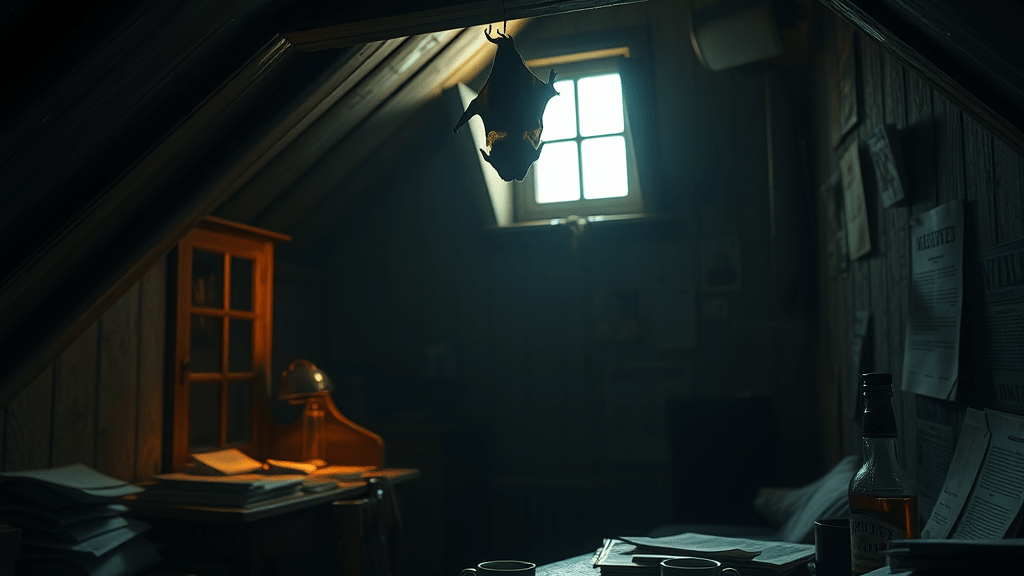
“Bat in the Attic” Flash Fiction by John Brantingham
In the morning, Charles smells a combination of diesel fuel burning and something dead, probably a deer or a raccoon out in the woods. The thing of it is that he starts to panic in the way that he did all those years ago when he got out of the war, and he was just back and didn’t know how to deal with the memories, so when he gets to the hardware store, before he opens up, he has a long and calming draught of the bourbon he keeps in his office even though it’s not quite 9am. It helps him to numb out a little. Just a little. Just enough.
He pours a little out of the bottle into his coffee cup because that seems more dignified than pulling at a bottle, and leans back in his chair to see a bat hanging on the far end of his office. His hardware store is in a converted house, and his office is in the attic, and he’s had bats in here before, but he thought he’d sealed the place. Somehow the little bastard found its way in, so he goes downstairs where he keeps a .38 behind the counter and comes back up and shoots it, the smell of the powder, the sound of the shot bringing him back to that space again, so he takes a long drink straight from the bottle, before he puts the weapon on his desk and sweeps the carcass into a dustpan.
When Cindy, the woman who usually runs the cash register comes in to work and opens the place up, she asks him, “What’s that smell?”
Charles sniffs his hand. “Gunpowder. There was a bat in the attic.”
“So you shot him?”
“Seemed the fastest way.”
She laughs. “Well you better not let Henry know you shot a bat.”
Charles knows that he should chuckle with her, their inside joke that Henry, his teenage boy, loves awkward little creatures like bats and toads a little more than is normal even for boys, but her statement burns at him a little. It brings him back to when he was a lieutenant, and he’d watched a man get shot, and he’d ordered his private to retrieve the body, and the private said that the field was probably being watched by snipers.
The private had probably been right, but in a reflex, Charles had pulled his pistol and was about to threaten the eighteen year old kid with it, when a captain told Charles to stand down, and he did. He spent a day and a half thinking about shooting that punk kid who had been right, the scene playing over and over, him raging harder and harder every time he did.
That’s what he’s feeling now, and his son is going to be here in the afternoon for the chores that earn him his spending money, and that drives Charles into his place of rage too, so he goes back upstairs and picks his pistol off the desk. He comes back down and gives it to Cindy. He says, “I need to take the morning and maybe the rest of the day off.”
“Where are you going?” Cindy asks, and it’s an innocent enough question, but it feels like insubordination.
He says, “I’m not sure, but I might not be back until tomorrow.”
Cindy waves, and Charles leaves, not going home but off somewhere to another town where Henry will not be.
John Brantingham is the recipient of a New York State Arts Council grant and was Sequoia and Kings Canyon National Parks’ first poet laureate. His work has been in hundreds of magazines and The Best Small Fictions 2016 and 2022. He has twenty-two books of poetry, nonfiction, and fiction. Check out his work at johnbrantingham.com.
If you would like to be part of the Rural Fiction Magazine family, follow this link to the submissions guidelines.
Please share this post to give it maximum distribution. Exposure is our contributors’ only compensation. Don’t forget to back link to this story.
Financial donations through either our GoFundMe or Buy Me a Coffee accounts will help expand our global reach by paying for advertising, more advanced WordPress plans, and expansion into more extensive Content Delivery Networks.
Image generated by AI
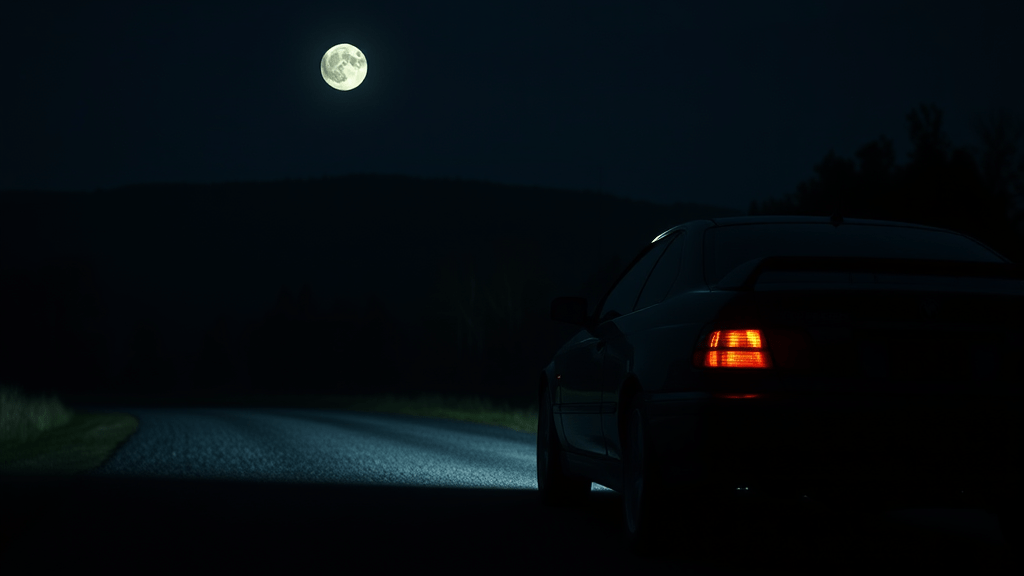
“Beethoven in Indiana” Flash Fiction by Zvi Sesling
It is three a.m. and I have been driving thirteen, fourteen, maybe fifteen hours. I have passed through West Virginia and then, Kentucky, which was the last time I stopped to eat. But now in the middle of the night there are no signs for restaurants or gas stations so I decide to get off the main highway and continue along on a backroad into Indiana.
It is a pitch black night on this lonely road so I stop, get out to relieve myself and take a sip of bottled energizer to help me stay alert. I keep driving and now I am in the middle of Indiana. I decide to turn on the car radio where that I figure the music will help me stay awake as long as it is loud and noisy. To my surprise the radio pulls in Beethoven’s Sixth Symphony.
My New York snobbishness tells me that I did not know they played Beethoven in Indiana. I would have figured country music, Hank Williams, Willie Nelson or Dolly Parton. But no, it is Beethoven on this Indiana station.
It is dark country in Indiana at 3 a.m., not like New York which stays alive twenty-four hours, lights make it seem like day time, especially in Times Square. But out here the night is black with no road lights so I have to stay alert. I would not want to hit a deer or a bear or even a coyote.
I slow down for a minute, take another shot from the bottle of energizer liquid, swallowing a long gulp.
The thing about these Indiana hills is that they are blacker than the night. They are just dark hulks. There are houses but they are spaced far apart and no lights are on at this hour. There are no towns, no gas stations no truck stops or diners. It is so dark even the moon sleeps and stars do not twinkle. You would think out here in nowhereland the stars would command the skies. A full moon would light the world.
It is kind of scary being all alone on a dark country road so I pump up the volume and slow down a bit to conserve gas but keep driving as Beethoven’s storm rages then calms and ends. The announcer is about to name the orchestra and conductor, but a rock station from somewhere takes over and a different announcer says, “That was Twisted Sister” as a faint morning light takes me head long through rough farm land.
Zvi A. Sesling, Brookline, MA Poet Laureate (2017-2020), has published numerous poems and flash fiction. He edits 10 By 10 Flash Fiction Stories. His flash fiction books are40 Stories (with Paul Beckman), Secret Behind the Gate and Wheels. Sesling lives in Brookline, MA with his wife
Susan J. Dechter.
Please share this story to give it maximum distribution. Exposure is our authors’ only pay. You can also help our contributors gain exposure by linking to them and to RFM’s homepage.
If you would like to be part of the Rural Fiction Magazine family, follow this link to the submissions guidelines.
Financial donations through either our GoFundMe or Buy Me a Coffee accounts will help expand our global reach by paying for advertising, more advanced WordPress plans, and expansion into more extensive Content Delivery Networks.
Image generated by AI
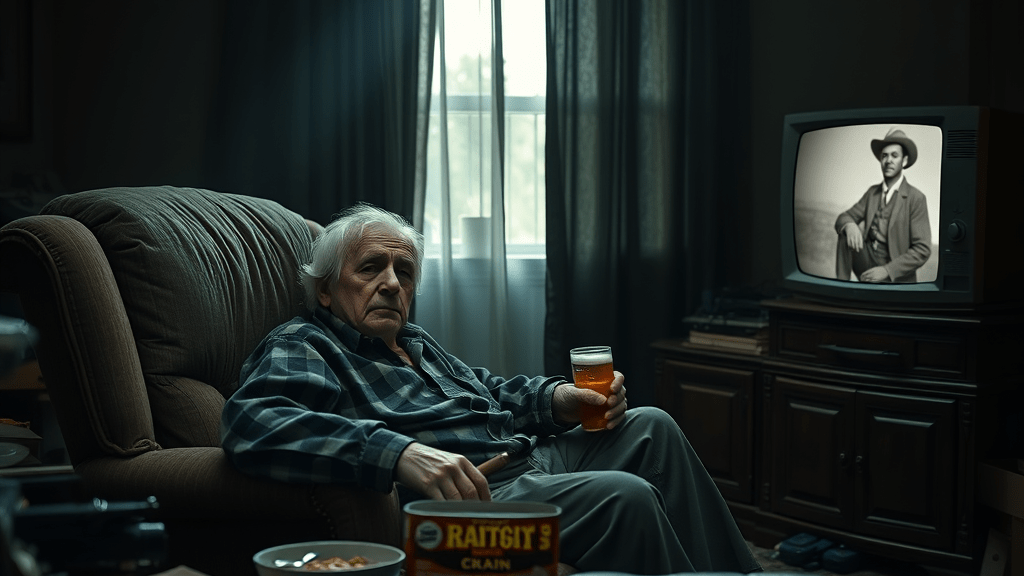
“Herm’s Rifle” Short Story by C.E. Williamson
Herm was a retiree of ten years and a widower of six. If he had to choose what he missed more, his job or his wife, he would have to say his job. Helen had been a fine wife in many aspects. She raised their two daughters well. She kept their small home tidy. She cooked them all three square meals a day, except on Saturdays when she neglected breakfast in favor of lazy mornings. That was all most men asked for, but Helen had one great failing as a spouse. She despised the marriage bed.
When Herm had first courted her as a young man, he had chalked this reluctance up to girlish timidity and a Lutheran upbringing. An aggravation that would surely fade after they were wed. So he married her and, to his shock, she was still celebate. They had sex of course, just not nearly as often as Herm liked. In Helen’s mind, only two things arose from affairs of the flesh. Children and sin. It was a minor thing in retrospect but they were young and resentful and the seeds of hatred took root.
As the years passed, their resentment grew. When he was forced to retire after the incident at the faculty party, she stopped talking to him entirely. On her deathbed at the age of sixty-seven, she confessed her hatred to him. With a gentle smile and a soft voice, he returned her sentiment. Helen died, and Herm was finally free to drink himself into peaceful oblivion.
On the day of the shootout, he awoke from his drunken slumber with extreme reluctance. His head, pulsing with pain, instinctively turned from the rays of the rising sun that poked through the dark curtains. He lay there, half awake, half asleep, fully hungover, for nearly twenty minutes. Not wanting to rise, but knowing that he had little choice. Finally, he eased upward out of his grimy sheets and shuffled to the kitchen.
He fixed himself a bowl of Raisin Bran and paired it with a cold Coor’s Banquet. As he stumbled into the den, he tripped over the lip between the rooms and spilled milk on the vinyl flooring. Ignoring it, Herm placed his breakfast on a cluttered end table and collapsed into the Lazy Boy at its side. His hand reached for the clicker but found it absent. Cursing, he dug into the trenches of his chair until the remote finally manifested.
The old man turned on the television and began to eat. He flipped the channels in a rapid, well-practiced manner until the screen rested on the black-and-white face of Chuck Conners. Herm loved The Rifleman. It had been his favorite show ever since he was a boy. It rarely came on the tube anymore. He paid an extra twenty-five dollars a month just for the oldies station to watch it. Helen had hated that but fuck her. Helen was gone. He turned the volume up as far as it would go and leaned back.
He finished his breakfast as he watched the monochrome cowboys. With the last bite of his cereal, Connors gunned down his foe. In a single fluid motion, his rifle orbited his hand, cocked, and fired. Herm grinned. He never got tired of that. Suddenly, like an echo, he heard a second gunshot. It came not from the T.V. but from outside. It was faint and distant, muffled by the glass of his window. Chick chick BOOM! Herm sighed and stretched himself out of his seat. Johnny was hungry.
Herm had seven birds. Four hens, a rooster, an old gobbler, and Johnny. He had worked with countless Grey Macaws over his career, but none had come close to Johnny. He was the smartest damn bird he had seen. Possessing a mastery over speech and vernacular that put many humans to shame. Often, he would learn new words or phrases in mere seconds. A true feathered genius. Unfortunately for Herm, he was also the biggest asshole he knew.
He kept Johnny in a tin barn about ten yards from his house. Once upon a time, the bird stayed in the house with him and his family. His daughters spoiled him and the old fiend reveled in the attention. He was moved to the barn after an incident with Helen’s gremlin of a cat. After the death of his wife, Herm had thought of bringing his friend back into his home but decided against it. The last thing he needed was Johnny repeating his drunken ramblings back at him in the morning. With aching joints and a throbbing head, Herm walked to the barn.
Johnny was still shooting at him as he approached. Chick chick BOOM! Chick chick BOOM! Chick chick BOOM! With each gunshot, his head vibrated with pain. When his feeble frame finally made it to the barn door, he saw something strange. There below him, in the red dirt patch that served as the door’s shadow, were prints. He could not tell what it was. The scuffs were messy and ill-formed, but something had surely been there the night before. Damn, coons. Trying to get his bird feed. Chick Chick BOOM.
“I’m comin’ you damn pigeon,” Herm shouted as he fiddled with the door. The sudden outburst of his own voice heightened his pain and he winced as his thumb turned the lock.
“Howdy Herm,” The bird said as he entered the stale room.
“Good Morning Johnny,” Herm said as he opened the cage.
“SQUAWK Whatcha Watchin’?”
“Our show.”
The bird got excited and flapped his wings as he climbed on Herm’s shoulders. “SQUAWK THE RIFLEMAN STARRING CHUCK CONNERS SQUAWK SQUAWK!”
“Yessir indeed,” Herm said. With Johnny on his left shoulder, he bent over and heaved a bag of feed over the other. The effort left him dizzy and stiff. Johnny waddled in place, impatient to start the day. Herm sighed and started the chores.
In truth, he didn’t mind feeding the birds. He actually enjoyed it. What he hated was the effort it took. He was not a spring chicken anymore and frankly, his birds didn’t care. Still, it was a joy to be near them. He missed his work. His daughters used to call him a chicken scientist. He would laugh and say chickens were beneath him. Now all he had were the chickens. And the turkey. And Johnny.
Gone were the days of South American voyages and ornithological conferences in Europe. Now he was a drunk old chicken farmer and he didn’t mind it. Academia was overrated. All of the serious studies were over and done. Now all his old colleagues did was bicker about migration trends and molting patterns. It was far more entertaining to watch his chickens argue and bicker. When one of them said something stupid they got a firm peck on the head as punishment. Birds were more just than people.
He and Johnny spent the better part of two hours feeding and watering them. Collecting eggs, Adding new scratch. Slowly Herm began to feel better. The cool breeze and warm sun worked together to clear his sinuses and relieve his hangover. Maybe today wouldn’t be a labor after all.
He kept his birds free range. Partly out of some old sense of morality and partly because he thought the eggs tasted better. At first, he had been worried about animals. Chickens, although mean and cantankerous, were easy pickings for a coon or possum. But his old rooster was tough and mean and hardy. Once he had watched as the cock chased a snake away from a ground nest. Wings held wide, beaked mouth screaming. The memory made him smile.
It also reminded him of the strange tracks by the barn door. As he put his feed bag away, he bent his crooked frame down again and stared at the ground. Once, as a younger man, he could identify the track of any local creature with a single glance. But he had not hunted in years and his eyes had dimmed with age.
Herm stayed crouched and staring for a long time. Something about those prints just didn’t sit right with him. It almost looked like something had tried to brush them away. To his aggravation Johnny squawked, interrupting his train of thought.
“Shut the hell up,” He snapped at the bird.
“He’s some type of teacher or somethin’,” Johnny said.
“What’s that?”
“He’s some type of teacher or somethin,” The parrot repeated.
“Oh I didn’t know that was a teacher track,” Herm said as he rose, bones creaking.
“SQUAWK!”
Herm continued to look at the tracks as he stretched his sore back. It was the darndest thing, they did look like boot prints at a certain angle.
“He’s some type of teacher or somethin, at a college,” Johnny said.
Herm froze.
“Probably has loads stashed away SQUAWK SQUAWK!”
It was noon before Sheriff Grey pulled into Herm’s long gravel drive. He was a man who very much matched his name. Short parted gray hair atop a gaunt face. His pallid flesh was pulled back in a grin as he stepped out of the cruiser. Herm hated Grey. He was a lazy ole coot like himself. He knew better than to trust lazy ole coots.
“Morning Herm.” The Sheriff said, eyeing the bird on his shoulder.
“Come in Sheriff.”
Grey walked past Herm and entered the house. “So what can I do for you, Herm?” He said, placing his hands on his hips and looking over the mess of a house.
“Someone is planning to break in.”
Grey nodded. “Dispatch told me. They also said that your bird was the one to report it.” The shit-eating grin warped Grey’s face for a second time. It made Herm sick.
“You know damn well I reported it. Johnny just found out about it.” Herm said. At the mention of his name, the bird perked up.
“He overheard it?” Grey said.
“Yes.”
“Your bird?”
“Don’t you do this to me, Grey, I’m not some damn loon!” Herm answered with angry exasperation.
“Uh huh, now Herm how much have you been drinkin’ this morning?” The sheriff asked.
“That’s got nothing to do with it!” Herm said.
“Because I count six Bud cans and four Banquet bottles from where I’m standing.” The sheriff said, ignoring his statement.
“I’m not drunk!” Herm barked, his face reddening.
“Not saying you are Herm. But being drunk and being in your right mind are two different things. You know that.”
It took everything Herm had not to punch the man. Ever since word got around about why he was forced to retire no one respected him. He was just the town drunkard. The local wino. Fuck the degrees, fuck the books, fuck the classes. He was nothing but a source of gossip. A joke.
“Get the hell out of my house!”
“Easy now Herm, I’m just trying to help,” Grey said. The grin still present.”
“Now!” Herm said.
“Now!” Johnny echoed.
Grey chuckled at this sudden burst of youthful rage. “All right, All right Herm. Call us if you need us.” He sauntered out of the house and drove away. Herm was shaking. The pounding in his head renewed. He sighed deeply and leaned against the counter., listening to the car’s tires crunch the driveway.
“Thanks for nothing you asshole.”
“You’re welcome, Herm.”
Surprisingly, Herm found that he was not panicking. Not anymore. If anything, he was calm. This was a problem to solve. Nothing more. He began to think. To plan. He considered just leaving but found that option unacceptable. This house and those birds were his whole life. He couldn’t pack it all up. Run away. Even if he could, Herm didn’t think he would. His whole life had been characterized by begrudging stubbornness. This situation was no different. He would rather die than let some stranger take dominion over him or his.
Naturally, his next thought was on defense. He had a .308 in his bedroom closet. A holdover from his hunting days. The firing pin had broken years ago. He had stuck it behind his dress shirts and hadn’t touched it since. Upon inspection, He and Johnny determined the weapon to be inoperable. Even if he could get it to fire, not a single round was to be found.
He could always leave, procure a new weapon, and return. He certainly had the funds. But this idea did not sit well with him either. They could be out there now for all he knew. Waiting for him to leave. It was too risky. He couldn’t leave until all of this was dealt with.
It was a pickle alright. A real pickle. He sat down in his armchair, Johnny hopping off his shoulder unto the head of the seat. He needed to think but found himself unable to. The T.V. was still blaring from this morning. The Rifleman had long since ended. In its place was Lee Van Cleef firing his revolver at Mexican bandits. With each pistol shot, Johnny would shoot back and jump in place. Between the bird and the movie, scarcely a sound could be heard. How could a man think like this? He reached with his clicker and then stopped himself. By God, it really was that simple wasn’t it? He smiled and leaned back into his chair, content to watch Sabata Returns with his friend.
They came just past nightfall. Three men. Boys really. Their boots crunched the gravel. With each footstep, they winced. All three were jumpy. Never before had that attempted such an endeavor. This was different from smashing mailboxes and rolling yards. This was serious. The fact Tommy insisted on bringing his dad’s nine-millimeter made them even more frightened. The gun added weight to their adventure which Levi and Lane did not like.
Tommy told them to take their boots off as they stepped onto Herm’s wooden porch. Even in their socked feet, each step was heavy and seemed amplified by the stillness of the evening. Tommy nodded to Levi who knelt down in front of the door and tied the knob. He turned it slowly, carefully, and found it locked.
They had planned for this. Two months ago, he had ordered a lockpick kit from Amazon. It turned out to be a real hoot with the boys. Opening lockers and filling them with cow shit. Picking trucks’ toolboxes and jacking the contents. Best twenty-four ninety-nine he had ever spent.
Now the thin metal tools felt heavy in his hand. He was all thumbs. Noiselly he racked the tools along the inside of the lock. Tommy thumped him hard on the back of the head.
“Shut the fuck up!” He hissed.
“What’s taking so long?” Lane whispered.
“Your boy is a fucking dumbass.” Tommy retorted. Turning to Levi he spoke again. “What the hell is taking so long!”
“You get down here and do it if you’ve got such a damn problem with it!” Levi barked back, louder than he should.
“Shut the fuck up! Do you want to wake him up! You got the pick, you open the door!”
“I don’t take orders from you Tommy!”
“The fuck you don’t, pick that pick back the fuck up and…”
Click Click.
The three boys froze. Silent. Listening to the night. A look amongst them verified their thoughts. They had all heard it. The mechanical click of a lever. Tommy opened his mouth to whisper a new command.
BOOM!
The rifle shot echoed off the pines. The boys ran, Levi, struggling to lift his modest girth off the porch, fell behind his two comrades.
Click click BOOM!
A second shot. Closer than the first. Lane swore he felt the whiz of a bullet fly past his ear and crash into the brush beyond. Levi was wheezing, trying to catch up. If he could see Tommy’s face, he would have seen tears.
Click click BOOM!
Tommy fell prone to avoid the shot, his pistol falling from his waistband. After he felt the bullet pass, he tried to rise. Levi stepped on him in his haste to escape. Tommy spurted up, in pain and with wet pants. He sprinted. Faster than he ever ran before.
Click click BOOM!
The trio rounded the driveway and vanished out of sight. Herm could hear their muttering wet cries echo from up the road. The old man grinned and stepped away from the window. Carefully he eased back into his chair and cracked open another beer. Johnny hopped from his shoulder onto the head of the seat. He flicked his clicker and turned the T.V. on. His rifle let out a squawk of delight as Chuck Conner’s face lit up the screen.
C.E.Williamson is a author living in Southern Mississippi with his wife Miranda. His previous published works include “Leviathan” found in Issue#172 of Frontier Tales Magazine
Please share this story to give it maximum distribution. Exposure is our authors’ only pay. You can also help our contributors gain exposure by linking to them and to RFM’s homepage.
If you would like to be part of the Rural Fiction Magazine family, follow this link to the submissions guidelines.
Financial donations through either our GoFundMe or Buy Me a Coffee accounts will help expand our global reach by paying for advertising, more advanced WordPress plans, and expansion into more extensive Content Delivery Networks.
Image generated by AI

“Free Birth” Flash Fiction by Sarah Das Gupta
It was hot in the Indian sunlight although it was early December. The students were sitting exams in stuffy classrooms where the ceiling fans whirred like dying insects. The rooms had a teacher’s desk raised above the level of the pupils. Girls bent over their papers, writing frantically. Every so often, a hand would shoot up for another sheet.
Sitting at the high desk, I noticed that every time I climbed down to hand out paper, I doubled up with a sharp pain which was increasingly hard to disguise. At eight and a half months through my second pregnancy, these spasms worried me. I certainly did not want to be the first member of staff to give birth in a classroom. I believed in practical work and class involvement but a demonstration of childbirth seemed to be stretching things too far.
Moreover, I was teaching in a convent school run by an order of nuns dedicated to the Blessed Virgin, so I probably couldn’t rely on much assistance. To my relief, the bell rang for the end of school. Most teachers welcome the bell, especially at the end of a long, humid day. In this case I had been praying for it.
The students in their starched white blouses and red skirts, streamed out through the gates. With difficulty, I threaded my way through the crowd and luckily flagged down a taxi.By this time the spasms were more intense, making me bend over. I could see reflected in the driver’s mirror, his puzzled, anxious expression. I counted off the familiar landmarks, Lower Circular Road, Kolkata (Calcutta) Rugby Club, Kwality Restaurant, at last the turn into Ballygunge Place.
The taxi came to a rattling halt as I fumbled in my bag for the key. As it happened, the door was opened by our Nepalese ayah. Taking one anxious look at me, her usually unflappable character quickly changed. Despite her efforts, she couldn’t disguise the panic on her face. My Bengali was kindergarten level and my Hindi, non-existent. However, no words, whatever the language, were needed to explain my doubling up with pain every ten minutes.
I too was near panic as I weighed up my options. It didn’t take long; the choice was limited. My husband, a journalist, was away on an assignment. My own family were thousands of miles away in leafy Surrey. I understood from the ayah’s limited Bengali, that she was not up for the role of mid-wife. She wanted me in hospital as soon as possible but it was far away in Alipore, another part of the city. I had no transport.
I went out into the street. Total darkness hit me like a brick wall. No street lights, curtains tightly pulled. The usually busy city, silent. Rather belatedly, I remembered that India was at war with Pakistan over the future of East Pakistan, soon to become Bangladesh. Not the best night to look for a taxi.
Anti-aircraft guns lit up parts of the city with brilliant arcs of light. The silence was unnerving. Kolkata is rarely silent: the roar of traffic, the impatient hooting of horns, the rattling of trams, must make it one of the noisiest cities on earth I thought the chances of finding a taxi in the circumstances were nil.
Just at that moment, a battle scarred, black and yellow vehicle, lights dimmed, was crawling down the street. Even from several yards away, I could hear a strange tapping noise from the engine and a general rattling as if all the bodywork were loose. As I raised my arm, the taxi came to a noisy halt. The driver was a Sikh, his turban just visible in the darkness.
Pointing at my obviously pregnant figure, I whispered, “Forest Nursing Home, Alipore,” before the next spasm gripped me. I collapsed on the back seat. The stuffing was sticking out from the plastic covered seats as well as a few rusty springs. A few moments later, I considered jumping out. The taxi was swooping backwards and forwards across the road like a drunken seagull.
Somehow or other, we eventually crawled through the hospital gates. I was quickly ushered into a lift by a nervous receptionist. The nurse, took one look at me doubled up in pain, before hurrying me into a delivery room. After a quick check-up, she commented with barely concealed annoyance, “You’ve come far too early. You might as well go home.”
The night sister suddenly appeared. She had hardly begun her check-up, before she shouted, “Get this patient ready now. She’s about to give birth any minute!”
I had hardly got into bed, before I was holding a tiny, pucker-faced daughter in my arms. My own doctor rushed in, red-faced and flustered.
“Don’t think I’m paying you. I delivered her myself!”
Sarah Das Gupta is a writer from Cambridge, UK who has also lived and worked in India and Tanzania. Her work has been published in twenty countries from Australia to Kazakhstan. It has appeared in over 200 literary magazines and anthologies including ‘The New English Review’, ‘ Moss Piglet’, ‘Songs of Eretz’, ‘Quail Bell’, ‘Waywords’, ‘Cosmic Daffodil’, ‘Dorothy Parker’s Ashes’, ‘Hooghly Review’, ‘Meat for Tea’, ‘Rural Fiction’ and many others. This year she has been nominated for Best of the Net’ and a Dwarf Star’.
“Free Birth” appeared originally in Juste LIterary Magazine.
Please share this story to give it maximum distribution. Exposure is our authors’ only pay. You can also help our contributors gain exposure by linking to them and to RFM’s homepage.
If you would like to be part of the Rural Fiction Magazine family, follow this link to the submissions guidelines.
Financial donations through either our GoFundMe or Buy Me a Coffee accounts will help expand our global reach by paying for advertising, more advanced WordPress plans, and expansion into more extensive Content Delivery Networks.
Image generated by AI
