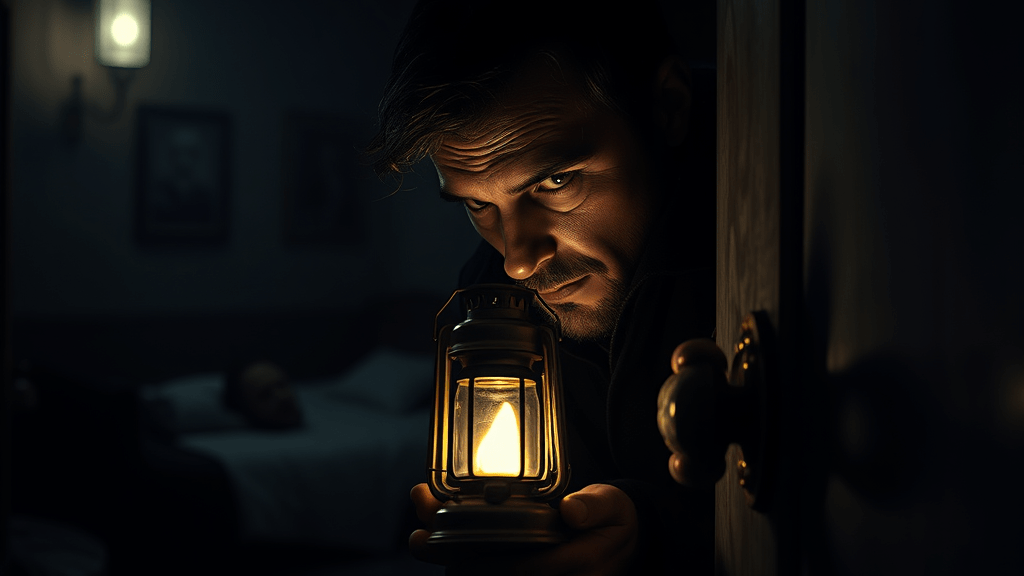
True!—nervous—very, very dreadfully nervous I had been and am; but why will you say that I am mad? The disease had sharpened my senses—not destroyed—not dulled them. Above all was the sense of hearing acute. I heard all things in the heaven and in the earth. I heard many things in hell. How, then, am I mad? Hearken! and observe how healthily—how calmly I can tell you the whole story.
It is impossible to say how first the idea entered my brain; but once conceived, it haunted me day and night. Object there was none. Passion there was none. I loved the old man. He had never wronged me. He had never given me insult. For his gold I had no desire. I think it was his eye! yes, it was this! He had the eye of a vulture—a pale blue eye, with a film over it. Whenever it fell upon me, my blood ran cold; and so by degrees—very gradually—I made up my mind to take the life of the old man, and thus rid myself of the eye forever.
Now this is the point. You fancy me mad. Madmen know nothing. But you should have seen me. You should have seen how wisely I proceeded—with what caution—with what foresight—with what dissimulation I went to work! I was never kinder to the old man than during the whole week before I killed him. And every night, about midnight, I turned the latch of his door and opened it—oh, so gently! And then, when I had made an opening sufficient for my head, I put in a dark lantern, all closed, closed, that no light shone out, and then I thrust in my head. Oh, you would have laughed to see how cunningly I thrust it in! I moved it slowly—very, very slowly, so that I might not disturb the old man’s sleep. It took me an hour to place my whole head within the opening so far that I could see him as he lay upon his bed. Ha!—would a madman have been so wise as this? And then, when my head was well in the room, I undid the lantern cautiously—oh, so cautiously—cautiously (for the hinges creaked)—I undid it just so much that a single thin ray fell upon the vulture eye. And this I did for seven long nights—every night just at midnight—but I found the eye always closed; and so it was impossible to do the work; for it was not the old man who vexed me, but his Evil Eye. And every morning, when the day broke, I went boldly into the chamber, and spoke courageously to him, calling him by name in a hearty tone, and inquiring how he has passed the night. So you see he would have been a very profound old man, indeed, to suspect that every night, just at twelve, I looked in upon him while he slept.
Upon the eighth night I was more than usually cautious in opening the door. A watch’s minute hand moves more quickly than did mine. Never before that night had I felt the extent of my own powers—of my sagacity. I could scarcely contain my feelings of triumph. To think that there I was, opening the door, little by little, and he not even to dream of my secret deeds or thoughts. I fairly chuckled at the idea; and perhaps he heard me; for he moved on the bed suddenly, as if startled. Now you may think that I drew back—but no. His room was as black as pitch with the thick darkness, (for the shutters were close fastened, through fear of robbers,) and so I knew that he could not see the opening of the door, and I kept pushing it on steadily, steadily.
I had my head in, and was about to open the lantern, when my thumb slipped upon the tin fastening, and the old man sprang up in bed, crying out—“Who’s there?”
I kept quite still and said nothing. For a whole hour I did not move a muscle, and in the meantime I did not hear him lie down. He was still sitting up in the bed listening;—just as I have done, night after night, hearkening to the death watches in the wall.
Presently I heard a slight groan, and I knew it was the groan of mortal terror. It was not a groan of pain or of grief—oh, no!—it was the low stifled sound that arises from the bottom of the soul when overcharged with awe. I knew the sound well. Many a night, just at midnight, when all the world slept, it has welled up from my own bosom, deepening, with its dreadful echo, the terrors that distracted me. I say I knew it well. I knew what the old man felt, and pitied him, although I chuckled at heart. I knew that he had been lying awake ever since the first slight noise, when he had turned in the bed. His fears had been ever since growing upon him. He had been trying to fancy them causeless, but could not. He had been saying to himself—“It is nothing but the wind in the chimney—it is only a mouse crossing the floor,” or “It is merely a cricket which has made a single chirp.” Yes, he had been trying to comfort himself with these suppositions: but he had found all in vain. All in vain; because Death, in approaching him had stalked with his black shadow before him, and enveloped the victim. And it was the mournful influence of the unperceived shadow that caused him to feel—although he neither saw nor heard—to feel the presence of my head within the room.
When I had waited a long time, very patiently, without hearing him lie down, I resolved to open a little—a very, very little crevice in the lantern. So I opened it—you cannot imagine how stealthily, stealthily—until, at length a simple dim ray, like the thread of the spider, shot from out the crevice and fell full upon the vulture eye.
It was open—wide, wide open—and I grew furious as I gazed upon it. I saw it with perfect distinctness—all a dull blue, with a hideous veil over it that chilled the very marrow in my bones; but I could see nothing else of the old man’s face or person: for I had directed the ray as if by instinct, precisely upon the damned spot.
And have I not told you that what you mistake for madness is but over-acuteness of the sense?—now, I say, there came to my ears a low, dull, quick sound, such as a watch makes when enveloped in cotton. I knew that sound well, too. It was the beating of the old man’s heart. It increased my fury, as the beating of a drum stimulates the soldier into courage.
But even yet I refrained and kept still. I scarcely breathed. I held the lantern motionless. I tried how steadily I could maintain the ray upon the eye. Meantime the hellish tattoo of the heart increased. It grew quicker and quicker, and louder and louder every instant. The old man’s terror must have been extreme! It grew louder, I say, louder every moment!—do you mark me well? I have told you that I am nervous: so I am. And now at the dead hour of the night, amid the dreadful silence of that old house, so strange a noise as this excited me to uncontrollable terror. Yet, for some minutes longer I refrained and stood still. But the beating grew louder, louder! I thought the heart must burst. And now a new anxiety seized me—the sound would be heard by a neighbour! The old man’s hour had come! With a loud yell, I threw open the lantern and leaped into the room. He shrieked once—once only. In an instant I dragged him to the floor, and pulled the heavy bed over him. I then smiled gaily, to find the deed so far done. But, for many minutes, the heart beat on with a muffled sound. This, however, did not vex me; it would not be heard through the wall. At length it ceased. The old man was dead. I removed the bed and examined the corpse. Yes, he was stone, stone dead. I placed my hand upon the heart and held it there many minutes. There was no pulsation. He was stone dead. His eye would trouble me no more.
If still you think me mad, you will think so no longer when I describe the wise precautions I took for the concealment of the body. The night waned, and I worked hastily, but in silence. First of all I dismembered the corpse. I cut off the head and the arms and the legs.
I then took up three planks from the flooring of the chamber, and deposited all between the scantlings. I then replaced the boards so cleverly, so cunningly, that no human eye—not even his—could have detected any thing wrong. There was nothing to wash out—no stain of any kind—no blood-spot whatever. I had been too wary for that. A tub had caught all—ha! ha!
When I had made an end of these labors, it was four o’clock—still dark as midnight. As the bell sounded the hour, there came a knocking at the street door. I went down to open it with a light heart,—for what had I now to fear? There entered three men, who introduced themselves, with perfect suavity, as officers of the police. A shriek had been heard by a neighbour during the night; suspicion of foul play had been aroused; information had been lodged at the police office, and they (the officers) had been deputed to search the premises.
I smiled,—for what had I to fear? I bade the gentlemen welcome. The shriek, I said, was my own in a dream. The old man, I mentioned, was absent in the country. I took my visitors all over the house. I bade them search—search well. I led them, at length, to his chamber. I showed them his treasures, secure, undisturbed. In the enthusiasm of my confidence, I brought chairs into the room, and desired them here to rest from their fatigues, while I myself, in the wild audacity of my perfect triumph, placed my own seat upon the very spot beneath which reposed the corpse of the victim.
The officers were satisfied. My manner had convinced them. I was singularly at ease. They sat, and while I answered cheerily, they chatted of familiar things. But, ere long, I felt myself getting pale and wished them gone. My head ached, and I fancied a ringing in my ears: but still they sat and still chatted. The ringing became more distinct:—it continued and became more distinct: I talked more freely to get rid of the feeling: but it continued and gained definiteness—until, at length, I found that the noise was not within my ears.
No doubt I now grew very pale;—but I talked more fluently, and with a heightened voice. Yet the sound increased—and what could I do? It was a low, dull, quick sound—much such a sound as a watch makes when enveloped in cotton. I gasped for breath—and yet the officers heard it not. I talked more quickly—more vehemently; but the noise steadily increased. I arose and argued about trifles, in a high key and with violent gesticulations; but the noise steadily increased. Why would they not be gone? I paced the floor to and fro with heavy strides, as if excited to fury by the observations of the men—but the noise steadily increased. Oh God! what could I do? I foamed—I raved—I swore! I swung the chair upon which I had been sitting, and grated it upon the boards, but the noise arose over all and continually increased. It grew louder—louder—louder! And still the men chatted pleasantly, and smiled. Was it possible they heard not? Almighty God!—no, no! They heard!—they suspected!—they knew!—they were making a mockery of my horror!—this I thought, and this I think. But anything was better than this agony! Anything was more tolerable than this derision! I could bear those hypocritical smiles no longer! I felt that I must scream or die! and now—again!—hark! louder! louder! louder! louder!
“Villains!” I shrieked, “dissemble no more! I admit the deed!—tear up the planks!—here, here!—It is the beating of his hideous heart!”
Edgar Allan Poe (né Edgar Poe; January 19, 1809 – October 7, 1849) was an American writer, poet, editor, and literary critic who is best known for his poetry and short stories, particularly his tales involving mystery and the macabre. He is widely regarded as one of the central figures of Romanticism and Gothic fiction in the United States and of early American literature. Poe was one of the country’s first successful practitioners of the short story, and is generally considered to be the inventor of the detective fiction genre. In addition, he is credited with contributing significantly to the emergence of science fiction. He is the first well-known American writer to earn a living by writing alone, which resulted in a financially difficult life and career.
This ebook is for the use of anyone anywhere in the United States and most other parts of the world at no cost and with almost no restrictions whatsoever. You may copy it, give it away or re-use it under the terms of the Project Gutenberg License included with this ebook or online at www.gutenberg.org. If you are not located in the United States, you will have to check the laws of the country where you are located before using this eBook.
By Woden, God of Saxons, From whence comes Wensday, that is Wodensday, Truth is a thing that ever I will keep Unto thylke day in which I creep into My sepulchre—
Cartwright.
Whoever has made a voyage up the Hudson must remember the Kaatskill mountains. They are a dismembered branch of the great Appalachian family, and are seen away to the west of the river, swelling up to a noble height, and lording it over the surrounding country. Every change of season, every change of weather, indeed, every hour of the day, produces some change in the magical hues and shapes of these mountains, and they are regarded by all the good wives, far and near, as perfect barometers. When the weather is fair and settled, they are clothed in blue and purple, and print their bold outlines on the clear evening sky; but, sometimes, when the rest of the landscape is cloudless, they will gather a hood of gray vapors about their summits, which, in the last rays of the setting sun, will glow and light up like a crown of glory.
At the foot of these fairy mountains, the voyager may have descried the light smoke curling up from a village whose shingle-roofs gleam among the trees, just where the blue tints of the upland melt away into the fresh green of the nearer landscape. It is a little village of great antiquity, having been founded by some of the Dutch colonists, in the early times of the province, just about the beginning of the government of the good Peter Stuyvesant, (may he rest in peace!) and there were some of the houses of the original settlers standing within a few years, built of small yellow bricks brought from Holland, having latticed windows and gable fronts, surmounted with weather-cocks.
In that same village, and in one of these very houses (which, to tell the precise truth, was sadly time-worn and weather-beaten), there lived many years since, while the country was yet a province of Great Britain, a simple good-natured fellow of the name of Rip Van Winkle. He was a descendant of the Van Winkles who figured so gallantly in the chivalrous days of Peter Stuyvesant, and accompanied him to the siege of Fort Christina. He inherited, however, but little of the martial character of his ancestors. I have observed that he was a simple good-natured man; he was, moreover, a kind neighbor, and an obedient hen-pecked husband. Indeed, to the latter circumstance might be owing that meekness of spirit which gained him such universal popularity; for those men are most apt to be obsequious and conciliating abroad, who are under the discipline of shrews at home. Their tempers, doubtless, are rendered pliant and malleable in the fiery furnace of domestic tribulation; and a curtain lecture is worth all the sermons in the world for teaching the virtues of patience and long-suffering. A termagant wife may, therefore, in some respects, be considered a tolerable blessing; and if so, Rip Van Winkle was thrice blessed.
Certain it is, that he was a great favorite among all the good wives of the village, who, as usual with the amiable sex, took his part in all family squabbles; and never failed, whenever they talked those matters over in their evening gossipings, to lay all the blame on Dame Van Winkle. The children of the village, too, would shout with joy whenever he approached. He assisted at their sports, made their playthings, taught them to fly kites and shoot marbles, and told them long stories of ghosts, witches, and Indians. Whenever he went dodging about the village, he was surrounded by a troop of them, hanging on his skirts, clambering on his back, and playing a thousand tricks on him with impunity; and not a dog would bark at him throughout the neighborhood.
The great error in Rip’s composition was an insuperable aversion to all kinds of profitable labor. It could not be from the want of assiduity or perseverance; for he would sit on a wet rock, with a rod as long and heavy as a Tartar’s lance, and fish all day without a murmur, even though he should not be encouraged by a single nibble. He would carry a fowling-piece on his shoulder for hours together, trudging through woods and swamps, and up hill and down dale, to shoot a few squirrels or wild pigeons. He would never refuse to assist a neighbor even in the roughest toil, and was a foremost man at all country frolics for husking Indian corn, or building stone-fences; the women of the village, too, used to employ him to run their errands, and to do such little odd jobs as their less obliging husbands would not do for them. In a word Rip was ready to attend to anybody’s business but his own; but as to doing family duty, and keeping his farm in order, he found it impossible.
In fact, he declared it was of no use to work on his farm; it was the most pestilent little piece of ground in the whole country; everything about it went wrong, and would go wrong, in spite of him. His fences were continually falling to pieces; his cow would either go astray or get among the cabbages; weeds were sure to grow quicker in his fields than anywhere else; the rain always made a point of setting in just as he had some out-door work to do, so that though his patrimonial estate had dwindled away under his management, acre by acre, until there was little more left than a mere patch of Indian corn and potatoes, yet it was the worst conditioned farm in the neighborhood.
His children, too, were as ragged and wild as if they belonged to nobody. His son Rip, an urchin begotten in his own likeness, promised to inherit the habits, with the old clothes of his father. He was generally seen trooping like a colt at his mother’s heels, equipped in a pair of his father’s cast-off galligaskins, which he had much ado to hold up with one hand, as a fine lady does her train in bad weather.
Rip Van Winkle, however, was one of those happy mortals, of foolish, well-oiled dispositions, who take the world easy, eat white bread or brown, whichever can be got with least thought or trouble, and would rather starve on a penny than work for a pound. If left to himself, he would have whistled life away in perfect contentment; but his wife kept continually dinning in his ears about his idleness, his carelessness, and the ruin he was bringing on his family. Morning, noon, and night, her tongue was incessantly going, and everything he said or did was sure to produce a torrent of household eloquence. Rip had but one way of replying to all lectures of the kind, and that, by frequent use, had grown into a habit. He shrugged his shoulders, shook his head, cast up his eyes, but said nothing. This, however, always provoked a fresh volley from his wife; so that he was fain to draw off his forces, and take to the outside of the house—the only side which, in truth, belongs to a hen-pecked husband.
Rip’s sole domestic adherent was his dog Wolf, who was as much hen-pecked as his master; for Dame Van Winkle regarded them as companions in idleness, and even looked upon Wolf with an evil eye, as the cause of his master’s going so often astray. True it is, in all points of spirit befitting an honorable dog, he was as courageous an animal as ever scoured the woods—but what courage can withstand the ever-during and all-besetting terrors of a woman’s tongue? The moment Wolf entered the house his crest fell, his tail drooped to the ground, or curled between his legs, he sneaked about with a gallows air, casting many a sidelong glance at Dame Van Winkle, and at the least flourish of a broom-stick or ladle, he would fly to the door with yelping precipitation.
Times grew worse and worse with Rip Van Winkle as years of matrimony rolled on; a tart temper never mellows with age, and a sharp tongue is the only edged tool that grows keener with constant use. For a long while he used to console himself, when driven from home, by frequenting a kind of perpetual club of the sages, philosophers, and other idle personages of the village; which held its sessions on a bench before a small inn, designated by a rubicund portrait of His Majesty George the Third. Here they used to sit in the shade through a long lazy summer’s day, talking listlessly over village gossip, or telling endless sleepy stories about nothing. But it would have been worth any statesman’s money to have heard the profound discussions that sometimes took place, when by chance an old newspaper fell into their hands from some passing traveller. How solemnly they would listen to the contents, as drawled out by Derrick Van Bummel, the schoolmaster, a dapper learned little man, who was not to be daunted by the most gigantic word in the dictionary; and how sagely they would deliberate upon public events some months after they had taken place.
The opinions of this junto were completely controlled by Nicholas Vedder, a patriarch of the village, and landlord of the inn, at the door of which he took his seat from morning till night, just moving sufficiently to avoid the sun and keep in the shade of a large tree; so that the neighbors could tell the hour by his movements as accurately as by a sun-dial. It is true he was rarely heard to speak, but smoked his pipe incessantly. His adherents, however (for every great man has his adherents), perfectly understood him, and knew how to gather his opinions. When anything that was read or related displeased him, he was observed to smoke his pipe vehemently, and to send forth short, frequent and angry puffs; but when pleased, he would inhale the smoke slowly and tranquilly, and emit it in light and placid clouds; and sometimes, taking the pipe from his mouth, and letting the fragrant vapor curl about his nose, would gravely nod his head in token of perfect approbation.
From even this stronghold the unlucky Rip was at length routed by his termagant wife, who would suddenly break in upon the tranquillity of the assemblage and call the members all to naught; nor was that august personage, Nicholas Vedder himself, sacred from the daring tongue of this terrible virago, who charged him outright with encouraging her husband in habits of idleness.
Poor Rip was at last reduced almost to despair; and his only alternative, to escape from the labor of the farm and clamor of his wife, was to take gun in hand and stroll away into the woods. Here he would sometimes seat himself at the foot of a tree, and share the contents of his wallet with Wolf, with whom he sympathized as a fellow-sufferer in persecution. “Poor Wolf,” he would say, “thy mistress leads thee a dog’s life of it; but never mind, my lad, whilst I live thou shalt never want a friend to stand by thee!” Wolf would wag his tail, look wistfully in his master’s face, and if dogs can feel pity I verily believe he reciprocated the sentiment with all his heart.
In a long ramble of the kind on a fine autumnal day, Rip had unconsciously scrambled to one of the highest parts of the Kaatskill mountains. He was after his favorite sport of squirrel shooting, and the still solitudes had echoed and re-echoed with the reports of his gun. Panting and fatigued, he threw himself, late in the afternoon, on a green knoll, covered with mountain herbage, that crowned the brow of a precipice. From an opening between the trees he could overlook all the lower country for many a mile of rich woodland. He saw at a distance the lordly Hudson, far, far below him, moving on its silent but majestic course, with the reflection of a purple cloud, or the sail of a lagging bark, here and there sleeping on its glassy bosom, and at last losing itself in the blue highlands.
On the other side he looked down into a deep mountain glen, wild, lonely, and shagged, the bottom filled with fragments from the impending cliffs, and scarcely lighted by the reflected rays of the setting sun. For some time Rip lay musing on this scene; evening was gradually advancing; the mountains began to throw their long blue shadows over the valleys; he saw that it would be dark long before he could reach the village, and he heaved a heavy sigh when he thought of encountering the terrors of Dame Van Winkle.
As he was about to descend, he heard a voice from a distance, hallooing, “Rip Van Winkle! Rip Van Winkle!” He looked round, but could see nothing but a crow winging its solitary flight across the mountain. He thought his fancy must have deceived him, and turned again to descend, when he heard the same cry ring through the still evening air: “Rip Van Winkle! Rip Van Winkle!”—at the same time Wolf bristled up his back, and giving a low growl, skulked to his master’s side, looking fearfully down into the glen. Rip now felt a vague apprehension stealing over him; he looked anxiously in the same direction, and perceived a strange figure slowly toiling up the rocks, and bending under the weight of something he carried on his back. He was surprised to see any human being in this lonely and unfrequented place, but supposing it to be some one of the neighborhood in need of his assistance, he hastened down to yield it.
On nearer approach he was still more surprised at the singularity of the stranger’s appearance. He was a short square-built old fellow, with thick bushy hair, and a grizzled beard. His dress was of the antique Dutch fashion—a cloth jerkin strapped round the waist—several pair of breeches, the outer one of ample volume, decorated with rows of buttons down the sides, and bunches at the knees. He bore on his shoulder a stout keg, that seemed full of liquor, and made signs for Rip to approach and assist him with the load. Though rather shy and distrustful of this new acquaintance, Rip complied with his usual alacrity; and mutually relieving one another, they clambered up a narrow gully, apparently the dry bed of a mountain torrent. As they ascended, Rip every now and then heard long rolling peals, like distant thunder, that seemed to issue out of a deep ravine, or rather cleft, between lofty rocks, toward which their rugged path conducted. He paused for an instant, but supposing it to be the muttering of one of those transient thunder-showers which often take place in mountain heights, he proceeded. Passing through the ravine, they came to a hollow, like a small amphitheatre, surrounded by perpendicular precipices, over the brinks of which impending trees shot their branches, so that you only caught glimpses of the azure sky and the bright evening cloud. During the whole time Rip and his companion had labored on in silence; for though the former marvelled greatly what could be the object of carrying a keg of liquor up this wild mountain, yet there was something strange and incomprehensible about the unknown, that inspired awe and checked familiarity.
On entering the amphitheatre, new objects of wonder presented themselves. On a level spot in the centre was a company of odd-looking personages playing at nine-pins. They were dressed in a quaint outlandish fashion; some wore short doublets, others jerkins, with long knives in their belts, and most of them had enormous breeches, of similar style with that of the guide’s. Their visages, too, were peculiar: one had a large beard, broad face, and small piggish eyes: the face of another seemed to consist entirely of nose, and was surmounted by a white sugar-loaf hat set off with a little red cock’s tail. They all had beards, of various shapes and colors. There was one who seemed to be the commander. He was a stout old gentleman, with a weather-beaten countenance; he wore a laced doublet, broad belt and hanger, high-crowned hat and feather, red stockings, and high-heeled shoes, with roses in them. The whole group reminded Rip of the figures in an old Flemish painting, in the parlor of Dominie Van Shaick, the village parson, and which had been brought over from Holland at the time of the settlement.
What seemed particularly odd to Rip was, that though these folks were evidently amusing themselves, yet they maintained the gravest faces, the most mysterious silence, and were, withal, the most melancholy party of pleasure he had ever witnessed. Nothing interrupted the stillness of the scene but the noise of the balls, which, whenever they were rolled, echoed along the mountains like rumbling peals of thunder.
As Rip and his companion approached them, they suddenly desisted from their play, and stared at him with such fixed statue-like gaze, and such strange, uncouth, lack-lustre countenances, that his heart turned within him, and his knees smote together. His companion now emptied the contents of the keg into large flagons, and made signs to him to wait upon the company. He obeyed with fear and trembling; they quaffed the liquor in profound silence, and then returned to their game.
By degrees Rip’s awe and apprehension subsided. He even ventured, when no eye was fixed upon him, to taste the beverage, which he found had much of the flavor of excellent Hollands. He was naturally a thirsty soul, and was soon tempted to repeat the draught. One taste provoked another; and he reiterated his visits to the flagon so often that at length his senses were overpowered, his eyes swam in his head, his head gradually declined, and he fell into a deep sleep.
On waking, he found himself on the green knoll whence he had first seen the old man of the glen. He rubbed his eyes—it was a bright sunny morning. The birds were hopping and twittering among the bushes, and the eagle was wheeling aloft, and breasting the pure mountain breeze. “Surely,” thought Rip, “I have not slept here all night.” He recalled the occurrences before he fell asleep. The strange man with a keg of liquor—the mountain ravine—the wild retreat among the rocks—the woe-begone party at nine-pins—the flagon—”Oh! that flagon! that wicked flagon!” thought Rip—”what excuse shall I make to Dame Van Winkle!”
He looked round for his gun, but in place of the clean well-oiled fowling-piece, he found an old firelock lying by him, the barrel incrusted with rust, the lock falling off, and the stock worm-eaten. He now suspected that the grave roysters of the mountain had put a trick upon him, and, having dosed him with liquor, had robbed him of his gun. Wolf, too, had disappeared, but he might have strayed away after a squirrel or partridge. He whistled after him and shouted his name, but all in vain; the echoes repeated his whistle and shout, but no dog was to be seen.
He determined to revisit the scene of the last evening’s gambol, and if he met with any of the party, to demand his dog and gun. As he rose to walk, he found himself stiff in the joints, and wanting in his usual activity. “These mountain beds do not agree with me,” thought Rip, “and if this frolic should lay me up with a fit of rheumatism, I shall have a blessed time with Dame Van Winkle.” With some difficulty he got down into the glen: he found the gully up which he and his companion had ascended the preceding evening; but to his astonishment a mountain stream was now foaming down it, leaping from rock to rock, and filling the glen with babbling murmurs. He, however, made shift to scramble up its sides, working his toilsome way through thickets of birch, sassafras, and witch-hazel, and sometimes tripped up or entangled by the wild grapevines that twisted their coils or tendrils from tree to tree, and spread a kind of network in his path.
At length he reached to where the ravine had opened through the cliffs to the amphitheatre; but no traces of such opening remained. The rocks presented a high impenetrable wall over which the torrent came tumbling in a sheet of feathery foam, and fell into a broad deep basin, black from the shadows of the surrounding forest. Here, then, poor Rip was brought to a stand. He again called and whistled after his dog; he was only answered by the cawing of a flock of idle crows, sporting high in air about a dry tree that overhung a sunny precipice; and who, secure in their elevation, seemed to look down and scoff at the poor man’s perplexities. What was to be done? the morning was passing away, and Rip felt famished for want of his breakfast. He grieved to give up his dog and gun; he dreaded to meet his wife; but it would not do to starve among the mountains. He shook his head, shouldered the rusty firelock, and, with a heart full of trouble and anxiety, turned his steps homeward.
As he approached the village he met a number of people, but none whom he knew, which somewhat surprised him, for he had thought himself acquainted with every one in the country round. Their dress, too, was of a different fashion from that to which he was accustomed. They all stared at him with equal marks of surprise, and whenever they cast their eyes upon him, invariably stroked their chins. The constant recurrence of this gesture induced Rip, involuntarily, to do the same, when, to his astonishment, he found his beard had grown a foot long!
He had now entered the skirts of the village. A troop of strange children ran at his heels, hooting after him, and pointing at his gray beard. The dogs, too, not one of which he recognized for an old acquaintance, barked at him as he passed. The very village was altered; it was larger and more populous. There were rows of houses which he had never seen before, and those which had been his familiar haunts had disappeared. Strange names were over the doors—strange faces at the windows—every thing was strange. His mind now misgave him; he began to doubt whether both he and the world around him were not bewitched. Surely this was his native village, which he had left but the day before. There stood the Kaatskill mountains—there ran the silver Hudson at a distance—there was every hill and dale precisely as it had always been—Rip was sorely perplexed—”That flagon last night,” thought he, “has addled my poor head sadly!”
It was with some difficulty that he found the way to his own house, which he approached with silent awe, expecting every moment to hear the shrill voice of Dame Van Winkle. He found the house gone to decay—the roof fallen in, the windows shattered, and the doors off the hinges. A half-starved dog that looked like Wolf was skulking about it. Rip called him by name, but the cur snarled, showed his teeth, and passed on. This was an unkind cut indeed—”My very dog,” sighed poor Rip, “has forgotten me!”
He entered the house, which, to tell the truth, Dame Van Winkle had always kept in neat order. It was empty, forlorn, and apparently abandoned. This desolateness overcame all his connubial fears—he called loudly for his wife and children—the lonely chambers rang for a moment with his voice, and then all again was silence.
He now hurried forth, and hastened to his old resort, the village inn—but it too was gone. A large rickety wooden building stood in its place, with great gaping windows, some of them broken and mended with old hats and petticoats, and over the door was painted, “the Union Hotel, by Jonathan Doolittle.” Instead of the great tree that used to shelter the quiet little Dutch inn of yore, there now was reared a tall naked pole, with something on the top that looked like a red night-cap, and from it was fluttering a flag, on which was a singular assemblage of stars and stripes—all this was strange and incomprehensible. He recognized on the sign, however, the ruby face of King George, under which he had smoked so many a peaceful pipe; but even this was singularly metamorphosed. The red coat was changed for one of blue and buff, a sword was held in the hand instead of a sceptre, the head was decorated with a cocked hat, and underneath was painted in large characters, General Washington.
There was, as usual, a crowd of folk about the door, but none that Rip recollected. The very character of the people seemed changed. There was a busy, bustling, disputatious tone about it, instead of the accustomed phlegm and drowsy tranquillity. He looked in vain for the sage Nicholas Vedder, with his broad face, double chin, and fair long pipe, uttering clouds of tobacco-smoke instead of idle speeches; or Van Bummel, the schoolmaster, doling forth the contents of an ancient newspaper. In place of these, a lean, bilious-looking fellow, with his pockets full of handbills, was haranguing vehemently about rights of citizens—elections—members of congress—liberty—Bunker’s Hill—heroes of seventy-six—and other words, which were a perfect Babylonish jargon to the bewildered Van Winkle.
The appearance of Rip, with his long grizzled beard, his rusty fowling-piece, his uncouth dress, and an army of women and children at his heels, soon attracted the attention of the tavern politicians. They crowded round him, eying him from head to foot with great curiosity. The orator bustled up to him, and, drawing him partly aside, inquired “on which side he voted?” Rip stared in vacant stupidity. Another short but busy little fellow pulled him by the arm, and, rising on tiptoe, inquired in his ear, “Whether he was Federal or Democrat?” Rip was equally at a loss to comprehend the question; when a knowing, self-important old gentleman, in a sharp cocked hat, made his way through the crowd, putting them to the right and left with his elbows as he passed, and planting himself before Van Winkle, with one arm akimbo, the other resting on his cane, his keen eyes and sharp hat penetrating, as it were, into his very soul, demanded in an austere tone, “what brought him to the election with a gun on his shoulder, and a mob at his heels, and whether he meant to breed a riot in the village?”—”Alas! gentlemen,” cried Rip, somewhat dismayed, “I am a poor quiet man, a native of the place, and a loyal subject of the king, God bless him!”
Here a general shout burst from the by-standers—”A tory! a tory! a spy! a refugee! hustle him! away with him!” It was with great difficulty that the self-important man in the cocked hat restored order; and, having assumed a tenfold austerity of brow, demanded again of the unknown culprit, what he came there for, and whom he was seeking? The poor man humbly assured him that he meant no harm, but merely came there in search of some of his neighbors, who used to keep about the tavern.
“Well—who are they?—name them.”
Rip bethought himself a moment, and inquired, “Where’s Nicholas Vedder?”
There was a silence for a little while, when an old man replied, in a thin piping voice, “Nicholas Vedder! why, he is dead and gone these eighteen years! There was a wooden tombstone in the church-yard that used to tell all about him, but that’s rotten and gone too.”
“Where’s Brom Dutcher?”
“Oh, he went off to the army in the beginning of the war; some say he was killed at the storming of Stony Point—others say he was drowned in a squall at the foot of Antony’s Nose. I don’t know—-he never came back again.”
“Where’s Van Bummel, the schoolmaster?”
“He went off to the wars too, was a great militia general, and is now in congress.”
Rip’s heart died away at hearing of these sad changes in his home and friends, and finding himself thus alone in the world. Every answer puzzled him, too, by treating of such enormous lapses of time, and of matters which he could not understand: war—congress—Stony Point;—he had no courage to ask after any more friends, but cried out in despair, “Does nobody here know Rip Van Winkle?”
“Oh, Rip Van Winkle!” exclaimed two or three. “Oh, to be sure! that’s Rip Van Winkle yonder, leaning against the tree.”
Rip looked, and beheld a precise counterpart of himself, as he went up the mountain; apparently as lazy, and certainly as ragged. The poor fellow was now completely confounded. He doubted his own identity, and whether he was himself or another man. In the midst of his bewilderment, the man in the cocked hat demanded who he was, and what was his name?
“God knows,” exclaimed he, at his wit’s end; “I’m not myself—I’m somebody else—that’s me yonder—no—that’s somebody else got into my shoes—I was myself last night, but I fell asleep on the mountain, and they’ve changed my gun, and every thing’s changed, and I’m changed, and I can’t tell what’s my name, or who I am!”
The by-standers began now to look at each other, nod, wink significantly, and tap their fingers against their foreheads. There was a whisper, also, about securing the gun, and keeping the old fellow from doing mischief, at the very suggestion of which the self-important man in the cocked hat retired with some precipitation. At this critical moment a fresh comely woman pressed through the throng to get a peep at the gray-bearded man. She had a chubby child in her arms, which, frightened at his looks, began to cry. “Hush, Rip,” cried she, “hush, you little fool; the old man won’t hurt you.” The name of the child, the air of the mother, the tone of her voice, all awakened a train of recollections in his mind. “What is your name, my good woman?” asked he.
“Judith Gardenier.”
“And your father’s name?”
“Ah, poor man, Rip Van Winkle was his name, but it’s twenty years since he went away from home with his gun, and never has been heard of since—his dog came home without him; but whether he shot himself, or was carried away by the Indians, nobody can tell. I was then but a little girl.”
Rip had but one question more to ask; but he put it with a faltering voice:
“Where’s your mother?”
“Oh, she too had died but a short time since; she broke a blood-vessel in a fit of passion at a New-England peddler.”
There was a drop of comfort, at least, in this intelligence. The honest man could contain himself no longer. He caught his daughter and her child in his arms. “I am your father!” cried he—”Young Rip Van Winkle once—old Rip Van Winkle now!—Does nobody know poor Rip Van Winkle?”
All stood amazed, until an old woman, tottering out from among the crowd, put her hand to her brow, and peering under it in his face for a moment, exclaimed, “Sure enough! it is Rip Van Winkle—it is himself! Welcome home, again, old neighbor—-Why, where have you been these twenty long years?”
Rip’s story was soon told, for the whole twenty years had been to him but as one night. The neighbors stared when they heard it; some were seen to wink at each other, and put their tongues in their cheeks: and the self-important man in the cocked hat, who, when the alarm was over, had returned to the field, screwed down the corners of his mouth, and shook his head—upon which there was a general shaking of the head throughout the assemblage.
It was determined, however, to take the opinion of old Peter Vanderdonk, who was seen slowly advancing up the road. He was a descendant of the historian of that name, who wrote one of the earliest accounts of the province. Peter was the most ancient inhabitant of the village, and well versed in all the wonderful events and traditions of the neighborhood. He recollected Rip at once, and corroborated his story in the most satisfactory manner. He assured the company that it was a fact, handed down from his ancestor the historian, that the Kaatskill mountains had always been haunted by strange beings. That it was affirmed that the great Hendrick Hudson, the first discoverer of the river and country, kept a kind of vigil there every twenty years, with his crew of the Half-moon; being permitted in this way to revisit the scenes of his enterprise, and keep a guardian eye upon the river, and the great city called by his name. That his father had once seen them in their old Dutch dresses playing at nine-pins in a hollow of the mountain; and that he himself had heard, one summer afternoon, the sound of their balls, like distant peals of thunder.
To make a long story short, the company broke up, and returned to the more important concerns of the election. Rip’s daughter took him home to live with her; she had a snug, well-furnished house, and a stout cheery farmer for a husband, whom Rip recollected for one of the urchins that used to climb upon his back. As to Rip’s son and heir, who was the ditto of himself, seen leaning against the tree, he was employed to work on the farm; but evinced an hereditary disposition to attend to any thing else but his business.
Rip now resumed his old walks and habits; he soon found many of his former cronies, though all rather the worse for the wear and tear of time; and preferred making friends among the rising generation, with whom he soon grew into great favor.
Having nothing to do at home, and being arrived at that happy age when a man can be idle with impunity, he took his place once more on the bench at the inn door, and was reverenced as one of the patriarchs of the village, and a chronicle of the old times “before the war.” It was some time before he could get into the regular track of gossip, or could be made to comprehend the strange events that had taken place during his torpor. How that there had been a revolutionary war—that the country had thrown off the yoke of old England—and that, instead of being a subject of his Majesty George the Third, he was now a free citizen of the United States. Rip, in fact, was no politician; the changes of states and empires made but little impression on him; but there was one species of despotism under which he had long groaned, and that was—petticoat government. Happily that was at an end; he had got his neck out of the yoke of matrimony, and could go in and out whenever he pleased, without dreading the tyranny of Dame Van Winkle. Whenever her name was mentioned, however, he shook his head, shrugged his shoulders, and cast up his eyes; which might pass either for an expression of resignation to his fate, or joy at his deliverance.
He used to tell his story to every stranger that arrived at Mr. Doolittle’s hotel. He was observed, at first, to vary on some points every time he told it, which was, doubtless, owing to his having so recently awaked. It at last settled down precisely to the tale I have related, and not a man, woman, or child in the neighborhood, but knew it by heart. Some always pretended to doubt the reality of it, and insisted that Rip had been out of his head and that this was one point on which he always remained flighty. The old Dutch inhabitants, however, almost universally gave it full credit. Even to this day they never hear a thunderstorm of a summer afternoon about the Kaatskill, but they say Hendrick Hudson and his crew are at their game of nine-pins; and it is a common wish of all hen-pecked husbands in the neighborhood, when life hangs heavy on their hands, that they might have a quieting draught out of Rip Van Winkle’s flagon.
NOTE
The foregoing Tale, one would suspect, had been suggested to Mr. Knickerbocker by a little German superstition about the Emperor Frederick der Rothbart, and the Kypphaüser mountain: the subjoined note, however, which he had appended to the tale, shows that it is an absolute fact, narrated with his usual fidelity:
“The story of Rip Van Winkle may seem incredible to many, but nevertheless I give it my full belief, for I know the vicinity of our old Dutch settlements to have been very subject to marvellous events and appearances. Indeed, I have heard many stranger stories than this, in the villages along the Hudson; all of which were too well authenticated to admit of a doubt. I have even talked with Rip Van Winkle myself, who, when last I saw him, was a very venerable old man, and so perfectly rational and consistent on every other point, that I think no conscientious person could refuse to take this into the bargain; nay, I have seen a certificate on the subject taken before a country justice and signed with a cross, in the justice’s own handwriting. The story, therefore, is beyond the possibility of doubt. D. K.”—[Author’s Note.]
POSTSCRIPT
The following are travelling notes from a memorandum-book of Mr. Knickerbocker:
The Kaatsberg, or Catskill mountains, have always been a region full of fable. The Indians considered them the abode of spirits, who influenced the weather, spreading sunshine or clouds over the landscape, and sending good or bad hunting seasons. They were ruled by an old squaw spirit, said to be their mother. She dwelt on the highest peak of the Catskills, and had charge of the doors of day and night to open and shut them at the proper hour. She hung up the new moons in the skies, and cut up the old ones into stars. In times of drought, if properly propitiated, she would spin light summer clouds out of cobwebs and morning dew, and send them off from the crest of the mountain, flake after flake, like flakes of carded cotton, to float in the air; until, dissolved by the heat of the sun, they would fall in gentle showers, causing the grass to spring, the fruits to ripen, and the corn to grow an inch an hour. If displeased, however, she would brew up clouds black as ink, sitting in the midst of them like a bottle-bellied spider in the midst of its web; and when these clouds broke, woe betide the valleys.
In old times, say the Indian traditions, there was a kind of Manitou or Spirit, who kept about the wildest recesses of the Catskill Mountains, and took a mischievous pleasure in wreaking all kinds of evils and vexations upon the red men. Sometimes he would assume the form of a bear, a panther, or a deer, lead the bewildered hunter a weary chase through tangled forests and among ragged rocks; and then spring off with a loud ho! ho! leaving him aghast on the brink of a beetling precipice or raging torrent.
The favorite abode of this Manitou is still shown. It is a great rock or cliff on the loneliest part of the mountains, and, from the flowering vines which clamber about it, and the wild flowers which abound in its neighborhood, is known by the name of the Garden Rock. Near the foot of it is a small lake, the haunt of the solitary bittern, with water-snakes basking in the sun on the leaves of the pond-lilies which lie on the surface. This place was held in great awe by the Indians, insomuch that the boldest hunter would not pursue his game within its precincts. Once upon a time, however, a hunter who had lost his way, penetrated to the garden rock, where he beheld a number of gourds placed in the crotches of trees. One of these he seized and made off with it, but in the hurry of his retreat he let it fall among the rocks, when a great stream gushed forth, which washed him away and swept him down precipices, where he was dashed to pieces, and the stream made its way to the Hudson, and continues to flow to the present day; being the identical stream known by the name of the Kaaters-kill.
Washington Irving (April 3, 1783 – November 28, 1859) was an American short-story writer, essayist, biographer, historian, and diplomat of the early 19th century. He wrote the short stories “Rip Van Winkle” (1819) and “The Legend of Sleepy Hollow” (1820), both of which appear in his collection The Sketch Book of Geoffrey Crayon, Gent. His historical works include biographies of Oliver Goldsmith, Muhammad, and George Washington, as well as several histories of 15th-century Spain that deal with subjects such as the Alhambra, Christopher Columbus, and the Moors. Irving served as American ambassador to Spain in the 1840s.
from Wikipedia
This ebook is for the use of anyone anywhere in the United States and most other parts of the world at no cost and with almost no restrictions whatsoever. You may copy it, give it away or re-use it under the terms of the Project Gutenberg License included with this ebook or online at www.gutenberg.org. If you are not located in the United States, you will have to check the laws of the country where you are located before using this eBook.
It is very seldom that mere ordinary people like John and myself secure ancestral halls for the summer.
A colonial mansion, a hereditary estate, I would say a haunted house, and reach the height of romantic felicity—but that would be asking too much of fate!
Still I will proudly declare that there is something queer about it.
Else, why should it be let so cheaply? And why have stood so long untenanted?
John laughs at me, of course, but one expects that in marriage.
John is practical in the extreme. He has no patience with faith, an intense horror of superstition, and he scoffs openly at any talk of things not to be felt and seen and put down in figures.
John is a physician, and perhaps—(I would not say it to a living soul, of course, but this is dead paper and a great relief to my mind)—perhaps that is one reason I do not get well faster.
You see, he does not believe I am sick!
And what can one do?
If a physician of high standing, and one’s own husband, assures friends and relatives that there is really nothing the matter with one but temporary nervous depression—a slight hysterical tendency—what is one to do?
My brother is also a physician, and also of high standing, and he says the same thing.
So I take phosphates or phosphites—whichever it is, and tonics, and journeys, and air, and exercise, and am absolutely forbidden to “work” until I am well again.
Personally, I disagree with their ideas.
Personally, I believe that congenial work, with excitement and change, would do me good.
But what is one to do?
I did write for a while in spite of them; but it does exhaust me a good deal—having to be so sly about it, or else meet with heavy opposition.
I sometimes fancy that in my condition if I had less opposition and more society and stimulus—but John says the very worst thing I can do is to think about my condition, and I confess it always makes me feel bad.
So I will let it alone and talk about the house.
The most beautiful place! It is quite alone, standing well back from the road, quite three miles from the village. It makes me think of English places that you read about, for there are hedges and walls and gates that lock, and lots of separate little houses for the gardeners and people.
There is a delicious garden! I never saw such a garden—large and shady, full of box-bordered paths, and lined with long grape-covered arbors with seats under them.
There were greenhouses, too, but they are all broken now.
There was some legal trouble, I believe, something about the heirs and co-heirs; anyhow, the place has been empty for years.
That spoils my ghostliness, I am afraid; but I don’t care—there is something strange about the house—I can feel it.
I even said so to John one moonlight evening, but he said what I felt was a draught, and shut the window.
I get unreasonably angry with John sometimes. I’m sure I never used to be so sensitive. I think it is due to this nervous condition.
But John says if I feel so I shall neglect proper self-control; so I take pains to control myself,—before him, at least,—and that makes me very tired.
I don’t like our room a bit. I wanted one downstairs that opened on the piazza and had roses all over the window, and such pretty old-fashioned chintz hangings! but John would not hear of it.
He said there was only one window and not room for two beds, and no near room for him if he took another.
He is very careful and loving, and hardly lets me stir without special direction.
I have a schedule prescription for each hour in the day; he takes all care from me, and so I feel basely ungrateful not to value it more.
He said we came here solely on my account, that I was to have perfect rest and all the air I could get. “Your exercise depends on your strength, my dear,” said he, “and your food somewhat on your appetite; but air you can absorb all the time.” So we took the nursery, at the top of the house.
It is a big, airy room, the whole floor nearly, with windows that look all ways, and air and sunshine galore. It was nursery first and then playground and gymnasium, I should judge; for the windows are barred for little children, and there are rings and things in the walls.
The paint and paper look as if a boys’ school had used it. It is stripped off—the paper—in great patches all around the head of my bed, about as far as I can reach, and in a great place on the other side of the room low down. I never saw a worse paper in my life.
One of those sprawling flamboyant patterns committing every artistic sin.
It is dull enough to confuse the eye in following, pronounced enough to constantly irritate, and provoke study, and when you follow the lame, uncertain curves for a little distance they suddenly commit suicide—plunge off at outrageous angles, destroy themselves in unheard-of contradictions.
The color is repellant, almost revolting; a smouldering, unclean yellow, strangely faded by the slow-turning sunlight.
It is a dull yet lurid orange in some places, a sickly sulphur tint in others.
No wonder the children hated it! I should hate it myself if I had to live in this room long.
There comes John, and I must put this away,—he hates to have me write a word.
We have been here two weeks, and I haven’t felt like writing before, since that first day.
I am sitting by the window now, up in this atrocious nursery, and there is nothing to hinder my writing as much as I please, save lack of strength.
John is away all day, and even some nights when his cases are serious.
I am glad my case is not serious!
But these nervous troubles are dreadfully depressing.
John does not know how much I really suffer. He knows there is no reason to suffer, and that satisfies him.
Of course it is only nervousness. It does weigh on me so not to do my duty in any way!
I meant to be such a help to John, such a real rest and comfort, and here I am a comparative burden already!
Nobody would believe what an effort it is to do what little I am able—to dress and entertain, and order things.
It is fortunate Mary is so good with the baby. Such a dear baby!
And yet I cannot be with him, it makes me so nervous.
I suppose John never was nervous in his life. He laughs at me so about this wallpaper!
At first he meant to repaper the room, but afterwards he said that I was letting it get the better of me, and that nothing was worse for a nervous patient than to give way to such fancies.
He said that after the wallpaper was changed it would be the heavy bedstead, and then the barred windows, and then that gate at the head of the stairs, and so on.
“You know the place is doing you good,” he said, “and really, dear, I don’t care to renovate the house just for a three months’ rental.”
“Then do let us go downstairs,” I said, “there are such pretty rooms there.”
Then he took me in his arms and called me a blessed little goose, and said he would go down cellar if I wished, and have it whitewashed into the bargain.
But he is right enough about the beds and windows and things.
It is as airy and comfortable a room as any one need wish, and, of course, I would not be so silly as to make him uncomfortable just for a whim.
I’m really getting quite fond of the big room, all but that horrid paper.
Out of one window I can see the garden, those mysterious deep-shaded arbors, the riotous old-fashioned flowers, and bushes and gnarly trees.
Out of another I get a lovely view of the bay and a little private wharf belonging to the estate. There is a beautiful shaded lane that runs down there from the house. I always fancy I see people walking in these numerous paths and arbors, but John has cautioned me not to give way to fancy in the least. He says that with my imaginative power and habit of story-making a nervous weakness like mine is sure to lead to all manner of excited fancies, and that I ought to use my will and good sense to check the tendency. So I try.
I think sometimes that if I were only well enough to write a little it would relieve the press of ideas and rest me.
But I find I get pretty tired when I try.
It is so discouraging not to have any advice and companionship about my work. When I get really well John says we will ask Cousin Henry and Julia down for a long visit; but he says he would as soon put fire-works in my pillow-case as to let me have those stimulating people about now.
I wish I could get well faster.
But I must not think about that. This paper looks to me as if it knew what a vicious influence it had!
There is a recurrent spot where the pattern lolls like a broken neck and two bulbous eyes stare at you upside-down.
I get positively angry with the impertinence of it and the everlastingness. Up and down and sideways they crawl, and those absurd, unblinking eyes are everywhere. There is one place where two breadths didn’t match, and the eyes go all up and down the line, one a little higher than the other.
I never saw so much expression in an inanimate thing before, and we all know how much expression they have! I used to lie awake as a child and get more entertainment and terror out of blank walls and plain furniture than most children could find in a toy-store.
I remember what a kindly wink the knobs of our big old bureau used to have, and there was one chair that always seemed like a strong friend.
I used to feel that if any of the other things looked too fierce I could always hop into that chair and be safe.
The furniture in this room is no worse than inharmonious, however, for we had to bring it all from downstairs. I suppose when this was used as a playroom they had to take the nursery things out, and no wonder! I never saw such ravages as the children have made here.
The wallpaper, as I said before, is torn off in spots, and it sticketh closer than a brother—they must have had perseverance as well as hatred.
Then the floor is scratched and gouged and splintered, the plaster itself is dug out here and there, and this great heavy bed, which is all we found in the room, looks as if it had been through the wars.
But I don’t mind it a bit—only the paper.
There comes John’s sister. Such a dear girl as she is, and so careful of me! I must not let her find me writing.
She is a perfect, and enthusiastic housekeeper, and hopes for no better profession. I verily believe she thinks it is the writing which made me sick!
But I can write when she is out, and see her a long way off from these windows.
There is one that commands the road, a lovely, shaded, winding road, and one that just looks off over the country. A lovely country, too, full of great elms and velvet meadows.
This wallpaper has a kind of sub-pattern in a different shade, a particularly irritating one, for you can only see it in certain lights, and not clearly then.
But in the places where it isn’t faded, and where the sun is just so, I can see a strange, provoking, formless sort of figure, that seems to sulk about behind that silly and conspicuous front design.
There’s sister on the stairs!
Well, the Fourth of July is over! The people are gone and I am tired out. John thought it might do me good to see a little company, so we just had mother and Nellie and the children down for a week.
Of course I didn’t do a thing. Jennie sees to everything now.
But it tired me all the same.
John says if I don’t pick up faster he shall send me to Weir Mitchell in the fall.
But I don’t want to go there at all. I had a friend who was in his hands once, and she says he is just like John and my brother, only more so!
Besides, it is such an undertaking to go so far.
I don’t feel as if it was worth while to turn my hand over for anything, and I’m getting dreadfully fretful and querulous.
I cry at nothing, and cry most of the time.
Of course I don’t when John is here, or anybody else, but when I am alone.
And I am alone a good deal just now. John is kept in town very often by serious cases, and Jennie is good and lets me alone when I want her to.
So I walk a little in the garden or down that lovely lane, sit on the porch under the roses, and lie down up here a good deal.
I’m getting really fond of the room in spite of the wallpaper. Perhaps because of the wallpaper.
It dwells in my mind so!
I lie here on this great immovable bed—it is nailed down, I believe—and follow that pattern about by the hour. It is as good as gymnastics, I assure you. I start, we’ll say, at the bottom, down in the corner over there where it has not been touched, and I determine for the thousandth time that I will follow that pointless pattern to some sort of a conclusion.
I know a little of the principle of design, and I know this thing was not arranged on any laws of radiation, or alternation, or repetition, or symmetry, or anything else that I ever heard of.
It is repeated, of course, by the breadths, but not otherwise.
Looked at in one way each breadth stands alone, the bloated curves and flourishes—a kind of “debased Romanesque” with delirium tremens—go waddling up and down in isolated columns of fatuity.
But, on the other hand, they connect diagonally, and the sprawling outlines run off in great slanting waves of optic horror, like a lot of wallowing seaweeds in full chase.
The whole thing goes horizontally, too, at least it seems so, and I exhaust myself in trying to distinguish the order of its going in that direction.
They have used a horizontal breadth for a frieze, and that adds wonderfully to the confusion.
There is one end of the room where it is almost intact, and there, when the cross-lights fade and the low sun shines directly upon it, I can almost fancy radiation after all,—the interminable grotesques seem to form around a common centre and rush off in headlong plunges of equal distraction.
It makes me tired to follow it. I will take a nap, I guess.
I don’t know why I should write this.
I don’t want to.
I don’t feel able.
And I know John would think it absurd. But I must say what I feel and think in some way—it is such a relief!
But the effort is getting to be greater than the relief.
Half the time now I am awfully lazy, and lie down ever so much.
John says I mustn’t lose my strength, and has me take cod-liver oil and lots of tonics and things, to say nothing of ale and wine and rare meat.
Dear John! He loves me very dearly, and hates to have me sick. I tried to have a real earnest reasonable talk with him the other day, and tell him how I wish he would let me go and make a visit to Cousin Henry and Julia.
But he said I wasn’t able to go, nor able to stand it after I got there; and I did not make out a very good case for myself, for I was crying before I had finished.
It is getting to be a great effort for me to think straight. Just this nervous weakness, I suppose.
And dear John gathered me up in his arms, and just carried me upstairs and laid me on the bed, and sat by me and read to me till it tired my head.
He said I was his darling and his comfort and all he had, and that I must take care of myself for his sake, and keep well.
He says no one but myself can help me out of it, that I must use my will and self-control and not let any silly fancies run away with me.
There’s one comfort, the baby is well and happy, and does not have to occupy this nursery with the horrid wallpaper.
If we had not used it that blessed child would have! What a fortunate escape! Why, I wouldn’t have a child of mine, an impressionable little thing, live in such a room for worlds.
I never thought of it before, but it is lucky that John kept me here after all. I can stand it so much easier than a baby, you see.
Of course I never mention it to them any more,—I am too wise,—but I keep watch of it all the same.
There are things in that paper that nobody knows but me, or ever will.
Behind that outside pattern the dim shapes get clearer every day.
It is always the same shape, only very numerous.
And it is like a woman stooping down and creeping about behind that pattern. I don’t like it a bit. I wonder—I begin to think—I wish John would take me away from here!
It is so hard to talk with John about my case, because he is so wise, and because he loves me so.
But I tried it last night.
It was moonlight. The moon shines in all around, just as the sun does.
I hate to see it sometimes, it creeps so slowly, and always comes in by one window or another.
John was asleep and I hated to waken him, so I kept still and watched the moonlight on that undulating wallpaper till I felt creepy.
The faint figure behind seemed to shake the pattern, just as if she wanted to get out.
I got up softly and went to feel and see if the paper did move, and when I came back John was awake.
“What is it, little girl?” he said. “Don’t go walking about like that—you’ll get cold.”
I thought it was a good time to talk, so I told him that I really was not gaining here, and that I wished he would take me away.
“Why darling!” said he, “our lease will be up in three weeks, and I can’t see how to leave before.
“The repairs are not done at home, and I cannot possibly leave town just now. Of course if you were in any danger I could and would, but you really are better, dear, whether you can see it or not. I am a doctor, dear, and I know. You are gaining flesh and color, your appetite is better. I feel really much easier about you.”
“I don’t weigh a bit more,” said I, “nor as much; and my appetite may be better in the evening, when you are here, but it is worse in the morning when you are away.”
“Bless her little heart!” said he with a big hug; “she shall be as sick as she pleases! But now let’s improve the shining hours by going to sleep, and talk about it in the morning!”
“And you won’t go away?” I asked gloomily.
“Why, how can I, dear? It is only three weeks more and then we will take a nice little trip of a few days while Jennie is getting the house ready. Really, dear, you are better!”
“Better in body perhaps”—I began, and stopped short, for he sat up straight and looked at me with such a stern, reproachful look that I could not say another word.
“My darling,” said he, “I beg of you, for my sake and for our child’s sake, as well as for your own, that you will never for one instant let that idea enter your mind! There is nothing so dangerous, so fascinating, to a temperament like yours. It is a false and foolish fancy. Can you not trust me as a physician when I tell you so?”
So of course I said no more on that score, and we went to sleep before long. He thought I was asleep first, but I wasn’t,—I lay there for hours trying to decide whether that front pattern and the back pattern really did move together or separately.
On a pattern like this, by daylight, there is a lack of sequence, a defiance of law, that is a constant irritant to a normal mind.
The color is hideous enough, and unreliable enough, and infuriating enough, but the pattern is torturing.
You think you have mastered it, but just as you get well under way in following, it turns a back somersault and there you are. It slaps you in the face, knocks you down, and tramples upon you. It is like a bad dream.
The outside pattern is a florid arabesque, reminding one of a fungus. If you can imagine a toadstool in joints, an interminable string of toadstools, budding and sprouting in endless convolutions,—why, that is something like it.
That is, sometimes!
There is one marked peculiarity about this paper, a thing nobody seems to notice but myself, and that is that it changes as the light changes.
When the sun shoots in through the east window—I always watch for that first long, straight ray—it changes so quickly that I never can quite believe it.
That is why I watch it always.
By moonlight—the moon shines in all night when there is a moon—I wouldn’t know it was the same paper.
At night in any kind of light, in twilight, candlelight, lamplight, and worst of all by moonlight, it becomes bars! The outside pattern I mean, and the woman behind it is as plain as can be.
I didn’t realize for a long time what the thing was that showed behind,—that dim sub-pattern,—but now I am quite sure it is a woman.
By daylight she is subdued, quiet. I fancy it is the pattern that keeps her so still. It is so puzzling. It keeps me quiet by the hour.
I lie down ever so much now. John says it is good for me, and to sleep all I can.
Indeed, he started the habit by making me lie down for an hour after each meal.
It is a very bad habit, I am convinced, for, you see, I don’t sleep.
And that cultivates deceit, for I don’t tell them I’m awake,—oh, no!
The fact is, I am getting a little afraid of John.
He seems very queer sometimes, and even Jennie has an inexplicable look.
It strikes me occasionally, just as a scientific hypothesis, that perhaps it is the paper!
I have watched John when he did not know I was looking, and come into the room suddenly on the most innocent excuses, and I’ve caught him several times looking at the paper! And Jennie too. I caught Jennie with her hand on it once.
She didn’t know I was in the room, and when I asked her in a quiet, a very quiet voice, with the most restrained manner possible, what she was doing with the paper she turned around as if she had been caught stealing, and looked quite angry—asked me why I should frighten her so!
Then she said that the paper stained everything it touched, that she had found yellow smooches on all my clothes and John’s, and she wished we would be more careful!
Did not that sound innocent? But I know she was studying that pattern, and I am determined that nobody shall find it out but myself!
Life is very much more exciting now than it used to be. You see I have something more to expect, to look forward to, to watch. I really do eat better, and am more quiet than I was.
John is so pleased to see me improve! He laughed a little the other day, and said I seemed to be flourishing in spite of my wallpaper.
I turned it off with a laugh. I had no intention of telling him it was because of the wallpaper—he would make fun of me. He might even want to take me away.
I don’t want to leave now until I have found it out. There is a week more, and I think that will be enough.
I’m feeling ever so much better! I don’t sleep much at night, for it is so interesting to watch developments; but I sleep a good deal in the daytime.
In the daytime it is tiresome and perplexing.
There are always new shoots on the fungus, and new shades of yellow all over it. I cannot keep count of them, though I have tried conscientiously.
It is the strangest yellow, that wallpaper! It makes me think of all the yellow things I ever saw—not beautiful ones like buttercups, but old foul, bad yellow things.
But there is something else about that paper—the smell! I noticed it the moment we came into the room, but with so much air and sun it was not bad. Now we have had a week of fog and rain, and whether the windows are open or not, the smell is here.
It creeps all over the house.
I find it hovering in the dining-room, skulking in the parlor, hiding in the hall, lying in wait for me on the stairs.
It gets into my hair.
Even when I go to ride, if I turn my head suddenly and surprise it—there is that smell!
Such a peculiar odor, too! I have spent hours in trying to analyze it, to find what it smelled like.
It is not bad—at first, and very gentle, but quite the subtlest, most enduring odor I ever met.
In this damp weather it is awful. I wake up in the night and find it hanging over me.
It used to disturb me at first. I thought seriously of burning the house—to reach the smell.
But now I am used to it. The only thing I can think of that it is like is the color of the paper! A yellow smell.
There is a very funny mark on this wall, low down, near the mopboard. A streak that runs round the room. It goes behind every piece of furniture, except the bed, a long, straight, even smooch, as if it had been rubbed over and over.
I wonder how it was done and who did it, and what they did it for. Round and round and round—round and round and round—it makes me dizzy!
I really have discovered something at last.
Through watching so much at night, when it changes so, I have finally found out.
The front pattern does move—and no wonder! The woman behind shakes it!
Sometimes I think there are a great many women behind, and sometimes only one, and she crawls around fast, and her crawling shakes it all over.
Then in the very bright spots she keeps still, and in the very shady spots she just takes hold of the bars and shakes them hard.
And she is all the time trying to climb through. But nobody could climb through that pattern—it strangles so; I think that is why it has so many heads.
They get through, and then the pattern strangles them off and turns them upside-down, and makes their eyes white!
If those heads were covered or taken off it would not be half so bad.
I think that woman gets out in the daytime!
And I’ll tell you why—privately—I’ve seen her!
I can see her out of every one of my windows!
It is the same woman, I know, for she is always creeping, and most women do not creep by daylight.
I see her on that long shaded lane, creeping up and down. I see her in those dark grape arbors, creeping all around the garden.
I see her on that long road under the trees, creeping along, and when a carriage comes she hides under the blackberry vines.
I don’t blame her a bit. It must be very humiliating to be caught creeping by daylight!
I always lock the door when I creep by daylight. I can’t do it at night, for I know John would suspect something at once.
And John is so queer now, that I don’t want to irritate him. I wish he would take another room! Besides, I don’t want anybody to get that woman out at night but myself.
I often wonder if I could see her out of all the windows at once.
But, turn as fast as I can, I can only see out of one at one time.
And though I always see her she may be able to creep faster than I can turn!
I have watched her sometimes away off in the open country, creeping as fast as a cloud shadow in a high wind.
If only that top pattern could be gotten off from the under one! I mean to try it, little by little.
I have found out another funny thing, but I shan’t tell it this time! It does not do to trust people too much.
There are only two more days to get this paper off, and I believe John is beginning to notice. I don’t like the look in his eyes.
And I heard him ask Jennie a lot of professional questions about me. She had a very good report to give.
She said I slept a good deal in the daytime.
John knows I don’t sleep very well at night, for all I’m so quiet!
He asked me all sorts of questions, too, and pretended to be very loving and kind.
As if I couldn’t see through him!
Still, I don’t wonder he acts so, sleeping under this paper for three months.
It only interests me, but I feel sure John and Jennie are secretly affected by it.
Hurrah! This is the last day, but it is enough. John is to stay in town over night, and won’t be out until this evening.
Jennie wanted to sleep with me—the sly thing! but I told her I should undoubtedly rest better for a night all alone.
That was clever, for really I wasn’t alone a bit! As soon as it was moonlight, and that poor thing began to crawl and shake the pattern, I got up and ran to help her.
I pulled and she shook, I shook and she pulled, and before morning we had peeled off yards of that paper.
A strip about as high as my head and half around the room.
And then when the sun came and that awful pattern began to laugh at me I declared I would finish it to-day!
We go away to-morrow, and they are moving all my furniture down again to leave things as they were before.
Jennie looked at the wall in amazement, but I told her merrily that I did it out of pure spite at the vicious thing.
She laughed and said she wouldn’t mind doing it herself, but I must not get tired.
How she betrayed herself that time!
But I am here, and no person touches this paper but me—not alive!
She tried to get me out of the room—it was too patent! But I said it was so quiet and empty and clean now that I believed I would lie down again and sleep all I could; and not to wake me even for dinner—I would call when I woke.
So now she is gone, and the servants are gone, and the things are gone, and there is nothing left but that great bedstead nailed down, with the canvas mattress we found on it.
We shall sleep downstairs to-night, and take the boat home to-morrow.
I quite enjoy the room, now it is bare again.
How those children did tear about here!
This bedstead is fairly gnawed!
But I must get to work.
I have locked the door and thrown the key down into the front path.
I don’t want to go out, and I don’t want to have anybody come in, till John comes.
I want to astonish him.
I’ve got a rope up here that even Jennie did not find. If that woman does get out, and tries to get away, I can tie her!
But I forgot I could not reach far without anything to stand on!
This bed will not move!
I tried to lift and push it until I was lame, and then I got so angry I bit off a little piece at one corner—but it hurt my teeth.
Then I peeled off all the paper I could reach standing on the floor. It sticks horribly and the pattern just enjoys it! All those strangled heads and bulbous eyes and waddling fungus growths just shriek with derision!
I am getting angry enough to do something desperate. To jump out of the window would be admirable exercise, but the bars are too strong even to try.
Besides I wouldn’t do it. Of course not. I know well enough that a step like that is improper and might be misconstrued.
I don’t like to look out of the windows even—there are so many of those creeping women, and they creep so fast.
I wonder if they all come out of that wallpaper as I did?
But I am securely fastened now by my well-hidden rope—you don’t get me out in the road there!
I suppose I shall have to get back behind the pattern when it comes night, and that is hard!
It is so pleasant to be out in this great room and creep around as I please!
I don’t want to go outside. I won’t, even if Jennie asks me to.
For outside you have to creep on the ground, and everything is green instead of yellow.
But here I can creep smoothly on the floor, and my shoulder just fits in that long smooch around the wall, so I cannot lose my way.
Why, there’s John at the door!
It is no use, young man, you can’t open it!
How he does call and pound!
Now he’s crying for an axe.
It would be a shame to break down that beautiful door!
“John dear!” said I in the gentlest voice, “the key is down by the front steps, under a plantain leaf!”
That silenced him for a few moments.
Then he said—very quietly indeed, “Open the door, my darling!”
“I can’t,” said I. “The key is down by the front door under a plantain leaf!”
And then I said it again, several times, very gently and slowly, and said it so often that he had to go and see, and he got it, of course, and came in. He stopped short by the door.
“What is the matter?” he cried. “For God’s sake, what are you doing!”
I kept on creeping just the same, but I looked at him over my shoulder.
“I’ve got out at last,” said I, “in spite of you and Jane! And I’ve pulled off most of the paper, so you can’t put me back!”
Now why should that man have fainted? But he did, and right across my path by the wall, so that I had to creep over him every time!
Charlotte Anna Perkins Gilman (née Perkins; July 3, 1860 – August 17, 1935), also known by her first married name Charlotte Perkins Stetson, was an American humanist, novelist, writer, lecturer, early sociologist, advocate for social reform, and eugenicist. She was a utopian feminist and served as a role model for future generations of feminists because of her unorthodox concepts and lifestyle. Her works were primarily focused on gender, specifically gendered labor division in society, and the problem of male domination. She has been inducted into the National Women’s Hall of Fame. Her best remembered work today is her semi-autobiographical short story “The Yellow Wallpaper”, which she wrote after a severe bout of postpartum psychosis.
from Wikipedia
This ebook is for the use of anyone anywhere in the United States and most other parts of the world at no cost and with almost no restrictions whatsoever. You may copy it, give it away or re-use it under the terms of the Project Gutenberg License included with this ebook or online at www.gutenberg.org. If you are not located in the United States, you will have to check the laws of the country where you are located before using this eBook.
May 8. What a lovely day! I have spent all the morning lying on the grass in front of my house, under the enormous plantain tree which covers and shades and shelters the whole of it. I like this part of the country; I am fond of living here because I am attached to it by deep roots, the profound and delicate roots which attach a man to the soil on which his ancestors were born and died, to their traditions, their usages, their food, the local expressions, the peculiar language of the peasants, the smell of the soil, the hamlets, and to the atmosphere itself. I love the house in which I grew up. From my windows I can see the Seine, which flows by the side of my garden, on the other side of the road, almost through my grounds, the great and wide Seine, which goes to Rouen and Havre, and which is covered with boats passing to and fro.
On the left, down yonder, lies Rouen, populous Rouen with its blue roofs massing under pointed, Gothic towers. Innumerable are they, delicate or broad, dominated by the spire of the cathedral, full of bells which sound through the blue air on fine mornings, sending their sweet and distant Iron clang to me, their metallic sounds, now stronger and now weaker, according as the wind is strong or light.
What a delicious morning it was! About eleven o’clock, a long line of boats drawn by a steam-tug, as big a fly, and which scarcely puffed while emitting its thick smoke, passed my gate.
After two English schooners, whose red flags fluttered toward the sky, there came a magnificent Brazilian three-master; it was perfectly white and wonderfully clean and shining. I saluted it, I hardly know why, except that the sight of the vessel gave me great pleasure.
May 12. I have had a slight feverish attack for the last few days, and I feel ill, or rather I feel low-spirited.
Whence come those mysterious influences which change our happiness into discouragement, and our self-confidence into diffidence? One might almost say that the air, the invisible air, is full of unknowable Forces, whose mysterious presence we have to endure. I wake up in the best of spirits, with an inclination to sing in my heart. Why? I go down by the side of the water, and suddenly, after walking a short distance, I return home wretched, as If some misfortune were awaiting me there. Why? Is it a cold shiver which, passing over my skin, has upset my nerves and given me a fit of low spirits? Is it the form of the clouds, or the tints of the sky, or the colors of the surrounding objects which are so changeable, which have troubled my thoughts as they passed before my eyes? Who can tell? Everything that surrounds us, everything that we see without looking at it, everything that we touch without knowing it, everything that we handle without feeling it, everything that we meet without clearly distinguishing it, has a rapid, surprising, and inexplicable effect upon us and upon our organs, and through them on our ideas and on our being itself.
How profound that mystery of the Invisible is! We cannot fathom it with our miserable senses: our eyes are unable to perceive what is either too small or too great, too near to or too far from us; we can see neither the inhabitants of a star nor of a drop of water; our ears deceive us, for they transmit to us the vibrations of the air in sonorous notes. Our senses are fairies who work the miracle of changing that movement into noise, and by that metamorphosis give birth to music, which makes the mute agitation of nature a harmony. So with our sense of smell, which is weaker than that of a dog, and so with our sense of taste, which can scarcely distinguish the age of a wine!
Oh! If we only had other organs which could work other miracles in our favor, what a number of fresh things we might discover around us!
May 16. I am ill, decidedly! I was so well last month! I am feverish, horribly feverish, or rather I am in a state of feverish enervation, which makes my mind suffer as much as my body. I have without ceasing the horrible sensation of some danger threatening me, the apprehension of some coming misfortune or of approaching death, a presentiment which is no doubt, an attack of some illness still unnamed, which germinates in the flesh and in the blood.
May 18. I have just come from consulting my medical man, for I can no longer get any sleep. He found that my pulse was high, my eyes dilated, my nerves highly strung, but no alarming symptoms. I must have a course of shower baths and of bromide of potassium.
May 25. No change! My state is really very peculiar. As the evening comes on, an incomprehensible feeling of disquietude seizes me, just as if night concealed some terrible menace toward me. I dine quickly, and then try to read, but I do not understand the words, and can scarcely distinguish the letters. Then I walk up and down my drawing-room, oppressed by a feeling of confused and irresistible fear, a fear of sleep and a fear of my bed.
About ten o’clock I go up to my room. As soon as I have entered I lock and bolt the door. I am frightened–of what? Up till the present time I have been frightened of nothing. I open my cupboards, and look under my bed; I listen–I listen–to what? How strange it is that a simple feeling of discomfort, of impeded or heightened circulation, perhaps the irritation of a nervous center, a slight congestion, a small disturbance in the imperfect and delicate functions of our living machinery, can turn the most light-hearted of men into a melancholy one, and make a coward of the bravest? Then, I go to bed, and I wait for sleep as a man might wait for the executioner. I wait for its coming with dread, and my heart beats and my legs tremble, while my whole body shivers beneath the warmth of the bedclothes, until the moment when I suddenly fall asleep, as a man throws himself into a pool of stagnant water in order to drown. I do not feel this perfidious sleep coming over me as I used to, but a sleep which is close to me and watching me, which is going to seize me by the head, to close my eyes and annihilate me.
I sleep–a long time–two or three hours perhaps–then a dream–no–a nightmare lays hold on me. I feel that I am in bed and asleep–I feel it and I know it–and I feel also that somebody is coming close to me, is looking at me, touching me, is getting on to my bed, is kneeling on my chest, is taking my neck between his hands and squeezing it–squeezing it with all his might in order to strangle me.
I struggle, bound by that terrible powerlessness which paralyzes us in our dreams; I try to cry out–but I cannot; I want to move–I cannot; I try, with the most violent efforts and out of breath, to turn over and throw off this being which is crushing and suffocating me–I cannot!
And then suddenly I wake up, shaken and bathed in perspiration; I light a candle and find that I am alone, and after that crisis, which occurs every night, I at length fall asleep and slumber tranquilly till morning.
June 2. My state has grown worse. What is the matter with me? The bromide does me no good, and the shower-baths have no effect whatever. Sometimes, in order to tire myself out, though I am fatigued enough already, I go for a walk in the forest of Roumare. I used to think at first that the fresh light and soft air, impregnated with the odor of herbs and leaves, would instill new life into my veins and impart fresh energy to my heart. One day I turned into a broad ride in the wood, and then I diverged toward La Bouille, through a narrow path, between two rows of exceedingly tall trees, which placed a thick, green, almost black roof between the sky and me.
A sudden shiver ran through me, not a cold shiver, but a shiver of agony, and so I hastened my steps, uneasy at being alone in the wood, frightened stupidly and without reason, at the profound solitude. Suddenly it seemed as if I were being followed, that somebody was walking at my heels, close, quite close to me, near enough to touch me.
I turned round suddenly, but I was alone. I saw nothing behind me except the straight, broad ride, empty and bordered by high trees, horribly empty; on the other side also it extended until it was lost in the distance, and looked just the same–terrible.
I closed my eyes. Why? And then I began to turn round on one heel very quickly, just like a top. I nearly fell down, and opened my eyes; the trees were dancing round me and the earth heaved; I was obliged to sit down. Then, ah! I no longer remembered how I had come! What a strange idea! What a strange, strange idea! I did not the least know. I started off to the right, and got back into the avenue which had led me into the middle of the forest.
June 3. I have had a terrible night. I shall go away for a few weeks, for no doubt a journey will set me up again.
July 2. I have come back, quite cured, and have had a most delightful trip into the bargain. I have been to Mont Saint-Michel, which I had not seen before.
What a sight, when one arrives as I did, at Avranches toward the end of the day! The town stands on a hill, and I was taken into the public garden at the extremity of the town. I uttered a cry of astonishment. An extraordinarily large bay lay extended before me, as far as my eyes could reach, between two hills which were lost to sight in the mist; and in the middle of this immense yellow bay, under a clear, golden sky, a peculiar hill rose up, somber and pointed in the midst of the sand. The sun had just disappeared, and under the still flaming sky stood out the outline of that fantastic rock which bears on its summit a picturesque monument.
At daybreak I went to it. The tide was low, as it had been the night before, and I saw that wonderful abbey rise up before me as I approached it. After several hours’ walking, I reached the enormous mass of rock which supports the little town, dominated by the great church. Having climbed the steep and narrow street, I entered the most wonderful Gothic building that has ever been erected to God on earth, large as a town, and full of low rooms which seem buried beneath vaulted roofs, and of lofty galleries supported by delicate columns.
I entered this gigantic granite jewel, which is as light in its effect as a bit of lace and is covered with towers, with slender belfries to which spiral staircases ascend. The flying buttresses raise strange heads that bristle with chimeras. with devils, with fantastic animals, with monstrous flowers, are joined together by finely carved arches, to the blue sky by day, and to the black sky by night.
When I had reached the summit. I said to the monk who accompanied me: “Father, how happy you must be here!” And he replied: “It is very windy, Monsieur”; and so we began to talk while watching the rising tide, which ran over the sand and covered it with a steel cuirass.
And then the monk told me stories, all the old stories belonging to the place–legends, nothing but legends.
One of them struck me forcibly. The country people, those belonging to the Mornet, declare that at night one can hear talking going on in the sand, and also that two goats bleat, one with a strong, the other with a weak voice. Incredulous people declare that it is nothing but the screaming of the sea birds, which occasionally resembles bleatings, and occasionally human lamentations; but belated fishermen swear that they have met an old shepherd, whose cloak covered head they can never see, wandering on the sand, between two tides, round the little town placed so far out of the world. They declare he is guiding and walking before a he-goat with a man’s face and a she-goat with a woman’s face, both with white hair, who talk incessantly, quarreling in a strange language, and then suddenly cease talking in order to bleat with all their might.
“Do you believe it?” I asked the monk. “I scarcely know,” he replied; and I continued: “If there are other beings besides ourselves on this earth, how comes it that we have not known it for so long a time, or why have you not seen them? How is it that I have not seen them?”
He replied: “Do we see the hundred-thousandth part of what exists? Look here; there is the wind, which is the strongest force in nature. It knocks down men, and blows down buildings, uproots trees, raises the sea into mountains of water, destroys cliffs and casts great ships on to the breakers; it kills, it whistles, it sighs, it roars. But have you ever seen it, and can you see it? Yet it exists for all that.”
I was silent before this simple reasoning. That man was a philosopher, or perhaps a fool; I could not say which exactly, so I held my tongue. What he had said had often been in my own thoughts.
July 3. I have slept badly; certainly there is some feverish influence here, for my coachman is suffering in the same way as I am. When I went back home yesterday, I noticed his singular paleness, and I asked him: “What is the matter with you, Jean?”
“The matter is that I never get any rest, and my nights devour my days. Since your departure, Monsieur, there has been a spell over me.”
However, the other servants are all well, but I am very frightened of having another attack, myself.
July 4. I am decidedly taken again; for my old nightmares have returned. Last night I felt somebody leaning on me who was sucking my life from between my lips with his mouth. Yes, he was sucking it out of my neck like a leech would have done. Then he got up, satiated, and I woke up, so beaten, crushed, and annihilated that I could not move. If this continues for a few days, I shall certainly go away again.
July 5. Have I lost my reason? What has happened? What I saw last night is so strange that my head wanders when I think of it!
As I do now every evening, I had locked my door; then, being thirsty, I drank half a glass of water, and I accidentally noticed that the water-bottle was full up to the cut-glass stopper.
Then I went to bed and fell into one of my terrible sleeps, from which I was aroused in about two hours by a still more terrible shock.
Picture to yourself a sleeping man who is being murdered, who wakes up with a knife in his chest, a gurgling in his throat, is covered with blood, can no longer breathe, is going to die and does not understand anything at all about it–there you have it.
Having recovered my senses, I was thirsty again, so I lighted a candle and went to the table on which my water-bottle was. I lifted it up and tilted it over my glass, but nothing came out. It was empty! It was completely empty! At first I could not understand it at all; then suddenly I was seized by such a terrible feeling that I had to sit down, or rather fall into a chair! Then I sprang up with a bound to look about me; then I sat down again, overcome by astonishment and fear, in front of the transparent crystal bottle! I looked at it with fixed eyes, trying to solve the puzzle, and my hands trembled! Some body had drunk the water, but who? I? I without any doubt. It could surely only be I? In that case I was a somnambulist–was living, without knowing it, that double, mysterious life which makes us doubt whether there are not two beings in us–whether a strange, unknowable, and invisible being does not, during our moments of mental and physical torpor, animate the inert body, forcing it to a more willing obedience than it yields to ourselves.
Oh! Who will understand my horrible agony? Who will understand the emotion of a man sound in mind, wide-awake, full of sense, who looks in horror at the disappearance of a little water while he was asleep, through the glass of a water-bottle! And I remained sitting until it was daylight, without venturing to go to bed again.
July 6. I am going mad. Again all the contents of my water-bottle have been drunk during the night; or rather I have drunk it!
But is it I? Is it I? Who could it be? Who? Oh! God! Am I going mad? Who will save me?
July 10. I have just been through some surprising ordeals. Undoubtedly I must be mad! And yet!
On July 6, before going to bed, I put some wine, milk, water, bread, and strawberries on my table. Somebody drank–I drank–all the water and a little of the milk, but neither the wine, nor the bread, nor the strawberries were touched.
On the seventh of July I renewed the same experiment, with the same results, and on July 8 I left out the water and the milk and nothing was touched.
Lastly, on July 9 I put only water and milk on my table, taking care to wrap up the bottles in white muslin and to tie down the stoppers. Then I rubbed my lips, my beard, and my hands with pencil lead, and went to bed.
Deep slumber seized me, soon followed by a terrible awakening. I had not moved, and my sheets were not marked. I rushed to the table. The muslin round the bottles remained intact; I undid the string, trembling with fear. All the water had been drunk, and so had the milk! Ah! Great God! I must start for Paris immediately.
July 12. Paris. I must have lost my head during the last few days! I must be the plaything of my enervated imagination, unless I am really a somnambulist, or I have been brought under the power of one of those influences–hypnotic suggestion, for example–which are known to exist, but have hitherto been inexplicable. In any case, my mental state bordered on madness, and twenty-four hours of Paris sufficed to restore me to my equilibrium.
Yesterday after doing some business and paying some visits, which instilled fresh and invigorating mental air into me, I wound up my evening at the Théâtre Français. A drama by Alexander Dumas the Younger was being acted, and his brilliant and powerful play completed my cure. Certainly solitude is dangerous for active minds. We need men who can think and can talk, around us. When we are alone for a long time, we people space with phantoms.
I returned along the boulevards to my hotel in excellent spirits. Amid the jostling of the crowd I thought, not without irony, of my terrors and surmises of the previous week, because I believed, yes, I believed, that an invisible being lived beneath my roof. How weak our mind is; how quickly it is terrified and unbalanced as soon as we are confronted with a small, incomprehensible fact. Instead of dismissing the problem with: “We do not understand because we cannot find the cause,” we immediately imagine terrible mysteries and supernatural powers.
July 14. Fête of the Republic. I walked through the streets, and the crackers and flags amused me like a child. Still, it is very foolish to make merry on a set date, by Government decree. People are like a flock of sheep, now steadily patient, now in ferocious revolt. Say to it: “Amuse yourself,” and it amuses itself. Say to it: “Go and fight with your neighbor,” and it goes and fights. Say to it: “Vote for the Emperor,” and it votes for the Emperor; then say to it: “Vote for the Republic,” and it votes for the Republic.
Those who direct it are stupid, too; but instead of obeying men they obey principles, a course which can only be foolish, ineffective, and false, for the very reason that principles are ideas which are considered as certain and unchangeable, whereas in this world one is certain of nothing, since light is an illusion and noise is deception.
July 16. I saw some things yesterday that troubled me very much.
I was dining at my cousin’s, Madame Sablé, whose husband is colonel of the Seventy-sixth Chasseurs at Limoges. There were two young women there, one of whom had married a medical man, Dr. Parent, who devotes himself a great deal to nervous diseases and to the extraordinary manifestations which just now experiments in hypnotism and suggestion are producing.
He related to us at some length the enormous results obtained by English scientists and the doctors of the medical school at Nancy, and the facts which he adduced appeared to me so strange, that I declared that I was altogether incredulous.
“We are,” he declared, “on the point of discovering one of the most important secrets of nature, I mean to say, one of its most important secrets on this earth, for assuredly there are some up in the stars, yonder, of a different kind of importance. Ever since man has thought, since he has been able to express and write down his thoughts, he has felt himself close to a mystery which is impenetrable to his coarse and imperfect senses, and he endeavors to supplement the feeble penetration of his organs by the efforts of his intellect. As long as that intellect remained in its elementary stage, this intercourse with invisible spirits assumed forms which were commonplace though terrifying. Thence sprang the popular belief in the supernatural, the legends of wandering spirits, of fairies, of gnomes, of ghosts, I might even say the conception of God, for our ideas of the Workman-Creator, from whatever religion they may have come down to us, are certainly the most mediocre, the stupidest, and the most unacceptable inventions that ever sprang from the frightened brain of any human creature. Nothing is truer than what Voltaire says: `If God made man in His own image, man has certainly paid Him back again.’
“But for rather more than a century, men seem to have had a presentiment of something new. Mesmer and some others have put us on an unexpected track, and within the last two or three years especially, we have arrived at results really surprising.”
My cousin, who is also very incredulous, smiled, and Dr. Parent said to her: “Would you like me to try and send you to sleep, Madame?”
“Yes, certainly.”
She sat down in an easy-chair, and he began to look at her fixedly, as if to fascinate her. I suddenly felt myself somewhat discomposed; my heart beat rapidly and I had a choking feeling in my throat. I saw that Madame Sablé’s eyes were growing heavy, her mouth twitched, and her bosom heaved, and at the end of ten minutes she was asleep.
“Go behind her,” the doctor said to me; so I took a seat behind her. He put a visiting-card into her hands, and said to her: “This is a looking-glass; what do you see in it?”
She replied: “I see my cousin.”
“What is he doing?”
“He is twisting his mustache.”
“And now?”
“He is taking a photograph out of his pocket.”
“Whose photograph is it?”
“His own.”
That was true, for the photograph had been given me that same evening at the hotel.
“What is his attitude in this portrait?”
“He is standing up with his hat in his hand.”
She saw these things in that card, in that piece of white pasteboard, as if she had seen them in a looking-glass.
The young women were frightened, and exclaimed: “That is quite enough! Quite, quite enough!”
But the doctor said to her authoritatively: “You will get up at eight o’clock to-morrow morning; then you will go and call on your cousin at his hotel and ask him to lend you the five thousand francs which your husband asks of you, and which he will ask for when he sets out on his coming journey.”
Then he woke her up.
On returning to my hotel, I thought over this curious séance and I was assailed by doubts, not as to my cousin’s absolute and undoubted good faith, for I had known her as well as if she had been my own sister ever since she was a child, but as to a possible trick on the doctor’s part. Had not he, perhaps, kept a glass hidden in his hand, which he showed to the young woman in her sleep at the same time as he did the card? Professional conjurers do things which are just as singular.
However, I went to bed, and this morning, at about half past eight, I was awakened by my footman, who said to me: “Madame Sablé has asked to see you immediately, Monsieur.” I dressed hastily and went to her.
She sat down in some agitation, with her eyes on the floor, and without raising her veil said to me: “My dear cousin, I am going to ask a great favor of you.”
“What is it, cousin?”
“I do not like to tell you, and yet I must. I am in absolute want of five thousand francs.”
“What, you?”
“Yes, I, or rather my husband, who has asked me to procure them for him.”
I was so stupefied that I hesitated to answer. I asked myself whether she had not really been making fun of me with Dr. Parent, if it were not merely a very well-acted farce which had been got up beforehand. On looking at her attentively, however, my doubts disappeared. She was trembling with grief, so painful was this step to her, and I was sure that her throat was full of sobs.
I knew that she was very rich and so I continued: “What! Has not your husband five thousand francs at his disposal? Come, think. Are you sure that he commissioned you to ask me for them?”
She hesitated for a few seconds, as if she were making a great effort to search her memory, and then she replied: “Yes–yes, I am quite sure of it.”
“He has written to you?”
She hesitated again and reflected, and I guessed the torture of her thoughts. She did not know. She only knew that she was to borrow five thousand francs of me for her husband. So she told a lie.
“Yes, he has written to me.”
“When, pray? You did not mention it to me yesterday.”
“I received his letter this morning.”
“Can you show it to me?”
“No; no–no–it contained private matters, things too personal to ourselves. I burned it.”
“So your husband runs into debt?”
She hesitated again, and then murmured: “I do not know.”
Thereupon I said bluntly: “I have not five thousand francs at my disposal at this moment, my dear cousin.”
She uttered a cry, as if she were in pair; and said: “Oh! oh! I beseech you, I beseech you to get them for me.”
She got excited and clasped her hands as if she were praying to me! I heard her voice change its tone; she wept and sobbed, harassed and dominated by the irresistible order that she had received.
“Oh! oh! I beg you to–if you knew what I am suffering–I want them to-day.”
I had pity on her: “You shall have them by and by, I swear to you.”
“Oh! thank you! thank you! How kind you are.”
I continued: “Do you remember what took place at your house last night?”
“Yes.”
“Do you remember that Dr. Parent sent you to sleep?”
“Yes.”
“Oh! Very well then; he ordered you to come to me this morning to borrow five thousand francs, and at this moment you are obeying that suggestion.”
She considered for a few moments, and then replied: “But as it is my husband who wants them–“
For a whole hour I tried to convince her, but could not succeed, and when she had gone I went to the doctor. He was just going out, and he listened to me with a smile, and said: “Do you believe now?”
“Yes, I cannot help it.”
“Let us go to your cousin’s.”
She was already resting on a couch, overcome with fatigue. The doctor felt her pulse, looked at her for some time with one hand raised toward her eyes, which she closed by degrees under the irresistible power of this magnetic influence. When she was asleep, he said:
“Your husband does not require the five thousand francs any longer! You must, therefore, forget that you asked your cousin to lend them to you, and, if he speaks to you about it, you will not understand him.”
Then he woke her up, and I took out a pocket-book and said: “Here is what you asked me for this morning, my dear cousin.” But she was so surprised, that I did not venture to persist; nevertheless, I tried to recall the circumstance to her, but she denied it vigorously, thought that I was making fun of her, and in the end, very nearly lost her temper.
There! I have just come back, and I have not been able to eat any lunch, for this experiment has altogether upset me.
July 19. Many people to whom I have told the adventure have laughed at me. I no longer know what to think. The wise man says: Perhaps?
July 21. I dined at Bougival, and then I spent the evening at a boatmen’s ball. Decidedly everything depends on place and surroundings. It would be the height of folly to believe in the supernatural on the Ile de la Grenouillière. But on the top of Mont Saint-Michel or in India, we are terribly under the influence of our surroundings. I shall return home next week.
July 30. I came back to my own house yesterday. Everything is going on well.
August 2. Nothing fresh; it is splendid weather, and I spend my days in watching the Seine flow past.
August 4. Quarrels among my servants. They declare that the glasses are broken in the cupboards at night. The footman accuses the cook, she accuses the needlewoman, and the latter accuses the other two. Who is the culprit? It would take a clever person to tell.
August 6. This time, I am not mad. I have seen–I have seen–I have seen!–I can doubt no longer–I have seen it!
I was walking at two o’clock among my rose-trees, in the full sunlight–in the walk bordered by autumn roses which are beginning to fall. As I stopped to look at a Géant de Bataille, which had three splendid blooms, I distinctly saw the stalk of one of the roses bend close to me, as if an invisible hand had bent it, and then break, as if that hand had picked it! Then the flower raised itself, following the curve which a hand would have described in carrying it toward a mouth, and remained suspended in the transparent air, alone and motionless, a terrible red spot, three yards from my eyes. In desperation I rushed at it to take it! I found nothing; it had disappeared. Then I was seized with furious rage against myself, for it is not wholesome for a reasonable and serious man to have such hallucinations.
But was it a hallucination? I turned to look for the stalk, and I found it immediately under the bush, freshly broken, between the two other roses which remained on the branch. I returned home, then, with a much disturbed mind; for I am certain now, certain as I am of the alternation of day and night, that there exists close to me an invisible being who lives on milk and on water, who can touch objects, take them and change their places; who is, consequently, endowed with a material nature, although imperceptible to sense, and who lives as I do, under my roof —
August 7. I slept tranquilly. He drank the water out of my decanter, but did not disturb my sleep.
I ask myself whether I am mad. As I was walking just now in the sun by the riverside, doubts as to my own sanity arose in me; not vague doubts such as I have had hitherto, but precise and absolute doubts. I have seen mad people, and I have known some who were quite intelligent, lucid, even clear-sighted in every concern of life, except on one point. They could speak clearly, readily, profoundly on everything; till their thoughts were caught in the breakers of their delusions and went to pieces there, were dispersed and swamped in that furious and terrible sea of fogs and squalls which is called madness.
I certainly should think that I was mad, absolutely mad, if I were not conscious that I knew my state, if I could not fathom it and analyze it with the most complete lucidity. I should, in fact, be a reasonable man laboring under a hallucination. Some unknown disturbance must have been excited in my brain, one of those disturbances which physiologists of the present day try to note and to fix precisely, and that disturbance must have caused a profound gulf in my mind and in the order and logic of my ideas. Similar phenomena occur in dreams, and lead us through the most unlikely phantasmagoria, without causing us any surprise, because our verifying apparatus and our sense of control have gone to sleep, while our imaginative faculty wakes and works. Was it not possible that one of the imperceptible keys of the cerebral finger-board had been paralyzed in me? Some men lose the recollection of proper names, or of verbs, or of numbers, or merely of dates, in consequence of an accident. The localization of all the avenues of thought has been accomplished nowadays; what, then, would there be surprising in the fact that my faculty of controlling the unreality of certain hallucinations should be destroyed for the time being?
I thought of all this as I walked by the side of the water. The sun was shining brightly on the river and made earth delightful, while it filled me with love for life, for the swallows, whose swift agility is always delightful in my eyes, for the plants by the riverside, whose rustling is a pleasure to my ears.
By degrees, however, an inexplicable feeling of discomfort seized me. It seemed to me as if some unknown force were numbing and stopping me, were preventing me from going further and were calling me back. I felt that painful wish to return which comes on you when you have left a beloved invalid at home, and are seized by a presentiment that he is worse.
I, therefore, returned despite of myself, feeling certain that I should find some bad news awaiting me, a letter or a telegram. There was nothing, however, and I was surprised and uneasy, more so than if I had had another fantastic vision.
August 8. I spent a terrible evening, yesterday. He does not show himself any more, but I feel that He is near me, watching me, looking at me, penetrating me, dominating me, and more terrible to me when He hides himself thus than if He were to manifest his constant and invisible presence by supernatural phenomena. However, I slept.
August 9. Nothing, but I am afraid.
August 10. Nothing; but what will happen to-morrow?
August 11. Still nothing. I cannot stop at home with this fear hanging over me and these thoughts in my mind; I shall go away.
August 12. Ten o’clock at night. All day long I have been trying to get away, and have not been able. I contemplated a simple and easy act of liberty, a carriage ride to Rouen–and I have not been able to do it. What is the reason?
August 13. When one is attacked by certain maladies, the springs of our physical being seem broken, our energies destroyed, our muscles relaxed, our bones to be as soft as our flesh, and our blood as liquid as water. I am experiencing the same in my moral being, in a strange and distressing manner. I have no longer any strength, any courage, any self-control, nor even any power to set my own will in motion. I have no power left to will anything, but some one does it for me and I obey.
August 14. I am lost! Somebody possesses my soul and governs it! Somebody orders all my acts, all my movements, all my thoughts. I am no longer master of myself, nothing except an enslaved and terrified spectator of the things which I do. I wish to go out; I cannot. He does not wish to; and so I remain, trembling and distracted in the armchair in which he keeps me sitting. I merely wish to get up and to rouse myself, so as to think that I am still master of myself: I cannot! I am riveted to my chair, and my chair adheres to the floor in such a manner that no force of mine can move us.
Then suddenly, I must, I must go to the foot of my garden to pick some strawberries and eat them–and I go there. I pick the strawberries and I eat them! Oh! my God! my God! Is there a God? If there be one, deliver me! save me! succor me! Pardon! Pity! Mercy! Save me! Oh! what sufferings! what torture! what horror!
August 15. Certainly this is the way in which my poor cousin was possessed and swayed, when she came to borrow five thousand francs of me. She was under the power of a strange will which had entered into her, like another soul, a parasitic and ruling soul. Is the world coming to an end?
But who is he, this invisible being that rules me, this unknowable being, this rover of a supernatural race?
Invisible beings exist, then! how is it, then, that since the beginning of the world they have never manifested themselves in such a manner as they do to me? I have never read anything that resembles what goes on in my house. Oh! If I could only leave it, if I could only go away and flee, and never return, I should be saved; but I cannot.
August 16. I managed to escape to-day for two hours, like a prisoner who finds the door of his dungeon accidentally open. I suddenly felt that I was free and that He was far away, and so I gave orders to put the horses in as quickly as possible, and I drove to Rouen. Oh! how delightful to be able to say to my coachman: “Go to Rouen!”
I made him pull up before the library, and I begged them to lend me Dr. Herrmann Herestauss’s treatise on the unknown inhabitants of the ancient and modern world.
Then, as I was getting into my carriage, I intended to say: “To the railway station!” but instead of this I shouted–I did not speak; but I shouted–in such a loud voice that all the passers-by turned round: “Home!” and I fell back on to the cushion of my carriage, overcome by mental agony. He had found me out and regained possession of me.
August 17. Oh! What a night! what a night! And yet it seems to me that I ought to rejoice. I read until one o’clock in the morning! Herestauss, Doctor of Philosophy and Theogony, wrote the history and the manifestation of all those invisible beings which hover around man, or of whom he dreams. He describes their origin, their domains, their power; but none of them resembles the one which haunts me. One might say that man, ever since he has thought, has had a foreboding and a fear of a new being, stronger than himself, his successor in this world, and that, feeling him near, and not being able to foretell the nature of the unseen one, he has, in his terror, created the whole race of hidden beings, vague phantoms born of fear.
Having, therefore, read until one o’clock in the morning, I went and sat down at the open window, in order to cool my forehead and my thoughts in the calm night air. It was very pleasant and warm! How I should have enjoyed such a night formerly!
There was no moon, but the stars darted out their rays in the dark heavens. Who inhabits those worlds? What forms, what living beings, what animals are there yonder? Do those who are thinkers in those distant worlds know more than we do? What can they do more than we? What do they see which we do not? Will not one of them, some day or other, traversing space, appear on our earth to conquer it, just as formerly the Norsemen crossed the sea in order to subjugate nations feebler than themselves?
We are so weak, so powerless, so ignorant, so small–we who live on this particle of mud which revolves in liquid air.
I fell asleep, dreaming thus in the cool night air, and then, having slept for about three quarters of an hour, I opened my eyes without moving, awakened by an indescribably confused and strange sensation. At first I saw nothing, and then suddenly it appeared to me as if a page of the book, which had remained open on my table, turned over of its own accord. Not a breath of air had come in at my window, and I was surprised and waited. In about four minutes, I saw, I saw–yes I saw with my own eyes–another page lift itself up and fall down on the others, as if a finger had turned it over. My armchair was empty, appeared empty, but I knew that He was there, He, and sitting in my place, and that He was reading. With a furious bound, the bound of an enraged wild beast that wishes to disembowel its tamer, I crossed my room to seize him, to strangle him, to kill him! But before I could reach it, my chair fell over as if somebody had run away from me. My table rocked, my lamp fell and went out, and my window closed as if some thief had been surprised and had fled out into the night, shutting it behind him.
So He had run away; He had been afraid; He, afraid of me!
So to-morrow, or later–some day or other, I should be able to hold him in my clutches and crush him against the ground! Do not dogs occasionally bite and strangle their masters?
August 18. I have been thinking the whole day long. Oh! yes, I will obey Him, follow His impulses, fulfill all His wishes, show myself humble, submissive, a coward. He is the stronger; but an hour will come.
August 19. I know, I know, I know all! I have just read the following in the Revue du Monde Scientifique: “A curious piece of news comes to us from Rio de Janeiro. Madness, an epidemic of madness, which may be compared to that contagious madness which attacked the people of Europe in the Middle Ages, is at this moment raging in the Province of San-Paulo. The frightened inhabitants are leaving their houses, deserting their villages, abandoning their land, saying that they are pursued, possessed, governed like human cattle by invisible, though tangible beings, by a species of vampire, which feeds on their life while they are asleep, and which, besides, drinks water and milk without appearing to touch any other nourishment.
“Professor Don Pedro Henriques, accompanied by several medical savants, has gone to the Province of San-Paulo, in order to study the origin and the manifestations of this surprising madness on the spot, and to propose such measures to the Emperor as may appear to him to be most fitted to restore the mad population to reason.”
Ah! Ah! I remember now that fine Brazilian three-master which passed in front of my windows as it was going up the Seine, on the eighth of last May! I thought it looked so pretty, so white and bright! That Being was on board of her, coming from there, where its race sprang from. And it saw me! It saw my house, which was also white, and He sprang from the ship on to the land. Oh! Good heavens!
Now I know, I can divine. The reign of man is over, and he has come. He whom disquieted priests exorcised, whom sorcerers evoked on dark nights, without seeing him appear, He to whom the imaginations of the transient masters of the world lent all the monstrous or graceful forms of gnomes, spirits, genii, fairies, and familiar spirits. After the coarse conceptions of primitive fear, men more enlightened gave him a truer form. Mesmer divined him, and ten years ago physicians accurately discovered the nature of his power, even before He exercised it himself. They played with that weapon of their new Lord, the sway of a mysterious will over the human soul, which had become enslaved. They called it mesmerism, hypnotism, suggestion, I know not what? I have seen them diverting themselves like rash children with this horrible power! Woe to us! Woe to man! He has come, the–the–what does He call himself–the–I fancy that he is shouting out his name to me and I do not hear him–the–yes–He is shouting it out–I am listening–I cannot–repeat–it–Horla–I have heard–the Horla–it is He–the Horla–He has come! —
Ah I the vulture has eaten the pigeon, the wolf has eaten the lamb; the lion has devoured the sharp-horned buffalo; man has killed the lion with an arrow, with a spear, with gunpowder; but the Horla will make of man what man has made of the horse and of the ox: his chattel, his slave, and his food, by the mere power of his will. Woe to us!
But, nevertheless, sometimes the animal rebels and kills the man who has subjugated it. I should also like–I shall be able to–but I must know Him, touch Him, see Him! Learned men say that eyes of animals, as they differ from ours, do not distinguish as ours do. And my eye cannot distinguish this newcomer who is oppressing me.
Why? Oh! Now I remember the words of the monk at Mont Saint-Michel: “Can we see the hundred-thousandth part of what exists? Listen; there is the wind which is the strongest force in nature; it knocks men down, blows down buildings, uproots trees, raises the sea into mountains of water, destroys cliffs, and casts great ships on to the breakers; it kills, it whistles, it sighs, it roars,–have you ever seen it, and can you see it? It exists for all that, however!”
And I went on thinking: my eyes are so weak, so imperfect, that they do not even distinguish hard bodies, if they are as transparent as glass! If a glass without quicksilver behind it were to bar my way, I should run into it, just like a bird which has flown into a room breaks its head against the windowpanes. A thousand things, moreover, deceive a man and lead him astray. How then is it surprising that he cannot perceive a new body which is penetrated and pervaded by the light?
A new being! Why not? It was assuredly bound to come! Why should we be the last? We do not distinguish it, like all the others created before us? The reason is, that its nature is more delicate, its body finer and more finished than ours. Our makeup is so weak, so awkwardly conceived; our body is encumbered with organs that are always tired, always being strained like locks that are too complicated; it lives like a plant and like an animal nourishing itself with difficulty on air, herbs, and flesh; it is a brute machine which is a prey to maladies, to malformations, to decay; it is broken-winded, badly regulated, simple and eccentric, ingeniously yet badly made, a coarse and yet a delicate mechanism, in brief, the outline of a being which might become intelligent and great.
There are only a few–so few–stages of development in this world, from the oyster up to man. Why should there not be one more, when once that period is accomplished which separates the successive products one from the other?
Why not one more? Why not, also, other trees with immense, splendid flowers, perfuming whole regions? Why not other elements beside fire, air, earth, and water? There are four, only four, nursing fathers of various beings! What a pity! Why should not there be forty, four hundred, four thousand! How poor everything is, how mean and wretched–grudgingly given, poorly invented, clumsily made! Ah! the elephant and the hippopotamus, what power! And the camel, what suppleness!
But the butterfly, you will say, a flying flower! I dream of one that should be as large as a hundred worlds, with wings whose shape, beauty, colors, and motion I cannot even express. But I see it–it flutters from star to star, refreshing them and perfuming them with the light and harmonious breath of its flight! And the people up there gaze at it as it passes in an ecstasy of delight!
What is the matter with me? It is He, the Horla who haunts me, and who makes me think of these foolish things! He is within me, He is becoming my soul; I shall kill him!
August 20. I shall kill Him. I have seen Him! Yesterday I sat down at my table and pretended to write very assiduously. I knew quite well that He would come prowling round me, quite close to me, so close that I might perhaps be able to touch him, to seize him. And then–then I should have the strength of desperation; I should have my hands, my knees, my chest, my forehead, my teeth to strangle him, to crush him, to bite him, to tear him to pieces. And I watched for him with all my overexcited nerves.
I had lighted my two lamps and the eight wax candles on my mantelpiece, as if, by this light I should discover Him.
My bed, my old oak bed with its columns, was opposite to me; on my right was the fireplace; on my left the door, which was carefully closed, after I had left it open for some time, in order to attract Him; behind me was a very high wardrobe with a looking-glass in it, which served me to dress by every day, and in which I was in the habit of inspecting myself from head to foot every time I passed it.
So I pretended to be writing in order to deceive Him, for He also was watching me, and suddenly I felt, I was certain, that He was reading over my shoulder, that He was there, almost touching my ear.
I got up so quickly, with my hands extended, that I almost fell. Horror! It was as bright as at midday, but I did not see myself in the glass! It was empty, clear, profound, full of light! But my figure was not reflected in it–and I, I was opposite to it! I saw the large, clear glass from top to bottom, and I looked at it with unsteady eyes. I did not dare advance; I did not venture to make a movement; feeling certain, nevertheless, that He was there, but that He would escape me again, He whose imperceptible body had absorbed my reflection.
How frightened I was! And then suddenly I began to see myself through a mist in the depths of the looking-glass, in a mist as it were, or through a veil of water; and it seemed to me as if this water were flowing slowly from left to right, and making my figure clearer every moment. It was like the end of an eclipse. Whatever hid me did not appear to possess any clearly defined outlines, but was a sort of opaque transparency, which gradually grew clearer.
At last I was able to distinguish myself completely, as I do every day when I look at myself.
I had seen Him! And the horror of it remained with me, and makes me shudder even now.
August 21. How could I kill Him, since I could not get hold of Him? Poison? But He would see me mix it with the water; and then, would our poisons have any effect on His impalpable body? No–no–no doubt about the matter. Then?–then?
August 22. I sent for a blacksmith from Rouen and ordered iron shutters of him for my room, such as some private hotels in Paris have on the ground floor, for fear of thieves, and he is going to make me a similar door as well. I have made myself out a coward, but I do not care about that!
September 10. Rouen, Hôtel Continental. It is done; it is done–but is He dead? My mind is thoroughly upset by what I have seen.
Well then, yesterday, the locksmith having put on the iron shutters and door, I left everything open until midnight, although it was getting cold.
Suddenly I felt that He was there, and joy, mad joy took possession of me. I got up softly, and I walked to the right and left for some time, so that He might not guess anything; then I took off my boots and put on my slippers carelessly; then I fastened the iron shutters and going back to the door quickly I double-locked it with a padlock, putting the key into my pocket.
Suddenly I noticed that He was moving restlessly round me, that in his turn He was frightened and was ordering me to let Him out. I nearly yielded, though I did not quite, but putting my back to the door, I half opened it, just enough to allow me to go out backward, and as I am very tall, my head touched the lintel. I was sure that He had not been able to escape, and I shut Him up quite alone, quite alone. What happiness! I had Him fast. Then I ran downstairs into the drawing-room which was under my bedroom. I took the two lamps and poured all the oil on to the carpet, the furniture, everywhere; then I set fire to it and made my escape, after having carefully double locked the door.
I went and hid myself at the bottom of the garden, in a clump of laurel bushes. How long it was! how long it was! Everything was dark, silent, motionless, not a breath of air and not a star, but heavy banks of clouds which one could not see, but which weighed, oh! so heavily on my soul.
I looked at my house and waited. How long it was! I already began to think that the fire had gone out of its own accord, or that He had extinguished it, when one of the lower windows gave way under the violence of the flames, and a long, soft, caressing sheet of red flame mounted up the white wall, and kissed it as high as the roof. The light fell on to the trees, the branches, and the leaves, and a shiver of fear pervaded them also! The birds awoke; a dog began to howl, and it seemed to me as if the day were breaking! Almost immediately two other windows flew into fragments, and I saw that the whole of the lower part of my house was nothing but a terrible furnace. But a cry, a horrible, shrill, heart-rending cry, a woman’s cry, sounded through the night, and two garret windows were opened! I had forgotten the servants! I saw the terror-struck faces, and the frantic waving of their arms!
Then, overwhelmed with horror, I ran off to the village, shouting: “Help! help! fire! fire!” Meeting some people who were already coming on to the scene, I went back with them to see!
By this time the house was nothing but a horrible and magnificent funeral pile, a monstrous pyre which lit up the whole country, a pyre where men were burning, and where He was burning also, He, He, my prisoner, that new Being, the new Master, the Horla!
Suddenly the whole roof fell in between the walls, and a volcano of flames darted up to the sky. Through all the windows which opened on to that furnace, I saw the flames darting, and I reflected that He was there, in that kiln, dead.
Dead? Perhaps? His body? Was not his body, which was transparent, indestructible by such means as would kill ours?
If He were not dead? Perhaps time alone has power over that Invisible and Redoubtable Being. Why this transparent, unrecognizable body, this body belonging to a spirit, if it also had to fear ills, infirmities, and premature destruction?
Premature destruction? All human terror springs from that! After man the Horla. After him who can die every day, at any hour, at any moment, by any accident, He came, He who was only to die at his own proper hour and minute, because He had touched the limits of his existence!
No–no–there is no doubt about it–He is not dead. Then–then–I suppose I must kill myself!
Henri René Albert Guy de Maupassant (5 August 1850 – 6 July 1893) was a 19th-century French author, celebrated as a master of the short story, as well as a representative of the naturalist school, depicting human lives, destinies and social forces in disillusioned and often pessimistic terms.
Day had broken cold and grey, exceedingly cold and grey, when the man turned aside from the main Yukon trail and climbed the high earth-bank, where a dim and little-travelled trail led eastward through the fat spruce timberland. It was a steep bank, and he paused for breath at the top, excusing the act to himself by looking at his watch. It was nine o’clock. There was no sun nor hint of sun, though there was not a cloud in the sky. It was a clear day, and yet there seemed an intangible pall over the face of things, a subtle gloom that made the day dark, and that was due to the absence of sun. This fact did not worry the man. He was used to the lack of sun. It had been days since he had seen the sun, and he knew that a few more days must pass before that cheerful orb, due south, would just peep above the sky-line and dip immediately from view.
The man flung a look back along the way he had come. The Yukon lay a mile wide and hidden under three feet of ice. On top of this ice were as many feet of snow. It was all pure white, rolling in gentle undulations where the ice-jams of the freeze-up had formed. North and south, as far as his eye could see, it was unbroken white, save for a dark hair-line that curved and twisted from around the spruce-covered island to the south, and that curved and twisted away into the north, where it disappeared behind another spruce-covered island. This dark hair-line was the trail—the main trail—that led south five hundred miles to the Chilcoot Pass, Dyea, and salt water; and that led north seventy miles to Dawson, and still on to the north a thousand miles to Nulato, and finally to St. Michael on Bering Sea, a thousand miles and half a thousand more.
But all this—the mysterious, far-reaching hairline trail, the absence of sun from the sky, the tremendous cold, and the strangeness and weirdness of it all—made no impression on the man. It was not because he was long used to it. He was a new-comer in the land, a chechaquo, and this was his first winter. The trouble with him was that he was without imagination. He was quick and alert in the things of life, but only in the things, and not in the significances. Fifty degrees below zero meant eighty odd degrees of frost. Such fact impressed him as being cold and uncomfortable, and that was all. It did not lead him to meditate upon his frailty as a creature of temperature, and upon man’s frailty in general, able only to live within certain narrow limits of heat and cold; and from there on it did not lead him to the conjectural field of immortality and man’s place in the universe. Fifty degrees below zero stood for a bite of frost that hurt and that must be guarded against by the use of mittens, ear-flaps, warm moccasins, and thick socks. Fifty degrees below zero was to him just precisely fifty degrees below zero. That there should be anything more to it than that was a thought that never entered his head.
As he turned to go on, he spat speculatively. There was a sharp, explosive crackle that startled him. He spat again. And again, in the air, before it could fall to the snow, the spittle crackled. He knew that at fifty below spittle crackled on the snow, but this spittle had crackled in the air. Undoubtedly it was colder than fifty below—how much colder he did not know. But the temperature did not matter. He was bound for the old claim on the left fork of Henderson Creek, where the boys were already. They had come over across the divide from the Indian Creek country, while he had come the roundabout way to take a look at the possibilities of getting out logs in the spring from the islands in the Yukon. He would be in to camp by six o’clock; a bit after dark, it was true, but the boys would be there, a fire would be going, and a hot supper would be ready. As for lunch, he pressed his hand against the protruding bundle under his jacket. It was also under his shirt, wrapped up in a handkerchief and lying against the naked skin. It was the only way to keep the biscuits from freezing. He smiled agreeably to himself as he thought of those biscuits, each cut open and sopped in bacon grease, and each enclosing a generous slice of fried bacon.
He plunged in among the big spruce trees. The trail was faint. A foot of snow had fallen since the last sled had passed over, and he was glad he was without a sled, travelling light. In fact, he carried nothing but the lunch wrapped in the handkerchief. He was surprised, however, at the cold. It certainly was cold, he concluded, as he rubbed his numbed nose and cheek-bones with his mittened hand. He was a warm-whiskered man, but the hair on his face did not protect the high cheek-bones and the eager nose that thrust itself aggressively into the frosty air.
At the man’s heels trotted a dog, a big native husky, the proper wolf-dog, grey-coated and without any visible or temperamental difference from its brother, the wild wolf. The animal was depressed by the tremendous cold. It knew that it was no time for travelling. Its instinct told it a truer tale than was told to the man by the man’s judgment. In reality, it was not merely colder than fifty below zero; it was colder than sixty below, than seventy below. It was seventy-five below zero. Since the freezing-point is thirty-two above zero, it meant that one hundred and seven degrees of frost obtained. The dog did not know anything about thermometers. Possibly in its brain there was no sharp consciousness of a condition of very cold such as was in the man’s brain. But the brute had its instinct. It experienced a vague but menacing apprehension that subdued it and made it slink along at the man’s heels, and that made it question eagerly every unwonted movement of the man as if expecting him to go into camp or to seek shelter somewhere and build a fire. The dog had learned fire, and it wanted fire, or else to burrow under the snow and cuddle its warmth away from the air.
The frozen moisture of its breathing had settled on its fur in a fine powder of frost, and especially were its jowls, muzzle, and eyelashes whitened by its crystalled breath. The man’s red beard and moustache were likewise frosted, but more solidly, the deposit taking the form of ice and increasing with every warm, moist breath he exhaled. Also, the man was chewing tobacco, and the muzzle of ice held his lips so rigidly that he was unable to clear his chin when he expelled the juice. The result was that a crystal beard of the colour and solidity of amber was increasing its length on his chin. If he fell down it would shatter itself, like glass, into brittle fragments. But he did not mind the appendage. It was the penalty all tobacco-chewers paid in that country, and he had been out before in two cold snaps. They had not been so cold as this, he knew, but by the spirit thermometer at Sixty Mile he knew they had been registered at fifty below and at fifty-five.
He held on through the level stretch of woods for several miles, crossed a wide flat of nigger-heads, and dropped down a bank to the frozen bed of a small stream. This was Henderson Creek, and he knew he was ten miles from the forks. He looked at his watch. It was ten o’clock. He was making four miles an hour, and he calculated that he would arrive at the forks at half-past twelve. He decided to celebrate that event by eating his lunch there.
The dog dropped in again at his heels, with a tail drooping discouragement, as the man swung along the creek-bed. The furrow of the old sled-trail was plainly visible, but a dozen inches of snow covered the marks of the last runners. In a month no man had come up or down that silent creek. The man held steadily on. He was not much given to thinking, and just then particularly he had nothing to think about save that he would eat lunch at the forks and that at six o’clock he would be in camp with the boys. There was nobody to talk to and, had there been, speech would have been impossible because of the ice-muzzle on his mouth. So he continued monotonously to chew tobacco and to increase the length of his amber beard.
Once in a while the thought reiterated itself that it was very cold and that he had never experienced such cold. As he walked along he rubbed his cheek-bones and nose with the back of his mittened hand. He did this automatically, now and again changing hands. But rub as he would, the instant he stopped his cheek-bones went numb, and the following instant the end of his nose went numb. He was sure to frost his cheeks; he knew that, and experienced a pang of regret that he had not devised a nose-strap of the sort Bud wore in cold snaps. Such a strap passed across the cheeks, as well, and saved them. But it didn’t matter much, after all. What were frosted cheeks? A bit painful, that was all; they were never serious.
Empty as the man’s mind was of thoughts, he was keenly observant, and he noticed the changes in the creek, the curves and bends and timber-jams, and always he sharply noted where he placed his feet. Once, coming around a bend, he shied abruptly, like a startled horse, curved away from the place where he had been walking, and retreated several paces back along the trail. The creek he knew was frozen clear to the bottom—no creek could contain water in that arctic winter—but he knew also that there were springs that bubbled out from the hillsides and ran along under the snow and on top the ice of the creek. He knew that the coldest snaps never froze these springs, and he knew likewise their danger. They were traps. They hid pools of water under the snow that might be three inches deep, or three feet. Sometimes a skin of ice half an inch thick covered them, and in turn was covered by the snow. Sometimes there were alternate layers of water and ice-skin, so that when one broke through he kept on breaking through for a while, sometimes wetting himself to the waist.
That was why he had shied in such panic. He had felt the give under his feet and heard the crackle of a snow-hidden ice-skin. And to get his feet wet in such a temperature meant trouble and danger. At the very least it meant delay, for he would be forced to stop and build a fire, and under its protection to bare his feet while he dried his socks and moccasins. He stood and studied the creek-bed and its banks, and decided that the flow of water came from the right. He reflected awhile, rubbing his nose and cheeks, then skirted to the left, stepping gingerly and testing the footing for each step. Once clear of the danger, he took a fresh chew of tobacco and swung along at his four-mile gait.
In the course of the next two hours he came upon several similar traps. Usually the snow above the hidden pools had a sunken, candied appearance that advertised the danger. Once again, however, he had a close call; and once, suspecting danger, he compelled the dog to go on in front. The dog did not want to go. It hung back until the man shoved it forward, and then it went quickly across the white, unbroken surface. Suddenly it broke through, floundered to one side, and got away to firmer footing. It had wet its forefeet and legs, and almost immediately the water that clung to it turned to ice. It made quick efforts to lick the ice off its legs, then dropped down in the snow and began to bite out the ice that had formed between the toes. This was a matter of instinct. To permit the ice to remain would mean sore feet. It did not know this. It merely obeyed the mysterious prompting that arose from the deep crypts of its being. But the man knew, having achieved a judgment on the subject, and he removed the mitten from his right hand and helped tear out the ice-particles. He did not expose his fingers more than a minute, and was astonished at the swift numbness that smote them. It certainly was cold. He pulled on the mitten hastily, and beat the hand savagely across his chest.
At twelve o’clock the day was at its brightest. Yet the sun was too far south on its winter journey to clear the horizon. The bulge of the earth intervened between it and Henderson Creek, where the man walked under a clear sky at noon and cast no shadow. At half-past twelve, to the minute, he arrived at the forks of the creek. He was pleased at the speed he had made. If he kept it up, he would certainly be with the boys by six. He unbuttoned his jacket and shirt and drew forth his lunch. The action consumed no more than a quarter of a minute, yet in that brief moment the numbness laid hold of the exposed fingers. He did not put the mitten on, but, instead, struck the fingers a dozen sharp smashes against his leg. Then he sat down on a snow-covered log to eat. The sting that followed upon the striking of his fingers against his leg ceased so quickly that he was startled, he had had no chance to take a bite of biscuit. He struck the fingers repeatedly and returned them to the mitten, baring the other hand for the purpose of eating. He tried to take a mouthful, but the ice-muzzle prevented. He had forgotten to build a fire and thaw out. He chuckled at his foolishness, and as he chuckled he noted the numbness creeping into the exposed fingers. Also, he noted that the stinging which had first come to his toes when he sat down was already passing away. He wondered whether the toes were warm or numbed. He moved them inside the moccasins and decided that they were numbed.
He pulled the mitten on hurriedly and stood up. He was a bit frightened. He stamped up and down until the stinging returned into the feet. It certainly was cold, was his thought. That man from Sulphur Creek had spoken the truth when telling how cold it sometimes got in the country. And he had laughed at him at the time! That showed one must not be too sure of things. There was no mistake about it, it was cold. He strode up and down, stamping his feet and threshing his arms, until reassured by the returning warmth. Then he got out matches and proceeded to make a fire. From the undergrowth, where high water of the previous spring had lodged a supply of seasoned twigs, he got his firewood. Working carefully from a small beginning, he soon had a roaring fire, over which he thawed the ice from his face and in the protection of which he ate his biscuits. For the moment the cold of space was outwitted. The dog took satisfaction in the fire, stretching out close enough for warmth and far enough away to escape being singed.
When the man had finished, he filled his pipe and took his comfortable time over a smoke. Then he pulled on his mittens, settled the ear-flaps of his cap firmly about his ears, and took the creek trail up the left fork. The dog was disappointed and yearned back toward the fire. This man did not know cold. Possibly all the generations of his ancestry had been ignorant of cold, of real cold, of cold one hundred and seven degrees below freezing-point. But the dog knew; all its ancestry knew, and it had inherited the knowledge. And it knew that it was not good to walk abroad in such fearful cold. It was the time to lie snug in a hole in the snow and wait for a curtain of cloud to be drawn across the face of outer space whence this cold came. On the other hand, there was keen intimacy between the dog and the man. The one was the toil-slave of the other, and the only caresses it had ever received were the caresses of the whip-lash and of harsh and menacing throat-sounds that threatened the whip-lash. So the dog made no effort to communicate its apprehension to the man. It was not concerned in the welfare of the man; it was for its own sake that it yearned back toward the fire. But the man whistled, and spoke to it with the sound of whip-lashes, and the dog swung in at the man’s heels and followed after.
The man took a chew of tobacco and proceeded to start a new amber beard. Also, his moist breath quickly powdered with white his moustache, eyebrows, and lashes. There did not seem to be so many springs on the left fork of the Henderson, and for half an hour the man saw no signs of any. And then it happened. At a place where there were no signs, where the soft, unbroken snow seemed to advertise solidity beneath, the man broke through. It was not deep. He wetted himself half-way to the knees before he floundered out to the firm crust.
He was angry, and cursed his luck aloud. He had hoped to get into camp with the boys at six o’clock, and this would delay him an hour, for he would have to build a fire and dry out his foot-gear. This was imperative at that low temperature—he knew that much; and he turned aside to the bank, which he climbed. On top, tangled in the underbrush about the trunks of several small spruce trees, was a high-water deposit of dry firewood—sticks and twigs principally, but also larger portions of seasoned branches and fine, dry, last-year’s grasses. He threw down several large pieces on top of the snow. This served for a foundation and prevented the young flame from drowning itself in the snow it otherwise would melt. The flame he got by touching a match to a small shred of birch-bark that he took from his pocket. This burned even more readily than paper. Placing it on the foundation, he fed the young flame with wisps of dry grass and with the tiniest dry twigs.
He worked slowly and carefully, keenly aware of his danger. Gradually, as the flame grew stronger, he increased the size of the twigs with which he fed it. He squatted in the snow, pulling the twigs out from their entanglement in the brush and feeding directly to the flame. He knew there must be no failure. When it is seventy-five below zero, a man must not fail in his first attempt to build a fire—that is, if his feet are wet. If his feet are dry, and he fails, he can run along the trail for half a mile and restore his circulation. But the circulation of wet and freezing feet cannot be restored by running when it is seventy-five below. No matter how fast he runs, the wet feet will freeze the harder.
All this the man knew. The old-timer on Sulphur Creek had told him about it the previous fall, and now he was appreciating the advice. Already all sensation had gone out of his feet. To build the fire he had been forced to remove his mittens, and the fingers had quickly gone numb. His pace of four miles an hour had kept his heart pumping blood to the surface of his body and to all the extremities. But the instant he stopped, the action of the pump eased down. The cold of space smote the unprotected tip of the planet, and he, being on that unprotected tip, received the full force of the blow. The blood of his body recoiled before it. The blood was alive, like the dog, and like the dog it wanted to hide away and cover itself up from the fearful cold. So long as he walked four miles an hour, he pumped that blood, willy-nilly, to the surface; but now it ebbed away and sank down into the recesses of his body. The extremities were the first to feel its absence. His wet feet froze the faster, and his exposed fingers numbed the faster, though they had not yet begun to freeze. Nose and cheeks were already freezing, while the skin of all his body chilled as it lost its blood.
But he was safe. Toes and nose and cheeks would be only touched by the frost, for the fire was beginning to burn with strength. He was feeding it with twigs the size of his finger. In another minute he would be able to feed it with branches the size of his wrist, and then he could remove his wet foot-gear, and, while it dried, he could keep his naked feet warm by the fire, rubbing them at first, of course, with snow. The fire was a success. He was safe. He remembered the advice of the old-timer on Sulphur Creek, and smiled. The old-timer had been very serious in laying down the law that no man must travel alone in the Klondike after fifty below. Well, here he was; he had had the accident; he was alone; and he had saved himself. Those old-timers were rather womanish, some of them, he thought. All a man had to do was to keep his head, and he was all right. Any man who was a man could travel alone. But it was surprising, the rapidity with which his cheeks and nose were freezing. And he had not thought his fingers could go lifeless in so short a time. Lifeless they were, for he could scarcely make them move together to grip a twig, and they seemed remote from his body and from him. When he touched a twig, he had to look and see whether or not he had hold of it. The wires were pretty well down between him and his finger-ends.
All of which counted for little. There was the fire, snapping and crackling and promising life with every dancing flame. He started to untie his moccasins. They were coated with ice; the thick German socks were like sheaths of iron half-way to the knees; and the mocassin strings were like rods of steel all twisted and knotted as by some conflagration. For a moment he tugged with his numbed fingers, then, realizing the folly of it, he drew his sheath-knife.
But before he could cut the strings, it happened. It was his own fault or, rather, his mistake. He should not have built the fire under the spruce tree. He should have built it in the open. But it had been easier to pull the twigs from the brush and drop them directly on the fire. Now the tree under which he had done this carried a weight of snow on its boughs. No wind had blown for weeks, and each bough was fully freighted. Each time he had pulled a twig he had communicated a slight agitation to the tree—an imperceptible agitation, so far as he was concerned, but an agitation sufficient to bring about the disaster. High up in the tree one bough capsized its load of snow. This fell on the boughs beneath, capsizing them. This process continued, spreading out and involving the whole tree. It grew like an avalanche, and it descended without warning upon the man and the fire, and the fire was blotted out! Where it had burned was a mantle of fresh and disordered snow.
The man was shocked. It was as though he had just heard his own sentence of death. For a moment he sat and stared at the spot where the fire had been. Then he grew very calm. Perhaps the old-timer on Sulphur Creek was right. If he had only had a trail-mate he would have been in no danger now. The trail-mate could have built the fire. Well, it was up to him to build the fire over again, and this second time there must be no failure. Even if he succeeded, he would most likely lose some toes. His feet must be badly frozen by now, and there would be some time before the second fire was ready.
Such were his thoughts, but he did not sit and think them. He was busy all the time they were passing through his mind, he made a new foundation for a fire, this time in the open; where no treacherous tree could blot it out. Next, he gathered dry grasses and tiny twigs from the high-water flotsam. He could not bring his fingers together to pull them out, but he was able to gather them by the handful. In this way he got many rotten twigs and bits of green moss that were undesirable, but it was the best he could do. He worked methodically, even collecting an armful of the larger branches to be used later when the fire gathered strength. And all the while the dog sat and watched him, a certain yearning wistfulness in its eyes, for it looked upon him as the fire-provider, and the fire was slow in coming.
When all was ready, the man reached in his pocket for a second piece of birch-bark. He knew the bark was there, and, though he could not feel it with his fingers, he could hear its crisp rustling as he fumbled for it. Try as he would, he could not clutch hold of it. And all the time, in his consciousness, was the knowledge that each instant his feet were freezing. This thought tended to put him in a panic, but he fought against it and kept calm. He pulled on his mittens with his teeth, and threshed his arms back and forth, beating his hands with all his might against his sides. He did this sitting down, and he stood up to do it; and all the while the dog sat in the snow, its wolf-brush of a tail curled around warmly over its forefeet, its sharp wolf-ears pricked forward intently as it watched the man. And the man as he beat and threshed with his arms and hands, felt a great surge of envy as he regarded the creature that was warm and secure in its natural covering.
After a time he was aware of the first far-away signals of sensation in his beaten fingers. The faint tingling grew stronger till it evolved into a stinging ache that was excruciating, but which the man hailed with satisfaction. He stripped the mitten from his right hand and fetched forth the birch-bark. The exposed fingers were quickly going numb again. Next he brought out his bunch of sulphur matches. But the tremendous cold had already driven the life out of his fingers. In his effort to separate one match from the others, the whole bunch fell in the snow. He tried to pick it out of the snow, but failed. The dead fingers could neither touch nor clutch. He was very careful. He drove the thought of his freezing feet; and nose, and cheeks, out of his mind, devoting his whole soul to the matches. He watched, using the sense of vision in place of that of touch, and when he saw his fingers on each side the bunch, he closed them—that is, he willed to close them, for the wires were drawn, and the fingers did not obey. He pulled the mitten on the right hand, and beat it fiercely against his knee. Then, with both mittened hands, he scooped the bunch of matches, along with much snow, into his lap. Yet he was no better off.
After some manipulation he managed to get the bunch between the heels of his mittened hands. In this fashion he carried it to his mouth. The ice crackled and snapped when by a violent effort he opened his mouth. He drew the lower jaw in, curled the upper lip out of the way, and scraped the bunch with his upper teeth in order to separate a match. He succeeded in getting one, which he dropped on his lap. He was no better off. He could not pick it up. Then he devised a way. He picked it up in his teeth and scratched it on his leg. Twenty times he scratched before he succeeded in lighting it. As it flamed he held it with his teeth to the birch-bark. But the burning brimstone went up his nostrils and into his lungs, causing him to cough spasmodically. The match fell into the snow and went out.
The old-timer on Sulphur Creek was right, he thought in the moment of controlled despair that ensued: after fifty below, a man should travel with a partner. He beat his hands, but failed in exciting any sensation. Suddenly he bared both hands, removing the mittens with his teeth. He caught the whole bunch between the heels of his hands. His arm-muscles not being frozen enabled him to press the hand-heels tightly against the matches. Then he scratched the bunch along his leg. It flared into flame, seventy sulphur matches at once! There was no wind to blow them out. He kept his head to one side to escape the strangling fumes, and held the blazing bunch to the birch-bark. As he so held it, he became aware of sensation in his hand. His flesh was burning. He could smell it. Deep down below the surface he could feel it. The sensation developed into pain that grew acute. And still he endured it, holding the flame of the matches clumsily to the bark that would not light readily because his own burning hands were in the way, absorbing most of the flame.
At last, when he could endure no more, he jerked his hands apart. The blazing matches fell sizzling into the snow, but the birch-bark was alight. He began laying dry grasses and the tiniest twigs on the flame. He could not pick and choose, for he had to lift the fuel between the heels of his hands. Small pieces of rotten wood and green moss clung to the twigs, and he bit them off as well as he could with his teeth. He cherished the flame carefully and awkwardly. It meant life, and it must not perish. The withdrawal of blood from the surface of his body now made him begin to shiver, and he grew more awkward. A large piece of green moss fell squarely on the little fire. He tried to poke it out with his fingers, but his shivering frame made him poke too far, and he disrupted the nucleus of the little fire, the burning grasses and tiny twigs separating and scattering. He tried to poke them together again, but in spite of the tenseness of the effort, his shivering got away with him, and the twigs were hopelessly scattered. Each twig gushed a puff of smoke and went out. The fire-provider had failed. As he looked apathetically about him, his eyes chanced on the dog, sitting across the ruins of the fire from him, in the snow, making restless, hunching movements, slightly lifting one forefoot and then the other, shifting its weight back and forth on them with wistful eagerness.
The sight of the dog put a wild idea into his head. He remembered the tale of the man, caught in a blizzard, who killed a steer and crawled inside the carcass, and so was saved. He would kill the dog and bury his hands in the warm body until the numbness went out of them. Then he could build another fire. He spoke to the dog, calling it to him; but in his voice was a strange note of fear that frightened the animal, who had never known the man to speak in such way before. Something was the matter, and its suspicious nature sensed danger,—it knew not what danger but somewhere, somehow, in its brain arose an apprehension of the man. It flattened its ears down at the sound of the man’s voice, and its restless, hunching movements and the liftings and shiftings of its forefeet became more pronounced but it would not come to the man. He got on his hands and knees and crawled toward the dog. This unusual posture again excited suspicion, and the animal sidled mincingly away.
The man sat up in the snow for a moment and struggled for calmness. Then he pulled on his mittens, by means of his teeth, and got upon his feet. He glanced down at first in order to assure himself that he was really standing up, for the absence of sensation in his feet left him unrelated to the earth. His erect position in itself started to drive the webs of suspicion from the dog’s mind; and when he spoke peremptorily, with the sound of whip-lashes in his voice, the dog rendered its customary allegiance and came to him. As it came within reaching distance, the man lost his control. His arms flashed out to the dog, and he experienced genuine surprise when he discovered that his hands could not clutch, that there was neither bend nor feeling in the lingers. He had forgotten for the moment that they were frozen and that they were freezing more and more. All this happened quickly, and before the animal could get away, he encircled its body with his arms. He sat down in the snow, and in this fashion held the dog, while it snarled and whined and struggled.
But it was all he could do, hold its body encircled in his arms and sit there. He realized that he could not kill the dog. There was no way to do it. With his helpless hands he could neither draw nor hold his sheath-knife nor throttle the animal. He released it, and it plunged wildly away, with tail between its legs, and still snarling. It halted forty feet away and surveyed him curiously, with ears sharply pricked forward. The man looked down at his hands in order to locate them, and found them hanging on the ends of his arms. It struck him as curious that one should have to use his eyes in order to find out where his hands were. He began threshing his arms back and forth, beating the mittened hands against his sides. He did this for five minutes, violently, and his heart pumped enough blood up to the surface to put a stop to his shivering. But no sensation was aroused in the hands. He had an impression that they hung like weights on the ends of his arms, but when he tried to run the impression down, he could not find it.
A certain fear of death, dull and oppressive, came to him. This fear quickly became poignant as he realized that it was no longer a mere matter of freezing his fingers and toes, or of losing his hands and feet, but that it was a matter of life and death with the chances against him. This threw him into a panic, and he turned and ran up the creek-bed along the old, dim trail. The dog joined in behind and kept up with him. He ran blindly, without intention, in fear such as he had never known in his life. Slowly, as he ploughed and floundered through the snow, he began to see things again—the banks of the creek, the old timber-jams, the leafless aspens, and the sky. The running made him feel better. He did not shiver. Maybe, if he ran on, his feet would thaw out; and, anyway, if he ran far enough, he would reach camp and the boys. Without doubt he would lose some fingers and toes and some of his face; but the boys would take care of him, and save the rest of him when he got there. And at the same time there was another thought in his mind that said he would never get to the camp and the boys; that it was too many miles away, that the freezing had too great a start on him, and that he would soon be stiff and dead. This thought he kept in the background and refused to consider. Sometimes it pushed itself forward and demanded to be heard, but he thrust it back and strove to think of other things.
It struck him as curious that he could run at all on feet so frozen that he could not feel them when they struck the earth and took the weight of his body. He seemed to himself to skim along above the surface and to have no connection with the earth. Somewhere he had once seen a winged Mercury, and he wondered if Mercury felt as he felt when skimming over the earth.
His theory of running until he reached camp and the boys had one flaw in it: he lacked the endurance. Several times he stumbled, and finally he tottered, crumpled up, and fell. When he tried to rise, he failed. He must sit and rest, he decided, and next time he would merely walk and keep on going. As he sat and regained his breath, he noted that he was feeling quite warm and comfortable. He was not shivering, and it even seemed that a warm glow had come to his chest and trunk. And yet, when he touched his nose or cheeks, there was no sensation. Running would not thaw them out. Nor would it thaw out his hands and feet. Then the thought came to him that the frozen portions of his body must be extending. He tried to keep this thought down, to forget it, to think of something else; he was aware of the panicky feeling that it caused, and he was afraid of the panic. But the thought asserted itself, and persisted, until it produced a vision of his body totally frozen. This was too much, and he made another wild run along the trail. Once he slowed down to a walk, but the thought of the freezing extending itself made him run again.
And all the time the dog ran with him, at his heels. When he fell down a second time, it curled its tail over its forefeet and sat in front of him facing him curiously eager and intent. The warmth and security of the animal angered him, and he cursed it till it flattened down its ears appeasingly. This time the shivering came more quickly upon the man. He was losing in his battle with the frost. It was creeping into his body from all sides. The thought of it drove him on, but he ran no more than a hundred feet, when he staggered and pitched headlong. It was his last panic. When he had recovered his breath and control, he sat up and entertained in his mind the conception of meeting death with dignity. However, the conception did not come to him in such terms. His idea of it was that he had been making a fool of himself, running around like a chicken with its head cut off—such was the simile that occurred to him. Well, he was bound to freeze anyway, and he might as well take it decently. With this new-found peace of mind came the first glimmerings of drowsiness. A good idea, he thought, to sleep off to death. It was like taking an anæsthetic. Freezing was not so bad as people thought. There were lots worse ways to die.
He pictured the boys finding his body next day. Suddenly he found himself with them, coming along the trail and looking for himself. And, still with them, he came around a turn in the trail and found himself lying in the snow. He did not belong with himself any more, for even then he was out of himself, standing with the boys and looking at himself in the snow. It certainly was cold, was his thought. When he got back to the States he could tell the folks what real cold was. He drifted on from this to a vision of the old-timer on Sulphur Creek. He could see him quite clearly, warm and comfortable, and smoking a pipe.
“You were right, old hoss; you were right,” the man mumbled to the old-timer of Sulphur Creek.
Then the man drowsed off into what seemed to him the most comfortable and satisfying sleep he had ever known. The dog sat facing him and waiting. The brief day drew to a close in a long, slow twilight. There were no signs of a fire to be made, and, besides, never in the dog’s experience had it known a man to sit like that in the snow and make no fire. As the twilight drew on, its eager yearning for the fire mastered it, and with a great lifting and shifting of forefeet, it whined softly, then flattened its ears down in anticipation of being chidden by the man. But the man remained silent. Later, the dog whined loudly. And still later it crept close to the man and caught the scent of death. This made the animal bristle and back away. A little longer it delayed, howling under the stars that leaped and danced and shone brightly in the cold sky. Then it turned and trotted up the trail in the direction of the camp it knew, where were the other food-providers and fire-providers.
John Griffith Chaney (January 12, 1876 – November 22, 1916), better known as Jack London, was an American novelist, journalist and activist. A pioneer of commercial fiction and American magazines, he was one of the first American authors to become an international celebrity and earn a large fortune from writing. He was also an innovator in the genre that would later become known as science fiction.
from Wikipedia
This ebook is for the use of anyone anywhere in the United States and most other parts of the world at no cost and with almost no restrictions whatsoever. You may copy it, give it away or re-use it under the terms of the Project Gutenberg License included with this ebook or online at www.gutenberg.org. If you are not located in the United States, you will have to check the laws of the country where you are located before using this eBook.