Publisher, Rural Fiction Magazine; publisher, The Chamber Magazine; founder, the Farmington Writers Circle. I have written short stories and poetry for many years. In my careers as a Naval officer and in the federal government, I have written thousands of documents of many types. I am currently working on a second edition for my poetry collection and a few novels.
Rural Fiction Magazine (RFM) would like to publish more writers from around the world, regardless of your country of origin. So far, RFM has readers and contributors from 46* nations.
RFM wants to develop talent, measuring it in a fair and equitable way to find hidden and disadvantaged talent in a world where not everybody has an equal chance to exhibit their abilities. RFM does not discriminate against anyone. The only personal criterium for publication is talent in use of English and in developing outstanding stories. Because RFM embraces the global community, RFM embraces differences, whether those are race, age, ethnicity, religion, gender, sexual orientation, or physical ability. RFM wants to see diversity in writing from around the world, from all time zones. RFM respects everyone’s voice and strives to create a culture in which people from all cultures, races, and backgrounds feel encouraged to express their ideas and perspectives. You can help our contributors gain exposure by sharing their works widely and also by back linking to them and to RFM’s homepage.
RFM is seeking short stories, poems, reviews and press releases, on rural fiction books that reflect the beauty, tranquility, joys, anguish, sorrows, humor, tragedy, comedy, and drama of rural life. RFM believes that all stories are about people and that genre is secondary. Therefore, RFM is open to almost all genres such as mainstream, literary, romance, horror, western, mystery, thriller, historical, realist, coming of age (Bildungsroman for those who speak German), science fiction, magical realism, dystopian, etc, so long as they are connected to rural life and culture anywhere in the world.
Your work must be in English. It can a translation from your native language, but it must be in English, which is spoken around the globe and gives the work and author substantial worldwide exposure.
Please note that there is no pay for this other than a publication credit and exposure to the English-speaking markets. However, all rights remain with the author.
Currently, RFM is publishing material within a few weeks of acceptance, though this may vary depending on the number of submissions.
Please share this announcement to give it maximum exposure.
Financial donations through either our GoFundMe or Buy Me a Coffee accounts will help expand our global reach by paying for advertising, more advanced WordPress plans, and expansion into more extensive Content Delivery Networks.
*These nations include Canada, United Kingdom, India, Austria, Taiwan, Australia, Thailand, Japan, Ireland, Germany, Poland, New Zealand, Lithuania, Indonesia, Costa Rica, Greece, Singapore, South Korea, France, Netherlands, Sweden, Norway, Nigeria, Finland, Saudi Arabia, Romania, South Africa, Mexico, Bangladesh, Italy, Palestinian Territories, Guatemala, Switzerland, Nepal, Portugal, Barbados, Kenya, Malta, Hungary, Spain, Ukraine, Turkey, Oman, Brazil, Estonia, and Pakistan.
Rural Fiction Magazine is on a mission to showcase the rich tapestry of rural experiences from around the globe. Whether you’re penning heartwarming tales, poignant poems, or insightful reviews on rural fiction books, we want your voice! Our open-minded approach means we welcome all genres—be it romance, horror, or magical realism—as long as it connects to rural life. Your story matters!
A Worldwide Platform for Diverse Voices
With contributors from 46* countries and counting, RFM celebrates the universal human experience. By submitting your work, you join a vibrant community that transcends borders. Share your unique perspective and connect with readers who appreciate the beauty and complexity of rural narratives.
RFM wants to develop talent, measuring it in a fair and equitable way to find hidden and disadvantaged talent in a world where not everybody has an equal chance to exhibit their abilities. RFM does not discriminate against anyone. The only personal criterium for publication is talent in use of English and in developing outstanding stories. Because RFM embraces the global community, RFM embraces differences, whether those are race, age, ethnicity, religion, gender, sexual orientation, or physical ability. RFM wants to see diversity in writing from around the world, from all time zones. RFM respects everyone’s voice and strives to create a culture in which people from all cultures, races, and backgrounds feel encouraged to express their ideas and perspectives. You can help our contributors gain exposure by sharing their works widely and also by back linking to them and to RFM’s homepage.
Fast Publication for Your Creative Work
No waiting indefinitely to see your words in print! At RFM, we pride ourselves on our efficiency—most submissions are published within weeks of acceptance. Get ready to inspire others and gain well-deserved exposure in English-speaking markets including the USA, UK, Canada, Australia, New Zealand, and Ireland.
Your Voice Matters – Take Action Today!
Ready to share your story? Visit our submissions page for detailed guidelines and join us in celebrating rural fiction’s diverse tapestry. Remember: while there’s no monetary compensation beyond publication credit and exposure, your writing will resonate with an audience eager for authentic voices like yours.
Please share this announcement far and wide to help us discover exceptional talent from every corner of the world!
Financial donations through either our GoFundMe or Buy Me a Coffee accounts will help expand our global reach by paying for advertising, more advanced WordPress plans, and expansion into more extensive Content Delivery Networks.
*These nations include Canada, United Kingdom, India, Austria, Taiwan, Australia, Thailand, Japan, Ireland, Germany, Poland, New Zealand, Lithuania, Indonesia, Costa Rica, Greece, Singapore, South Korea, France, Netherlands, Sweden, Norway, Nigeria, Finland, Saudi Arabia, Romania, South Africa, Mexico, Bangladesh, Italy, Palestinian Territories, Guatemala, Switzerland, Nepal, Portugal, Barbados, Kenya, Malta, Hungary, Spain, Ukraine, Turkey, Oman, Brazil, Estonia, and Pakistan.
You are a pianist, composer, author, and poet. Obviously, you have a deeply ingrained streak of creativity. Is there someplace in your mind that these intersect? Is there some point of understanding or perspective that enables you to understand all of these arts? Is there a key or a common factor that enables you to understand each of these individually?
Phil, you omitted visual artist, in addition! I have held many nationally-curated exhibitions in the past. And it is precisely the visual aspect of self-expression that has the strongest hold over my imagination. This all ties in with the concept of synesthesia—or, in my case—chromesthesia, an unusual state of perception that seamlessly intertwines all sensory input into a unified and organic whole. In other words, through conceptual-auditory synesthesia, I don’t hear notes, for instance, when I am playing an instrument. I see sound, or swathes of sound that reverberate to specific colors. Like the key of A major, for example: I ‘hear’ a pinkish orange wash of tones that exude a strangely sugary, anodyne underlying taste. I also have a form of graphene-synesthesia in which numbers assume a dedicated color profile reflecting a personal vibratory association. For me, a number ‘2’ is soft ochre or pale yellow in essence, a number ‘7’ is a steel green in hue. From the limited statistics available on this specialized subject, approximately 1-2% of the general population have been born with this ‘neurodivergent’ trait, most always evidenced from early childhood. I explored this phenomenon briefly in my story Paint By Numbershttps://masticadoresusa.wordpress.com/2025/02/05/paint-by-numbers-by-e-c-traganas/. It never occurred to me that this was an uncommon ‘condition’, and it has simply formed the sensory backdrop as to how I process and express emotional perceptions.
What is your writing process? Any favorite places to write? Any interesting quirks, traditions, or rituals you may have? How many times might you revise something before being satisfied with it? Besides you, does anyone else edit your work?
Often, I ask members of my Woodside Writers forum what it is they love about writing. My own response has always been that it is the only creative activity I can effectively pursue while reclining in bed in the dark! Tying in with the aspect of chromesthesia, I require an absolute minimum of external sensory input and distraction in order to write: no screen time, no glaring monitors, no background music, no keyboard clicking away noisily impeding the tactile flow of nascent thought transferring itself from mental image to twitching pencil point. Scraps of paper are always at hand, especially at the ready on my nightstand when my mind often erupts spontaneously in subconscious ideas in the dead of night. I simply close my eyes, let my pencil scratch itself over a clean white sheet of paper—and voilá, a poem births itself out of nowhere. Then, the critical sense takes over in broad daylight: painstaking revisions, weighing the effectiveness of internal pulse, line breaks, word substitutions—agonizing editorial scrutiny and objective cold-blooded evaluation. This process may take days, even years, and sometimes I will shelve a work for decades before returning to it, airing it out, refining it before finally sending it off for publication. Every now and then, I am unable to retouch a single line of a poem as everything just seems to fall effortlessly into place at the first pass, chiseled into completion somehow from within. Strangely, those are the poems most often accepted by editors. Others, the mummified, over-processed poems, seem to pose a greater challenge when pairing them with fitting publication platforms. I rely on my internal objective analysis and review when editing: Beta readers can be of little use if you are striving towards an original voice in your stylistic goals. They can, in fact, be a detriment. Focus intensely, listen to your own voice and edit savagely and relentlessly.
If you have an idea or emotion that you want to express, do you find that it might be expressed better via one art form than another? For example, if you hit upon an idea, and you have to decide whether you could express it better by writing a sonata versus expressing it in a poem or short story?
In all creative forms, you must have a compelling reason to break the silence, or interrupt the flow of time. For me, music has always functioned on its own transcendent plane, with the most immediate, soul-wrenching effect of all the arts on the body’s nervous system and neuronal processes. As Schopenhauer explains, music is the most sublime and significant of all art forms ‘capable of channeling a higher universal truth’. Expose a plant to a week’s worth of Mozart or Bach and it will flourish exponentially in lush and healthy foliage, almost as if in gratitude. Read short stories to it, or flash some paintings in its presence, and the effect might be positive in some indirect way, but will most likely be negligible in the long run. The rewards of performing music on stage are indescribable: when all the stars are in alignment, one becomes a direct arbiter, a transmitter tapping in to a profound cosmic source, acting as a medium or middle-man, so to speak. The nifty thing is, though, that as a writer, one has the tools at one’s disposal to describe in words what the process of composition involves, what the visual artist sees or feels. Through writing, one can channel the composer’s mind and merge with his psyche, one can become an artist like Albrecht Dürer or C. D. Friedrich (my favorite painters, by the way) and explore their creative process through intense focus, allowing their personas to communicate directly to you through your writing. Alright, this hearkens back to my previous remark. The most direct mode of self-expression in my case is the easiest: one which involves simply grabbing a pencil and a scrap of paper and going at it—even while reclining in the dark!
Did you have a professor at Juilliard (or at any school for that matter) from whom you learned lessons that you have valued throughout your life?
I will always remember one particular instance involving my mentor Paul Badura-Skoda (1927-2019), the pre-eminent Mozart specialist active in the Viennese performance scene. We were seated at dinner in a posh restaurant in Nuremberg after a performance, and when the waiter placed a platter of the famous Nürnberger Bratwürstchen before him, he joyously clapped his hands, burst out in a snaggletoothed smile, rolled his eyes heavenwards and exclaimed, ‘Oh, sausages! I am such a lucky man!’—just like that, nodding in excitement with his tuxedo and stiff white tie. It was an artless proclamation of endless delight in the simplest of everyday things. And that is the message I took away that evening: that the most seemingly insignificant things can have the greatest impact on our happiness and overall state of being, something I try and incorporate into my writing at all times. I also credit many of my teachers at Juilliard and elsewhere for generously giving of their time, eschewing any financial recompense in return, and that ethos of selflessly assisting others has always remained with me as a guidepost in life: Give freely with no worldly expectation.
Do you ever think that you just want to quit everything and take up a job with more regular hours like teaching or maybe being a consultant to arts organizations or museums?
Quit? Unthinkable. Unimaginable. Does a poet wish to muffle their mouth or cut out their tongue? Does an artist willingly agree to blindfold their eyes? Does a lark aspire to bury its voice and chain itself to a land-locked sand dune? Being an artist implies endless, eternal freedom.
When are you thinking of retiring, if ever? What would you do in retirement?
Retire? Unthinkable. Unimaginable. Why would I ever contemplate putting an end to all the joyful pursuits I am now engaged in? Depending on one’s point of view, if having fun and enjoying oneself is the definition of retirement, I probably have been ‘retired’ most of my life!
From what I can see, you spent many years in music before you decided to write a novel. What motivated you to write a novel? What were the challenges of writing a novel? What are the personal rewards? Do you plan on writing any more novels or books of poetry? Are any coming out within the next few years? What should we watch for?
Writing for me has always gone hand-in-hand with performing. I have kept extensive notebooks and journals for as long as I can remember, with volumes of teen-aged poetry and stories stashed away in forgotten corners of my desk drawers. Unfortunately, performance preparation involves constant practice without let-up. I recall periods in my life during which I would immerse myself in 7-8 hours of intensive daily rehearsal. That left little time to plan & plot an extended narrative. The time eventually arrived, though, allowing me to plunge into the necessary and exhaustive work, and Twelfth House was birthed. Yes, I do have plans…but have learned to exercise restraint and to never divulge one’s endeavors in advance. To do so always seems to result in a dissipation of momentum.
What first interested you about music and when was that?
I am proud to say that my background is non-artistic, and that afforded the opportunity to develop and discover myself ‘sui generis’ as it were without parental pressure and undue influence. I have vivid memories of a moment long ago when I was about three years old. My parents brought me to an old stone-edificed church in the Bronx where we were living at the time. It was a reconverted Protestant building which now served our family’s Eastern Orthodox community. I was sitting in the front pew and gasped with something akin to recognition when I noticed a facade of glimmering organ pipes near the altar. I can’t describe the sensation that came over me, but I do know I fell into some kind of trance state and burst out spontaneously in tears! Afterwards, my parents took me down to the adjoining parsonage. My eyes were immediately drawn to an imposing upright piano in a corner of the room. I ran up to it, and, mesmerized by the black and white keys, started coaxing soft melodies from the keyboard. I was enchanted by the magical sounds! Soon, the priest came up and started humming some tunes to me and it seemed like the easiest thing for me to just play them back to him. To be seated in front of that piano was the most natural thing in the world for me then, something I seemed to have instantly recognized from long, long ago. Soon afterwards, my parents bought me a toy 32-note piano and I remember spending hours and hours improvising on it, exploring tones and sound combinations until the poor instrument finally fell apart! It would be years later, however, when I would eventually get my own ‘real’ piano and begin lessons. At the age of eleven, I was hired for my first job as church organist. And since then, throughout the decades, the high point of my week continues to be the hours spent up in the organ loft playing for Sunday morning church services.
Who do you read? Who’s your favorite author and why? Who do you consider your greatest influences in writing, or music, or art?
I love Rainer Maria Rilke, especially in German, as I believe his unique melodiousness cannot be adequately translated. My admiration for him prompted a pilgrimage to his final retreat in Castle Muzot, Switzerland, where the caretaker kindly let me spend an afternoon alone at the desk where he composed The Duino Elegies. I do admire T. S. Eliot, although he seems to be in and out of favor as the wayward winds blow. I also remember reading the first chapter of Wuthering Heights as a twelve-year-old and feeling the force of the windswept moors completely overwhelm my imagination. That experience led to another pilgrimage up in Yorkshire to visit the Brontë Parsonage. I am intrigued by Tang Dynasty poetry, especially that of Wang Wei, hold Bashō and the Japanese poets in high esteem; I have devoured all the world classics—Russian, French, Greek, German, Icelandic, etc.—and remain an avid bibliophage to this day. I love reading and writing historical fiction, and admire well-researched contemporary works: the Egyptian-inspired novels of Pauline Gedge, Ken Follett’s Kingsbridge series, most novels by Anya Seton, everything (well-researched or not) of Philippa Gregory’s, Sharon Kay Penman, Rosemary Sutcliff, Pearl S. Buck, to name a few, and I retain a soft spot for the Saxon Tale series of Bernard Cornwell. But above all, J. S. Bach forever remains my guiding light and keeper of the keys to my soul.
Of all your accomplishments, which one(s) do you consider your greatest?
Here, I must circle back to the ethos of selfless giving. Returning the love I felt from my parents during my childhood, and especially being a caregiver to my mother throughout her health challenges, watching over her devotedly at home as she gradually faded and slipped into death shall remain the most sacred and fulfilling privilege of my life’s journey.
Making a living in the arts is no doubt demanding. What keeps you going? What keeps you motivated? What are the rewards that motivate you to keep pressing on?
Being up on stage is a thrill like no other: time is suspended, you are living intensely in the moment, in a reality that unfolds within its own intrinsic laws. Play Chopin and you ‘speak’ to your listeners in an emotionally rich language of universal balance. Play the strange music of Russian mystic Alexander Scriabin and you immerse your audience in a mesmerizing and hypnotic world of vibrant colors and celestial sonorities. And when you bring them back to earth at the end of a recital and they show their appreciation with applause, perhaps a standing ovation, and occasionally with a tear of gratitude in their eyes, you have most definitely reaped your rewards.
Please share this story to give it maximum distribution. Exposure is our authors’ only pay. You can also help our contributors gain exposure by back linking to them and to RFM’s homepage.
Financial donations through either our GoFundMe or Buy Me a Coffee accounts will help expand our global reach by paying for advertising, more advanced WordPress plans, and expansion into more extensive Content Delivery Networks.
In the morning, Charles smells a combination of diesel fuel burning and something dead, probably a deer or a raccoon out in the woods. The thing of it is that he starts to panic in the way that he did all those years ago when he got out of the war, and he was just back and didn’t know how to deal with the memories, so when he gets to the hardware store, before he opens up, he has a long and calming draught of the bourbon he keeps in his office even though it’s not quite 9am. It helps him to numb out a little. Just a little. Just enough.
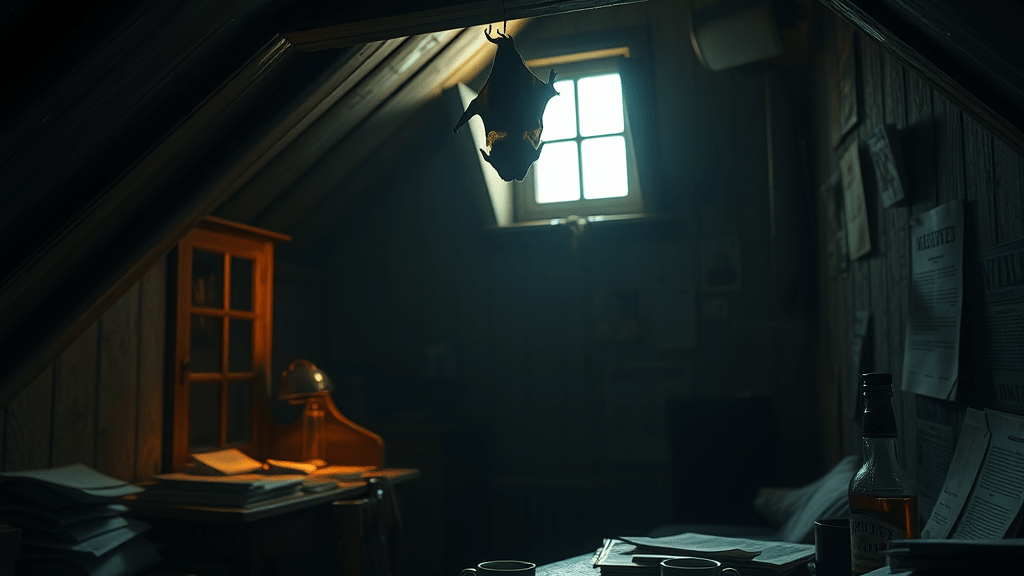
He pours a little out of the bottle into his coffee cup because that seems more dignified than pulling at a bottle, and leans back in his chair to see a bat hanging on the far end of his office. His hardware store is in a converted house, and his office is in the attic, and he’s had bats in here before, but he thought he’d sealed the place. Somehow the little bastard found its way in, so he goes downstairs where he keeps a .38 behind the counter and comes back up and shoots it, the smell of the powder, the sound of the shot bringing him back to that space again, so he takes a long drink straight from the bottle, before he puts the weapon on his desk and sweeps the carcass into a dustpan.
When Cindy, the woman who usually runs the cash register comes in to work and opens the place up, she asks him, “What’s that smell?”
Charles sniffs his hand. “Gunpowder. There was a bat in the attic.”
“So you shot him?”
“Seemed the fastest way.”
She laughs. “Well you better not let Henry know you shot a bat.”
Charles knows that he should chuckle with her, their inside joke that Henry, his teenage boy, loves awkward little creatures like bats and toads a little more than is normal even for boys, but her statement burns at him a little. It brings him back to when he was a lieutenant, and he’d watched a man get shot, and he’d ordered his private to retrieve the body, and the private said that the field was probably being watched by snipers.
The private had probably been right, but in a reflex, Charles had pulled his pistol and was about to threaten the eighteen year old kid with it, when a captain told Charles to stand down, and he did. He spent a day and a half thinking about shooting that punk kid who had been right, the scene playing over and over, him raging harder and harder every time he did.
That’s what he’s feeling now, and his son is going to be here in the afternoon for the chores that earn him his spending money, and that drives Charles into his place of rage too, so he goes back upstairs and picks his pistol off the desk. He comes back down and gives it to Cindy. He says, “I need to take the morning and maybe the rest of the day off.”
“Where are you going?” Cindy asks, and it’s an innocent enough question, but it feels like insubordination.
He says, “I’m not sure, but I might not be back until tomorrow.”
Cindy waves, and Charles leaves, not going home but off somewhere to another town where Henry will not be.
John Brantingham is the recipient of a New York State Arts Council grant and was Sequoia and Kings Canyon National Parks’ first poet laureate. His work has been in hundreds of magazines and The Best Small Fictions 2016 and 2022. He has twenty-two books of poetry, nonfiction, and fiction. Check out his work at johnbrantingham.com.
Please share this post to give it maximum distribution. Exposure is our contributors’ only compensation. Don’t forget to back link to this story.
Financial donations through either our GoFundMe or Buy Me a Coffee accounts will help expand our global reach by paying for advertising, more advanced WordPress plans, and expansion into more extensive Content Delivery Networks.
It is three a.m. and I have been driving thirteen, fourteen, maybe fifteen hours. I have passed through West Virginia and then, Kentucky, which was the last time I stopped to eat. But now in the middle of the night there are no signs for restaurants or gas stations so I decide to get off the main highway and continue along on a backroad into Indiana.
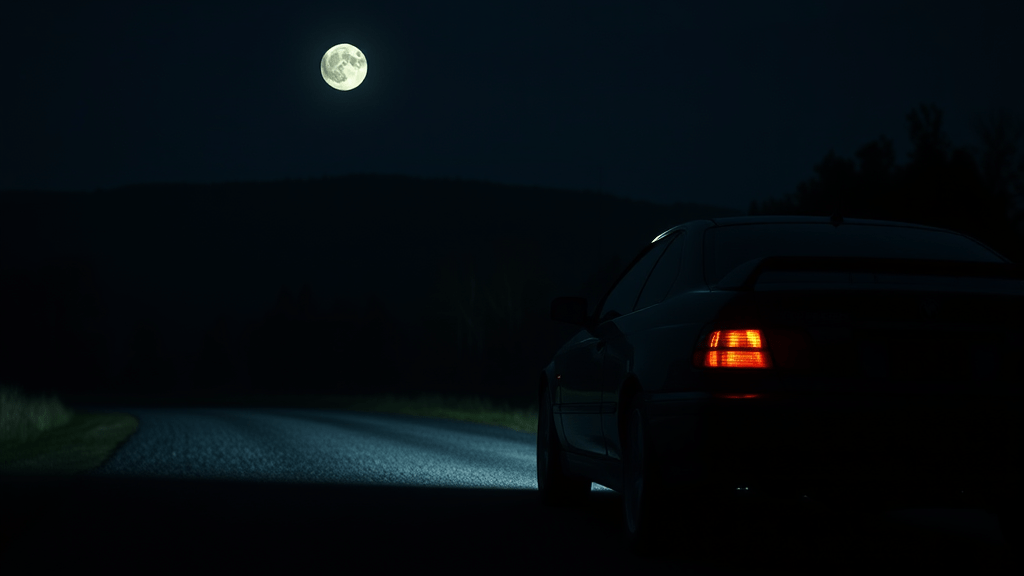
It is a pitch black night on this lonely road so I stop, get out to relieve myself and take a sip of bottled energizer to help me stay alert. I keep driving and now I am in the middle of Indiana. I decide to turn on the car radio where that I figure the music will help me stay awake as long as it is loud and noisy. To my surprise the radio pulls in Beethoven’s Sixth Symphony.
My New York snobbishness tells me that I did not know they played Beethoven in Indiana. I would have figured country music, Hank Williams, Willie Nelson or Dolly Parton. But no, it is Beethoven on this Indiana station.
It is dark country in Indiana at 3 a.m., not like New York which stays alive twenty-four hours, lights make it seem like day time, especially in Times Square. But out here the night is black with no road lights so I have to stay alert. I would not want to hit a deer or a bear or even a coyote.
I slow down for a minute, take another shot from the bottle of energizer liquid, swallowing a long gulp.
The thing about these Indiana hills is that they are blacker than the night. They are just dark hulks. There are houses but they are spaced far apart and no lights are on at this hour. There are no towns, no gas stations no truck stops or diners. It is so dark even the moon sleeps and stars do not twinkle. You would think out here in nowhereland the stars would command the skies. A full moon would light the world.
It is kind of scary being all alone on a dark country road so I pump up the volume and slow down a bit to conserve gas but keep driving as Beethoven’s storm rages then calms and ends. The announcer is about to name the orchestra and conductor, but a rock station from somewhere takes over and a different announcer says, “That was Twisted Sister” as a faint morning light takes me head long through rough farm land.
Zvi A. Sesling, Brookline, MA Poet Laureate (2017-2020), has published numerous poems and flash fiction. He edits 10 By 10 Flash Fiction Stories. His flash fiction books are40 Stories (with Paul Beckman), Secret Behind the Gate and Wheels. Sesling lives in Brookline, MA with his wife Susan J. Dechter.
Please share this story to give it maximum distribution. Exposure is our authors’ only pay. You can also help our contributors gain exposure by linking to them and to RFM’s homepage.
Financial donations through either our GoFundMe or Buy Me a Coffee accounts will help expand our global reach by paying for advertising, more advanced WordPress plans, and expansion into more extensive Content Delivery Networks.