Publisher, Rural Fiction Magazine; publisher, The Chamber Magazine; founder, the Farmington Writers Circle. I have written short stories and poetry for many years. In my careers as a Naval officer and in the federal government, I have written thousands of documents of many types. I am currently working on a second edition for my poetry collection and a few novels.
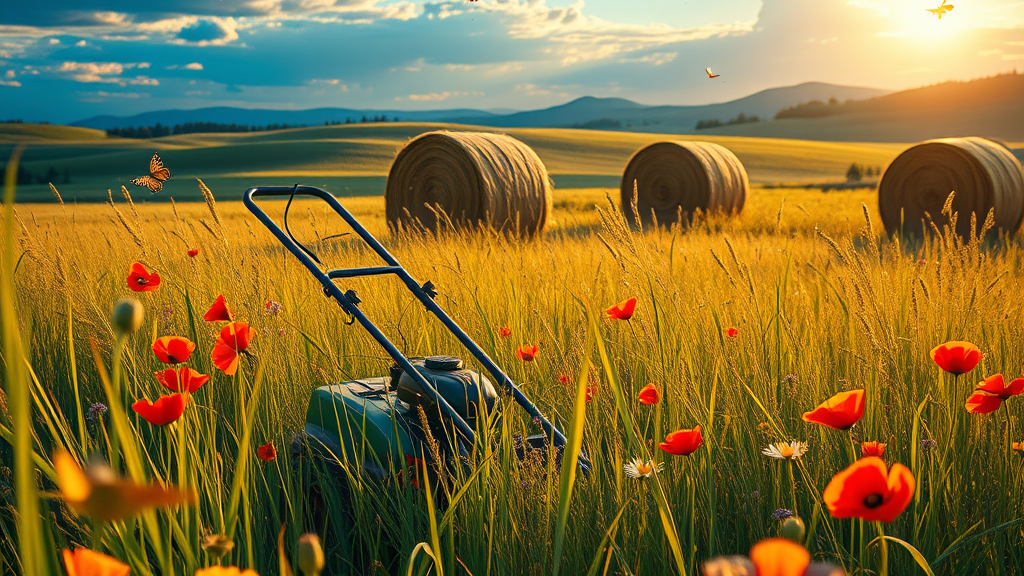
In the meadows, grass grows tall.
Poppies, vetch and clover
caught in the summer light
paint a canvas worthy of
Monet, Cezanne, van Gogh.
Flies and gnats drifting in clouds,
rise and sink as the breeze
strengthens, then dies away.

The mower relentlessly scythes
through the swaying grass,
with all its flowery jewels.
A lark’s nest falls victim
to the executioner’s blade.
Field mice flee before
the flashing metal fangs.
Butterflies hover, mesmerised
by the magnetic power
of certain death.
That impossibly blue sky
throws its airy net
over distant valleys
and far hills.
Haymakers’ weather
at last!

In the heat of midsummer,
the swathes are slowly drying.
The hay bob’s been busy
tossing and turning
the sleepy clumps.
Soon dry grass is neatly raked
in military ranks, under
the machine’s strident orders.
In the shade of a wood,
the tractor driver snatches
a hasty snack, a sneaky beer.
Looks at a job well done.

All week the weather holds,
The morning mist drifts away.
An officious red baler disturbs
the lark’s song high above
in the endless blue.
Neat bales of new hay
form into rigid lines.
Brash binder twine
strangles the dying poppies.

As evening falls,
swallows fly low, over
the twilight fields.
Breasting the waves of darkness,
they fish the shoals of insects.
The bales of hay stand sentinels
over a deepening silence.
Sarah Das Gupta is a writer from Cambridge, UK who has also lived and worked in India and Tanzania. Her work has been published in twenty countries from Australia to Kazakhstan. It has appeared in over 200 literary magazines and anthologies including ‘The New English Review’, ‘ Moss Piglet’, ‘Songs of Eretz’, ‘Quail Bell’, ‘Waywords’, ‘Cosmic Daffodil’, ‘Dorothy Parker’s Ashes’, ‘Hooghly Review’, ‘Meat for Tea’, ‘Rural Fiction’ and many others. This year she has been nominated for Best of the Net’ and a Dwarf Star’.
Rural Fiction Magazine is on a mission to showcase the rich tapestry of rural experiences from around the globe. Whether you’re penning heartwarming tales, poignant poems, or insightful reviews on rural fiction books, we want your voice! Our open-minded approach means we welcome all genres—be it romance, horror, or magical realism—as long as it connects to rural life. Your story matters!
A Worldwide Platform for Diverse Voices
With contributors from 46 countries and counting, RFM celebrates the universal human experience. By submitting your work, you join a vibrant community that transcends borders. Share your unique perspective and connect with readers who appreciate the beauty and complexity of rural narratives.
Fast Publication for Your Creative Work
No waiting indefinitely to see your words in print! At RFM, we pride ourselves on our efficiency—most submissions are published within weeks of acceptance. Get ready to inspire others and gain well-deserved exposure in English-speaking markets including the USA, UK, Canada, Australia, New Zealand, and Ireland.
Your Voice Matters – Take Action Today!
Ready to share your story? Visit our submissions page for detailed guidelines and join us in celebrating rural fiction’s diverse tapestry. Remember: while there’s no monetary compensation beyond publication credit and exposure, your writing will resonate with an audience eager for authentic voices like yours.
Spread the Word!
Please share this announcement far and wide to help us discover exceptional talent from every corner of the world!
I smell his cigarette smoke, hear his wheezing before the door to my room opens. There’s no squeak, so I know that little green air tank he drags around is sitting next to his chair in living room. I can hear some right-wing talking head coming for the TV down the hall.
“Put that goddamn book down and go take care of him,” he slurs.
I put the book on my desk, taking care to mark my page. I turn to look at him. He’s holding our varmint rifle, a smoldering grit hanging from his blue tainted lip, smoke swirling up around his gaunt weathered leather face. I say nothing. I hold my face and eyes blank and flat like carboard.
“Be a man for fucks sake. Go put him out of his misery. One between his eyes. Then dig a grave if he means that much to you.” I take the rifle from him, say nothing, and head out back.
Jet is laying on his side on pile of fallen leaves. His tawny coat blends into the yellow and reds surrounding him, as if the earth has already begun to reclaim him. He hears and smells me looking in my general direction with milky, cataracted eyes. His tail wags, he stands, and shuffles to greet me. He leans against my leg, all his weight now, and I rub his head. I know that old bastard is right. The blindness is new, but his tumors and arthritis…
“Jesus Christ! Just shoot him. Do I have to do everything?”
I take two steps back, lever a round in the chamber, put the barrel to Jet’s forehead.
“Goodbye buddy,” I say, voice cracking, then squeeze.
There is no sound beside the boom and it’s over and it’s merciful.
“Was that so damn hard?” he says from behind me.
I turn and we lock eyes. “No,” I say. Then I jack another round, already resigned to the digging ahead.
JD Clapp writes in San Diego, CA. His work has appeared in Wrong Turn Literary, The Milk House, The Whisky Blot, and several others. His story, One Last Drop, was a finalist in the 2023 Hemingway Shorts Literary Journal, Short Story Competition. This story was previously published in Bristol Noir.
Please share this to give it maximum distribution.
Rural Fiction Magazine is on a mission to showcase the rich tapestry of rural experiences from around the globe. Whether you’re penning heartwarming tales, poignant poems, or insightful reviews on rural fiction books, we want your voice! Our open-minded approach means we welcome all genres—be it romance, horror, or magical realism—as long as it connects to rural life. Your story matters!
A Worldwide Platform for Diverse Voices
With contributors from 46 countries and counting, RFM celebrates the universal human experience. By submitting your work, you join a vibrant community that transcends borders. Share your unique perspective and connect with readers who appreciate the beauty and complexity of rural narratives.
Fast Publication for Your Creative Work
No waiting indefinitely to see your words in print! At RFM, we pride ourselves on our efficiency—most submissions are published within weeks of acceptance. Get ready to inspire others and gain well-deserved exposure in English-speaking markets including the USA, UK, Canada, Australia, New Zealand, and Ireland.
Your Voice Matters – Take Action Today!
Ready to share your story? Visit our submissions page for detailed guidelines and join us in celebrating rural fiction’s diverse tapestry. Remember: while there’s no monetary compensation beyond publication credit and exposure, your writing will resonate with an audience eager for authentic voices like yours.
Spread the Word!
Please share this announcement far and wide to help us discover exceptional talent from every corner of the world!
Now I had to learn to shoot. The sound of the rifle was tremendous echoing off the mountainsides. It was late summer and the fireweed was blooming and the huckleberries were ripe. The smell of the gunpowder lingered in my limbic nerves, triggering danger, danger, bravery. Then the summer turned to autumn, and now the hunt was on. The air turned crisp and the birch tree changed from green to golden. Nature was humming and bullets paraded on the flats. I would leave the matriarchal farmer with a glint in my eye knowing the game was waiting. She would always protest, but I had history behind me – when a man is off to hunt, you must leave him alone. She ran to me when I was leaving: don’t go, don’t go. I looked her coldly in the eyes and guided her back to the garden then laughed to myself, as I drove off down the road. I passed the bear then met the man who had dementia right beside his cherry tree. With time, I chose to do my hunt alone.
The witchy matriarch was six-foot tall with piercing, pagan eyes. She was an empath with a hardened character bred from decades of abuse and chronic pain. She spoke the language of the horses, the flowers and the bees, but she doubted me and this would leave me fuming, pacing, slamming doors and acting lawless. I ran power trips like an aristocrat so that I could gain respect and prove this woman wrong.
And so the game, I thought, would be way up high where mankind wouldn’t go. It was a steep hike, miles up the incline of a mountain to a clearcut on the peak. I would see a raven now and then, as I marched upwards, rifle strapped over my shoulder. I waited many days empty-handed, but then the first buck showed up with his proud antlers shining in the sun, trotting down the mountain meadow ready to make acquaintance. The adrenaline hit fast so I trailed him, rushing into the timber, before I reassessed my strategy and headed to my ambush spot. It wasn’t long before he came walking right up to me. Exhilarated, I kneeled into position, but he caught my scent, jumped, and bolted away hurriedly down the cuts back into the timber. I had lost him again. Seriously concerned that I had squandered my only chance, I walked back down the mountain to my car.
There comes those times in life, those certain times, when we must embrace a manic perseverance … a willpower so dedicated that it leads us to walk through harm’s way gladly and trudge forwards unscathed and still highly motivated. I woke up in the middle of the night and trekked back up the mountain to the peak. Bitterly cold, I tramped uphill through the snow determinedly, as a wolf howled and I grit my teeth. In the final stretch before the break of dawn, when there was light to see, I approached my ambush spot and much to my surprise, stumbled right into the buck. He was there feeding overnight. He stared straight at me, startled and curious, and froze into a shaky posture, so I tiptoed even closer, and my only shot was for its neck. Bang. The loud sound echoed through the mountains and he jolted up into the air like he had stepped on a landmine. He sprinted into the timber as fast as his legs would take him. I saw hair on the ground where he had been, but no blood trail. I knew I had missed the shot. I sat there in exhaustion and humiliation. I didn’t know what I would tell them.
I returned to the farmhouse that afternoon to see the married couple bickering away, clearly in a serious dispute. They were not surprised at all to see me empty-handed. I pulled up a chair in their rustic kitchen filled with plants and earthy paintings, just to be treated like the figurehead of irresponsibility. After I told my tale, the man reflected for a steady minute, then looked at me and said he thought I shot the buck. His wife then mimicked his remark, stating, “Always go look for the animal.”
The farmer and I went to look but it had escaped without damage and this led to impatience to get another try due to the fact that the year was wrapping up.
But my optimism came flooding back when I saw fresh tracks in the fresh snow. They couldn’t have been more than a couple hours old. We were in the final days of the season now and I made my ambush by a tall evergreen making sure my wind was right. I waited about half an hour and then a deer walked into sight. He was about sixty yards down the mountain, slightly hidden by a patch of saplings and I looked with strained eyes to see if he had antlers. I was hit with a feeling of radiance. He had little horns on the top of his head. This was a spike buck. I walked slowly towards him, tense to the extreme, manoeuvring to the proper angle to align the perfect shot. I kneeled, took a breath and pulled the trigger. Boom. He sprinted forwards and there was a luminous feeling of an earthly animal member passing on. A flash of red illuminated after the clap of the shot, but when I got to where he was standing, there was no blood-trail. Following his tracks into the timber, I was convinced that I had missed again. Turning the bend and following the hoof tracks — suddenly, in front of me was the dead body of a spike buck slumped in this mountain forest. I had connected through the heart-lung cavity. It felt like I had been told I no longer had to hold up the weight of the sky on my shoulders. There was a profound sensation of deep relief.
Maxwell Adamowski is a Canadian survivalist and woodsman who lived alone for a year in the wilderness performing a series of rite of passage rituals. “The Spike Buck” is one of the first stories in his book, CarQuest.
Please share this to give it maximum distribution.