
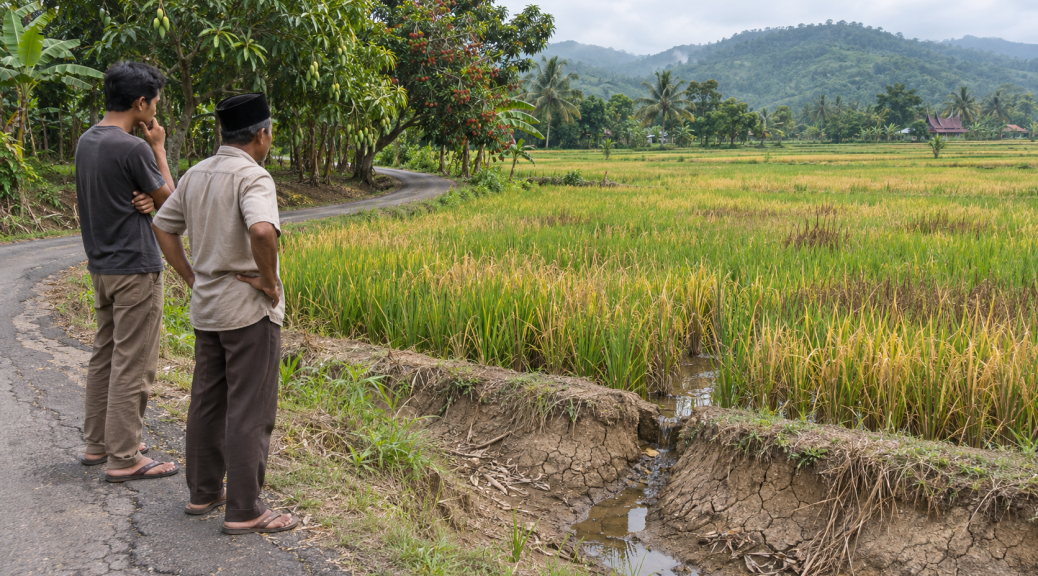
The village divided the stream by day, not by ownership. Monday belonged to the rice fields below the mosque. Tuesday, to the farmers behind the school. Wednesday had been reserved for the orchards at the bend. My uncle knew the arrangement by heart because his father had taught it to him while both stood barefoot in the irrigation ditch.
When I returned from Padang, the Wednesday channel was dry.
A new roadside guesthouse had installed a pump upstream. The owner was a man named Hendra, who had married into the village and built six clean rooms for visitors who wanted to sleep in view of the valley. He argued that his guests used less water than the rice fields wasted. On his wall hung a framed certificate praising the property for sustainable tourism.
My uncle took me to see the bend. The channel smelled of mud and old leaves. Beside it, dozens of rice seedlings stood yellow at the tips.
“We could ask the district office,” I said.
“We’ve asked.”
“Then the village council.”
“We’ve asked them too.”
“What did they say?”
“That Hendra has papers.”
My uncle removed a stone from the channel and returned it, as though the argument had loosened it.
I wanted him to be angry. Anger would have given me something to carry home, a story with a villain and a line of dialogue I could repeat. Instead, he asked whether I had eaten.
That evening I found Hendra cleaning the glass doors of his guesthouse. He recognized me from school and invited me inside. The lobby smelled of paint and lemon polish. On the reception desk stood a ceramic bowl of flower petals, each floating on water so clear it was almost invisible.
“People need jobs,” he said before I had asked anything. “One of my cleaners is your cousin. The vegetable seller supplies our kitchen. You can’t keep a place alive only by remembering what it used to be.”
He showed me the pump meter and its modest daily numbers. I could see that he believed himself.
“Come on Wednesday,” I said. “Walk the channel with us.”
He agreed, perhaps because he assumed I would not be there.
On Wednesday morning we began at the old diversion gate. Hendra wore polished shoes. By the time we reached the fields, mud had climbed to his ankles. My uncle said almost nothing. He showed us where water used to turn a small wheel for grinding grain. He pointed to the spot where children caught fish during the wet season. Then he reached the orchard channel and asked Hendra to kneel.
In the dry bed, beneath the cracked clay, lay a line of snail shells the size of fingernails. My uncle brushed one clean with his thumb.
“These don’t sign papers,” he said. “But we know where they live.”
Hendra stood and said the water levels had fallen throughout the valley. That much was true. He said the guesthouse was only a small part of the problem. That was probably true too. My uncle did not contradict him.
The argument might have ended there. Then Hendra’s phone rang. A guest wanted to know why the swimming pool had been closed. Hendra answered in a voice meant for customers, promising that the water would be clean by noon.
My uncle looked at the phone, then at the channel. At last he smiled, not kindly.
“Come,” he said. “Let us meet this pool.”
Within a month, an engineer hired by Hendra had moved the pump inlet below the irrigation diversion and fitted a storage tank to collect rain from the guesthouse roof. The change cost more than he liked and supplied less water in the dry season than his brochure promised. The pool remained closed twice a week. Some guests complained online.
The Wednesday channel began to run again. Not every week; the drought was real. But enough that the yellow tips of the seedlings turned green.
When Hendra next came by, my uncle offered him tea. Hendra refused the first cup and accepted the second. They sat at the edge of the field without becoming friends. The current passed between them, carrying one pale snail shell toward the bend.
Zaky Satria is an Indonesian writer interested in Minangkabau
oral traditions, cultural memory, and short fiction that crosses
languages and landscapes.
If you would like to be part of the Rural Fiction Magazine family, follow this link to the submissions guidelines.
Please share this post to give it maximum distribution. Exposure is our contributors’ only compensation. Don’t forget to back link to this story.
Financial donations through either our GoFundMe or Buy Me a Coffee accounts will help expand our global reach by paying for advertising, more advanced WordPress plans, and expansion into more extensive Content Delivery Networks.
Image generated by AI.
