
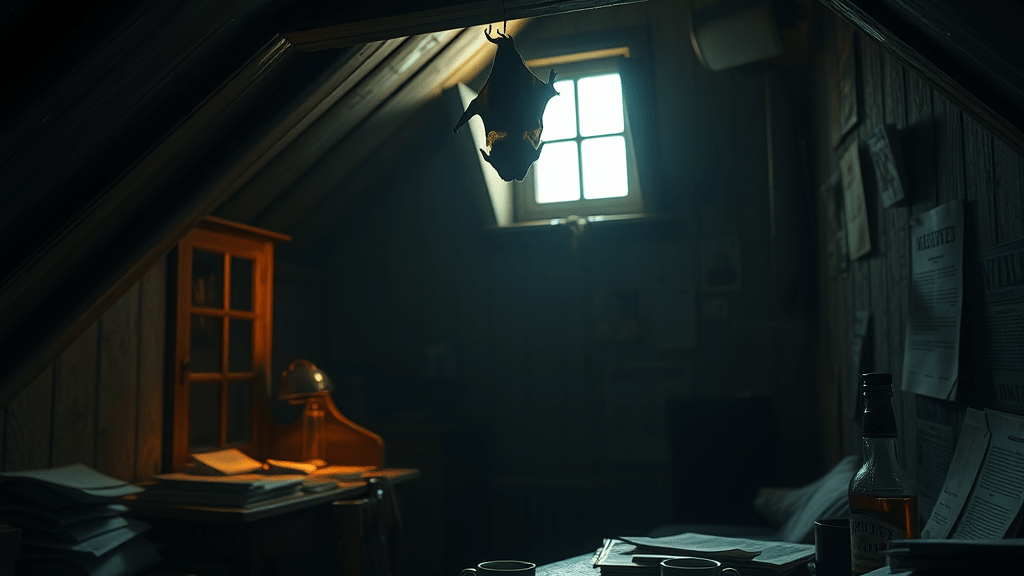
In the morning, Charles smells a combination of diesel fuel burning and something dead, probably a deer or a raccoon out in the woods. The thing of it is that he starts to panic in the way that he did all those years ago when he got out of the war, and he was just back and didn’t know how to deal with the memories, so when he gets to the hardware store, before he opens up, he has a long and calming draught of the bourbon he keeps in his office even though it’s not quite 9am. It helps him to numb out a little. Just a little. Just enough.
He pours a little out of the bottle into his coffee cup because that seems more dignified than pulling at a bottle, and leans back in his chair to see a bat hanging on the far end of his office. His hardware store is in a converted house, and his office is in the attic, and he’s had bats in here before, but he thought he’d sealed the place. Somehow the little bastard found its way in, so he goes downstairs where he keeps a .38 behind the counter and comes back up and shoots it, the smell of the powder, the sound of the shot bringing him back to that space again, so he takes a long drink straight from the bottle, before he puts the weapon on his desk and sweeps the carcass into a dustpan.
When Cindy, the woman who usually runs the cash register comes in to work and opens the place up, she asks him, “What’s that smell?”
Charles sniffs his hand. “Gunpowder. There was a bat in the attic.”
“So you shot him?”
“Seemed the fastest way.”
She laughs. “Well you better not let Henry know you shot a bat.”
Charles knows that he should chuckle with her, their inside joke that Henry, his teenage boy, loves awkward little creatures like bats and toads a little more than is normal even for boys, but her statement burns at him a little. It brings him back to when he was a lieutenant, and he’d watched a man get shot, and he’d ordered his private to retrieve the body, and the private said that the field was probably being watched by snipers.
The private had probably been right, but in a reflex, Charles had pulled his pistol and was about to threaten the eighteen year old kid with it, when a captain told Charles to stand down, and he did. He spent a day and a half thinking about shooting that punk kid who had been right, the scene playing over and over, him raging harder and harder every time he did.
That’s what he’s feeling now, and his son is going to be here in the afternoon for the chores that earn him his spending money, and that drives Charles into his place of rage too, so he goes back upstairs and picks his pistol off the desk. He comes back down and gives it to Cindy. He says, “I need to take the morning and maybe the rest of the day off.”
“Where are you going?” Cindy asks, and it’s an innocent enough question, but it feels like insubordination.
He says, “I’m not sure, but I might not be back until tomorrow.”
Cindy waves, and Charles leaves, not going home but off somewhere to another town where Henry will not be.
John Brantingham is the recipient of a New York State Arts Council grant and was Sequoia and Kings Canyon National Parks’ first poet laureate. His work has been in hundreds of magazines and The Best Small Fictions 2016 and 2022. He has twenty-two books of poetry, nonfiction, and fiction. Check out his work at johnbrantingham.com.
If you would like to be part of the Rural Fiction Magazine family, follow this link to the submissions guidelines.
Please share this post to give it maximum distribution. Exposure is our contributors’ only compensation. Don’t forget to back link to this story.
Financial donations through either our GoFundMe or Buy Me a Coffee accounts will help expand our global reach by paying for advertising, more advanced WordPress plans, and expansion into more extensive Content Delivery Networks.
Image generated by AI
