
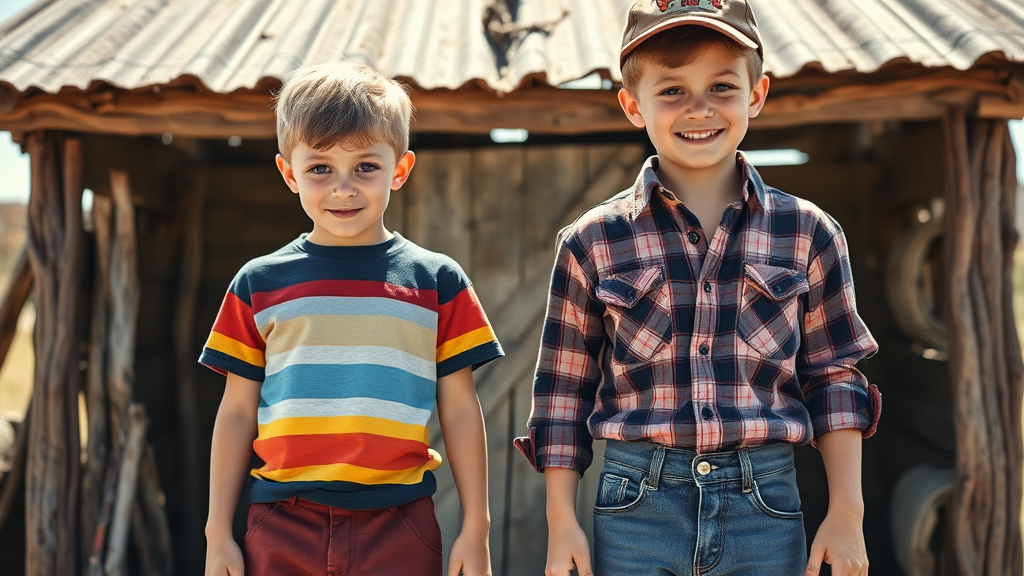
There is a Polaroid of my cousin Nathan and me standing in front of the coal shed. The coal shed is bare plank wood with a corrugated tin roof. Written on the back of the picture in blue ink is Philip and Nathan, 1972. I was 6, Nathan was 12. I’m wearing a four-color horizontally striped t-shirt and maroon pants; he’s wearing a plaid button-up collared shirt, denim bell bottoms and a Mid South Mack cap—the bulldog logo still discernible in the center of the crown. Our arms dangle at our sides after my mother, who took the photo, told us to uncross our arms. Both of us are squinting in the sun, making our smiles look forced. The photo is very faded after fifty years. I only know that my pants are maroon, not the pinkish color in the photo, because they were my favorite pants.
Nathan came to live with my family before I was born. His mother was unable to care for him because she was sick, but we were never told what her illness was. It’s not unusual to see extended families in Eastern Kentucky—cousins, aunts, uncles, grandparents all living under the same roof—but when Nathan’s mother recovered Nathan had already been with us for so long he stayed with us after she moved to Chattanooga, Tennessee. When I was brought home after being born at the Pineville Community Hospital, Nathan kicked a hole in the living room wall and ran to his bedroom.
Nathan spent his allowance money on wrestling magazines and cut out the pictures of his favorite wrestlers to pin up on the bedroom wall. He had an autographed picture of his most favorite wrestler, Ric Flair, that he often stared at in bed before going to sleep. He told me many times I was never to touch it. When I was three, I was moved out of my parents’ bedroom and into Nathan’s. “I’m your big brother,” he told me. “I was sent here to take care of you.” He would tell me stories as we lay there in the dark; stories about monsters in the woods behind our house, stories about man-eating fish in the river that could jump out of the water and get you, venomous snakes hiding in the weeds. Those stories made me afraid, but they didn’t make me afraid of him. Until he told me the story that did make me afraid of him.
When Nathan was six years old he killed our grandmother. “One night I just did it.”
“Why?” I asked.
“I don’t remember,” he said. “I think I was really mad about something. Don’t tell anyone.”
“I won’t.”
“You better not.”
“I said I won’t.”
* * *
I never met my grandmother, I knew her only from the old black and white portrait in an oval frame that hung on the wall in the living room along with portraits of other family members. Her portrait, like many of them, looked like those old west photos of women with pulled-back hair and masculine facial features. The day after Nathan told me he killed our grandmother, I walked over to the Highway 119 General Store where my mother worked as a cashier and stocker. “What happened to mammaw?” I asked.
She put the last bottle of Nehi in the cooler and slid the glass lid shut. As she stacked the plastic bottle crates she said, “Philip, God called her home when it was time. She’s in heaven with Jesus now. It’s best forgotten. I don’t want you to talk about it no more.” She went to the front of the store to ring up the purchase of someone with a Moon Pie and an RC Cola. She came back to take the bottle crates to the rear of the store for the delivery driver to pick up the next day.
“I just want to know what happened,” I said, more quietly than the first time.
“It’s something that shouldn’t be thought about. Run along back home and play. I have to work now.”
* * *
For my eighth birthday I got a Rubik’s Cube and the next day I found it under my bed with five of the colored stickers peeled off. That Christmas I got a Shazam action figure and a few days later it was in pieces after the rubber bands inside had broken. When my bicycle seat had been slashed I showed it to my mother. “Think of all the poor children in the world who don’t even have a bicycle at all,” she said.
Nathan was quick to anger and I did my best not to provoke him. Whenever I did he would punch my shoulders or pinch my ears. My parents trusted Nathan enough to leave me in his care, even letting him take me fishing to the river a half mile from our home. If I caught the first fish I risked another one of his lashings, so I learned how to secretly remove the bait from my hook before my first cast. His anger never lasted very long, within a day or two he would go back to telling me stories and reassuring me that I really was his little brother and he was there to take care of me. “You know you don’t deserve it,” he said. “but I’ll still take care of you.”
When Nathan was fourteen his face broke out in huge red boils and white pustules. He would spend evenings after supper in front of the bathroom mirror popping them, leaving pus splatter on the glass. The white cream that a doctor had prescribed for him wasn’t working and it frustrated him. One Saturday afternoon after watching a TV science fiction show where one of the characters was a swordsman, he began leaping about and parrying with a leatherman’s awl that he had taken from my father’s steam trunk and yelling, “Look! I’m Lieutenant Sulu! Prepare to swordfight!” He was jabbing the thing close enough to frighten me, but he kept telling me he was just playing and wouldn’t hurt me. Then he jabbed the thing right through my left cheek.
I howled for hours as my mom tried to stop the bleeding both inside and out. The next day as she was driving me to the Daniel Boone Clinic I told her Nathan had done it on purpose, that he was mad because his face had broken out and he wanted to mess up my face, too. “No, he didn’t sweetheart, it was an accident. You have to play careful.”
Nights in our bedroom he would repeatedly apologize and ask to look at the stitch in my cheek. He would lift the gauze and pick at it with his fingernail even as I was telling him it hurt. It was a month before it healed enough for the doctor to remove the stitch. The scar was a pink elliptical.
* * *
My father was asked to pull the float for the 119 General Store in the upcoming Mountain Laurel Festival parade. Every year Mr. Ingalls, the owner of the store, pulled the float but he had passed away a few months ago and his widow asked if my father would like to do it. My father broke the news to us as we sat at the supper table. He told me I could ride on the Massey Ferguson tractor with him in the parade like he sometimes let me do as he plowed our field. However, the day before the parade my father told me he was going to let Nathan ride with him instead of me.
“But why? You said I could ride with you.”
“You can ride next year. Nathan’s going to be 17 next year, so let’s let him ride this year.”
My mother, sitting next to my father, rose from the sofa and went to the refrigerator for a bottle of Coke to mollify me. I had been telling everybody at school I was going to be in the parade. I refused to accept the pop. Nathan, seated in the wicker chair next to the coal stove, smirked and shrugged his shoulders at me.
The volcano of my rage erupted. “He’s a murderer!” I screamed, pointing at Nathan. “He killed mammaw! He told me all about it!”
Nobody said anything, nobody’s expressions changed. My mother returned the bottle of Coke to the refrigerator.
* * *
Things happened pretty fast after that. My mother packed an old Amelia Earhart suitcase with my things and I was sent to Aunt Dorothy’s to live. Aunt Dorothy was 65, widowed, and addicted to cooking sherry. “It won’t be long,” my mother said as we walked over. Aunt Dorothy’s home was just fifty yards away across a creek and up a small hill. “Nathan’s had a hard life, Philip. I hope you understand.” No, I did not understand. I was her son and she was abandoning me. And to Aunt Dorothy of all people! Her home was a moldy shack and she hadn’t bathed or changed her clothes in nobody knows how long. She looked like a bowling ball with stick figure arms and legs.
My father had telephoned ahead, and as soon as my mother and I went in I was sent to the kitchen where a bag of Fritos and a bottle of Sprite awaited me on the round wooden table. They whispered in the front room for about five minutes or so and then came back to the kitchen. “It’ll be just for a little while,” my mother said, patting my wrist. “I’ll come by tomorrow morning to get you to go watch the parade.” I told her I didn’t want to go. “All right then.” She patted my wrist again and then walked back home.
I spent almost that entire summer at Aunt Dorothy’s. Sunday nights we had supper at my mother’s, and while Nathan and I both participated in the conversations, we never spoke to each other.
On the last Saturday night of August, Aunt Dorothy and I were watching Love Boat and Fantasy Island like we always did. She was reclining on the sagging sofa holding a plastic tumbler of sherry on her belly. “You and Nate will be friends again, Phil,” she said after a sip. “You’re like a little brother to him.”
“No we won’t,” I said without taking my eyes off the television. “And we aren’t brothers.”
“Of course you are. He loves you and you love him.”
I couldn’t take it anymore. “He killed mammaw! He’s the murderer and I’m the one that gets kicked out!”
She sat up on the sofa and set her tumbler on the cluttered coffee table after another sip. “Lord amercy, where do you young’uns come up with this nonsense,” she whispered, jiggling a cigarette out of its pack. “First of all Phil, you ain’t kicked out. We go over there once a week, sometimes more.” She paused to exhale and rub her weary eyes. “This was all so long ago. Nathan was only five or six years old at the time. Pappaw was drunker’n hell like he always was. Mammaw’d had enough and told him to get his drunk ass out of the house. He took the poker from the fireplace and commenced to beating the tar out of her. She was on the floor unconscious with blood coming out of her ears, nose, and mouth before he finally stopped. Pappaw knelt on the floor crying for her to wake up, wailing to high heaven that he was sorry and that he loved her. It wasn’t til Herschel came home that they was found. The whole kitchen floor was covered in mammaw’s blood. Nathan was hid behind the ice box, he saw the whole thing. Mammaw died the next day in the hospital.”
* * *
The weekend before the new school year started, Nathan moved to Chattanooga to be with his mother. I moved back home and had the bedroom all to myself. I wiped the booger smears off the wall next to Nathan’s former bed with a paper towel and Formula 409. Our family grew over the space that Nathan had left almost like he had never been there.
Almost five years to the day after Nathan left us, we attended his wedding in Chattanooga. During the long drive down, I wondered if he’d forgotten me, but upon our arrival I received the heartiest greeting of all when he stuck out his hand saying, “Phildo! How the hell are you little brother? Long time no see.” We stayed overnight at Nathan’s mother’s house, which he and his bride also lived in. My mother kept Nathan’s wedding portrait on her nightstand until the day she died. It scarcely resembled a wedding portrait, Nathan in a cheap Botany 500 suit, his bride Angelina in a Kmart casual skirt suit. Nathan is smiling with his lips closed, Angelina isn’t smiling at all and no matter how long I look at it I can not make out the expression on her face.
When I cleaned out my mother’s home in 1999 after she died, I found all of Nathan’s cut outs of pro wrestlers, including the autographed one of Ric Flair. I telephoned Nathan in Chattanooga to see if he’d like me to send it to him.
“I never had an autographed picture of Ric Flair,” he said.
“Sure you did. You always used to tell me not to touch it.” He insisted he’d never had an autographed picture of any pro wrestler and launched into a story about catching a 30 pound channel catfish in the Tennessee river over the summer. One fish tale led to another and as he talked, I listened for any evidence of what he’d seen as a child, listened for any trauma that might still be living within him. After his final fish tale I asked again if he wanted me to mail him the picture.
“Naw. Just do whatever you want with it.”
I fingered the small pit on my left cheek as we said our goodbyes and hung up.
Hugh Blanton’s latest book is Kentucky Outlaw. He can be reached on X @HughBlanton5.
If you would like to be part of the Rural Fiction Magazine family, follow this link to the submissions guidelines.
Please share this story to give it maximum distribution. Exposure is our authors’ only pay. You can also help our contributors gain exposure by back linking to them and to RFM’s homepage.
Image generated by AI
