

In the almost forgotten times that wrought the after-years, the world and its weather changed, bringing storm and famine, war and famine, drought and famine. Nations were riven and destroyed. Petty warlords fought for smaller and smaller fiefs until farm and town were made desolate and the people fled. The scattered survivors were oppressed by hunger and hardship, fire and want. The after-years created devastation and loosed upon the land the wanderers, the hunters, and the displaced soldiers of fortune.
So it chanced that one such soldier trudged the dog end of a long road at the gloaming of a day in spring. Behind him, the sun slipped to the rocky hills he had just descended. The dying rays illuminated skeletons of burned-out trees that lined the empty path. His elongated shadow stretched far ahead on the broken, grass-choked pavement.
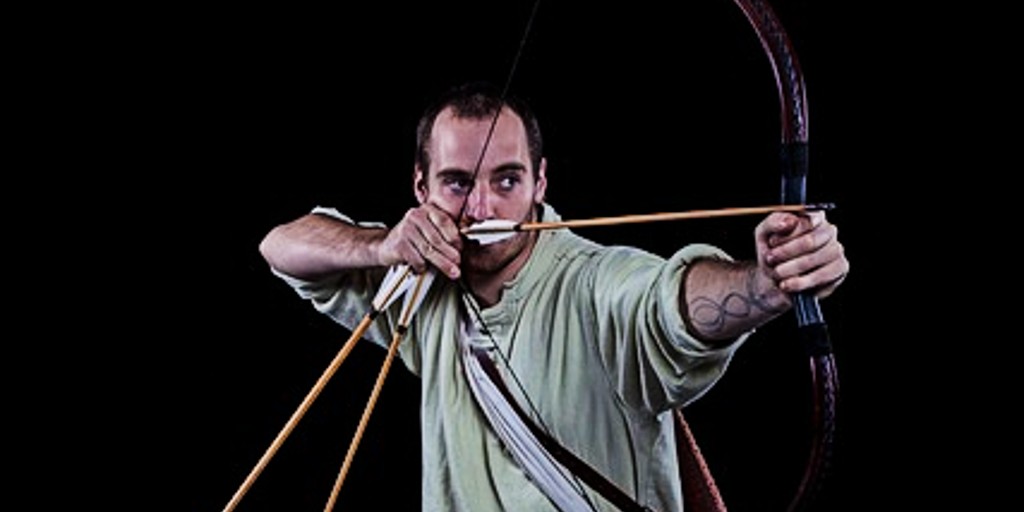
The lone man strode after his shadow with a loose gait. He stood tall, lean, and wolfish. He was not young. Four decades he bore, and his face was lined. A heavy rucksack and quiver hung from his shoulders, and he carried in his hand a longbow of yew.
His self-given name was Adam, from a book his aunt read to him as a child. Adam Damned, if any dared to ask his surname. Few did. Adam Damned was an archer, a marketable trade now that guns and the bullets that fed them had vanished into obscurity. His loyalties were for sale to any prince who could pay his wages and fill his belly.
The cracked roadway ran down to an open valley and the ruins of a town. It was once a thriving place astraddle the meeting of two highways. Now, the roads were empty ribbons, and the town inhabited by ghosts. A few scroungers lived amongst the ruins, trading worthless junk and bartering for a mean existence.
The name of the town was Consequences.
Adam Damned reached the edge of the town as night fell over it. Empty doors and windows gaped dark and blind from either side of the road. There were no human sounds, only the rustling and creeping of nocturnal creatures. He did not stop to hunt, for he already carried fresh meat to barter. A feeble light glimmered at the distant end of the street and a wheezing sort of music reached his ears.
Adam walked on. The light became a glow, and the stumbling pulse of the music grew louder. He stepped from the darkness into the circle of light. The music ceased as if cut from the air with a knife.
A woman sat upon the steps of a red brick hotel. Paired candle lanterns hung from the hotel doorway, dropping a flickering light over the seated woman.
She might have been forty or sixty. Impossible to tell in that light. Her bare arms were lean as twisted rope, and she held a battered concertina in her lap. The woman cocked her head and smiled. Her teeth were strong and white. Her hair was silvered, but by age or candlelight, Adam could not tell.
His hunter’s eyes searched the light and the blackness beyond, but no one did he see. He turned his eyes back to the woman.
“I wish you a good evening.”
She chuckled at his words.
“A fine wish, but empty of promise. Still, I thank you. Welcome to Consequences.”
Adam felt the weight of his rucksack and the hunger in his belly. He pointed to the sign illuminated by the candle lanterns.
“Is there room at the inn?”
The woman laughed and swept a hand through the air.
“This whole damn town is vacant, stranger. Empty rooms for the taking.”
“I’ve walked far. I prefer somewhere with a hot stove and a warm pallet.”
The woman rubbed her chin and held her hand out, palm up.
“You’ve goods to barter, then?”
“I have. Two fat snakes, fresh today, and a flask of grappa.”
She stood herself straight and tall. The concertina unfolded with a groan.
“Step inside, stranger. Let’s see to your belly and bed.”
* * *
The plates were polished clean and the table bare before Adam dug the flask from his rucksack. The woman who called herself Maude sat across the table, younger now in the soft light of tallow candles. A third figure sat on a stool beside the table, an idiot boy of twenty years or so. If he had a name, no one knew it. Maude called him Boy.
“Will the boy drink?”
“He will. A small one won’t hurt him.”
Adam nodded, uncorked the flask, and poured. Two full drams for himself and Maude, a short pour for the boy. Maude reached for her drink and raised it. The boy aped her, a lopsided grin on his face. Then Adam raised his own glass. They nodded, drank, and grimaced against the fiery liquor.
“Whew! That will liven a girl.”
“Another then?”
Maude nodded and Adam poured. He stoppered the flask and set it aside. He pushed his empty plate aside and leaned his elbows on the table.
“I thank you for the meal, Maude.”
The woman bowed her head in a mockery of courtesy.
“You did not lie, traveler. Those were fine, fat snakes. The deal is square. You’re a guest under my roof, at least for this night.”
“Then I must think of the morrow. What chance of employment in these parts?”
“None in this shithole of a town. You came out of the West. You saw how empty the land is. Two days’ walk to the North lies the territory of a warlord. Payton is his name. The same distance south will bring you to another band of thugs led by a man named Jackson. One as bad as the other, and both looking for men.”
“And this town stuck between the two?”
“They leave us alone. Everything there is to take has been taken. Consequences has no more to give.”
“Us? There are others?”
“Of course, there are others. They’re shy of fighters. You with your longbow, I expect you scared them off. You’ll see them tomorrow.”
The boy erupted in gurgling chuckles.
“What lies to the East?”
“A road you do not want to tread. It leads to an evil place ringed by a tangled hedge of briar. Thorns like claws and sharp as daggers. The hedge guards the past and kills every fool who tries to pierce it.”
Adam drank off half his grappa and winced.
“Another of the old tales. I have heard something like this before. Tell me the rest to pass the rest of the evening.”
Maude shook her head, and her smile disappeared from her face.
“Very well but mind your scorn. Old is not the same as false.”
Then she began to tell the tale.
* * *
It happened when my grandmother was just a small girl, before the great storms and fires. A band of strangers came to this town. It wasn’t called Consequences back then. The strangers seemed to be rich. They bought up the lands east of town and started building. They named their new settlement Paradise. Some of the townsfolk called it a cult, but they said it quiet. The newcomers spent hard cash for goods. Cult or not, folks were glad for the trade.
A young married couple led the pilgrims at Paradise, their king and queen in a way. By all accounts, they were beautiful and wise. The commune prospered under their rule. Homes were built, crops planted, and babies conceived. But not for the queen. She remained childless despite her hopes, the king’s desire, and the chanted dreams of all those in Paradise.
One still summer afternoon, the queen fell asleep on the banks of the stream that watered Paradise. A frog came to her in a dream and told her that her wish would come true. The talking frog promised that within the year, the queen would have a child.
The dream became reality. The queen gave birth to a beautiful baby girl. When their daughter was one year old, the king planned a great feast and festival to celebrate. There would be food and music and special rituals that brought visions of the future.
The feast ran long into the summer twilight. Special wines were passed amongst the elders of Paradise, and small trays of peyote buttons, bitter to the tongue. While the others sang and danced, the wise ones ate the peyote, drank the wine, and waited.
The moon rose in the night sky and the first elder with it. The music ceased and the dancers stilled. All listened as the wise ones bestowed their visions. One by one they stood, offering their gifts to the girl child of the king and queen. One spoke of beauty, another of riches to come, yet another of the virtues the child would inherit.
But all was not well. One of the wise ones fell upon his back, writhing and moaning. When the others tried to assist him, he leaped to his feet, eyes wide and staring. He cried out the words of his vision, and they were dire.
‘When the girl reaches fifteen years, she will feel the sting of life, and life will leave her and all those who dwell with her.’
Then the man fell on his face as if dead. Frightened hands carried his rigid body from the commons.
Under the canopy of the summer stars, the people stared in shocked silence. The king sprang to his feet in anger. The queen’s face blanched deathly pale. But one elder remained who had not yet spoken. She smiled at those assembled and spread her hands wide.
‘I cannot unsay this awful vision, but I can soften it, perhaps. Death shall not be the fate of this beautiful princess, but rather sleep, the sleep of a century. A brave kiss shall awaken her if such kiss can find its way to her sleeping lips.’
The years passed and the little princess grew into a lively, curious child. Her father did everything he could to protect his daughter from the sting of life. Sharp objects were removed from the household. The princess never heard any news of sadness or loss, for these things were banished.
All the good visions came to pass. The princess was a beautiful, virtuous, good-natured girl, so full of joy that all who knew her loved her.
Her fifteenth birthday drew near. Paradise had grown with the princess. The little commune was now a thriving community, and all the inhabitants busied themselves with preparations for the birthday of the princess.
At last, the special day arrived. The king and queen were busy with preparations for the birthday party. The princess was left alone to do as she pleased. She roamed around the compound, stopping to pet the sheep, or speak with the burly blacksmith.
Back in the very farthest corner of the compound, she came to a building she did not know. She slipped past double doors and stepped into a large workroom.
It was a magical place the likes of which the girl had never seen. A dozen young women sat at wheels and spindles, spinning flax into yarn. On the other side of the room, men and women worked at looms, weaving the flax yarn into linen cloth.
The princess was enchanted with the clatter and clack of the looms, and the delightful rattle of the wheel and spindle. She wished to learn everything about this magical process.
The women were delighted by the chance to teach the princess to spin flax. They sat the princess on a stool, but when the girl reached for the spindle, she pricked her finger and felt the sting.
In that moment, the princess fell into a swoon. The weavers carried the girl back to her chambers. Their steps were slow, for they felt a great weariness slipping over them.
They laid the girl on her maiden bower and pulled the coverlet to her chin. Then the grieving weavers and spinners went in search of the king and queen, but they never found the girl’s parents.
Before they could impart their dire news, weariness captured them. Their eyelids drooped and close. A deep sleep fell over the compound and all that dwelt there. The king and queen slept, as did every inhabitant of Paradise. The blacksmith at his forge and the shepherdess by her flock, each fell fast asleep. The horses slept in their stables, the sheep in their pens, the dogs in the yard, and the birds on the branches. All was silent. Not a leaf stirred.
As Paradise slept away the seasons, a thorny hedge of briar grew up all around the compound, surrounding it with a tangled wall. With each passing year, the hedge grew higher and the thorns longer, until it was a grasping, deadly peril, thrice the height of the tallest man.
The tale went far and wide of a beautiful princess trapped in a thorny prison. There were riches and glory for any brave lad who freed the poor girl from her enchantment. The spell could only be broken when a lone warrior breached the evil hedge and awakened the princess with a brave kiss.
And so it was that the brave sons of rich men and paupers, and not a few daughters as well, came to test their strength and skill against the thorny hedge that imprisoned the princess.
Many tried, and many failed. They were young and brave, but they were foolish. They hewed their way into the hedge and were swallowed by it. The hooked thorns of the hedge were sharp as an eagle’s talon, strong as the claws of a great bear.
The doomed young men and women were pinioned by the grasping vines, which moved as living serpents. Deadly thorns tore their young flesh. The malignant briar hedge captured each one of the brave fools, bound them with tendrils and vines, pierced their flesh with thorns, and bled the life from them. They died a miserable death.
* * *
Her tale told, Maude leaned back in her chair. The candles guttered in an unseen draught, and shadows wavered across the table.
Adam raised his glass and tossed off the last of the grappa. The empty glass rapped loud against the wooden table.
“Another wild tale about the sorrow of young fools. Bravery and foolishness are bound together. I’ve seen many dead fools after a battle, each of them stiff as boards and cloaked in their bravery.”
Maude leaned forward and stared into his eyes.
“You do not believe the tale?”
“My belief has nothing to do with it. It may be true. Perhaps one day I will go and see this damned briar hedge with my own eyes.”
“I would argue against you.”
Adam Damned smiled at this silver-haired woman.
“Would you indeed, Maude? Well, there is no need. Tomorrow I will go to the North. It is work I need, not foolish errands.”
He reached a strong hand to his rucksack and hoisted himself from his chair.
“Has my barter bought me breakfast?”
“It has. I will show you to your pallet.”
She rose and led him from the darkening kitchen. The man and woman retired, each to their own bed, leaving the idiot boy to sleep beside the dying warmth of the stove.
Adam Damned awakened to the crack of an ax and the thump of wood against earth. He threw off the quilts, stepped to the window, and peered into the dawn. In the yard below, the idiot boy was splitting kindling for the morning fire. The blade of his ax flashed in the rays of the rising sun.
Hunger gnawed at his belly, as it did every morning he had ever known. He splashed his face in a basin of cold water, dressed himself, and descended to the kitchen.
Maude knelt before the old iron stove, stoking a fire. She wished him a good morning without turning, intent on her task. Adam seated himself at the table and waited. Boy clumped into the kitchen with an armload of split firewood.
Breakfast was pungent sage tea and a bowl of porridge. As he took the first spoonful into his mouth, a warm sweetness danced over Adam’s tongue. Surprise raised his eyebrows and Maude caught the look.
“Agave honey. Boy gathers it. He’s a wonder with the bees. They’ll chase me half a mile, but he’s never stung.”
Boy grinned at Maude and shoveled mush into his mouth.
When he departed, Adam left all the food he could spare. He called it an advance on future lodging. Maude accepted the barter without comment. With the rucksack lighter on his shoulders, Adam marched away to the North, intent on selling his bow to the warlord named Payton.
* * *
Six weeks the bowman served Payton, fighting the marauding bands that dared to challenge the warlord’s territory. He fought well and earned his wages. When the fighting came to an end, Adam Damned took his leave, though his bloody employer entreated the bowman to stay.
Adam left the warlord’s service a richer man, with a promise of future wages in his ear, and booty slung upon the back of a mule. He led the stubborn animal south, a two-day march, until he reached Consequences. He slipped past the town by moonlight of the second night and made his camp to the south.
The warlord Jackson hired Adam on sight, just as Payton had. One long look at the bowman served to establish his credentials. Adam killed in Jackson’s service every day for a long month, his arrows felling all who dared to stand against him.
Adam gathered his blood wages and departed for the North. The mule bore a heavy load, packs lashed and bound with newly plaited chord. Coils of horsehair rope hung from the packs. The mule strained and balked under the weight of blood wages. Adam kept a tight grip on the animal’s lead rope.
Two days later, as night fell over the town, Adam Damned walked back into the ruined town. He paced up the empty street. The weary mule plodded behind, balking now and then in a half-hearted way.
Ahead, Adam saw the flickering candle lanterns hanging from the hotel doorway. Maude sat on the stairs, torturing her wheezing concertina. Boy sat beside her. The mule snorted and Maude looked toward the sound. He saw a smile crease her face. Boy pointed, gurgling his unintelligible talk.
He stepped into the circle of light. Maude squeezed the last jangled chords from the concertina and dropped her hands to her lap. Silence settled over the street. Then the mule snorted, and Boy resumed his quiet gibbering.
“I see you’re still living.”
“That I am, Maude.”
“And you’ve come back.”
Adam nodded and smiled at her banter.
“I have.”
She set the concertina aside and stood up.
“You’ll be wanting to eat, I suppose. Have you anything to barter, then?”
Adam laughed out loud, and the sound of his laughter filled the street. He pointed to the laden mule.
“I find myself in a good position to barter.”
Maude gave Boy a dig with the toes of her bare foot.
“See to the mule, Boy, and bring the packs into the kitchen. I believe we’re going to feast tonight.”
Boy leaped to his feet and scampered across the pool of light. He stopped in front of Adam and held out his hand. Adam handed Boy the lead rope, and the idiot chortled as he led the mule into the darkness.
Maude waved to the door and Adam stepped forward. He climbed the stairs to stand beside her, looking down into her grey eyes. She gave him a smile and a nod, then pushed the door open with her foot. Her hand snaked around to the small of his back and she gave him a shove.
“Get on with you, then.”
He stepped through the door. Maude snuffed the candle lanterns and followed. The heavy door closed behind her, shutting out the night.
The feast ran long around the kitchen table, and the drink longer. Maude and Adam sat in the over-warm kitchen, flushed and sweating from the rare indulgence of enough food and too much wine. Boy snored from his pallet beside the stove. Soiled dishes and crusted pans soaked in the wash barrel.
Maude swirled the dregs of her wine and raised the glass to Adam. Glass chimed glass in the quiet room. They tilted their heads and drank away the last.
Two empty wine glasses stood sentinel over the table. Maude laced her fingers through Adam’s, or perhaps Adam’s hand clasped Maude’s. Later, they would not remember. They took each other up the stairs to Maude’s bed, where Adam discovered that silver-haired or no, Maude was younger still than he’d imagined.
* * *
Adam did not depart the next morning or yet the next. As the days passed, he and Maude and Boy feasted on the perishable food before it spoiled. They hoarded the rest of the booty against future hunger.
Life in Consequences was lean but peaceful. The few wanderers who stopped at the hotel minded their manners. Maude’s stern grey eyes and Adam’s long shadow kept the peace. The furtive inhabitants grew accustomed to Adam, grateful for his longbow.
Adam and Boy roamed the valley and hills. The bowman hunted quail and hare, bringing them down with blunted arrows. Boy gathered honey and collected eggs from hidden nests.
In the evenings, they gathered under the candlelight. A few of the townsfolk grew brave enough to join the circle. Maude tortured her concertina while they clapped and laughed at the noise.
Through the long summer nights, Maude and Adam shared a bed and each other. As the season turned, and the nights grew longer, so too did Adam and Maude grow into something larger than the sum of woman and man alone.
This new existence stood outside anything Adam had ever known. There was love in his life. A strong woman cared for him, and he for her. No one was trying to kill him, and his bow was not for sale. The townsfolk treated him with respect instead of fear.
And yet for all of that, a restlessness nipped at his heels. Adam tried to ignore his nagging thoughts, but they would not be denied. Whispers tempted his ears as he prowled the hills.
You came from the West. You fought in the North and the South. What of the East? Have you forgotten the tale? Are you afraid?
Adam answered the call while pretending not to hear. He hunted further and further to the East, forbidding Boy to follow. Boy whimpered and cried, but Adam ignored him. Maude noted the change between the idiot boy and her hunter. She sensed Adam’s discontent, as one senses a storm building over the edge of the far hills.
When at last he spoke his declaration, his words held no surprise for Maude.
“I will go and see the briar hedge with my own eyes, to know if it is true or no. I am not afraid.”
Sitting across the table, Maude raised her eyes to his, careful with her words.
“And who here ever named you afraid?”
“No one, truly, but this thing gnaws at me. I must go or call myself a coward.”
Maude smashed her fist down and the dishes jumped. Boy whimpered and fled to his sanctuary beside the stove.
“I’d call you a fool, but the words would be wasted. I’m the fool for letting my mouth run away from me. If I’d never told you that stupid tale, you’d have no need of this folly.”
Maude did all she could to dissuade him, both in word and deed. Adam hesitated, his mind torn in a way he had never known. But his hesitation did not last.
Adam hunted still further into the East, for the game seemed more plentiful in that direction. One afternoon, he stood upon the crest of a small knoll. Behind him, the autumn sun slipped toward the horizon. The slanting light etched the land in sharp relief. And in that light, Adam caught his first glimpse of the briar hedge.
A green barrier stretched across the open land before the valley rose to the eastern hills beyond. From a distance, it took on the appearance of a wall fashioned by men, uniform in height. The green wall ran from north to south, then curved back upon itself to form a ring. From his vantage atop the knoll, Adam could not see the far side of the ring, but he did not doubt. This was the briar hedge told of in the legend, and the remains of Paradise lay within.
Adam turned away from the hunt and hurried toward the setting sun. As he walked, he plotted his return, laying plans for his assault on the wall of briar.
Adam Damned left Consequences at sunrise of the following day. He promised to return, but Maude did not hold with empty vows. She watched him go, her eyes dry and flashing with anger. Beside her, Boy blubbered and cried. When he and the mule vanished from sight, Maude turned away. She shoved the sobbing idiot to his chores and set herself to her own.
* * *
Adam marched the long day and the mule followed behind, glad for its lighter load. Coils of rope hung from its back, and Boy’s sharp ax lashed above. Man and mule reached the briar hedge as evening fell over the land. Adam made camp in a small grove within sight of the thorny wall.
The sun rose, and Adam set to work. He turned the hobbled mule out to graze and took up the ax. First, he felled two young, straight pines. He limbed the fallen trunks, shearing the trunks down to two stout poles, then lopping the tops. Each pole was thick as a man’s arm and longer than the height of the briar hedge.
Selecting such limbs as were straight and stout, Adam chopped them into rungs. Turning back to the poles, he cut shallow notches at intervals, laying a rung across the paired notches as he worked his way up the poles. The morning was running on to noon when he laid aside the ax.
Using lengths of the plaited rope, Adam lashed the rungs to the poles. With the ladder completed, he turned his attention to the menace of the briar hedge.
The green wall towered above him, adorned in glossy green leaves and armed with cruel thorns, long and sharp as curved daggers. As Adam paced along the thorny hedge, he discovered grim evidence of the legend’s truth.
Grey-white bones gleamed from within the tangled vines, full skeletons standing upright, frozen in a grotesque pantomime of hacking and chopping. Not a scrap of flesh remained. The sharp beaks of birds, wind and weather, and the passage of many years had stripped the bones clean. Hard thorns pierced fleshless ribcages and green tendrils grew through empty, gaping eye sockets.
Adam left the foolish dead to their green tomb and turned back to his work. He caught the mule and harnessed it to one end of the ladder. The stubborn animal shied at the awkward load, but Adam coaxed it to the very edge of the briar hedge. Hobbling the mule once more, he set about raising his ladder.
He lifted the near end of the ladder waist high, crouched, and raised himself to his full height. Bracing the ladder with a forked branch, he stepped from beneath it and shook out his limbs. Another forked branch pushed the ladder higher. Adam pushed and braced until the ladder teetered above the height of the hedge. He laid all his weight and strength into the last push, and the ladder toppled forward onto the hedge.
The moment the timber ladder touched the crown of the briar, a violent shudder passed through the green wall. Leaves quivered and thorns rattled as if swept by a sudden storm. Tendrils sprang from the briar hedge. Fast as serpents, thorny vines grew into groping fingers, snaring and binding the poles of the ladder.
Adam stood at the base of the ladder and waited. The briar hedge immobilized the invading ladder, anchoring it more securely than one man could have hoped to. Sensing no more danger, the briar hedge went still, malevolent in its silent brooding.
Nothing moved. Adam waited. There was no sound except the mule’s teeth cropping rough grass. Turning away from the hedge, he walked to his camp.
Adam returned to the ladder prepared for his assault on the briar hedge. In his right hand, he carried the ax. A coil of knotted rope was draped over his shoulder and across his chest. He stood at the base of the ladder, looked up, and began to climb.
He scaled the rungs swift as a hunting cat, his feet leaping from rung to rung. His left hand reached for the next rung while he held the ax ready in his right.
The briar hedge reacted with another angry shudder, but Adam had already gained the last rung. While angry tendrils groped in vain, he made the rope fast to the top of the ladder. He threw the knotted rope and it uncoiled to the ground inside the hedge.
With grasping vines reaching for his boots, Adam tucked the ax into his belt and leaped.
In the next heartbeat, he dangled from the swaying rope. The ladder remained locked tight in the briar’s wooden grip, a strong anchor for rope and man. Adam slid down the knotted line, just out of reach of the briar hedge and its thorny arms. Then he felt the hard ground beneath his boot soles. The hedge was breached. He stepped away from the hedge, pulling the ax free from his belt.
A wide flagstone path led to a patchwork wall made up of the backs of low buildings. A timbered archway guarded a wide opening in the wall. Strange symbols hung from hewn timber above Adam’s head, but there was no gate to bar the way. He did not pause to study the symbols.
Beyond the archway lay a wide common area and a deathly quiet. Adam stepped forward, his eyes alert and the ax ready at hand. He expected to find ruins, tumbled walls and piles of moldering bones. What he found instead was unlike anything he had ever known.
The first inhabitant he saw was the blacksmith. The big man stood at his forge, hands on the bellows. Adam froze where he was. He waited, but the big man did not move. Scooping a pebble from the ground, Adam tossed the stone onto the overhanging roof above the blacksmith’s head. The rattle and clatter sounded like an avalanche in the stillness. The blacksmith remained still as a statue.
Adam walked into the smithy and stood beside the man. Discarding the patience of the hunter, he poked the man’s thick arm. The flesh felt cool and waxen under his fingertip. Not living skin, and yet not rotting like a corpse. Not alive and not dead.
Shaking his head in wonder, Adam stepped out of the smithy.
As he circled the edge of the commons, Adam felt the pall of sleep that blanketed this place. No birds sang. No dogs barked. He passed a pen of statue sheep, their shepherdess asleep and leaning on her crook. The sleeping corpses were everywhere. They leaned out of windows or sat on stools outside workshops.
Adam moved on. He came to the large building on the far side of the commons, a place that looked like an assembly hall or a church. Inside the shadowed room, a man and woman sat upon a dais, hand in hand, their two carved chairs side by side. Many other statue bodies were scattered around the hall, some seated on cushions, some standing, but all facing the pair on the raised platform.
Leaving the somnambulists, Adam crossed the hall. A double doorway pierced the wall to the right of the platform, and the doors were flung wide. Adam entered, moving into deeper shadows.
Parting a hanging curtain, he stepped into what was obviously a bedchamber. A narrow window allowed a shaft of sunlight to pierce the room. Dust motes hung suspended in the light. In the center of the chamber stood a narrow bed, and on that bed lay a beautiful young woman covered to the throat and bedecked with unwithered flowers.
Even with all he had seen this day, Adam struggled to believe what he saw before his eyes. The princess of legend, the girl of Paradise. Was it all true then?
Adam Damned strode to the bower and leaned over the princess. She was very fair, and yet pale as parchment. No color touched her skin, and no smile creased her lips. Dead and not dead, a perilous beauty waiting for what? The kiss of her prince? He was no king’s son and yet he felt the pull of her cold lips. He stooped, bending his face to hers. One kiss would set this all to rights.
That thought stopped him dead. He stared at those pale eyelids only inches from his own, his warm mouth hovering over her cold lips. He pushed himself upright and took a step back.
There would be no paradise here, no legend sprung to life. The whole thing was a cruel prank, and these sleeping zombies were the butt of the joke. Wake them with a kiss? Wake them to what? They fell asleep thinking they had built their heaven. Would you wake them to face a miserable hell, the cracked and broken world outside the briar hedge? No, better to leave the poor fools to their dreams.
Adam turned away from the sleeping princess and left the bedchamber. He hurried past the royal parents frozen on their thrones, past the gathered court, and out into the still air.
Once outside the building, Adam gulped lungfuls of air. He alone lived and breathed, yet he knew he was the biggest fool in this sleeping paradise.
All his dreams lay one day’s march to the West. Maude, and Boy, shelter and peace. Love, a home, things he had never known. A place to belong to, even the broken town of Consequences.
Leave these poor souls to their dreams. He would go to his.
Adam paced across the wide courtyard, past the sleeping shepherdess and the statue of the blacksmith. He did not pause beneath the archway, did not puzzle over its symbols.
The knotted rope hung from the ladder. He slid the ax into his belt and climbed the rope, hand over hand, boot edges gripping the knots. He pulled himself onto the ladder and swept the ax to hand, ready to battle the briar hedge.
There was no need. The green wall remained as still as the sleepers inside its barrier. No leaf quivered, no tendrils grasped at his feet. He did not stop to wonder but scampered down the ladder and onto the firm earth beyond the briar hedge.
Adam gathered his meager supplies, packed the mule, and removed the animal’s hobbles. He took up the mule’s lead, then looked to the hedge. What of his ladder, a lure for other fools?
The hedge answered him. With a sudden rush, the briar came to life. Hoary branches engulfed the ladder, swallowing it into the green wall. Pole and rung splintered until nothing remained. Only a few raw splinters marked where the ladder had stood. The briar hedge fell silent and still.
Adam Damned turned toward the place he would forever after call home and began to march. The mule followed willingly, not needing to be pulled. Man and mule disappeared into the westering sun, leaving the briar hedge to brood in the solitude of dreams.
Marco Etheridge is a writer of prose, an occasional playwright, and a part-time poet. He lives and writes in Vienna, Austria. His work has been featured in more than eighty reviews and journals across Canada, Australia, the UK, and the USA.“U6 Stories: Vienna Underground Tales” is Marco’s latest collection of short fiction. When he isn’t crafting stories, Marco is a contributing editor and layout grunt for a new ‘Zine called Hotch Potch.
Author website: https://www.marcoetheridgefiction.com/
If you would like to be part of the Rural Fiction Magazine family, follow this link to the submissions guidelines. If you like contemporary dark fiction and poetry, you may also want to check out The Chamber Magazine.
Please repost this story to give it maximum distribution.
